

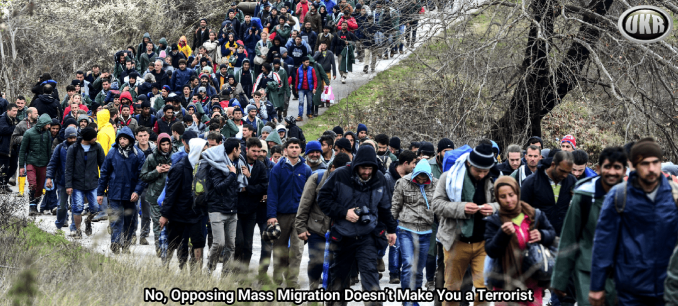
No, opposing mass migration doesn’t make you a terrorist
Prevent is demonising concerns shared by millions of ordinary people.
RAKIB EHSAN COLUMNIST
According to Prevent, the British government’s counter-extremism programme, expressing concern about high levels of immigration is to be treated as a mark of terrorist ideology.
The terrorist ideology in question is defined by government documents as ‘cultural nationalism’. This, apparently, is the belief that ‘Western culture is under threat from mass migration and a lack of integration by certain ethnic and cultural groups’. In other words, if you express worries about the social and cultural impact on Britain of a huge influx of people from around the world, you could find yourself being referred to the government’s deradicalisation scheme.
This is further evidence – if any were needed – that Prevent is not fit for purpose. This is a critical part of the UK’s counter-terrorism architecture. Yet instead of being used to identify potential threats to the public, it is now focussed on demonising perfectly legitimate views as symptoms of a so-called terrorist ideology.
Perhaps Prevent should refer the UK prime minister to a deradicalisation programme. After all, Keir Starmer presented the government’s new white paper on cutting immigration last month by articulating what sounded very much like ‘cultural nationalism’. He promised to end the UK’s ‘open-borders experiment’ and said that a lack of integration risked turning us into ‘an island of strangers’.
Categorising concern about mass migration as a sign of radicalisation is really not a good use of the UK’s counter-terror infrastructure. It effectively turns Prevent into another vehicle of state censorship.
People ought to be free to question the negative social and cultural impacts of mass immigration – which has reached record levels in recent years. While it’s important not to generalise about the hundreds of thousands of people who have arrived in the UK over the past few years, many are from countries such as India, Pakistan and Nigeria – all of which have serious problems with religious fundamentalism and ethnic violence. Should someone really be considered a radicalisation risk if they express concerns about the effect of large inward flows from such countries? This is not an unreasonable fear, given that the UK has long been struggling to integrate newcomers into a shared national culture – not least because its political and cultural elites have spent years waging war on any shared national traditions and history.
There are also legitimate concerns about the threat to public safety posed by mass migration. Indeed, it’s worth noting that Britain’s lax borders are putting British women, in particular, at risk, with foreign nationals being vastly overrepresented among those convicted of sex crimes. When compared with British citizens, Afghans and Eritreans are more than 20 times more likely to account for convictions connected to sex crimes. This is not to cast aspersions on everyone from Afghanistan or Eritrea. But when so little effort is made to identify who is entering the UK – especially via illegal-migration routes – is it any surprise that some unsavoury characters are taking advantage? Yet, according to Prevent, just raising questions about any of this could have you marked out as some sort of far-right terrorist sympathiser.
The Prevent scheme was originally designed with a clear aim in mind – to stop people from becoming terrorists or supporting terrorism. But it has clearly been ideologically compromised. This is not a new development. Sir William Shawcross’s independent review of Prevent, published in 2023, exposed the fundamental mismatch between the ideological composition of cases referred to Prevent and the true nature of the terrorist threat in the UK.
Indeed, in the year ending 31 March 2022, the percentage of cases referred to Prevent following concerns over Islamist-related radicalisation was just 16 per cent. Meanwhile, the percentage of cases referred to Prevent involving concerns over extreme right-wing radicalisation stood at 20 per cent. This is completely at odds with the relative threats posed by Islamist and extreme right-wing terrorism. Indeed, 80 per cent of the Counter Terrorism Policing network’s live investigations are Islamist-related, while only 10 per cent of the investigations are associated with far-right extremism. It now looks as if Prevent will also be going after so-called cultural nationalists, too, further distracting attention from the Islamist threat.
Part of the blame for this warping of Prevent’s priorities lies with the public bodies responsible for identifying potential radicalisation risks. These bodies, from education to healthcare, suffer from a left-leaning, progressive bias. This means they’re more than happy to adopt a negative, fear-mongering view of those with right-leaning views, such as scepticism towards migration, while ignoring the real terror threats in our midst.
Prevent needs a radical overhaul if it’s to serve a useful purpose. It needs to better reflect the landscape inhabited by our security services and counter-terror police. It ought to be focussing on combatting the ever-evolving threats to British citizens, not delegitimising those same citizens’ perfectly reasonable concerns over immigration, integration and national identity.
Just about the only thing Prevent is preventing at the moment is free and open debate.
Rakib Ehsan is the author of Beyond Grievance: What the Left Gets Wrong about Ethnic Minorities, which is available to order on Amazon.
This article (No, opposing mass migration doesn’t make you a terrorist) was created and published by Spiked Online and is republished here under “Fair Use” with attribution to the author Rakib Ehsan
See Related Article Below
Disagreement is not terrorism
The UK government is playing word games to demonise political opposition.

ANDREW DOYLE
Words are slippery critters. You might describe yourself as being on the ‘left’, be a lifelong Labour voter, and yet if you believe that there are only two sexes it won’t be long before strangers online are branding you ‘far right’. You can be profoundly opposed to racism, and still be accused of being ‘racist’ if you don’t accept the claims of activists to have detected the presence of ‘systemic racism’ even in the absence of any evidence. And now, if you believe that ‘Western culture is under threat from mass migration and a lack of integration by certain ethnic and cultural groups’, you are officially a terrorist.
That’s according to the government’s anti-terrorism ‘Prevent’ programme, which has listed ‘Cultural Nationalism’ – defined as the belief that national identity is threatened by cultural or demographic change – as a ‘terrorist ideology’. At the stroke of a pen, millions of law-abiding UK citizens are now having to adjust to their new identities as terrorists. Indeed, this definitional shift has birthed so many new terrorists that it may qualify as a protected characteristic.
We’ve been here before, of course. The phrase ‘stochastic terrorism’ has often been deployed as a means to reinterpret non-terrorism as terrorism. Specifically, it has been applied to those whose speech can be said to inspire the demonisation of minority groups. It’s always been a nonsense phrase; similar to ‘dog whistle’, which is a label used to insinuate that someone has secretly communicated something that they have not actually said out loud. Culture warriors have always been prolific amateur telepaths.
In July 2021, I interviewed the Reverend Dr Bernard Randall, a school chaplain at Trent College in Derbyshire, who told me about training sessions in which staff were instructed to chant ‘smash heteronormativity’. When he delivered a sermon about the importance of respectfully challenging such ideological viewpoints he was reported to Prevent. (Dr Randall returned to my show Free Speech Nation in October 2024, and you can watch that interview here.) When a school chaplain is under suspicion of terrorism for encouraging civil debate, we can be sure that the word has lost all meaning.
The culture war has always been about language, and who gets to define the meanings of words. For the postmodernist mindset, our understanding of reality is wholly constructed by language, which means that describing something as ‘terroristic’ automatically makes it so. In Lewis Carroll’s Through the Looking Glass (1871), Humpty Dumpty says to Alice: ‘When I use a word, it means just what I choose it to mean – neither more nor less’. He is the prototype of the woke activist, and similarly fragile.
Consider the use of the term ‘social justice’. When most of us use this term, we mean the concept of equality under the law, opposition to prejudice and discrimination, and equal opportunities for all. When social justice activists say ‘social justice’, they mean an emphasis on group identity over the rights of the individual, a rejection of social liberalism, and the assumption that unequal outcomes are always evidence of structural inequalities.
The ambiguity is the point. It comes down to a matter of supply and demand. The woke movement has depended upon the perpetuation of the myth that we live in a culture swarming with racists. Unfortunately for these ideologues, every reputable study shows that the UK is among the least racist societies to have ever existed. And so the word ‘racist’ had to be redefined so that it could apply to as many people as possible and justify the woke cultural revolution.
So we should hardly be surprised to find that reasonable concerns about mass immigration, and the failure of assimilation that is the inevitable outcome of a blind fealty to multiculturalism, become rebranded as ‘terrorism’. It means that the authorities can justify further censorship and suppression of criticism. It is sleight-of-tongue of the most sinister kind.
Such rhetorical manoeuvres cannot go unchallenged. The Prevent programme has been a failure, largely because the authorities keep insisting that far right white nationalism represents the most prominent risk to our security, even though 75 per cent of MI5’s counter-terrorism work relates specifically to Islamist threats. While I am certainly concerned about the creeping rise of the far right, we need to be honest about where the most pressing danger lies. For all the word play of those in power, to be concerned about terrorism does not make one a terrorist.
This article (Disagreement is not terrorism) was created and published by Andrew Doyle and is republished here under “Fair Use”
Featured image: x.com

••••
The Liberty Beacon Project is now expanding at a near exponential rate, and for this we are grateful and excited! But we must also be practical. For 7 years we have not asked for any donations, and have built this project with our own funds as we grew. We are now experiencing ever increasing growing pains due to the large number of websites and projects we represent. So we have just installed donation buttons on our websites and ask that you consider this when you visit them. Nothing is too small. We thank you for all your support and your considerations … (TLB)
••••
Comment Policy: As a privately owned web site, we reserve the right to remove comments that contain spam, advertising, vulgarity, threats of violence, racism, or personal/abusive attacks on other users. This also applies to trolling, the use of more than one alias, or just intentional mischief. Enforcement of this policy is at the discretion of this websites administrators. Repeat offenders may be blocked or permanently banned without prior warning.
••••
Disclaimer: TLB websites contain copyrighted material the use of which has not always been specifically authorized by the copyright owner. We are making such material available to our readers under the provisions of “fair use” in an effort to advance a better understanding of political, health, economic and social issues. The material on this site is distributed without profit to those who have expressed a prior interest in receiving it for research and educational purposes. If you wish to use copyrighted material for purposes other than “fair use” you must request permission from the copyright owner.
••••
Disclaimer: The information and opinions shared are for informational purposes only including, but not limited to, text, graphics, images and other material are not intended as medical advice or instruction. Nothing mentioned is intended to be a substitute for professional medical advice, diagnosis or treatment.
Disclaimer: The views and opinions expressed in this article are those of the author and do not necessarily reflect the official policy or position of The Liberty Beacon Project.


Leave a Reply