

ANDREW TATTENBORN
Our countryside, we have just been solemnly told by administrators, is too white. It is ‘seen by both black, Asian and minority ethnic groups and white people as very much a ‘white’ environment’. National Park and National Landscapes administrators (as Areas of Outstanding Natural Beauty planners have now become) have jumped enthusiastically on board, announcing plans for such exciting things as a ‘more diverse cultural interpretation’, and removal of ‘barriers to access’ faced by ethnic minorities, some of whose parents, it was said, ‘did not feel safe enough’ to take them to it.
Let’s take the obvious point first. Unless you are a heritage industry insider, the thinking here looks remarkably dodgy. Anyone is free to visit the countryside; there is no serious evidence of overt discrimination by shops, eateries or hotels. Equally, statements that minorities do not feel ‘safe’ in the country need unpicking. You can’t just be ‘unsafe’, period. Just what, apart perhaps from charging bulls or awkward stiles, are you frightened of?
Further, statements about how black, Asian and minority ethnic groups view rural England are equally doubtful. Apart from the facile (and some might say racist – oops!) assumption that non-white people all think much the same way, this bears all the hallmarks of a collation of answers to suggestive questionnaires, filled in by unrepresentative samples, and assembled by lanyard-wearing apparatchiks with the aid of a rather rarefied class of academic hangers-on with research grants to earn.
Disproportionate numbers of ethnic minorities may well have reservations about visiting the English countryside, but for all the money spent on this campaign – which some might think could have been spent on more deserving causes – these reasons seem not to add up. More likely, such people may have too many concerns at home or (like quite a lot of working-class urban white people) just don’t like the great outdoors. And in any case, it’s not immediately clear why there is anything wrong with visitors to the country not reflecting the makeup of the country as a whole.
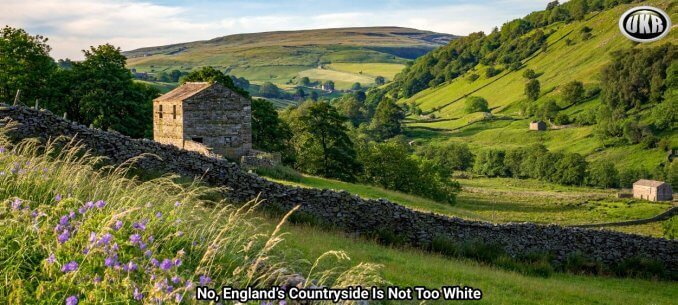
But there are more serious issues here. This whole campaign is actually an attack on the rural way of life. The English countryside is currently an informal working social ecosystem in which lives, livelihoods and lifestyles combine more or less harmoniously, if not at times easily. It is an ecosystem, moreover, which is not unwelcoming to outsiders, provided they are prepared to fit in and knuckle down.
The thinking behind this movement turns all this on its head. Running through it, like the lettering in a stick of Brighton rock, is the unstated assumption that the country is not so much a working polity as a public amenity, a bit like a glorified municipal country park. Instead of a place that visitors choose to patronise or not (and country life can be hard going), the functionaries behind these proposals see rural Britain as a kind of nationalised Great British Non-urban Leisure Agency, tasked with the corporate provision of recreation facilities for a grateful population on a footing of equality.
Predictably, accompanying this world view is an undercurrent of bossiness and a desire to micromanage people’s lives. A number of proposals give this game way. The countryside as a place for quiet solitary contemplation? Certainly not, according to the Malvern Hills administration: too English, and doesn’t satisfy ethnic minorities, all of whom, in an apparently broad brush way, ‘prefer social company (family, friends, schools)’ – in other words, we need to encourage the presence of chattering crowds and charabancs everywhere. Pubs? Too traditional again, and (puritanism alert) too much reliance on alcohol, which offends some groups: we therefore need intervention to provide more varied eateries catering for minority tastes. And even dogs, those most rural of animals, might need to be curbed, some groups being ‘scared’ of them (this from the Chilterns authorities is code, one suspects, for saying that people living there must change their lifelong habits to appease the religious scruples of urban Muslims from Luton).
The reason the English countryside has survived so far has been a tradition of fairly light-touch administration (apart from strict building laws to prevent country areas turning into upmarket subdivided housing estates US-style), and a live-and-let-live attitude that as far as possible lets those who live and work there control what goes on. It is this which is under threat, with this new call for micro-regulation in the name of equality.
There is an irony here. In the booming 1980s, well-heeled people who bought into the Cotswolds and then complained that they just couldn’t get ciabatta or proper Italian olive oil to drizzle on it for love nor money were rightly laughed at and told to stop trying to impose the ways of Richmond or Putney on Witney and Winchcombe. The lanyard classes are now trying to do much the same thing this time, and turn the country into a kind of multicultural Camden Town with fields. They can’t be allowed to do this. Once again, up, country-dwellers, and at ‘em!
Click here to subscribe to our daily briefing – the best pieces from CapX and across the web.
CapX depends on the generosity of its readers. If you value what we do, please consider making a donation.
This article (No, England’s countryside is not too white) was created and published by CapX and is republished here under “Fair Use” with attribution to the author Andrew Tattenborn

••••
The Liberty Beacon Project is now expanding at a near exponential rate, and for this we are grateful and excited! But we must also be practical. For 7 years we have not asked for any donations, and have built this project with our own funds as we grew. We are now experiencing ever increasing growing pains due to the large number of websites and projects we represent. So we have just installed donation buttons on our websites and ask that you consider this when you visit them. Nothing is too small. We thank you for all your support and your considerations … (TLB)
••••
Comment Policy: As a privately owned web site, we reserve the right to remove comments that contain spam, advertising, vulgarity, threats of violence, racism, or personal/abusive attacks on other users. This also applies to trolling, the use of more than one alias, or just intentional mischief. Enforcement of this policy is at the discretion of this websites administrators. Repeat offenders may be blocked or permanently banned without prior warning.
••••
Disclaimer: TLB websites contain copyrighted material the use of which has not always been specifically authorized by the copyright owner. We are making such material available to our readers under the provisions of “fair use” in an effort to advance a better understanding of political, health, economic and social issues. The material on this site is distributed without profit to those who have expressed a prior interest in receiving it for research and educational purposes. If you wish to use copyrighted material for purposes other than “fair use” you must request permission from the copyright owner.
••••
Disclaimer: The information and opinions shared are for informational purposes only including, but not limited to, text, graphics, images and other material are not intended as medical advice or instruction. Nothing mentioned is intended to be a substitute for professional medical advice, diagnosis or treatment.
Disclaimer: The views and opinions expressed in this article are those of the author and do not necessarily reflect the official policy or position of The Liberty Beacon Project.


Leave a Reply