

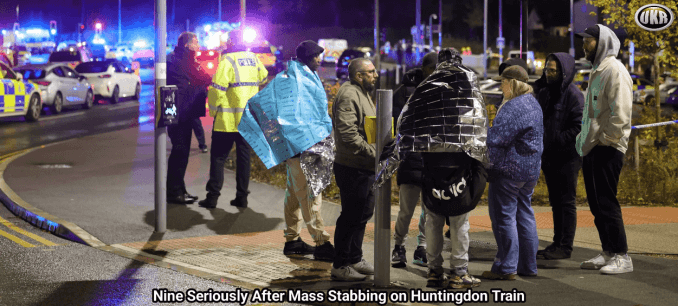
Nine fighting for their lives after mass stabbing on train
Counter-terror police assist investigation as two men arrested
Nine people are fighting for their lives in hospital after a mass stabbing on a train in Cambridgeshire on Saturday.
Police have declared a “major incident” and counter-terror officers are investigating following the attack in which ten passengers were attacked by two men.
The men were arrested at Huntingdon station by armed police shortly before 8pm.
Witnesses said passengers hid in toilets to avoid the assailants, with others describing scenes of “pure chaos” and like something “from a film”.
Passengers were described as being covered in blood and falling over themselves to escape the attackers along the train aisle.
Eyewitnesses said they saw a man dressed in black walking through the train stabbing passengers on board with a large knife.
One witness said there was “blood everywhere” and people were getting “stamped” on by others as they tried to flee. They added: “I heard some people shouting we love (you).”
Witnesses have reported a man holding a large knife on the platform with police pointing weapons at him.
A witness told Sky News that the man was tasered and restrained near the train.
Police responding to the mass stabbing had at one point declared it “Operation Plato”, the national code used by officers to denote a response to a marauding terror attack.
However, British Transport Police said this declaration was later rescinded.
In a statement on X, Sir Keir Starmer, the Prime Minister, said: “The appalling incident on a train near Huntingdon is deeply concerning. “My thoughts are with all those affected, and my thanks go to the emergency services for their response.”
Footage shared on social media showed scores of blue-light police cars and emergency vehicles in a station car park, and a team of armed police running towards the stationary train at Huntingdon station.
[…]
Chief Superintendent Chris Casey of the British Transport Police (BTP) said it may be “some time” before officers could give more details on the incident.
The Telegraph: continue reading
See Related Article Below
Law and Order: the new normal?
RICHARD NORTH
My snapshot of England published yesterday could hardly have anticipated the events of the evening when an InterCity train on its way from Newcastle to London Kings Cross was the scene of a horrific knife attack. Ten casualties are being reported, nine with life-threatening injuries. Mercifully, there have been no fatalities.
Details at the time of writing were sketchy and confused, but it is known that the train made an emergency stop at Huntington station in Cambridgeshire around 7:44pm, to be met by armed police. Two persons are reported to have been arrested and are in custody.
The incident was briefly subject to an “Operation Plato” declaration, which is the national codeword used by police to denote a response to a “marauding terror attack”. However, British Transport Police have said that this declaration has been rescinded.
That does not exclude the possibility that this was a terror attack and counter-terrorism police are said to be assisting with the investigation of what has been officially classified as a “major incident”.
According to diverse (as yet unconfirmed) sources, the incident started just after the train had left Peterborough station, when a man with “a large machete” started his attack. Passengers hid in the toilets in a desperate attempt to escape.
One “extremely bloodied” person is said to have collapsed as the train pulled into the station while a witness says he saw someone moving through his carriage saying: “They’ve got a knife, I’ve been stabbed”.
Via this source, publishing a clip from Sky News, another witness described an attacker as “a black male in all-black clothing” who, still holding “a large knife”, was subsequently seen on the platform being tasered by police.
Another source, who says he was on the train, seems to confirm this. As part of a lengthy account, he wrote on X, “I only know of one attacker, he got on the train from Peterborough. He was black mid-20’s. We ran from the back of the train to the end as everyone was screaming to run, explaining there was somebody stabbing everyone and everything”.
Further confirmation seems to come from this sourcewhose girlfriend was on the train, from whom he learnt that “2 black guys were the attackers”.
The description of the attackers has not been confirmed by the police who, as always, are being extremely reticent about releasing details. Home secretary Shabana Mahmood urges us “to avoid comment and speculation at this early stage”, presumably to give the officials time to finesse the details and manage the responses.
Within minutes of news breaking, however, speculation was rife on social media and, if the attacker(s) do turn out to be “persons of colour” – or your common and garden jihadists – no-one will be in the least surprised. Random, murderous attacks by such people are precisely what we have come to expect in this increasingly lawless state, and this seems to be just another milestone in our descent to perdition.
My last piece made an attempt at charting that journey, looking at a mere four days, with multiple crimes and multiple criminals, evil deeds ranging from rape to the foulest of murders. All had in common immigrants, well represented by asylum seekers, and people of immigrant heritage. With the fourth day not yet complete, it seems as if we might have another immigrant-related atrocity to add to the tally.
How bad the situation has actually become is difficult to assess objectively. It is a given that official statistics on criminality are a mess – anything managed by the Home Office is bound to be. Not least of the crucial defects is the absence of data on ethnicity and nationality, not only in terms of serious crime such as murder and rape, but across the broad spectrum of criminal activity.
Therefore, while most of the indigenous population (unless your name is Fraser Nelson, of course) will have a gut feeling about what is perceived to be an explosion in crime, and the contribution of immigrants and their descendants to the burden, conveniently for the authorities there are no consolidated data which will confirm (or refute) the suspicions of so many.
However, anyone with an active social media account, and who follows the legacy media with even half an eye, cannot help but walk away with the impression that the “ethnic” segment of our population is disproportionately involved in all types of nefarious crime. The Huntington incident may well be their latest contribution.
Here, it has to be said that impressions do have some value. They, more than dry statistics, often have more impact on the way we see the world. And the message we are getting from a broad swathe of information flowing through the public domain is that immigrant/descendant crime is a real issue, however much politicians and the authorities generally (including the police) try to play it down.
It was because of that that I compiled yesterday’s piece, providing that small, unscientific snapshot of the state of the nation. I had not intended to do so, but through the day I had been struck by the number of reports coming to my attention, and I resolved to put some form to an otherwise chaotic and disconnected narrative.
The point to come away from this is that, even without a statistical framework – which will include the many crimes perpetrated by the indigenous (white) population – the immigrant “community” (with their descendants) presents us with a burden of crime which, as a matter of logic, would not exist if they were not in the country.
What the politicians in particular seek to avoid is any conversation about cost-benefits – whether this additional burden of crime is offset by the supposed benefits of migration and thus whether we should accept this new level of criminality as a necessary and acceptable consequence of the current levels of immigration.
As someone born in the aftermath of the Second World War and brought up in North London – in areas now regarded as crime hotspots – I recall a free-roaming youth where I could wander (and cycle) through the streets without fear, and with absolutely no concern that I might become a victim of crime. The thought of stabbing frenzy on an express train to London lay beyond the realms of the imagination – truly unthinkable.
That, if you like, is what is fashionably termed “lived experience”. It should be the birthright of every child born and brought up in a civilised nation, and the experience of every adult, young and old. Sadly, it is no longer the case.
And that – whether perception or reality (or a mixture of both) – represents a loss which transcends any economic value. It goes to who we are and how we feel about ourselves and our society. There can be no escape from the view that we now live in a violent, crime-ridden society, much of which is attributable directly and indirectly to immigration.
Furthermore, away from the dry statistics which can be manipulated and rationalised every which way – there is not only a quantitative element to this crime. There is a qualitative aspect to it: the nature of the crime we are experiencing, which seems more brutal, more random and more unpredictable – such as knifemen running amok on a train.
The random nature of this violence goes some way to explain the shock generated by the murder on 27 October of Wayne Broadhurst, and the stabbing of two others on the street of an Uxbridge suburb by Afghan former asylum-seeker (and one-time illegal immigrant) Safi Dawood.
What was particularly telling was the sheer contrast between the normality of Mr Broadhurst’s activity and the violence of his murder. He was out for an early-evening stroll, taking his dog for a walk. There are few things more normal – and inoffensive – that that, making the savage knife attack by a murderous foreigner all the more startling and abhorrent.
But no sooner had we absorbed the violence of this crime, then we were confronted with details of the appalling action by another former asylum seeker. It was, in fact, old news, relating back to 6 May, but the case had come to court and was reported on 29 October, with the BBC telling us of the foul deed of Somali, Haybe Cabdiraxmaan Nur.
Nur, who had police records in four European Union countries, had “calmly” walked into a bank and stabbed Gurvinder Johal, 37 – a total stranger – through the heart without provocation or motive, killing him instantly. He has been jailed for life, with a minimum term of 25 years.
The BBC provides the chilling background to this crime, but then has its social affairs correspondent Jeremt Ball, noting that it “feeds into a febrile political debate”, suggesting that “There will be concerns over whether it could be a lightning rod for community tensions too”.
If anything, though, the BBC – along with the political establishment, locally and nationally – is doing its best to suppress that “febrile” debate. This is happening more on social media than it is in the legacy media, which rarely reports nationally any but the most egregious examples of violence.
However, the national media could hardly avoid noticing Sudanese asylum seeker Deng Chol Majek who, on 20 October 2024, followed hotel worker, 27-year-old Rhiannon Skye Whyte from the migrant hotel where she worked to the railway station where he brutally stabbed her with a screwdriver, 23 times, leaving her for dead. She died of her injuries in hospital three days later, having suffered a fatal brain injury.
The trial was reported by the Guardian on 24 October which, with the Wayne Broadhurst and Gurvinder Johal murders, made for three murderous asylum seekers in the news during October.
Far from a national debate, though, there has been an uncanny silence on the issues while the legacy media obsesses over the fate of the former prince Andrew, temporarily distracted by the latest round of stabbing. Only now does the prime minister concede, with Huntingdon, that an attack “is deeply concerning”, having made no public comment on the Uxbridge attack.
And yet, the murders and mayhem go on. So far I have recorded only a fraction of the horrors but, even with those recorded, I defy anyone to chart such a grim picture of carnage at any other time in living memory. By any reckoning, this is abnormal but the sombre reality is that, under the pitiless gaze of the Starmer Regime, it is set to become the new normal.
Featured image: The Telegraph

••••
The Liberty Beacon Project is now expanding at a near exponential rate, and for this we are grateful and excited! But we must also be practical. For 7 years we have not asked for any donations, and have built this project with our own funds as we grew. We are now experiencing ever increasing growing pains due to the large number of websites and projects we represent. So we have just installed donation buttons on our websites and ask that you consider this when you visit them. Nothing is too small. We thank you for all your support and your considerations … (TLB)
••••
Comment Policy: As a privately owned web site, we reserve the right to remove comments that contain spam, advertising, vulgarity, threats of violence, racism, or personal/abusive attacks on other users. This also applies to trolling, the use of more than one alias, or just intentional mischief. Enforcement of this policy is at the discretion of this websites administrators. Repeat offenders may be blocked or permanently banned without prior warning.
••••
Disclaimer: TLB websites contain copyrighted material the use of which has not always been specifically authorized by the copyright owner. We are making such material available to our readers under the provisions of “fair use” in an effort to advance a better understanding of political, health, economic and social issues. The material on this site is distributed without profit to those who have expressed a prior interest in receiving it for research and educational purposes. If you wish to use copyrighted material for purposes other than “fair use” you must request permission from the copyright owner.
••••
Disclaimer: The information and opinions shared are for informational purposes only including, but not limited to, text, graphics, images and other material are not intended as medical advice or instruction. Nothing mentioned is intended to be a substitute for professional medical advice, diagnosis or treatment.
Disclaimer: The views and opinions expressed in this article are those of the author and do not necessarily reflect the official policy or position of The Liberty Beacon Project.


Leave a Reply