

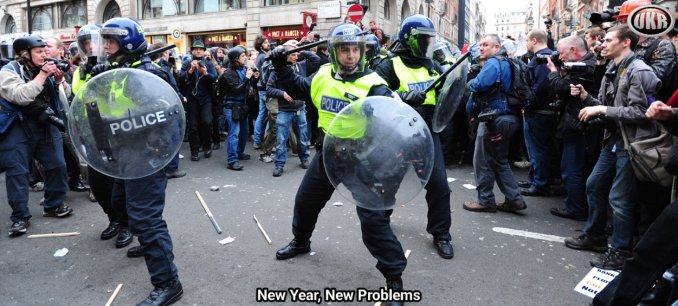
The politics of 2026 present a challenge for UK law enforcement

DOMINIC ADLER
I hope you all had a good Christmas. As 2026 approaches, I thought I’d ponder what – from a political perspective, the New Year has in store for UK policing. My rationale is virtually every decision impacting on policing this year will turn on the following:
- There is no money, especially for policing. None. Zero. Nada.
- The UK faces dramatic political, economic, technological and demographic change – arguably comparable with the European tumult of 1848. The shock absorbers for societies undergoing such turbulence? The police, military and intelligence / security services. Who have no money.
- A fractious Labour Party is busy infighting, decreasing its bandwidth for actually governing. The more pro law-and-order ‘Blue Labour’ faction might have the Home Secretary, but ‘Soft Labour’ enjoys the political clout with party members. I honestly believe, knowing they face a one-term government, Labour are (a) salting the fields for a future right-wing administration, while (b) preparing for a possible coalition with other left-liberal parties (including the Greens). I give you, as evidence, Starmer’s pro-EU maneuvering as an example of a core vote buttering-up exercise.
- This suggests policy changes will be modest and, probably, retrograde. Fundamentally, the left is wedded to the idea a re-distributionist society will ameliorate the need for expensive, nasty coppers. Many on the left honestly believe this. Furthermore (remember), there’s no money, and social democratic governments only know how to spend it. Not how to generate wealth in the first place.
- It really, really does bear repeating: THERE IS NO MONEY.
With that in mind, here we go:
Police Force Restructuring
Home Secretary Shabana Mahmood supports merging England and Wales’s 43 constabularies into 12-15 ‘strategic forces.’ The Home Office – not to mention more than a few chief constables – have been agitating for such a move for years. This, ostensibly, makes sense. Mergers mean cost savings and the spreading of responsibility for failure. Issues such as accountability and control? Civil servants hope such esoterica flies over the heads of mere ‘normies.’
I wrote on this, for UnHerd, here: [T]ime will tell whether this desire for centralisation translates into more effective neighbourhood policing for the average Briton, but we can be certain that Home Office mandarins will continue to exercise control over forces without accountability for any crises, scandals or mistakes.
During 2026, look out for blatantly untrue promises that creating a dozen mini-Metropolitan Police clones will somehow improve neighbourhood coppering. Which, of course, they won’t.

Reviews, Reviews and (more) Reviews
As I wrote here, policing’s social justice Spartans won’t go quietly. Expect more reviews, scandals and committees as the DEI grift machine joins the wider leftish, end-of-an-era Götterdämmerung. Although there’s no money, there’s (mysteriously) always a few million down the back of the sofa for a critical-theory inspired review. Treble matchas all round, Jocasta!
Incidentally, if you want to see the current standard of strategic thinking around law enforcement, I dare you to check out Mayor Sadiq Khan’s ‘London Policing Plan.’ Just for a giggle, here’s a link to the ‘easy reading’ version, along with some of the most hilarious politically-correct illustrations I’ve ever seen.
So the DEI industry ain’t going quietly – policing news in 2026 will be seeded with the usual identitarian hobby-horses. Meanwhile commonsense vetting, selection and training of police officers (the real problem) will continue to be neglected. Reviews are cheaper, after all.
Terrorism and Extremism
Terrorism and extremism flourish when economies tank. Ours is tanking. QED. The primary terrorist threat is Islamist. This is especially problematic for Labour, which finds itself in a demographic stranglehold in seats with large Asian Muslim communities. Despite the police doing excellent, albeit largely under-reported, work there’ll be more outrages. No crystal balls are required to predict the Southport-style response by an increasingly restless – albeit unfocused – indigenous lumpenproletariat.
This ties in with themes of sectarianism and preparedness (see below). Police forces will come under increasing pressure to firefight political violence, but are saddled with a mediocre intelligence apparatus. Then there’s local political pressure, as we have seen with the West Midlands Police / Maccabi Tel Aviv scandal (and it is a scandal). If British society increasingly resembles a Soviet-era power station in the late 1980s, then I would suggest this issue is its leakiest reactor.

The College of Policing
It’s been a terrible year for the College of Policing (ha ha ha). Its latest humiliation is the withdrawal of Non-Crime Hate Incidents, which it pioneered and supported with gusto… until it didn’t. The notoriously woke College is loathed by the right-of-centre police commentariat. The Tories, hilariously (given they invented it) have jumped on the bandwagon too.
Why is this significant? Much of the progressive bullshit infecting policing emanates from the College. Which now faces a dilemma: how to survive the coming populist political apocalypse? It nailed its (rainbow) colours to the mast, just as a fleet of teal-sailed Reform pirate ships appeared on the horizon. Expect to see the College turn in the wind during 2026. You’d need a heart of stone not to laugh. Which leads us to…
Culture War Nonsense
I honestly believe some (but not all) chief constables are as sick to the back teeth of policing social media/ identitarian bullshit as the rest of us. However, ambition-fueled moral cowardice means our top Vichy Cops go with the flow. Furthermore, headline grabbers like NCHIs don’t address the real problem – which runs downstream from a wider political schema around ‘disinformation’. As I wrote elsewhere:
But the issue goes far deeper than the recording of “questionable behaviour” of the sort which might end up being disclosed on a vetting check for employment. Most of the high-profile cases concerning criminalisation of opinion on social media aren’t due to NCHIs, instead falling under the creaky, pre-internet 1986 Public Order Act. The Act makes “threatening, abusive or insulting words or behaviour, or display of written material, with intent or likelihood to stir up racial hatred” a specific offence. In 1986, this was intended to address hard copy race-hate material distributed by neo-Nazi groups. Four decades later, it’s being applied to tweets.
Police are also bound by Section 127 of the Communications Act 2003, which includes distributing material which is “grossly offensive or of an indecent, obscene or menacing character” over a public electronic communications network. That includes memes sent over WhatsApp, as five former police officers discovered when they received suspended prison sentences two years ago for sending racist jokes in a private group. The cases of the journalist Allison Pearson, Lucy Connolly and former Royal Marine Jamie Michael had nothing to do with NCHIs: they were state overreach into freedom of speech issues using criminal law.
So expect to see more of this stuff in 2026. And, perhaps, join the Free Speech Union.
International Affairs
International affairs disproportionately impact UK law enforcement for two main reasons. The first is due to diaspora communities, whereby disputes in faraway places can easily lead to disorder in British cities and towns. The second is due to our Janus-like relationship with America and the EU. America is concerned about UK immigration and censoriousness – issues over which it is prepared to use political pressure.
The EU, on the other hand, is concerned about disinformation and – of course – trying to screw the UK for as much money as it possibly can. Starmer will happily oblige, so expect to see carefully-planted stories concerning the benefits of increased EU / UK police cooperation. As a former practitioner, my view of European police forces is much like Gen. Norman Schwarzkopf’s famous opinion of our Gallic neighbours – ‘going to war without the French is like going hunting without an accordion.’
I mean, how’s the whole ‘smashing the gangs’ thing going?
Preparedness
2025 saw the UK intelligence, defence and security establishment warn of impending conflict with Russia – while at the same time the Government sabotaged attempts to prosecute alleged Chinese agents and (almost certainly) will approve the CCP’s new Death Star-style London embassy. Meanwhile, our army has 200 generals and 14 artillery pieces – not to mention a fleet of utterly useless armoured vehicles. Meanwhile, Russian fleets roam the North Sea, interfering with our comms infrastructure. I’m actually fairly sceptical of Trumpian / MAGA foreign policy, but it’s easy to see why America despairs of Europe’s defence and security architecture.
The police will be expected to play a role in national defence and preparedness measures, impacting on core service delivery. 2026 is likely to see forces come under pressure to contribute to ‘resilience’, which are likely to be folded into the wider argument for fewer, larger police services.
So watch out for civil service comms officers peddling stories about melting down railings to make Spitfires and parachuting Russian nuns (etc).
Sectarianism and Unrest
To me, the UK currently feels like an unruly pub at closing time – many seem to want a dust-up, but few want to throw the first punch. The aggrieved seek a casus belli. This is why European governments are obsessed with disinformation and comms – they can’t control reality. They can try to mitigate what you see online.
Because when it does kick off?
The Government knows it might not be able to hold the line. If Russia and Ukraine is the UK’s Defence nightmare, then public disorder is its Home Affairs equivalent. In early 2025, Professor David Betz’s predictions of civil war were dismissed as a hyper-conservative fever dream. By the end of the year, even the New Statesman was kinda onboard with Betzian doom-mongering. I wrote about Betz’s prognosis here (I think his paper was excellent) – this article remains my most viewed piece on Substack.
Meanwhile, the mainstream media has finally woken up too, noticing how parts of England increasingly resemble Troubles-era Belfast. Meanwhile, there’s a right-wing zeitgeist, with ethno-nationalists openly discussing once-taboo issues such as ‘remigration.’ Even Tommy Robinson has, apparently, found God.
My tip?
Watch out for a local elections bombshell in May, when ‘Gaza Independents’ begin winning council seats in the Midlands and Northwest England. This will generate cultural friction, of the kind police forces should keep a beady, suspicious eye on – but won’t. Yes, Craig Guildford, I’m looking at you.

Continuing failure of the Criminal Justice System
This is a dry subject, until an axe-murderer is released early from prison. The police is part of this wider system, which includes the courts, prisons and probation service. When one part catches a cold, so do the rest.
And, as of 2025, all of these organs have varying stages of cancer.
2026 will see the disease worsen. Court logjams mean longer remand periods. Longer remand periods lead to tension inside overcrowded prisons (which are increasingly staffed by underpaid and corruption-prone kids). The proposed solution? 1. Early release schemes. 2. Less jury trials. 3. David Lammy.
Early release means more criminals on the streets for the police to deal with. Plus, scrotes know they’re unlikely to face imprisonment, emboldening them on the street. Expect to see this stuff continue to prompt why-oh-why? questions in politics and media during 2026. The answer, incidentally, is massive investment in prisons and rehabilitation.
But, of course, there’s no money.
Technology
Expect to see three main issues dominate policing and technology in 2026:
- Facial recognition – forces love it because it’s relatively cheap and spookily effective. It’s the biometric equivalent of ANPR cameras. Starmerite Labour, in case you hadn’t noticed, has an authoritarian streak, so expect to see more of this stuff moving ‘forward’.
- Drones. I know, they ain’t new. But criminals have discovered them. Cops are starting to use them. As drones become cheaper and cleverer – as we’ve seen in Ukraine – terrorists will be using them next. Will 2026 be the year of the Terror Drone?
- Artificial Intelligence. Again, the police will see this as a surefire way to save money. Intelligence units, for example, would benefit from AI as an enhanced research tool. However, having worked in such environments? There’ll be an overwhelming temptation to over-rely on AI-based solutions in risk-laden decision-making processes. If you think stories like this are bad, wait until Old Bill gets involved!
And the Positives for 2026?
This won’t take long, I’m afraid.
- There’s a growing recognition police governance models aren’t fit for purpose. With the demise of Police and Crime Commissioners, will we see forces freed from excessive micromanagement? Will Shabana Mahmood see the move to strategic forces as an opportunity to inject much-needed subsidiarity into operational policing? I’m sceptical, but the opportunity exists should anyone choose to take it.
- Failure usually presages change. Something has to give – and I suspect it will. What will that change look like, though?
- The prospect of defeat focuses the minds of politicians. Will Labour, seeing the very real threat of a Reform government, entrust law and order to its realist wing?
- By my estimation, both Reform and the Conservatives are upping their policy game. Chris Philp, who was a mediocre police minister during the last Conservative administration, currently has the bit between his teeth – he has an informed view on issues such as stop and search and technology. Reform, on the other hand? They seem to be keeping their powder dry – will they pull a rabbit out of the hat (I suspect they might), or rely on tired Dixon-of-Dock-Green / Bobbies on the beat platitudes? I’m not a member or active supporter of either party, so from a purely policy perspective? I’d say the Tories have the edge at the moment. In any case, an ideas ‘arms race’ is a good thing for policing.
- The Poor Bloody Infantry – the constables, sergeants and inspectors, continue to hold the line. As they usually do.
There you have it, my predictions for 2026. Which, of course, will be overtaken by events – as such predictions usually are. Please, keep reading, and I trust you all have a Happy New Year.
Dom
This article (New Year, New Problems) was created and published by Dominic Adler and is republished here under “Fair Use”
Featured image: The Telegraph


Leave a Reply