


Ed Miliband’s net zero plan is raising, not lowering, household gas and electricity costs.
Another day, another broken promise from this hapless Government.
Well, not quite yet perhaps, but Ed Miliband’s pledge to bring down household energy bills is as good as dead after it was rubbished by some of the industry’s most influential figures in devastating fashion. [emphasis, links added]
It seems set to join a growing list of unfulfilled, exaggerated, and unachievable manifesto promises made by Labour in its desperate bid for power, whether that be a commitment to smash the boat gangs, targets on NHS waiting lists, or welfare reform.
The party made scores of manifesto pledges, too many for the vast majority of voters to be able to keep count.
But for a whole host of reasons, everyone remembers Miliband’s guarantee to reduce energy bills by £300 by 2030, not least because it was one of Labour’s flagship promises.
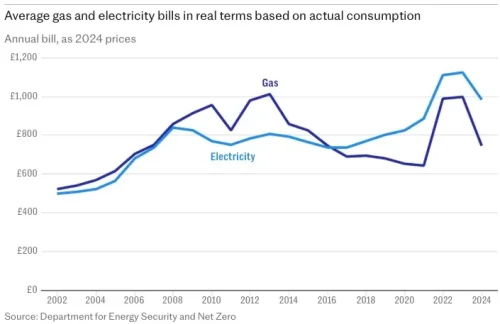
A typical family forked out a wallet-busting £1,740 to heat and light their home last year, unsurprisingly making Labour’s promised £300 saving extremely meaningful for millions.
Indeed, for the many who have been struggling to pay their bills – two fifths of UK households fall into that category, according to charities – it’s the sort of incentive that wins votes.
However, Miliband’s promise of lower energy costs has been on the rocks for months as it becomes ever more apparent that far from being the solution to eye-watering bills, his green energy scramble is actually part of the problem.
Much to his embarrassment, Miliband’s pledge was given a thorough roasting in Parliament on Wednesday at the hands of folk who understand how the energy market works better than anyone.
As a slew of energy bosses queued to warn of higher bills, the hearing highlighted the absurdity of Labour’s vow to magically make bills more affordable by building yet more wind turbines.
The revelations from the stinging energy select committee session leave Miliband’s credibility in tatters – if it wasn’t already, of course.
Among the many marmalade-droppers to come out of the session was that from Rachel Fletcher, the director for regulation at Octopus Energy.
She said that, contrary to Miliband’s rash talk of lower bills, households are likely to be spending considerably more on energy by the end of the decade.
This isn’t because of those much-maligned fossil fuels that Labour is attempting to eradicate at light speed either, but because of a slew of green policy costs that help to bankroll the Energy Secretary’s obsession with yet more renewables that the grid can’t cope with.
Almost comically, it turns out Miliband was right to be banding around a figure of £300, just not in the way he anticipated. Instead, that’s how much Octopus calculates will be added to bills in the coming years as a result of net zero-related charges, including green levies.
In fact, green levies are becoming so exorbitant that they threaten to push household bills higher, even if gas and power prices fall dramatically, MPs were warned.
This means that even if the wholesale cost of electricity is halved, bills would still spike by around £150 overall, Fletcher claimed.
At which point, Miliband should have gone for a lie down in a field full of solar panels – at least, until the Government can find someone less likely to lead this country down the path to financial ruin.
Instead, the testimony was greeted by Miliband’s department with the sort of response that sounded like it came from a parallel universe or compiled by ChatGPT.
Dismissing the claims as nothing more than “speculation,” – which they clearly weren’t – a spokesman trotted out the usual unfounded cut-and-paste propaganda that we are used to hearing by now:
“The only way to bring down energy bills for good is by making Britain a clean energy superpower, which will get the UK off the roller-coaster of fossil fuel prices and onto clean, home-grown power that we control.”
It’s a stance that treats voters with contempt.
Yes, an energy industry built on fossil fuels is intrinsically wired to display some level of resistance to a green revolution that requires an entirely new system to be constructed.
But to dismiss these concerns as nothing more than pure guesswork is plain wrong.
Read rest at The Telegraph
See Related Article Below
Energy: lies exposed
RICHARD NORTH
It won’t be the first time that I have complained about the difficulty in entertaining any sort of a debate about net zero because of the lack of honesty when it comes to the core facts.
In particular, reliable data on electricity generating costs are hard to come by, with differing results from the wide range of sources offering such data. But the problem is not made easier when we have an energy secretary in the form of Ed Miliband who is a consistent and sustained liar.
Yesterday, I was recording Shabana Mahmood telling us in the Telegraph that failures on migration were eroding trust “not just in us as political leaders … but in the credibility of the state itself”, which is a point well made.
But there can be nothing more calculated to erode that trust and utterly destroy the credibility of the state than to have a secretary of state who routinely lies about key aspects of his portfolio, most egregiously on the relative merits and costs of electricity generation vis-à-vis renewable energy and fossil fuels – which, in the context invariably means gas.
And he’s been at it again, this time in a speech to Energy UK’s annual conference in London where, once again, he repeats his endless mantra that “our exposure to fossil fuel markets remains the Achilles heel of our energy system, keeping bills high and giving us no long-term certainty over price”.
Seeking to justify the situation where UK electricity retail costs are the highest in the world, he asserts that the main driver of the price disparity “driven by the UK’s reliance on natural gas power generation”.
Yet this is an out-and-out, naked lie with absolutely no basis in fact. Looking at domestic prices, under the June to September 2025 direct debit price cap the average annual bill for typical gas and electricity consumption was £1,720.
This is well below the peak level of £2,380 level under the Energy Price Guarantee from October 2022 to June 2023, but still 42 percent higher than in the winter of 2021/22, when prices started to rise over uncertainty over Ukraine.
If we look at average prices of gas for power producers, however, from just over £19 per MWh in the first quarter of 2021, it had peaked at £65 per MWh in the summer but had dropped back to an average of £42.5 per MWh for the last quarter, although by December 2021, the seven-day average price had reached highs of £128 per MWh – more than eight times higher than the same period in the previous year. However, the annual average turned out at £29.7 per MWh.
During the following year, 2022, with intense fighting in Ukraine and disruption to gas supplies, prices peaked in the summer and autumn, averaging around £65 per MWh, with some short-term wholesale prices peaking in August at around £218.4 per MWh. Prices were down to £58 per MWh by the winter, although the year averaged out at approximately £54 per MWh.
Prices remained high during 2023 but, for 2024, the average gas price for the whole year had dropped to £30.5 per MWh and while January of this year saw peaks £43.1 per MWh at the end of January, by October 2025, prices were down to £30.2 per MWh.
Against the 2021 average of £29.7 per MWh, therefore, the current price stands at £30.2 per MWh, representing an increase of less than 2 percent. Yet the dual energy price cap is 42 percent up, attributable according to Mr Miliband to our reliance on gas.
And just to add insult to injury, the price cap has just increased by a further 2 percent – more than the total wholesale gas price rise from 2021 to 2025.
Doubling down on his lies, however, Miliband is sticking to his claim that the increased use of renewables will allow him by 2023 to cut average domestic energy bills by £300.
Just for once, though, the secretary of state is being called out, not by the usual array of bloggers, pundits and analysts, but the industry itself. Far from the average bill dropping by £300 – estimated at about 17 percent lower – Britain’s biggest energy supplier, Octopus Energy, has told MPs that bills are on track to climb by 20 percent in the next four years – effectively 37 percent higher than Miliband’s prediction.
This news is carried in the Guardian and other media sources, recording evidence given to the Commons energy select committee yesterday.
The evidence in this case was given by Rachel Fletcher, the director for regulation and economics at Octopus, who warned that the rise was inevitable unless the government took radical action to address what she called the burden of increasing “non-commodity costs”, even in a scenario where wholesale electricity prices fell by half.
This is in the broader context where Miliband and his fellow travellers constantly refer to the wholesale gas price setting the cost of electricity generation, quite deliberately omitting to say that the cost of generation is only a part of the overall wholesale price of electricity.
As Fletcher points out, it is the “non-commodity costs” which are hiking up the retail price, including levies paid through bills to support upgrades to gas and electricity networks, running the energy system and subsidising low-carbon power projects.
According to the Financial Times, Simone Rossi, chief executive of EDF UK’s energy business, also pitched in, telling the committee that electricity demand had fallen 8 percent since before the coronavirus pandemic, which has spread costs across a smaller base. “Even if the wholesale price were to halve, bills will rise”, he said, adding that the cost of serving customers in Britain is roughly double that of France.
He complains that Britain “is building infrastructure as if there was more demand, but in reality there is less and less demand”. The drop of 8 percent comes despite years of forecasts predicting steady growth.
Chris Norbury, chief executive of E.ON UK, went further on the bills issue, saying that some of the modelling suggested “we could get to a position by 2030 where if the wholesale price was zero, bills would still be the same as they are today”, due to “non-commodity costs” from increased spending on policy and the network.
Even the Guardian isn’t buying the Miliband fluff, telling us that the typical household energy bill under the government’s price cap has climbed to £1,755 a year for the average dual-fuel customer this winter, despite market prices falling in recent months.
The cap, it says, is now just over £500 a year higher than in the winter before Russia’s invasion of Ukraine accelerated already increasing gas market prices. However, it adds, only about £200 of this higher cap can be directly attributed to the wholesale cost of energy – which is still something of an exaggeration.
Nevertheless, the paper does tell us that other costs that have risen over recent years include the price of upgrading Britain’s energy networks, which has increased by more than £140 annually in the last four years to £396 a year under the cap. Policy costs, which include supporting low-carbon electricity projects, have climbed by £86 a year to £215 under the current price cap.
Fletcher is brought back in to say: “It’s time we got this burden under control”, as she complains that: “There’s no budgetary control of this and yet it all ends up on household bills or contributing to making our electricity some of the most expensive in the industrialised world”.
Unsurprisingly, the government spokesperson, disagrees. “We categorically reject this speculation. Wholesale gas costs for households remain 75 percent higher than they were before Russia invaded Ukraine in 2022, and the main reason energy bills remain high”.
Thus we have the lie direct again, with the totally spurious claim that: “The only way to bring down energy bills for good is by making Britain a clean energy superpower, which will get the UK off the rollercoaster of fossil fuel prices and onto clean, homegrown power that we control”.
There is no good reason to trust the energy suppliers, who have bought in to much of the net-zero garbage, and milked the subsidy system for all it’s worth, but with their consumer debt surging to £4.43 billion, they must know that price resistance is stiffening, and the writing is on the wall.
When it comes to an out-and-out truth contest between the industry and Miliband, there can be little doubt about which side to choose. And it ain’t Miliband.
This article (Energy: lies exposed) was created and published by Turbulent Times and is republished here under “Fair Use” with attribution to the author Richard North
Featured image: Getty Images


Leave a Reply