


WILL JONES
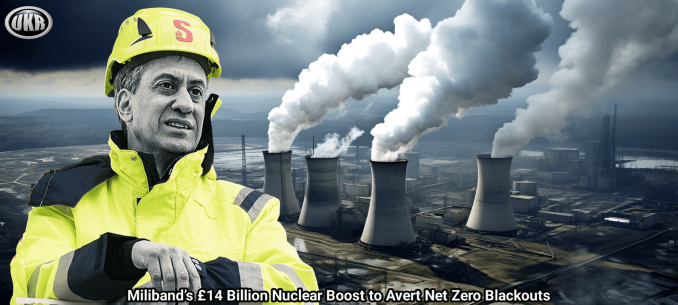
Ed Miliband is set to commit more than £14 billion of public money to a nuclear power renaissance in a bid to avert blackouts as Net Zero approaches. The Telegraph has more.
The Energy Secretary will on Tuesday commit £14.2 billion to building two giant reactors at Sizewell, Suffolk, capable of providing six million homes with electricity regardless of low winds and dark winter days.
The heavy investment comes as fears rise that Mr Miliband’s rush to build wind and solar farms is leaving the grid too exposed to the weather and vulnerable to outages.
Over-reliance on intermittent renewables could even threaten blackouts of the kind that hit Spain in April, say experts.
Nuclear generation is a reliable source of so-called baseload power, the minimum amount of demand on the grid.
Writing in Telegraph, Mr Miliband said the announcement marked a new “golden age” for the British nuclear industry.
He said: “This challenge of energy security and the demands of the climate crisis mean that it is in our interests to shift as fast as possible to clean, home-grown power.
“The demand for that power is expected to at least double by 2050. That’s why we need all the clean, home-grown sources that we can to meet the demands we face. New nuclear is a crucial source of firm, baseload power.”
In the Spectator, Ross Clark looks at the expected timeframes for this boost to nuclear power and concludes it isn’t going to save Ed Miliband.
But nothing that Miliband has unveiled does anything to help the Energy and Climate Secretary achieve his ambition to decarbonise the electricity supply by 2030 – or ease the coming crunch as he tries to reach that target. It has already been 15 years since the government approved plans for a new nuclear plant at Hinkley C – which developers EDF promised would be ready to cook our Christmas turkeys by 2017. The earliest it will now open is 2029, by which time it will have cost at least £46 billion.
Hinkley C is proposed to use the same design, which has proved difficult and costly to build in France and Finland, too. Why Miliband should think it will be any different this time around is hard to tell. To judge by past experience, it will be the 2040s before Sizewell C is cooking our turkeys. The only change in Sizewell C’s case is that the UK taxpayer will be bearing far more of the construction costs. In Hinkley C’s case, EDF is supposed to be bearing all the risk; with Sizewell C, that has been mostly transferred to the taxpayer.
Nor are SMRs going to save Miliband. There is logic in reducing the scale of nuclear reactors so that they can be built on a production line rather than by bespoke design on-site. It is good that Rolls Royce has won the competition for government cash to develop its SMR design, £2.5 billion funding for which has also been announced today. Nevertheless, there is hardly anyone who believes that SMRs will be up and running before 2035. There is also no guarantee they will prove cheaper than existing large nuclear plants.
Both the Telegraph report and Ross’s Spectator article are worth reading in full.
See Related Article Below
Ed Miliband’s nuclear golden era could soon become a new dark age
We are careering into a future without gas, and the atomic solutions offered for so long are not ready
PHILIP JOHNSTON
This Government is fond of making grandiose claims for things that are yet to happen. The latest is Ed Miliband’s declaration that we are in “a golden era of nuclear power.” He has made a series of announcements that may or may not come to fruition over the next two decades, including a new nuclear plant at Sizewell with £14 billion of public money behind it.
But Mr Miliband is getting well ahead of himself. History shows that few public policies of modern times have been more mishandled. Britain once led the world in nuclear energy and it was very much a cross-party venture. The post-war Attlee government established the Atomic Energy Research Establishment and the first ever commercial nuclear reactor was built at Calder Hall under the Tories in 1956 just as the Suez crisis increased concerns over the supply of oil. British nuclear expertise was second to none and sought around the world.
Under both Conservative and Labour administrations, the UK became a leader in nuclear power development, commencing operations on 26 Magnox reactors between 1956 and 1971. The technology chopped and changed, moving from advanced gas-cooled reactors (AGRs) in the 1970s to pressurised water reactors (PWRs) and even a fast-breeder reactor experiment at Dounreay in Scotland, opened amid great fanfare by Margaret Thatcher but which has now closed.
Her government set in train a plan for eight new PWRs, only one of which – Sizewell B – was ever built. What happened? One answer is North Sea oil and gas. Fears about fuel scarcity and sky high prices abated as more came ashore. Cheap gas made the cost of nuclear look prohibitive to politicians fixated only on the short term.
Meanwhile, across the Channel, the French, with no oil and depleted coal reserves, invested instead in nuclear power. By 1979 they had installed 56 reactors, satisfying their power needs and even exporting electricity to other European countries, including us. The French are even going to be building Sizewell C.
They produce 70 per cent of their electricity by nuclear fission, which does not emit CO2, and are not dependent on energy from volatile regions like the Gulf or despotic regimes like Russia. This serendipity was as much a function of force majeure as foresight. As the French said “no oil, no gas, no coal, no choice”. As a result they have found themselves in a better position than Britain in the switch to low carbon renewables.
Because of the apparent bonanza provided by North Sea oil, we neglected the one source of power that would help create self-sufficiency and meet climate change objectives. Only when it was too late and much of the industry’s expertise had been lost did the last Labour government try to reactivate the nuclear programme. Ironically, it was Mr Miliband as Environment Secretary who revived the programme 15 years ago in the teeth of objections from Labour “greens”.
Yet only one new reactor at Hinkley Point – using French technology and, to begin with, Chinese finance – has been given the go ahead. It is way behind schedule by at least six years and massively over budget.
For all the trumpet-blowing is the new Sizewell announcement just another milestone along a road paved with good intentions and wretched decision-making? We know it will be hugely expensive and the idea of it coming on stream within 10 years is for the birds.
Since it is a copy of Hinkley it should benefit by learning from the mistakes made there. But few can have confidence in the project meeting any of its financial targets or the timetable for construction because nothing in this country ever does.
Around the world there is a boom in nuclear power building as countries see it as an essential complement to wind and solar, not least because it provides a baseload and is not dependent on the weather. Sixty reactors are being built globally – 30 of them in China, which has also opened a thorium plant, something we could have done years ago since we have plentiful supplies and the process reduces waste.
The Telegraph: continue reading

••••
The Liberty Beacon Project is now expanding at a near exponential rate, and for this we are grateful and excited! But we must also be practical. For 7 years we have not asked for any donations, and have built this project with our own funds as we grew. We are now experiencing ever increasing growing pains due to the large number of websites and projects we represent. So we have just installed donation buttons on our websites and ask that you consider this when you visit them. Nothing is too small. We thank you for all your support and your considerations … (TLB)
••••
Comment Policy: As a privately owned web site, we reserve the right to remove comments that contain spam, advertising, vulgarity, threats of violence, racism, or personal/abusive attacks on other users. This also applies to trolling, the use of more than one alias, or just intentional mischief. Enforcement of this policy is at the discretion of this websites administrators. Repeat offenders may be blocked or permanently banned without prior warning.
••••
Disclaimer: TLB websites contain copyrighted material the use of which has not always been specifically authorized by the copyright owner. We are making such material available to our readers under the provisions of “fair use” in an effort to advance a better understanding of political, health, economic and social issues. The material on this site is distributed without profit to those who have expressed a prior interest in receiving it for research and educational purposes. If you wish to use copyrighted material for purposes other than “fair use” you must request permission from the copyright owner.
••••
Disclaimer: The information and opinions shared are for informational purposes only including, but not limited to, text, graphics, images and other material are not intended as medical advice or instruction. Nothing mentioned is intended to be a substitute for professional medical advice, diagnosis or treatment.
Disclaimer: The views and opinions expressed in this article are those of the author and do not necessarily reflect the official policy or position of The Liberty Beacon Project.


But you cannot make nuclear weapons using thorium feedstock. Starmer choosing peace?