

WILL JONES
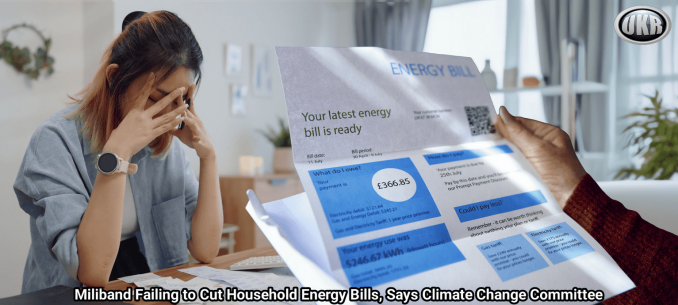
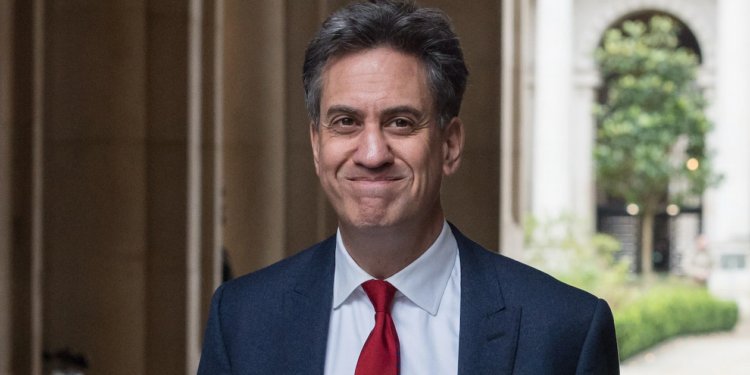
Ed Miliband has failed to make any progress on cutting household energy bills, the Climate Change Committee has warned, as it also called on ministers to curb the public’s use of air travel and ban new homes from using gas. The Telegraph has more.
The quango said in a damning new report that the Energy Secretary has not done enough to remove Net Zero levies from bills, which is making electricity too expensive.
This failure means the UK remains at risk of missing its 2030 clean power target, it said, as inflated energy costs deter consumers from switching to electric cars and heat pumps.
Its research found that green levies are adding £500 to heat pump running costs each year.
“The Government has made no clear progress on removing policy costs since the election,” the report said. “Making electricity cheaper remains our first recommendation.”
As part of its latest recommendations, the committee also called on ministers to curb emissions from Britain’s aviation sector and ban all new homes from connecting to the gas network.
“By far the most important recommendation we have for the Government is to reduce the cost of electricity, both for households and for businesses and industry as well,” said Professor Piers Forster, CCC chair.
“If we want the country to benefit from the transition to electrification, we have to see it reflected in the utility bills, and that is our biggest recommendation – one that we have yet to see this Government deliver.” …
Mr Miliband thanked the CCC and said: “The only way to get bills down for good is by becoming a clean-energy superpower and we continue to work tirelessly to deliver clean power for families and businesses.”
Worth reading in full.
Stop Press: The owner of one of Britain’s biggest chemical plants has said it will close, despite Keir Starmer’s just-launched Industrial Strategy. According to the Telegraph, “Saudi Aramco-owned Sabic said on Wednesday that it had decided to shut the Olefins 6 ‘cracker’ facility in Teesside permanently following a review of ‘competitiveness’”.
See Related Article Below
The Case Against Net Zero – an Eleventh Update
Unachievable Disastrous Pointless
ROBIN GUENIER
In October 2008, Parliament passed the Climate Change Act requiring the Government to ensure that by 2050 ‘the net UK carbon account’ was reduced to a level at least 80% lower than that of 1990; ‘carbon account’ refers to CO2 and ‘other targeted greenhouse gas emissions’. Only five MPs voted against it. Then in 2019, by secondary legislation and without serious debate, Parliament increased the 80% to 100%i, creating the Net Zero policy (i.e. any remaining emissions must be offset by equivalent removals from the atmosphere).
Unfortunately, it’s a policy that’s unachievable, potentially disastrous and in any case pointless. And that’s true whether or not Britain’s greenhouse gas emissions are contributing to increased global temperatures.
1. It’s unachievable.
1.1 A modern, advanced economy depends on fossil fuels; something that’s unlikely to change globally until well after 2050.ii Examples fall into two categories: (i) vehicles and machines such as those used in agriculture, mining and quarrying, mineral processing, building, the transportation of heavy goods, commercial shipping, commercial aviation, the military and emergency services and (ii) products such as nitrogen fertilisers, cement and concrete, primary steel, plastics, insecticides, pharmaceuticals, anaesthetics, lubricants, solvents, paints, adhesives, insulation, tyres and asphalt. All the above require either the combustion of fossil fuels or are made from oil derivatives; easily deployable, commercially viable alternatives have yet to be developed.iii
1.2 Wind is our most effective source of renewable electricity – because of our latitude solar makes only a small contribution. Nonetheless wind has significant problems: (i) the substantial costs of subsidising, building, operating, maintaining and replacing (when worn-out) the turbines needed for Net Zero – all exacerbated by high interest rates; (ii) the complex engineering and cost challenges of establishing, as required for renewables, an expanded, stable and reliable high voltage grid by 2030 as planned by the Government; (iii) the vast scale of what’s involved (a multitude of enormous wind turbines, immense amounts of space iv and vast quantities of increasingly unavailable and expensive raw materials and components v); and (iv) the intermittency of renewable energy (see 2 below).vi This means that the UK may be unable to generate sufficient electricity for current needs by 2030 let alone for the mandated EVs and heat pumps and for the energy requirements of industry and the huge new data centres being developed to support for example the Government’s plans for the rapid growth of artificial intelligence (AI).vii
1.3 In any case, we don’t have enough skilled technical managers, electrical, heating and other engineers, electricians, plumbers, welders, mechanics and other skilled tradespeople required to do the multitude of tasks essential to achieve Net Zero; a problem exacerbated by the Government’s plans for massively increased house building.viii
2. It’s potentially disastrous.
2.1 The Government aims for 95% renewable electricity by 2030, but has not yet published a fully costed engineering plan for the provision of grid-scale back-up and network stability when there’s little or no wind or sun; a problem that’s complicated by the likely retirement of elderly nuclear and fossil fuel power plants. The Government has indicated that the problem may be resolved by the provision of new gas-fired power plants ix or possibly by ‘green’ hydrogen. But it has yet to publish any detail about its plans for either. The former is obviously not a ‘clean’ solution and it seems the Government’s answer is to fit the power plants with carbon capture and underground storage (CCS) systems. But both green hydrogen and CCS are very expensive, controversial and commercially unproven at scale.x This issue is desperately important: without a solution, electricity blackouts are likely, potentially ruining many businesses and causing dreadful problems including serious health risks for everyone, particularly the most vulnerable. And note: the blackout in Spain on 28th April (the result it seems of over reliance on solar power and lack of ‘grid inertia’xi) caused 7 deaths.xii
2.2 Another major Net Zero problem is its overall cost and the impact of that on the economy. Because there’s no comprehensive plan for the project’s delivery, it’s impossible to produce an accurate estimate of overall cost; but, with several trillion pounds a likely estimate, it could well be unaffordable.xiii The borrowing and taxes required for costs at this scale would put a huge burden on millions of households and businesses and, particularly in view of the economy’s many current problemsxiv, could further jeopardise Britain’s vulnerable international credit standing and threaten its economic viability.
2.3 But Net Zero is already contributing to a serious economic concern: essentially because of the costs of renewables (e.g. subsidies and back-up to cope with intermittency), the UK has the highest industrial and amongst the highest domestic electricity prices in the developed world.xv The additional costs referred to elsewhere in this essay – for example the costs of establishing a non-fossil grid and of fitting CCS systems to gas-fired power plants used as back-up – can only make this worse. And high energy costs are incompatible with the Government’s principal mission of increased economic growth.
2.4 Net Zero’s pursuit increases our dangerous reliance on other countries. For example, the closure of North Sea oil and gas means an increase in uncertain imports of natural gas; likewise, our dependence on China is exacerbated by its effective control of the supply of key materials (e.g. lithium cobalt, graphite, nickel, copper and so-called rare earths) essential for the manufacture of renewables. There’s also major concern about communication devices (so-called ‘kill switches’) found in Chinese-built power inverters.xvi
2.5 Moreover, the UK is becoming increasingly vulnerable to sabotage of or attack on its increasing numbers of offshore wind turbines and numerous undersea cables. Another concern is how offshore wind turbines can interfere with vital air defences.xvii
2.6 The vast mining and mineral processing operations required for renewables are already causing horrific environmental damage and dreadful human suffering throughout the world, affecting in particular fragile, unspoilt ecosystems and many of the world’s poorest and most vulnerable people.xviii The continued pursuit of Net Zero will make all this far worse.
3. In any case it’s pointless.
3.1 It’s absurd to regard the closure of greenhouse gas (GHG) emitting activities here and their ‘export’ mainly to South East Asia (especially China), to plants commonly with poor environmental regulation and powered by coal-fired electricity – thereby increasing global emissions – as a positive step towards Net Zero. Yet, because of efforts to ‘decarbonise’ the UK, that’s what’s happening; it’s why our chemical and fertiliser industries face extinctionxix and why the closure of our remaining blast furnaces would end our ability to produce commercially viable primary steel (see endnote 3). These concerns apply also to most of the machines and other products listed in the first paragraph of item 1 above.xx It means that Britain, instead of manufacturing or extracting key products and materials itself, is increasingly importing them in CO2 emitting ships from around the world. A related absurdity is our importing vast amounts of wood for the Drax power plant; a fuel that emits more CO2 than coal.xxi
3.2 The USAxxii plus most major non-Western countries – together the source of over 80% of global GHG emissions and home to about 85% of humanity – don’t regard emission reduction as a priority and, either exempt (by international agreement) from or ignoring any obligation to reduce their emissions, are focused instead on economic and social development, poverty eradication and energy security.xxiii As a result, global emissions are increasing (by 62% since 1990) and are set to continue to increase for the foreseeable future. As the UK is the source of only 0.7% of global emissions any further emission reduction it makes (even to zero) would make no discernible difference to the global position.xxiv
In other words, Net Zero means the UK is legally obliged to pursue an unachievable, potentially disastrous and pointless policy – a policy that could result in Britain’s economic destruction.
Robin Guenier June 2025
Guenier is a retired, writer, speaker and business consultant. He has a law degree from Oxford, has qualified as a barrister and for twenty years was chief executive of various high-tech companies, including the Central Computing and Telecommunications Agency reporting to the UK Cabinet Office. A Freeman of the City of London, he was member of the Court of the IT Livery Company, Executive Director of Taskforce 2000, founder chair of the medical online research company MedixGlobal and a regular contributor to TV and radio.
End notes:
i http://www.legislation.gov.uk/ukpga/2008/27/part/1/crossheading/the-target-for-2050
ii See Vaclav Smil’s important book, How the World Really Works: http://tiny.cc/xli9001
iii Regarding steel for example see the penultimate paragraph of this article and: https://www.construction-physics.com/p/the-blast-furnace-800-years-of-technology.
iv See Andrews & Jelley, “Energy Science”, 3rd ed., Oxford, page 16: http://tiny.cc/4jhezz
v http://tiny.cc/b9qtzz Also see paragraph 2.4 above.
vi For a comprehensive view of wind power’s many problems, see this: https://watt-logic.com/2023/06/14/wind-farm-costs/.
vii https://www.theguardian.com/technology/2025/jan/14/keir-starmer-ai-labour-green-energy-promise
viii A detailed Government report: http://tiny.cc/bgg5001 See also pages 10 and 11 of the Royal Academy of Engineering report (Note 6 below). Also see: http://tiny.cc/0mm9001
ix See this report by the Royal Academy of Engineering: http://tiny.cc/qlm9001 (Go to section 2.4.3 on page 22.) This interesting report contains a lot of valuable information.
x These reports on CCS are relevant: http://tiny.cc/emi9001, and https://heimildin.is/grein/24581/. Re hydrogen see this: https://www.manhattancontrarian.com/blog/2024-2-14-when-you-crunch-the-numbers-green-hydrogen-is-a-non-starter.
xi An energy specialist reviews the facts and risks here: https://watt-logic.com/2025/05/09/the-iberian-blackout-shows-the-dangers-of-operating-power-grids-with-low-inertia/
xii See http://tiny.cc/lh7j001 (in Spanish).
xiii The National Grid (now the National Energy System Operator (NESO)) has said net zero will cost £3 trillion: https://www.current-news.co.uk/reaching-net-zero-to-cost-3bn-says-national-grid-eso/. And in this presentation Michael Kelly, Emeritus Professor of Technology at Cambridge, shows how the cost would amount to several trillion pounds: https://www.youtube.com/watch?v=NkImqOxMqvU
xiv An interesting summary here: http://tiny.cc/nli9001
xv For international price comparisons see Table 5.3.1 here: http://tiny.cc/axah001. Note that the UK’s industrial electricity price is well above that of our international competition. Also note, from Table 5.7.1, that the UK gas price is about average. And see this comprehensive report: https://watt-logic.com/2025/05/19/new-report-the-true-affordability-of-net-zero/
xvi See http://tiny.cc/6nm9001 and http://tiny.cc/0gvj001. And re unauthorised communication devices found in power inverters in Chinese-built solar panels and batteries see: http://tiny.cc/vgvj001
xvii For examples of vulnerability concerns see these: http://tiny.cc/9ruf001, http://tiny.cc/xau9001 and http://tiny.cc/r73j001. Also this essay by Dieter Helm (Professor of Economic Policy at Oxford) is covers vulnerability and much else considered above: http://tiny.cc/dtyf001
xviii See http://tiny.cc/gtazzz and http://tiny.cc/unx8001. And harrowing evidence is found in Siddharth Kara’s book Cobalt Red – about the horrors of cobalt mining in the Congo: http://tiny.cc/nmm9001. And for a more detailed view of minerals’ environmental and economic costs: http://tiny.cc/klz9001.
xix As explained here: http://tiny.cc/chg5001
xx A current example: https://www.bbc.co.uk/news/articles/c70zxjldqnxo
xxi See this Public Accounts Committee report: http://tiny.cc/qpwh001
xxii Note: Trump’s abandoning plans for renewables is not really such a huge change for the US as, despite his climate policies, the oil and gas industries flourished under Biden: http://tiny.cc/2ww1001
xxiii This essay shows how developing countries have taken control of climate negotiations: https://ipccreport.wordpress.com/wp-content/uploads/2020/07/the-west-vs-the-rest-2.1.1.pdf. (Nothing that’s happened since 2020 changes the conclusion: for example see the ‘Dubai Stocktake’ agreed at COP28 in 2023 of which item 38 unambiguously confirms developing countries’ exemption from any emission reduction obligation.)
xxiv This comprehensive EU analysis provides detailed information by country re global greenhouse gas (GHG) and CO2 emissions: https://edgar.jrc.ec.europa.eu/report_2024?vis=ghgtot#emissions_table
This article (The Case Against Net Zero – an Eleventh Update) was created and published by Climate Scepticism and is republished here under “Fair Use” with attribution to the author Robin Guenier

••••
The Liberty Beacon Project is now expanding at a near exponential rate, and for this we are grateful and excited! But we must also be practical. For 7 years we have not asked for any donations, and have built this project with our own funds as we grew. We are now experiencing ever increasing growing pains due to the large number of websites and projects we represent. So we have just installed donation buttons on our websites and ask that you consider this when you visit them. Nothing is too small. We thank you for all your support and your considerations … (TLB)
••••
Comment Policy: As a privately owned web site, we reserve the right to remove comments that contain spam, advertising, vulgarity, threats of violence, racism, or personal/abusive attacks on other users. This also applies to trolling, the use of more than one alias, or just intentional mischief. Enforcement of this policy is at the discretion of this websites administrators. Repeat offenders may be blocked or permanently banned without prior warning.
••••
Disclaimer: TLB websites contain copyrighted material the use of which has not always been specifically authorized by the copyright owner. We are making such material available to our readers under the provisions of “fair use” in an effort to advance a better understanding of political, health, economic and social issues. The material on this site is distributed without profit to those who have expressed a prior interest in receiving it for research and educational purposes. If you wish to use copyrighted material for purposes other than “fair use” you must request permission from the copyright owner.
••••
Disclaimer: The information and opinions shared are for informational purposes only including, but not limited to, text, graphics, images and other material are not intended as medical advice or instruction. Nothing mentioned is intended to be a substitute for professional medical advice, diagnosis or treatment.
Disclaimer: The views and opinions expressed in this article are those of the author and do not necessarily reflect the official policy or position of The Liberty Beacon Project.


Leave a Reply