

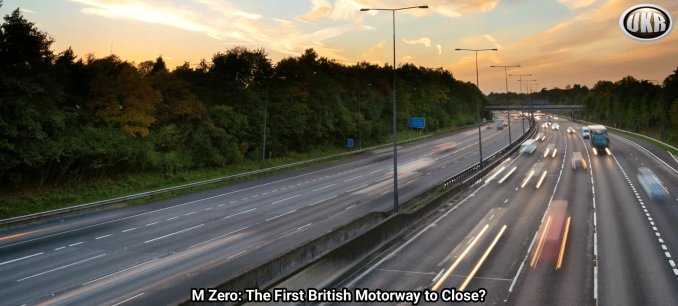
M Zero: the first British motorway to close?
NIALL MCCRAE
What would you think about Britain’s motorway network, mostly built from the Sixties to the Eighties, going into reverse? I am of two minds on this. While I would always lament the loss of green pastures to concrete, pollution and noise, I fear that plans to reduce car use are not for our welfare but for the misanthropic mission of the global elite. The first stretch of motorway being planned for closure is one of the busiest: the M8 in Glasgow. Justified by a contrived climate crisis, the city council’s Net Zero policy will make the major artery crossing the city into M Zero.
I am just old enough to remember Glasgow before the M8. My family lived 30 miles along the River Clyde, and to get there from the south, the main thoroughfare was the A8. This took cars and lorries through the east end on London Road, crossing the Clyde to pass through the infamous Gorbals (by then a vast building site, with new tower blocks under construction), and then snaking around the shipyards of Govan before heading towards Renfrew and beyond.
This arduous route was superseded in 1972 by the motorway, which skirted the city centre. The plan was for a city ring road, but the southern part was never built. The M8 was good for motorists, and for the city economy, but it had adverse social impact.
As well as swaths of housing lost to the road-builders in inner-city districts such as Cowcaddens, the new traffic corridor severed the city centre from its populous northern environs. According to the city chambers, ‘construction of the M8 motorway tore through established residential communities of Glasgow, and to this day acts as a scar in the urban fabric of the city’. In Retrospective Journal, Logan McKinnon reflected on what was lost over fifty years ago: –
Charing Cross was sacrificed to the noted ‘utopian fantasies’ in so losing some of the finest examples of Victorian architecture in the city, no less so than the Grand Hotel that couples en masse around the city flocked to in its closing days for one last time to take in the gorgeous venue where they had spent their honeymoons. The Grant Hotel was just one casualty however, with hundreds of buildings making way for the screaming modernity manifested in the M8 – and today the Mitchell Library sticks out like a sore thumb amongst the brutalist buildings that captured this modernity, representative of two entirely different visions for the city, one centred around the people and one which people simply existed as a cog within.
On the western end of Argyle Street, half a mile from Central Station, the historic Anderston Cross was levelled by the wrecking ball. The new shopping mall was a concrete carbuncle that struggled to attract custom. On a retail management course at the Central College of Commerce in the early Eighties, fellow students and I went on a field trip to the shopping centre, which was by then an exemplar of planning failure. Hardly any shops survived, the only sign of life the studios of Radio Clyde, which was taking advantage of cheap rent in a central location.
McKinnon’s missive featured a photograph of a black Daimler limousine, looking like a hearse, taking the Lord Provost of Glasgow for a drive on the newly-opened stretch of motorway in 1972, with protestors on a bridge. ‘This scar will never heal’, proclaimed one of the banners, but McKinnon believes that a cure is now possible.

To some extent the motorway compounded the demise of the Second City of Empire, but it was certainly not the cause. Townhead, for example, site of the St Rollox locomotive works, was mostly redundant when the excavators arrived. Thirty-storey blocks of flats had recently been built at Sighthill, surrounded by open space where hitherto bustling streets of homes, pubs, shops and churches faded into memory. The scene was as grey as the prevailing weather. The M8 was part but not whole of this exercise in throwing out the baby with the bathwater.
McKinnon remarked: –
The city’s tourism slogan may state ‘People Make Glasgow’ but with such an evidently damaging effect on communities presented by the lingering impact of the M8 motorway and its arterial developments, it is clear that the city works against Glaswegians in its modern design.
As announced two years ago, idealistic city planners want to reconnect the city centre to the outer areas. They think that the eight-lane M8 can be replaced by a vibrant boulevard. The Replace the M8 campaign, led by London-based urban designer Peter Kelly asserts ‘an absolute certainty that Glasgow is a global livability champion in waiting’. This is wishful thinking, but I fear that the public will be hoodwinked into accepting motorway closure by promises that will never be fulfilled.
The M8 is not a conventional motorway, having confusing right-lane exits, and in recent decades the speed limit has been curtailed to 50 miles per hour or lower. It became a cash cow for the debt-ridden authority, with dozens of speeding fines issued daily. A Green Party proposal to reduce the speed limit to 30 miles per hour was passed by the city council, which has written to Transport Scotland to take the desired action. Meanwhile the motorway has been given piecemeal improvements at its major junctions.
The real motive for slowing and eventually removing the motorway is not cultural regeneration but the global clamour for Net Zero. Vital infrastructure of the twentieth century is to be replaced by the digital control grid of the Smart City, which will be much more restricting than anything designed for the automobile age. The M8 becoming M Zero will surely be the wrong solution to the wrong problem.
This article (M Zero: the first British motorway to close?) was created and published by Niall McCrae and is republished here under “Fair Use”

••••
The Liberty Beacon Project is now expanding at a near exponential rate, and for this we are grateful and excited! But we must also be practical. For 7 years we have not asked for any donations, and have built this project with our own funds as we grew. We are now experiencing ever increasing growing pains due to the large number of websites and projects we represent. So we have just installed donation buttons on our websites and ask that you consider this when you visit them. Nothing is too small. We thank you for all your support and your considerations … (TLB)
••••
Comment Policy: As a privately owned web site, we reserve the right to remove comments that contain spam, advertising, vulgarity, threats of violence, racism, or personal/abusive attacks on other users. This also applies to trolling, the use of more than one alias, or just intentional mischief. Enforcement of this policy is at the discretion of this websites administrators. Repeat offenders may be blocked or permanently banned without prior warning.
••••
Disclaimer: TLB websites contain copyrighted material the use of which has not always been specifically authorized by the copyright owner. We are making such material available to our readers under the provisions of “fair use” in an effort to advance a better understanding of political, health, economic and social issues. The material on this site is distributed without profit to those who have expressed a prior interest in receiving it for research and educational purposes. If you wish to use copyrighted material for purposes other than “fair use” you must request permission from the copyright owner.
••••
Disclaimer: The information and opinions shared are for informational purposes only including, but not limited to, text, graphics, images and other material are not intended as medical advice or instruction. Nothing mentioned is intended to be a substitute for professional medical advice, diagnosis or treatment.
Disclaimer: The views and opinions expressed in this article are those of the author and do not necessarily reflect the official policy or position of The Liberty Beacon Project.


Leave a Reply