

US State Department condemns UK Home Office for calling “Cultural nationalism” an “extreme right-wing terrorism” ideology
CONNOR TOMLINSON
The US State Department has condemned the UK government’s counter-extremism program, Prevent, after the Telegraph reported last week it has instructed Home Office civil servants to treat “Cultural nationalism” — the belief that “Western culture is under threat from mass migration and a lack of integration by certain ethnic and cultural groups” — as an “extreme right-wing terrorism” ideology.
Speaking exclusively to Courage Media, an official from the State Department said:
“Western culture is not something to demonize, diminish, or apologize for. Rather, Americans and Europeans should honor our shared heritage of self-government, liberty, and rule of law. Extremism comes not from those who respect our traditions, but from those who seek to erase them. We must continue to uphold these values and cease efforts to censor, marginalize, or stigmatize individuals for their beliefs, while rejecting all violent extremism.”
In March, Vice President JD Vance expressed concerns over incursions on free speech by governments in Europe. The State Department, under Secretary Rubio, has expressed alarm at the prosecution of Christians praying silently outside abortion clinics in Britain, and the arrest of child protection activists “Billboard” Chris Elston and Lois McLatchie Miller in Brussels last week.
Other American political figures took notice. Representative Riley Moore of West Virginia ridiculed the Prevent definition on X:
“Hey @Keir_Starmer, I believe western civilization is under threat from mass migration and a lack of integration by certain ethnic & cultural groups.
I also think western civilization is under threat from leaders like you who hate your heritage and are ashamed of your ancestors.”
Prevent duty training, available on the GOV.UK website, lists “Cultural nationalism” alongside “White/ethno-nationalism” and “White supremacism” as “extreme right-wing terrorism”.

According to this definition, I, alongside Matt Goodwin, Konstantin Kisin, Douglas Murray, and Ayaan Hirsi Ali would all be ensnared in this broad, censorious net of “extreme right-wing” critics of immigration. As would the Prime Minister, since Keir Starmer described Britain as becoming “an island of strangers” thanks to an “open-borders experiment” run by successive governments.
Government ministers have already been smeared as right-wing extremists: with Prevent’s parent body, RICU, writing in a research report that former MP, Sir Jacob Rees Mogg was an example of said “cultural nationalists”. A former civil servant was then questioned by police about being a “far-Right extremist”, and if he voted Brexit, because he posted a selfie with Sir Jacob on social media.
Speaking to Courage Media, Andrew Hale-Byrne said,
“”The United Kingdom is now a dystopian censorship state. The Counter Terrorism police asked me how I voted in the Brexit Referendum, and I refused to tell them. They also interrogated me over a selfie photograph with Jacob Rees-Mogg that I had posted on Facebook. The Counter Terrorism Command Police also accused me of not being concerned about the plight of the non-binary during Non-Binary Awareness Week.”
The ideological capture of the civil service would explain why the definitions of “White/ethno-nationalism”, “White supremacism”, or “Extreme right-wing” aren’t fit for purpose either. Ethno-nationalism — the belief that national identity is inherited exclusively through lineage, and not conferred via legal documents or values — is not practiced exclusively by white Europeans. A number of studies show British people, and Europeans more broadly, have lower levels of in-group racial bias, and higher levels of out-group tolerance, than other nations and ethnicities. Furthermore, by failing to differentiate ethnicity (national identity, heritage, culture) from race (categories like white, black, Asian), the distinction between “White/ethno-nationalism” and “White supremacism” is redundant. The definition of “White supremacism” even uses the term “ethno-tribalism” in it.
Civil servants betray a flimsy understanding of philosophy with these definitions. Italian fascism was not a racialised form of authoritarianism, and came from Parisian communes and Marxist trade-unions. Fascism is not the exclusive domain of the right. Nor is authoritarianism a form of government invented or more commonly practiced by white Europeans. Most Muslim states are theocratic, and many African nations are governed by dictators. Yet the Home Office pretends that bringing millions of expats from those nations will have no impact on British culture, levels of ethnic and religious tribalism, nor bring our system of Parliamentary democracy under any strain.
Worst is the definition of “Extreme right-wing”, as being “the active or vocal support of ideologies that advocate discrimination or violence against minority groups.” The definition treats speech as indistinguishable from violence, presenting further cause for concern about incursions on free speech by the British government. It also bakes in a Marxist view of the world being dichotomised into oppressor and oppressed classes, on the basis of their demographic size or perceived differences in power, wealth, and status. It is also premised on the discrimination = disparity belief that inequalities result not from discrepancies in individual ability but from the hidden-hand of bigotry. The only acceptable position, according to the British state, is bogus anthropology of blank slate egalitarianism.
This is insidious, given former government Counter-Extremism Commissioner, Dame Sara Khan released a report last December with state-funded communist group HOPE Not Hate, which called “Cultural Marxism” a conspiracy theory and an “extremist” belief. However, if Khan’s (and her sister, Sabrina’s) former department think “Cultural nationalism” is tantamount to right-wing terrorism, then the acceptable antonym would be leftist cultural internationalism. Ideologues within the Home Office will proscribe any position but cultural Marxism, and then condemn you as an extremist if you notice and oppose it.
These shoddy, partisan-political definitions have been the operational handbook at the Home Office for some time. Last November, details of a report commissioned by Home Secretary Yvette Cooper, during the summer protests that followed the Southport murders, were leaked to GB News. The paper claimed that “right-wing extremist narratives (particularly around immigration and policing) are in some cases ‘leaking’ into mainstream debates”. These narratives include “anti-communism”, “Cultural Nationalism”, and believing that “Western culture is under threat from mass migration”. The Pakistani grooming gang scandal was dismissed as a “grievance narrative” exploited by “right-wing extremists” to “promote anti-Muslim sentiment as well as anti-government and anti-‘political correctness’ narratives”. In January 2025, Policy Exchange obtained the full report. Despite being the leading cause of deaths and injuries from terrorism, the largest number of terror suspects, and largest motivation of incarcerated terrorists, Islamist terror only received 160 words of coverage and one case study. 320 words were spent on a single incident of school bullying on “Punish a Muslim Day”; and 430 words on an anti-immigration sticker campaign.
Responding to reporting by The Telegraph, a Home Office spokesman said, “Prevent is not about restricting debate or free speech, but about protecting those susceptible to radicalization.” Hard to believe when Prevent has failed to thwart terror attacks by Axel Rudakubana and Abi Harbi Ali, both referred to the service, in recent years. Meanwhile, it has been busy proscribing books by Douglas Murray, C. S. Lewis, Beowulf, Brave New World, The Lord of the Rings, and 1984 as “actively patriotic and proud” texts read by rightwing extremists. (The latter of which received a new trigger-warning last week.) In a seminar for civil servants, a lecturer asked “To what extent should Joe Rogan and Douglas Murray be suppressed? … To de-platform them would cause issues … so, society needs to find other ways to suppress them.” Apparently, Yes, Minister and Michael Portillo’s Great British Railway Journeys deserve greater concern to those combating terroism than, say, the Qur’an. I’d compare it to a Brass Eye sketch, but I suppose that would put me on the watchlist too.
Why such a myopic focus on the “far right”? They are only 10% of Counter-Terror Police and 25% of MI5’s open caseload. Whereas Islamists caused 94% of deaths and 88% of injuries in acts of terror since 1999, are 63% of terrorists in custody, 80% of Counter-Terror Police suspects, and comprise 75% of MI5’s open caseload. Yet, of the 6,922 referrals to Prevent in 2023 – 2024, 1,314 were for rightwing extremism, compared to 913 for Islamism. Islamist referrals remain 75% lower than their peak (3,706) in 2016 – 2017. Why have the Home Office effectively stopped monitoring the most lethal terror threat in Britain?
At the heart of the Home Office is an Islamic Network, who work to “promote the recruitment, retention and progression of Muslim staff in the Home Office” and “influence policymakers so that policy is more inclusive of Muslim needs.” It has exceeded 700 members — one of whom said in a seminar that “Prevent is inherently racist because it focuses on Islamist extremism”. That same civil servant later pointed and laughed at an ISIS recruitment video, saying, “He used to go to my school! I know him!” Another member rejected the application of a Christian asylum seeker fleeing forced conversion, accusing her of “making it all up,” and distorted passages from Home Office reports to argue her country was “safe for Christians.” One whistleblower said:
“Having an Islamic lobby group inside the Home Office represents a serious threat to the Government’s aims in combating Islamic extremism and granting asylum to those fleeing Islamic countries over religious persecution.”
This might explain why, in its Glossary of terms, Prevent is keen to emphasise that “Islamist should not be interpreted as a reference to individuals who follow the religion of Islam.” They are eager to protect Islam from any suggestion that Jihadists may derive their justification from an accurate, rather than a distorted, interpretation of Islamic doctrine. But if you, dear citizen, are concerned about the unprecedented and unwanted importing of millions of unfamiliar people into your home, and the effect that might have on the continuity of your culture, then you’re a dangerous extremist who deserves to be deradicalized by the government.
RICU, the parent body of Prevent, also manipulates media coverage after Islamic terror attacks to minimize the reputation damage for Muslims and Islam. It organises photo-ops for Imams at the scenes of atrocities, runs prefabricated hashtag campaigns on social media to distort public perception, and organises events that serve as distractions from outrage and grief — including the “Don’t Look Back in Anger” concert after the 2017 Manchester Arena bombing. Given Prevent’s priorities have been shaped by politically-correct sensitivities and a desire to protect the reputation of Muslims, it is likely RICU’s operations have been distorted in the same fashion.
Lord Toby Young, director general of the Free Speech Union, has written to the Home Secretary, expressing “serious concern” about the Prevent definitions:
“Now that ‘cultural nationalism’ has been classified as a subcategory of extreme right-wing terrorist ideology, even mainstream, right-of-centre beliefs risk being treated as ideologically suspect, despite falling well within the bounds of lawful expression.
“Topics captured under the Prevent category of ‘cultural nationalism’ include widely held views, ranging from concerns about immigration and social cohesion to the belief that integration should be a policy priority, and that shared cultural norms help sustain a liberal society.”
However, the likelihood that the Labour government will comply with strongly-worded letters from their ideological adversaries is unlikely. Instead, it may take a muscular response from our American allies in order to provoke action.
It is a damning indictment of the British government that American congressmen care more about conserving the culture and liberties of the British people than they do. Without clearing ideologues out of the civil service, and repealing the DEI laws that ensure their employment, sensible patriots will continue to be persecuted as extremists by the British state.
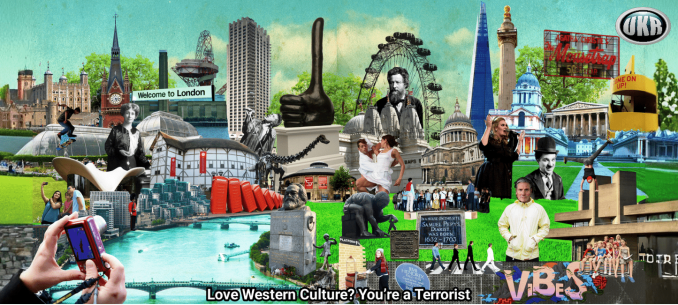
This article (Love Western Culture? You’re a Terrorist) was created and published by Connor Tomlinson and is republished here under “Fair Use”
See Related Article Below
You Have No Rights
There is no such thing as human rights law’, redux

NEWS FROM UNCIBAL
If someone has a right…this means that it is for some reason wrong for officials to act in violation of that right, even if they (correctly) believe that the community as a whole would be better off if they did.
-Ronald Dworkin
Hamit Coskum, the man on the left in the photo above, has the right to freedom of expression according to the Human Rights Act 1998. Yet he has recently been convicted of the offence of ‘disorderly behaviour within the hearing or sight of a person likely to be caused harassment, alarm or distress’, because ‘he set fire to a copy of the Qu’ran and held it aloft while [shouting], “Fuck Islam” and “Islam is religion of terrorism” and “Qu’ran is burning”’ in front of the Turkish Embassy in London. He was duly fined £180, increased to £240 on the grounds of his actions being motivated by ‘hatred of Muslims’ and thus being ‘religiously aggravated’.
It is a symbol of the sheer debasement of the criminal justice system in this country that the prosecution’s case rested in part on the fact that Coskum’s actions had clearly caused ‘distress’ because they had led a random Muslim onlooker to attack him with a knife. In another context that would be called ‘victim-blaming’. But in the weird UK of the 2020s, a knife attack is considered a proportionate and reasonable response directed against somebody acting as a fly in the diversity ointment. Coskum, himself a Kurdish asylum-seeker, was not following the script, wherein everybody in multicultural Britain always gets along. He was making things complicated. And for that he is deemed to have deserved everything he got.
This case has generated a great deal of comment because it is suggestive of the emergence of a de facto blasphemy law, which prohibits (and indeed criminalises) conduct which might cause Muslims ‘distress’. (This is why the Free Speech Union is funding Coskum’s appeal.) Here, though, I would like to emphasises a different aspect of the case, which is what it says about the role which human rights law in general and the right to freedom of expression in particular play in regulating the relationship between individual and State in 2025.
Coskum’s defence rested in part, as one might expect, on his having been exercising his rights to freedom of conscience, freedom of expression, and freedom of assembly (articles 9, 10 and 11 of the European Convention on Human Rights, given effect in the UK by the Human Rights Act 1998). This argument was given short shrift by the judge. And in rejecting it he revealed an important truth: there is no meaningful sense in which it can be said that people in the UK – or indeed anywhere else for that matter – have human rights at all. What they have, rather, is ultimately merely political duties to act in accordance with whatever is deemed to be in the ‘public interest’.
To explain this, it is necessary to (I apologise) devote a little bit of time to describing what a right actually is phenomenologically, and to do this we can helpfully refer to one of the strangest and most sinister books written in the twentieth century – Alexandre Kojève’s Outline of a Phenomenology of Right. This text, penned in 1943 but posthumously published in the early 1980s, can be understood as many things: an elaboration of the book by Hegel from which it derives its title; a synthesis of Marxism and capitalism; a crypto-Stalinist screed; a theory of justice; and more besides. But it also contains within it an attempt to set out the holy grail of 20th century legal philosophy: an account of the autonomy of law. Is there, in other words, something that can be called law that is separate from the moral or the political? Is there a system of right that relies for its authority solely on the fact that it realises Justice in the purest sense, rather than giving effect to State reason or raison d’État, tradition or inherited morality, and so on?
The effort is complicated for the native English speaker by the fact that Kojève was writing in French, and the English word ‘right’ and the French word ‘droit’ are not synonyms. It is also complicated by the fact that Kojève uses the words ‘droit’, ‘Droit’, and sometimes ‘Droit’ to mean subtly different things. But nonetheless, something useful and important can be gleaned about the nature of rights in the English-speaking sense from his thoughts on the matter.
Simplifying somewhat, Kojève boils the phenomenology of right down to a simple three-way relationship between two persons, A and B, and a ‘disinterested third’, C. If A has a right to something, it means that, if B acts in such a way as to harm, hinder, seize, obstruct or damage A’s claim on that thing, then C will intervene in their interaction to suppress B. There are various other requirements which Kojève spends some time discussing, but the only one of them that bears mentioning at this stage is that C’s intervention should be realised through objective rules (as opposed to whim, randomness, etc.).
C, for Kojève, is – in modernity, at least – the State in what can be called its juridical form: the police, the legislature, the judiciary. A and B can be almost anything other than that; they could be two individuals, for example, or they could be a composite ‘public interest’ or even some individual public authority or other. And what I have called the ‘suppression’ of B could come in different forms – most often it is implicit or inert, and just comes in the form of deterrence; at other times it is injunctive, so as to constrain action; at others it is remedial, so as to require a transfer typically of money; at others it is punitive; and so on.
The classic exposition of this would be, to stick with the example of freedom of expression, an interaction between A, who expresses himself in a particular way, B, the public, who notionally wish him not to, and C, the ‘disinterested’ State who intervenes to suppress B by – let’s say – enacting and enforcing legislation to protect A’s speech rights. Another would be an interaction between A, a disabled person who wishes to go to watch a football match, B, the football club, and C, the ‘disinterested’ State who intervenes by requiring B to spend money improving disability access. You get the drift.
There are four problems to which this phenomenological exposition gives rise, of which Kojève himself was fully aware and for which he had an explanation, but to elucidate that explanation would require us diverging into an involved discussion of his cod-Hegelian philosophical exposition of the trajectory of history. That would be unnecessary in order to achieve our aims here. Let us just lay the problems out, then, as a way of framing what follows.
The first problem which the exposition brings to the fore is that of what I have elsewhere referred to as ‘political reason’ and what Kojève calls raison d’État – in other words: the State is never ‘disinterested’. In creating and enforcing a system of right, it does so with an eye not solely, or indeed mainly, on doing Justice but on a range of factors, chief among them being the need to perpetuate itself. And this in turn gives rise to certain incentives which lead it necessarily to utilise rights to govern in various highly non-disinterested ways. I will not say a great deal more about this issue, except in closing, but I am in any case currently writing a proper academic piece about it, with footnotes and everything – people who are particularly interested are welcome to read it when it is published.
The second, third and fourth problems are more salient for our purposes, and they are as follows.
To begin, Kojève’s account does not do what it says on the tin, in that it does not give an account to us of an autonomous system of right (or law). Rather, as you may have noticed if you are particularly eagle-eyed, what it really does is situate the origin of right in political decisions of the State. It does not conceive of right as an objective and absolute standard, but as something which is contingent on whether or not the State makes a decision to intervene in any given interaction between any given A or B. One does not have a right in advance, except perhaps nominally; one rather only has a right in its actualisation or in the decision taken to give it effect. (Kojève is, in this respect, intensely if perhaps unintentionally Schmittian.)
Consider Mr Coskun. In actuality – when it came to the point of intervention from the disinterested third (C) between him and the purported interests of Muslims generally – it turned out that whatever ‘right’ he thought he might have had was not in fact a right at all. In the decision of the disinterested third, there was no right – it was a figment of his imagination. Or, spun another way, in the event it turned out that Mr Coskun was actually in the position of B and the Muslim interest, as it were, in position A. This is really the same point, made slightly differently – in the decision of the State, the Muslim interest finds itself having the right not to be ‘distressed’, which obliterates any putative or notional right to freedom of expression which Mr Coskun may have thought himself to possess.
This is crucial, then, so it bears repeating: the existence of right is contingent on the decision of the ‘disinterested’ third, meaning the State. It is not contingent on objective rules or standards. The ontology of right, we might say, is decisional or situational, not formal or normative.
That was the second problem raised by Kojève’s phenomenology. The third problem it raises is the relationship between B and C (or, indeed, for that matter between A and C, but we will set that to one side for a moment). B, remember, is the figure whose interaction with A is ‘suppressed’ (again, this is my word) by C in the name of the actualisation of the right of A. What then is the relationship between B and C? It is one of duty: B must act in accordance with the decision of C. If A has a right as a disabled person to access a football stadium owned by B, for example, then that is simply the converse of saying that B has a duty to provide that access, enforced by C. If A has a right to express himself, then B has a duty to refrain from violating that right, again enforced by C.
This is in a sense a simplified Hohfeldian analysis of right: any claim-right imposes a correlative duty on somebody. But Kojève’s analysis exposes the logic in a much more useful and, it must be said, ominous way, because it makes plain that B’s duty is not directly owed to A, but in fact to C, the disinterested State: A has no way to bring about the performance of B’s duty without C, and the duty is indeed meaningless without, again, C’s decision. This places C at the centre of the enforcement of duties, and makes duty itself a fundamentally political matter; just as the ontology of right lies in the political decision, in other words, so does the ontology of duty.
And something similar can be said in respect of the fourth problem, which this time concerns the relationship between A and C. Is it possible for A, the individual, to have a right against B, in the form of the State, with something else taking on the role of C, the disinterested third? Kojève is clear: the answer has to be ‘no’. There are alternative possibilities for entities taking on the role of C other than the State, but in modernity these are illusory or at least off the table. The most obvious alternative is God; another would be some underlying framework of natural right or cosmic order. But since in modernity those options are not permitted to enter into the concept of government, we are left with the circumstance that if there is ever to be a ‘C’ then it must be the State or at least the juridical aspect of the State apparatus, acting through political decision.
It follows from this that the individual can never have a right against the State, except insofar as the State itself voluntarily undertakes not to take some action or other – because (hold onto your hats for a surefire contender for a News From Uncibal quote of the century) the State can never be B. Since there is nothing that can act as the ‘disinterested third’ between the individual A and State-as-B, that is tantamount to saying there is no system of right that applies vertically between individual and State. Right can only apply horizontally between subjects of the State, and that is that. The State is unconstrained in its decision making (another point at which Kojève and Schmitt might be said to converge), though it may of course decide to constrain itself in the interests of expediency.
What this means in the shake out of course is that, far from laying out an autonomous system of right, Kojève in fact describes a purely and essentially political one. A person has rights (or duties) because of political decision. One does not have rights in the abstract, or in advance. One only has a right in the decision itself: to repeat, right is in fact actualised in the decision, rather than existing as a pre-political norm.
This may sound very airy-fairy, but in Mr Coskum’s case we see its practical consequences laid out very clearly. The most salient purported ‘right’ that Coskum possessed was that of freedom of expression, given effect by the Human Rights Act 1998, which makes Article 10 of the European Convention on Human Rights part of UK law. Article 10 reads as follows [emphases added]:
- Everyone has the right to freedom of expression. This right shall include freedom to hold opinions and to receive and impart information and ideas without interference by public authority and regardless of frontiers. This Article shall not prevent States from requiring the licensing of broadcasting, television or cinema enterprises.
- The exercise of these freedoms, since it carries with it duties and responsibilities, may be subject to such formalities, conditions, restrictions or penalties as are prescribed by law and are necessary in a democratic society, in the interests of national security, territorial integrity or public safety, for the prevention of disorder or crime, for the protection of health or morals, for the protection of the reputation or rights of others, for preventing the disclosure of information received in confidence, or for maintaining the authority and impartiality of the judiciary.
What you will note about this, in light of the preceding analysis, is that it precisely vindicates the point that the State in its juridical capacity can only ever be C, and never B; an individual A can never exercise a right to freedom of expression against the State in the strict sense, because it is the State which also intervenes in the name of said right; the State itself determines what ‘formalities, conditions, restrictions or penalties’ are ‘necessary in a democratic society in the interests of national security, territorial integrity or public safety’, and so on and so forth. The most that can be said is that the State may in some interest or other permit and protect speech, but that this is a voluntary self-restraint that derives not from right but political imperative.
And what you will also note about this right to freedom of expression is that, insofar as it applies horizontally (which is to say between individual, A, and another individual, composite collection of interests, legal person, etc., B), it can be restricted for the purpose of the ‘protection of the…rights of others’. In other words, the right to freedom of expression has to be traded-off against other rights. And this returns us to a point that I alluded to earlier, of course, which is that it is the State, C, which determines which of the two parties in an interaction involving rights is in the position of A or B. Remember, it is A who possesses a right and B whose reaction against it is suppressed. But since it is the State which actualises any right through a decision, that is tantamount to saying that it is through the State’s decision that a given individual finds himself in the position of A and another in the position of B. It could just as well have been the other way around if the State had decided differently.
The question then becomes: in the conflict between Coskun’s freedom of expression and what I earlier referred to as the ‘Muslim interest’ in not being distressed, which party is really A, and which is B? The answer of course is that the party which is A is the one which has the right. And the one which has the right, as we saw in the event, turned out to be the ‘Muslim interest’ rather than Coskun himself. It is the ‘Muslim interest’ that is in the position of A; it is Coskun that is in the position of B. Coskun is not the bearer then of right – he is rather to be understood, much more accurately, as the bearer of a duty. In the first instance this duty is to pay a fine, of course, but in the broader sense it is his duty, in the interests of deterrence, to stand in as a symbol of what happens to those who engage in expression which goes against the mainstream manners of the day.
And what goes for Coskun goes for the rest of us, of course, because by dint of the decision of District Judge John McGarva, we now all of us find ourselves placed in the position of B with respect to the ‘Muslim interest’, A. That which has the right, as it were, is the composite Muslim population of the country, which is not to be ‘distressed’, and that which has the duty is the rest of the population, which must not impinge on that right. And this duty of ours is owed to C, and will be enforced by it – in the great majority of cases in an indirect, chilling effect on free expression, but in others, undoubtedly, in the form of fines or even custodial sentences. To repeat: we have no rights except in their actualisation by decision of the State, and the State has here made its decision.
In closing, it is worth remarking briefly on the possibility of alternatives. The edifice of human rights law is defunct, and always was so, because it has no autonomous existence outside of the political decision, as Kojève inadvertently shows. What viable options exist, then, for the protection of fundamental freedoms, such as freedom of expression, in law?
The US Constitution has a clue. As ever, in reading that document, one is struck by the strange genius of the Founders, who thought very carefully about the type of regime they wished to construct and how it would be rightly constituted. Everybody knows that the First Amendment protects ‘freedom of speech’. But what they tend to overlook is that the text of that Amendment does not refer to freedom of speech explicitly as a right. Rather, it provides that ‘Congress shall make no law…abridging the freedom of speech’. This is a subtle, but important distinction, since it does not and cannot in itself result (as the European Convention rights necessarily must) in the imposition of political duties on some or all individuals. Rather, it imposes a duty only on the Congress – namely, not to make laws of a particular kind. Of course, the contours of that duty have been shaped and re-shaped in the centuries since. But it may that its peculiarly non-rights-based framing lies at the heart of the enduring American commitment to freedom of speech that Britain sorely lacks.
The problem for Britain of course is that once Pandora’s box has been opened it is rather difficult to get the contents back inside. The British State has in the period since 1998 become thoroughly addicted to the power it derives from taking on the role of picking and choosing who has rights and who doesn’t, and in what contexts, and this indeed has become one of the central planks in its own self-justification – it manages the heterogeneity, or diversity, of a ‘free’ society in the best possible way. The American Founders lived in a blank-slate moment in which a new constitutional order was being founded. One, regretfully, increasingly wonders whether this is the type of scenario that will have to unfold if Britain is to rescue itself from its malaise.
This article (You Have No Rights) was created and published by News From Uncibal and is republished here under “Fair Use”
Featured image: movaway.fr

••••
The Liberty Beacon Project is now expanding at a near exponential rate, and for this we are grateful and excited! But we must also be practical. For 7 years we have not asked for any donations, and have built this project with our own funds as we grew. We are now experiencing ever increasing growing pains due to the large number of websites and projects we represent. So we have just installed donation buttons on our websites and ask that you consider this when you visit them. Nothing is too small. We thank you for all your support and your considerations … (TLB)
••••
Comment Policy: As a privately owned web site, we reserve the right to remove comments that contain spam, advertising, vulgarity, threats of violence, racism, or personal/abusive attacks on other users. This also applies to trolling, the use of more than one alias, or just intentional mischief. Enforcement of this policy is at the discretion of this websites administrators. Repeat offenders may be blocked or permanently banned without prior warning.
••••
Disclaimer: TLB websites contain copyrighted material the use of which has not always been specifically authorized by the copyright owner. We are making such material available to our readers under the provisions of “fair use” in an effort to advance a better understanding of political, health, economic and social issues. The material on this site is distributed without profit to those who have expressed a prior interest in receiving it for research and educational purposes. If you wish to use copyrighted material for purposes other than “fair use” you must request permission from the copyright owner.
••••
Disclaimer: The information and opinions shared are for informational purposes only including, but not limited to, text, graphics, images and other material are not intended as medical advice or instruction. Nothing mentioned is intended to be a substitute for professional medical advice, diagnosis or treatment.
Disclaimer: The views and opinions expressed in this article are those of the author and do not necessarily reflect the official policy or position of The Liberty Beacon Project.


Civil SERVANTS do not work for a living. That includes Starmer and Charles. They are only authorities, nothing more. Their modus operandi is enforcement not intellect.