

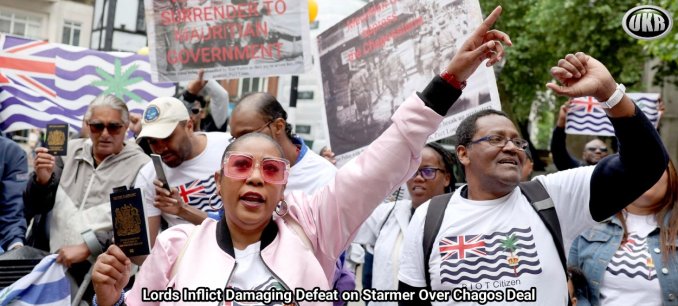
Lords inflict damaging defeat on Starmer over Chagos deal as peers force rethink of Mauritius treaty
CP
Sir Keir Starmer’s controversial plan to hand the Chagos Islands to Mauritius suffered a serious parliamentary blow last night after the House of Lords voted to derail the Government’s timetable and force a renegotiation of key terms of the deal.
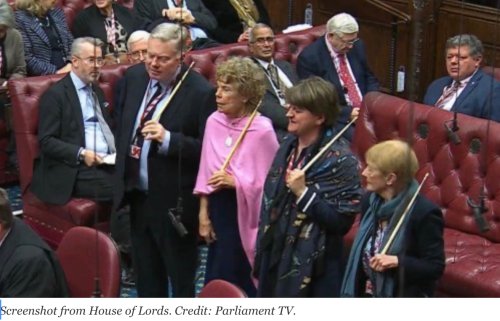
In a closely fought division during the Report stage of the Diego Garcia Military Base and British Indian Ocean Territory Bill, peers voted by 132 to 124 to back an amendment requiring ministers to seek changes to the treaty so that Britain would stop making payments to Mauritius if the Diego Garcia military base became unusable.
The defeat delays ratification of the agreement and exposes deep unease across the House about a deal critics say locks the United Kingdom into decades of vast payments with little protection for taxpayers, national security or the rights of the Chagossian people.
The treaty, signed by Sir Keir in May, transfers sovereignty of the British Indian Ocean Territory to Mauritius while committing the UK to rent back Diego Garcia, home to a major British and American military base, for 99 years. The overall cost is estimated at more than £30 billion, with some experts warning it could reach £35 billion over the lifetime of the agreement.
The successful amendment was tabled by Lord Craig of Radley, a former Chief of the Defence Staff, who warned that the treaty as drafted required Britain to keep paying Mauritius even if the base was rendered unusable by environmental damage, military attack or geopolitical change.
“There seems to be no break or conditional clause agreeing any reasons why the UK may cease these payments before the 99 year date is reached,” he told the House. He warned that history showed how rapidly strategic circumstances could change, adding, “In well under the past 100 years, foes have become friends and friends, potential and real, have become foes.”
Lord Craig raised the prospect of sea level rise, a catastrophic attack or a future decision by the United States that it no longer needed the base, asking whether Britain would still be bound to pay regardless. He questioned whether there was any legally binding agreement guaranteeing American use of Diego Garcia for the full duration of the lease.
“I do not wish to suggest any lack of importance of the base to national and international security at the present time,” he said. “But experience tells us that much can and does change over time.”
Support came from across the House. Lord Houghton of Richmond, another former senior military figure, said the amendment was “no wider purpose than common sense” and warned that Diego Garcia’s strategic value and isolation could make it an attractive target in a future conflict.
“Pause for a moment to imagine the early stages of a global conflict,” he said, describing a scenario in which a hostile power might destroy the base with little risk of civilian casualties. “I cannot think of an obviously better or more considered target than Diego Garcia.”
Conservative peer Lord Hannan of Kingsclere accused the Government of failing to think through obvious risks during negotiations. He cited reports that the treaty had been “championed by a small number of civil servants” and claimed that among those administering the territory “there is no one who supports this treaty”.
Despite these warnings, ministers urged peers to reject the amendment. Responding for the Government, Baroness Chapman of Darlington argued that reopening negotiations with Mauritius would be unhelpful and could undermine relations with allies.
“The US, which has invested heavily in Diego Garcia, agrees that opening up the possibility of the agreement with Mauritius being terminated early is not helpful,” she said. She pointed to plans for a joint commission with Mauritius and said international treaty law already allowed for termination if performance became impossible.
Quoting the Vienna Convention, she told peers that international law permits termination where there is “the permanent disappearance or destruction of an object indispensable for the execution of the treaty”.
But her assurances failed to convince a majority of the House. Summing up before forcing a vote, Lord Craig said, “I still feel that this is something which should and could be sorted out before we get into formal ratification,” and declared that he would test the opinion of the House.
The result was a clear rebuke to the Government.
Conservatives seized on the defeat as proof that Labour’s Chagos policy is unraveling. Lord Callanan, leading for the Opposition, described the treaty as “an abject surrender” that was never put before voters.
“The British people were not consulted on the treaty, yet it will see over £34 billion worth of taxpayers’ money paid to the Government of Mauritius over the treaty’s lifetime,” he said. He contrasted this with statements by the Mauritian Prime Minister that the money would be used to fund debt repayments and tax cuts at home.
“It is unconscionable that British taxpayers should be forced to continue to fund the Mauritian Government under the terms of the treaty in circumstances where the military base has become inoperable,” he added, pledging Conservative support for Lord Craig’s amendment.
The debate also laid bare mounting anger over the Government’s treatment of the Chagossian people, who were forcibly removed from their islands between 1968 and 1973 and remain dispersed across the UK, Mauritius and the Seychelles.
Peers repeatedly criticised Labour for pushing ahead without meaningful consultation or consent. A recent survey conducted by the House of Lords International Relations and Defence Committee received more than 3,000 responses from Chagossians worldwide and found deep distrust of Mauritius, strong support for self determination and widespread opposition to the transfer of sovereignty without their say.
Lord De Mauley, who helped oversee the survey, said respondents expressed a “profound and enduring sense of injustice” and a desire to return to their homeland. He noted that many, “despite the appalling treatment the British Government have meted out to these people”, still expressed a preference for British sovereignty.
Several peers also questioned the Government’s haste in pushing the Bill through Parliament while a live judicial review remains unresolved. The case, brought by Chagossians and organised with the support of the Great British PAC, challenges the lawfulness of the Government’s actions and the lack of consultation. Judgment is expected shortly.
Critics warned that rushing the Bill to completion before the court has ruled risks rendering the judicial review academic. As one peer put it, Parliament should be “slow to legislate in a manner that pre empts or undermines live judicial proceedings, particularly where those proceedings concern the rights of a specific identifiable group”.
Despite the Lords defeat, Labour ministers are expected to try to overturn the amendment when the Bill returns to the House of Commons. With a large majority, MPs are likely to reinstate the original wording.
However, last night’s vote guarantees delay and intensifies pressure on Sir Keir Starmer over a deal that many now regard as reckless and poorly thought through. What the Prime Minister once described as the only way to protect Diego Garcia from hostile influence is increasingly seen by critics as an expensive concession that weakens Britain’s position, alienates the Chagossians and leaves taxpayers on the hook for decades to come.
This article (Lords inflict damaging defeat on Starmer over Chagos deal as peers force rethink of Mauritius treaty) was created and published by Conservative Post and is republished here under “Fair Use” with attribution to the author CP
See Related Article Below
Britain can still escape Starmer’s dreadful Chagos deal
STEPHEN DAISLEY
he government’s latest difficulties in the House of Lords over plans to surrender the Chagos islands is another humiliation for Keir Starmer, but it is also one last opportunity to avert a historic mistake.
The Prime Minister proposes to hand over the Chagos to Mauritius, which has never exercised sovereignty over a cluster of Indian Ocean islands which have been British for two centuries. Starmer has agreed to pay Mauritius £101 million every year for 99 years to lease back one of the islands, Diego Garcia, which is home to a joint UK-US military base.
On Monday, peers outvoted the government on four key amendments. These would require ministers to publish a breakdown of payments to Mauritius, give MPs oversight of these transactions, and stop paying if the island base becomes unusable. (Paying billions for a base we’ve been told we can’t use would be the most British thing ever.) A fourth amendment, from the Lib Dems, would give UK-based Chagossians a referendum on Starmer’s plan.
The deal now goes back to the Commons. MPs should welcome this as a chance to apply an eleventh-hour handbrake on an ill-conceived and wholly unnecessary treaty that is bad for Britain’s national security, bad for its financial resources, and bad for the indigenous Chagossians.
There is no reason whatsoever for the UK to gift its lawfully held territory to a foreign power. The reason Starmer insists on doing so is predictably lawbrained: an advisory judgment from the International Court of Justice – the Model UN of global tribunals – ruled that Britain’s 1965 severance of its Indian Ocean territory from its Mauritian territory was unlawful. Any normal country would thank the ICJ for its non-binding opinion, note that it enjoys all the legal force of a politely worded email, and proceed as before.
Naturally Britain under the Tories chose to cave and once Starmer was in No. 10 it was an all-you-can-eat buffet for the Mauritians, who not only got all the British territory they wanted but got paid to the tune of £10 billion to take it off Britain’s hands. Britain, meanwhile, got the best end of the bargain: all those domestic and international elites who hate it will welcome its self-abasement then continue hating it all the same. Bask in that sweet, sweet soft power, baby.
Accepting the Lords amendments, in particular the referendum for Chagossians, is the best option for Labour MPs, representing a setback rather than a comprehensive defeat for the government. The time required to hold a referendum would give parliament more time to scrutinise the treaty and in particular its national security implications. Several regional and global powers (read: China and India) will almost certainly become very good friends of the Mauritians the minute Port Louis becomes the legal sovereign over a UK-US military base. This is why the transfer shouldn’t happen at all, but if it must happen, parliament should at least be able to cut off payments to Mauritius if its government begins behaving in a manner contrary to Britain’s national interests. (We’ve got our own government to do that for us, thank you very much.)
On a point of principle, if we are to hold a referendum on ceding sovereign UK territory, it ought to be a referendum of all British citizens, not just a subset, but Chagossians undoubtedly harbour a unique and profound connection to these islands. That so many are fiercely opposed to handing them over to Mauritius ought to have been accorded more weight than it has by a government more concerned with winning a Good Global Citizen of the Month certificate than with considering the practical and moral implications of its proposals.
Labour MPs should ask themselves if they really want to be a party to this
A survey of Chagossians last year commissioned by the House of Lords International Relations Committee found widespread ‘mistrust of the Mauritian government’ because of ‘historical marginalisation, neglect and mismanagement’. This included ‘allegations of racism and human rights abuses against Chagossians resident in Mauritius’. Many Chagossians long to return to the islands, but Starmer’s deal places no resettlement obligation on Mauritius and denies Chagossians a say over the future of their homeland. The committee warned ministers: ‘Disregarding these voices risks repeating past injustices; true redress can only be secured with Chagossians at the centre of every decision affecting their homeland.’
Labour MPs should ask themselves if they really want to be a party to all this. Loyalty to a struggling leader is one thing, but when the price is the rights and dignity of an already dispossessed people, their leader is surely asking too much of them. Britain has already done the Chagossians dirty once before. Is a repeat performance really necessary? And while Chagossian self-determination is unlikely to come up on the doorstep, they can expect their Reform opponent to make noise about them voting to send £10 billion overseas when their constituency needs a new school or hospital.
Keir Starmer’s premiership is probably beyond saving, but on the Chagos sellout he needs saving from himself.
Written by
This article (Britain can still escape Starmer’s dreadful Chagos deal) was created and published by The Spectator and is republished here under “Fair Use” with attribution to the author Stephen Daisley
Featured image: Sky News


Leave a Reply