

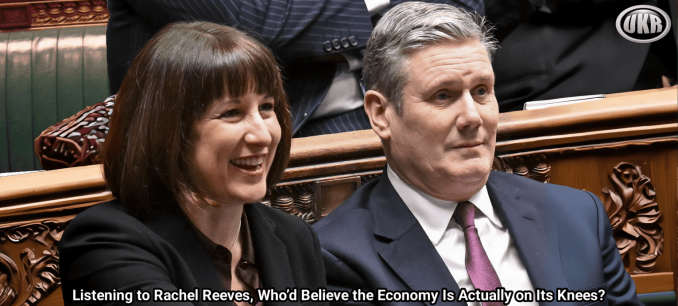
Listening to Rachel Reeves, who’d believe the economy is actually on its knees?

EWAN STEWART
ONE OF my friends is a joker. He sent me this from Starmer’s X account a few days ago proclaiming the Good News of Labour.
‘The Tories left us with a £22bn black hole. My government has fixed the foundations of our economy. We now have the fastest growth in the G8, four interest rate cuts and we have signed three trade deals to protect jobs and put more money in your pockets. Keir Starmer 9/6/2025’
Does our Prime Minister really believe this nonsense, or is it just part of the spin and optics he thinks will impress us? If he does believe it he is deluded.
I have followed and written on the British economy for over 30 years and believe me, while there has been a steady erosion in the edifice over the last 20 or so of those years, we are now reaching a point which is close to terminal. The foundations are built on sand.
To cap Starmer’s amusing alchemy was Rachel Reeves’s statement in the Commons on Wednesday outlining her spending plans for 2025-6. Listening to her toss money around you would have thought the patient had a strong bank account, not that it was on its knees.
There is a complete misunderstanding here as to how economies become healthy, sustainable and prosperous. The Reeves view seems to be she knows best and the orchestra requires her conducting. Every assumption she made strengthened the state and weakened the private sector. Central spending was to increase, employment legislation to tighten yet further, weakly costed and largely unviable infrastructure projects announced and yet more money into pet projects and net zero fantasy.
Public spending remains out of control and will continue to grow at 2.3 per cent in real terms, a rate much faster than the private sector and that is from a base where public spending is already not far off half the entire economy.
Reeves’s spending plans amount to the State spending a staggering £48,000 for each of the 28million households in the land. £48,000 – imagine! I would be fascinated as to what proportion of readers believe they are even getting half that amount in ‘value back’. This extraordinary largesse is despite the fact that the national debt has increased eightfold since Tony Blair came to power in 1997. Eight times for exactly what?
Reeves’s statement was full of factual errors. Her starting assumption that there was a £22billion hole is utter fiction. The hole is more like £200billion in excess spending after inflation since Johnson became Prime Minister in 2020. (Total managed expenditure £888billion 2019-20, forecast £1,389billion current year, Office for Budget Responsibility – nominal numbers before inflation) And she wishes to increase that imbalance further.
Moreover Reeves continues to peddle the myth of austerity. The trouble is that this fiction, repeated so often, gains traction. As a matter of record, how could there conceivably have been any austerity when the state has increased from a third of the economy under Blair to almost half today? The austerity has entirely been in the private sector as absurdly poor policy decisions on spending, tax, regulation, net zero, the lot have been taken by successive governments.
Each decision has the false underlying assumption that we the State benevolently know best. It’s a complete fallacy. Successful economies are built on strong foundations of trust and consistency of law, moral foundations based on family, community and mutual trust, non-arbitrary tax and regulation and a strong competitive private sector. All of these factors have been greatly, and in some cases deliberately, eroded.
The unfortunate truth is Britain is no longer in any material sense a free-market economy. It is one of the most directed command economies in the world. There are a few nations whose state spending exceeds the 45 per cent that is the UK’s figure (France, Belgium and Italy come to mind) but the UK state is some 10 points higher than OECD averages and often twice the size of Asian competitors who are catching up to the UK rather quickly. As corrosive as the scale of the state is, the degree of control even over notionally private sectors is every bit as damaging.
A few examples:
Energy policy is entirely under direct state control, with disastrous effects – domestic energy pricing is several times that of the US.
The banking sector is regulated to an inch of its life, as is the City.
Employment terms are also highly dictated from minimum wage legislation to diversity targets and contextual offers.
Transport policy is hardly free. Look at the railways.
Private education is marginalised and bullied as the state does not like competition.
Even agriculture is under the regulatory and tax thumb.
The unfortunate truth is the unfettered private sector in the UK is now tiny, perhaps less than a third of the entire economy. It is not a coincidence that as this highly productive free market sector has shrunk, so our economy has withered and growth stagnated.
Consider when was the last time any significant manufacturer listed on the London Stock Exchange over the last 20 years? I can barely think of one. Come to mention it, with the honourable exceptions of the recent tech float Raspberry Pie and the drinks manufacture Fever Tree, when was the last time any UK company in any productive sector floated excluding government outsourcing companies, or some public sector-backed consultancy? Doubtless there are one or two, but a very few. Contrast this with the US where literally hundreds of true private-sector start-ups have blossomed over the same period.
I have followed a very simple personal investment philosophy over my career. Never invest in anything where the Government is the substantial customer or regulatory controller. The reasoning was simple. Their decisions are often arbitrary and open to review. They are what one might call an exogenous factor; in plain English unpredictable and unreliable. This philosophy has broadly served me well. Unfortunately the entire UK economy is now becoming the plaything of the State. Until there is a change of philosophy, and we must urgently pray that there is, Britain is thus largely uninvestible. Far better opportunities, sadly, exist elsewhere.
This article appeared in Global Britain on June 13, 2025, and is republished by kinid permission.
See Related Article Below
Borrow like there’s no tomorrow
JOHN REDWOOD
The Chancellor set about spending with rare enthusiasm as she pandered to her Labour MP audience. In a heavily party drenched presentation she played fairy godmother giving out public sector sweeties to as many named MP s, public sector trade unions and client groups as she could cram in . A bloated state was put on a fattening diet.
Every part of the public sector mentioned was praised for its employees and achievements. Every part had according to Reeves been starved of money by the previous governments which had put up public spending every year. Not once did she mention the productivity collapse, the staggering losses of the nationalised industries, the huge cost overruns of many public sector projects. This was fantasy economics.
We are asked to believe they will build nuclear power stations on time and to budget, yet we are not told what either the cost or the timetable will be. We are asked to believe the newly nationalised railway will run to time and not send supplementary bills. We are told British steel is saved without being told how we replace the blast furnaces, square the Chinese owners and avoid all the US tariffs. We are asked to believe that re announcing tram and rail projects long in the pipeline will revive city centres and solve problems of urban decline.
There was no mention that longer term interest rates are way above Truss levels, that markets think the government is borrowing too much, or that the small increases in spend for the last two years look implausible under a spendthrift government wanting to be re elected. This Chancellor invented a black hole then set about digging a much bigger one.
PS The document issued after the speech promises 5% savings from efficiency improvements based on a £3 bn Transformation Fund to spend more on computing. This does not even remove all the lost productivity since 2019. There are targets to reduce administrative costs without explaining how.
SOURCE: John Redwood’s Diary
Featured image: x.com

••••
The Liberty Beacon Project is now expanding at a near exponential rate, and for this we are grateful and excited! But we must also be practical. For 7 years we have not asked for any donations, and have built this project with our own funds as we grew. We are now experiencing ever increasing growing pains due to the large number of websites and projects we represent. So we have just installed donation buttons on our websites and ask that you consider this when you visit them. Nothing is too small. We thank you for all your support and your considerations … (TLB)
••••
Comment Policy: As a privately owned web site, we reserve the right to remove comments that contain spam, advertising, vulgarity, threats of violence, racism, or personal/abusive attacks on other users. This also applies to trolling, the use of more than one alias, or just intentional mischief. Enforcement of this policy is at the discretion of this websites administrators. Repeat offenders may be blocked or permanently banned without prior warning.
••••
Disclaimer: TLB websites contain copyrighted material the use of which has not always been specifically authorized by the copyright owner. We are making such material available to our readers under the provisions of “fair use” in an effort to advance a better understanding of political, health, economic and social issues. The material on this site is distributed without profit to those who have expressed a prior interest in receiving it for research and educational purposes. If you wish to use copyrighted material for purposes other than “fair use” you must request permission from the copyright owner.
••••
Disclaimer: The information and opinions shared are for informational purposes only including, but not limited to, text, graphics, images and other material are not intended as medical advice or instruction. Nothing mentioned is intended to be a substitute for professional medical advice, diagnosis or treatment.
Disclaimer: The views and opinions expressed in this article are those of the author and do not necessarily reflect the official policy or position of The Liberty Beacon Project.


Leave a Reply