

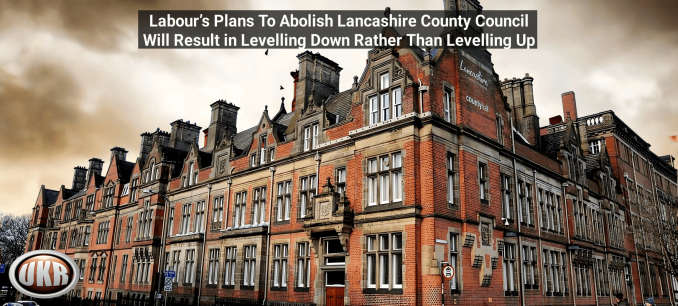
James Ford: Labour’s plans to abolish Lancashire County Council will result in levelling down rather than levelling up

JAMES FORD
James Ford is a public affairs consultant with considerable expertise working in local and devolved government. Between 2010 and 2012 he was an adviser to Mayor of London Boris Johnson on transport, environment and technology policy and was subsequently head of strategic communications and PR for Lancashire’s Local Enterprise Partnership (2020-21).
First they came for the pensioners. Then they came for the farmers. Now Labour are coming for England’s county councils. Rumours swirl that the Government’s much-heralded English Devolution White Paper, expected imminently, is looking to launch the most ambitious re-organisation of local government in more than 50 years and England’s remaining 21 two-tier county councils are at the top of Labour’s hit list.
It seems likely that Labour’s vision for local government will be to abolish the current system of two-tier local authorities – where local services (like managing parks and bin collection) are run by district or borough councils and more strategic services (like transport, education and social care) are overseen by county councils – and replace it with a patchwork of unitary authorities and, above them, combined authorities headed up by directly-elected Mayors. Their official rationale for such sweeping changes will be efficiency and simplicity.
But it is easy to see that these changes are not really about efficiency. Of the 21 two-tier county councils, 19 are Conservative controlled and the remaining two are run by Lib Dem-led coalitions. None of these local authorities are Labour controlled. As such, Labour changes must be seen as the blatant attempt at gerrymandering that they are.
In my native Lancashire, the opening salvo of this looming political battle was fired by Burnley MP Oliver Ryan last week, who claims that a majority of the 11 Labour MPs in Lancashire support the scrapping of Lancashire’s 15 local authorities (including Lancashire County Council itself) and replacing them with a directly elected Mayor and three or four large unitary councils. This is despite the fact that Lancashire struck a generous devolution deal with the new Labour government just a few weeks ago.
The proposed shift to new unitary authorities is more likely to result in poorer performing local services across Lancashire, especially when it comes to education. Lancashire County Council (LCC) schools outperform those run by Blackpool or Blackburn with Darwen, the county’s two existing unitary authorities. In 2023, according to DfE figures, the average point score (APS) at A-level for LCC schools was 36.07, which is higher than the average for both the north west (30.79) and England (35.29). Blackpool and Blackburn with Darwen, respectively, achieved scores of 33.27 and 32.02 which, whilst above the average for the north west, are lower than the England average. Whereas more than 92% of pupils at LCC schools and sixth forms achieved passing scores in at least two A-levels, only 77% of pupils in Blackpool achieved likewise.
Nor is the performance disparity between LCC and the local unitary authorities limited to educational attainment. Whilst LCC’s children’s services are currently rated as ‘good’ by Ofsted, those in Blackpool are rated ‘requires improvement’ (and this is a significant upgrade from 2018 when Blackpool was rated ‘inadequate’). Taking local services that are delivering for residents, breaking them up and then merging them with under-performing services can only result in levelling down rather than levelling up, even before we factor in the disruption that a re-organisation would inevitably entail.
Worse still, not only would local services likely be worse but many citizens in Lancashire would end up paying higher rates of council tax for them. Take, for example, the residents of Fylde (the only Lancashire borough to send a Conservative MP to Parliament at the last election). Under the Labour plans, residents of this borough would find themselves merged into either a ‘mid Lancashire’ unitary authority with Preston, Ribble Valley and Pendle or a ‘North Lancashire’ unitary with Blackpool, Wyre and Lancaster. Currently, council tax rates in Labour-controlled Preston are 4% higher than those in Fylde whilst Labour-controlled Blackpool was recently revealed to be paying £24.4m a year to service its debts (with council reserves allegedly plummeting from £7m to just £76,000 in a year). Why should voters in Fylde or Wyre or Ribble Valley find themselves suddenly liable to pay for the profligacy and mismanagement of their neighbours? This is likely to be the case in most of the county council areas that Labour is proposing to abolish and should concern council taxpayers nationwide.
Labour’s last great attempt to force its brand of top-down devolution – John Prescott’s plans for elected regional assemblies – were, thankfully, defeated at the ballot box. In November 2004, when citizens of the North East of England were polled on the idea of creating a regional assembly, only 22% backed the proposal, killing the concept outright. Indeed, there is ample precedent for local government changes like these to require the explicit consent of the effected local communities. That was not just the case for creating large, devolved bodies in Scotland, Wales and London, it was also necessary before directly elected mayors were introduced for individual London boroughs like Lewisham, Hackney, Croydon, Tower Hamlets and Newham (all of which have populations far smaller than the 1.5m people who call Lancashire home). Certainly, the sotto voce support of a handful of local Labour MPs is an insufficient justification for major local government changes on this scale and a county-wide referendum would be essential.
True devolution celebrates local democracy, it is not imposed by diktat from Whitehall. The approach of previous Conservative governments to local government has understood that there is no one-size-fits-all solution for how different areas choose to organise themselves to best tackle local problems. There was also a pragmatic acceptance that devolved bodies may, inevitably, choose to elect Mayors from a different party. Labour, by contrast, seem obsessed with driving forward reforms that will turn the UK into a one-party state. Perhaps rattled by how quickly the shine has come off the Starmer administration (and how strangely precarious that government feels despite its whopping majority), the government seems intent upon delivering devolution by conscription and coercion rather than by consent. Unwilling to tolerate that the voters in some counties might want their schools and other key services to be run by Conservatives, they seem intent upon taking a wrecking ball to local government across England. It must fall to Conservatives nationwide to defend local democracy and insist that any re-organisations require the direct and explicit consent of local communities.
This article (James Ford: Labour’s plans to abolish Lancashire County Council will result in levelling down rather than levelling up) was published by Conservative Home and is republished here under “Fair Use” with attribution to the author James Ford

••••
The Liberty Beacon Project is now expanding at a near exponential rate, and for this we are grateful and excited! But we must also be practical. For 7 years we have not asked for any donations, and have built this project with our own funds as we grew. We are now experiencing ever increasing growing pains due to the large number of websites and projects we represent. So we have just installed donation buttons on our websites and ask that you consider this when you visit them. Nothing is too small. We thank you for all your support and your considerations … (TLB)
••••
Comment Policy: As a privately owned web site, we reserve the right to remove comments that contain spam, advertising, vulgarity, threats of violence, racism, or personal/abusive attacks on other users. This also applies to trolling, the use of more than one alias, or just intentional mischief. Enforcement of this policy is at the discretion of this websites administrators. Repeat offenders may be blocked or permanently banned without prior warning.
••••
Disclaimer: TLB websites contain copyrighted material the use of which has not always been specifically authorized by the copyright owner. We are making such material available to our readers under the provisions of “fair use” in an effort to advance a better understanding of political, health, economic and social issues. The material on this site is distributed without profit to those who have expressed a prior interest in receiving it for research and educational purposes. If you wish to use copyrighted material for purposes other than “fair use” you must request permission from the copyright owner.
••••
Disclaimer: The information and opinions shared are for informational purposes only including, but not limited to, text, graphics, images and other material are not intended as medical advice or instruction. Nothing mentioned is intended to be a substitute for professional medical advice, diagnosis or treatment.
Disclaimer: The views and opinions expressed in this article are those of the author and do not necessarily reflect the official policy or position of The Liberty Beacon Project.


Leave a Reply