

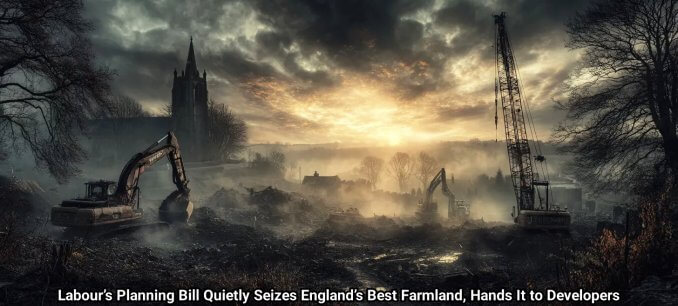
The New Enclosures
How Labour’s Planning Bill quietly seizes England’s best farmland, hands it to developers, and calls it fairness
THE RATIONALS
There is a moment, familiar to anyone who has ever driven through the English lowlands at dusk, when the hedgerows close in, the church spire pricks the sky, and the illusion of permanence feels almost tangible. Somewhere in that landscape a farmer is standing at his kitchen window, mug of builder’s tea cooling in his hand, watching a council officer walk up the lane with a compulsory-purchase notice in his briefcase.
This is no Victorian melodrama. It is the direct and foreseeable consequence of Labour’s Planning and Infrastructure Bill — a 150-clause juggernaut that completed its final Parliamentary skirmish in the House of Lords on November 24th 2025 and now awaits only Royal Assent in early December.
The Government presents the legislation as the long-overdue antidote to decades of planning paralysis — the indispensable fix if Britain is to deliver 1.5 million homes this Parliament and achieve clean power by 2030. Housing Secretary Steve Reed repeats the mantra “getting Britain building again” with the weary conviction of a man who has never laid a brick in anger, insisting the reforms will unlock growth without “selling out” communities or the natural world. The official factsheets speak of “fair compensation rather than inflated prices” and a “win-win” for the economy and the environment. The language is soothing. The reality is not.
Tucked away in clauses 83 to 92 of Part 5 is a provision that fundamentally rewrites the rules of compulsory purchase. Local authorities — district councils, county councils, even parish councils in certain circumstances — may now acquire land, including some of the most productive farmland in Europe, at “existing use” value, typically £8,000 to £13,500 an acre for prime arable. Once planning permission is secured, the same land can be resold at ‘hope’ value — anything from £500,000 to £1.5 million an acre, often far more. The uplift goes neither to the Treasury nor to the dispossessed farmer. It lands, unring-fenced, in the council’s bank account. There is no duty to audit it, no obligation to spend it locally, and no legal barrier to diverting it elsewhere. In the wrong hands — and many councils are now hundreds of millions in the red — that is not a windfall. It is an invitation. Ministers insist forthcoming statutory guidance will require “fair and reasonable” use of the power and some sharing of uplift with local communities, but as presently drafted the Bill imposes no statutory duty to do so, and no ring-fencing or audit requirement whatsoever.
The National Farmers’ Union, hardly a radical organisation, has warned that the mechanism risks eroding trust in Government and forcing thousands of family farms into distress sales, with inadequate compensation leaving landowners unable to relocate or reinvest. That warning is not campaign rhetoric, it draws from evidence submitted to the Public Bill Committee, including NFU testimonies on the “shivers” sent down farmers’ spines by expanded compulsory powers without safeguards. Consider one unremarkable 200-acre holding of grade-two arable. Bought by the council at existing-use value, £1.9 million. Sold on after outline permission at £600,000 an acre, £120 million. Profit to the public purse, £118.1 million. Even on less favoured land in the Midlands or East Anglia the same transaction still nets the council £15-25 million. Not bad for a morning’s work — and all of it made possible by a Government that still affects to believe it is merely removing unearned ‘hope value’ from the grasp of greedy landowners.
And as if that were not enough, Labour’s October 2024 Budget supplied the perfect accomplice. Whether by design or disastrous timing, its inheritance-tax changes are forcing thousands of family farms onto the market at exactly the moment local authorities have been handed unprecedented compulsory-purchase powers at sub-market prices.
The legislative journey was a masterclass in managed decline. In the Lords a cross-party alliance of rural peers and former ministers mounted a serious rearguard action. Yet the asymmetry of influence behind the scenes was stark. Freedom-of-information requests reveal that dozens of house builders enjoyed more ministerial meetings in four months than the National Farmers’ Union has been granted during the entire Starmer Government — while the NFU and the RSPB together managed fewer than five. The result is a Bill that bears the fingerprints of big developers far more clearly than those of the people who actually live and work on the land. As Farrer & Co noted in an April 2025 analysis, these reforms “amend the compulsory purchase order regime, perhaps the most notable of which is altering the rules around hope value”, tilting the scales decisively in the industry’s favour. Persimmon and Barratt, in its Q3 2025 trading updates, hailed the Bill’s reforms as enabling “the business [to] increase margins, returns and shareholder value… over the medium term” — shareholder catnip served on a platter of expropriated acres.
The environmental claims made for the legislation are, if anything, even more threadbare. The centrepiece is the Nature Restoration Levy — a mechanism that allows developers to pay a tariff into a central fund rather than deliver biodiversity improvements on the site they are concreting over. True, the Bill makes 10% Biodiversity Net Gain mandatory for the first time and replaces the old EU system with Environmental Outcomes Reports. Conservationists, however, regard both as fig-leaves: the gains are dwarfed by the gutting of nutrient-neutrality rules and a levy that is neither ring-fenced nor audited. Ministers, as ever, wave the magic words “statutory guidance” at us — as though a promise from this Government were worth the recycled paper it is printed on.
On the day the Lords capitulated, the RSPB and Wildlife Trusts issued a joint statement calling the outcome “disastrous” and accusing Ministers of handing developers a “licence to destroy”. “The Planning and Infrastructure Bill is now in its final stages, yet vital safeguards for wildlife and habitats remain absent,” the RSPB warned, describing a “perfect storm” threatening England’s special places.
The Bill compounds this disaster by explicitly fast-tracking Nationally Significant Infrastructure Projects, including solar and battery storage, on BMV (Best and Most Versatile) farmland — the top 20% of England’s soil, capable of growing the widest range of crops with the least inputs. Government projections suggest solar could cover 0.4% of UK land by 2030 if trends continue, risking disproportionate loss of productive arable. CPRE research published in July 2025 found that 59% of the largest solar farms approved since 2020 had been built on productive agricultural land rather than brownfield or low-grade sites — now escalated to two-thirds of mega solar farms covering 827 hectares of BMV. The Town and Country Planning (General Permitted Development) (England) (Amendment) Order 2025 (made May 2025) expands permitted development rights for solar arrays up to 1 MW on non-domestic land, without excluding BMV sites, effectively easing approvals on farmland if developers meet basic conditions. Basic conditions that do not, alas, include the ability to grow food.
Nutrient-neutrality rules have also been significantly weakened. Chalk streams, of which England has 85% of the world’s total, are already failing water-quality targets at 70% of sites. The Bill’s dilution of these safeguards will allow thousands more homes to be built in sensitive catchments, with the promised “mitigation” often consisting of nothing more than a cheque to the same unring-fenced fund.
The human and cultural price is the hardest to put in pounds and pence, yet it is the most real of all. The ‘grey belt’ policy — a concept the House of Lords Built Environment Committee has already dismissed as “largely redundant” — will force councils to release lower-quality green-belt land through boundary reviews. The result will be the quiet merger of villages into one continuous commuter sprawl. And with every hectare concreted over, the soil loses half its natural ability to absorb rainwater — more floods downstream, higher insurance premiums, sandbags at the door.
And when the fields go, so do the pubs, churches, harvest festivals — the entire, fragile rhythm of rural life. In Devon, where the Wildlife Trusts fought tooth and nail for Amendment 130 to curb the worst environmental damage, people do not simply fear the loss of a few meadows. They fear the death of the ploughman’s lunch at The Swan, the ancient, unspoken pact between a community and the soil that has fed it for centuries.
That same soil also underpins a £153 billion agri-food economy and half a million rural livelihoods. Lose it, and the cascade begins: barley shortages push pub ale prices up 10-20%, beef processors face 15-25% input volatility, supply chains already bruised by post-Brexit customs delays simply fracture. This is not nostalgia, it is the quiet sabotage of a living countryside.
Food self-sufficiency has already slipped from 78% in the 1980s to 62% today. At current rates of farmland loss, a Parliamentary group warns it will slump by almost a third by 2050, adding £10 billion annually to the import bill — the imports coming from countries with lower environmental standards, neatly cancelling out the carbon savings of the solar panels the Bill is so keen to plaster across the same fields. Food security, in short, is treated as an after thought.
The taxpayer, as ever, picks up the tab in the form of higher subsidies to plug the widening food gap, with £100-150 added to every household energy bill for grid upgrades, billions a year in flood damage once the fields become concrete, and councils quietly banking nine-figure windfalls from land flips that no one is required to audit.
And yet this sabotage strikes deepest at the land’s ancient capacity to defend itself against the deluge. Under the Bill’s fast-tracks, councils — armed with compulsory powers and housing quotas — stand poised to approve thousands more homes on floodplains, sites once dismissed as too risky but now ripe for ‘hope value’ uplift. In the 12 English authorities with the highest flood exposure, over 7,000 such permissions have already been granted since 2020, with Labour’s 1.5 million homes target set to add tens of thousands more by 2030. For buyers, the trap snaps shut, premiums on floodplain homes now average £454 annually — double the £227 for low-risk properties — with excesses of £250 and claims averaging £32,000, pricing families out even as values plummet 8-32%. Flood Re offers temporary relief, but with one-in-13 new builds already in zones, uninsurability looms by 2039. New estates exacerbate the peril, with concreted expanses shedding water like oilskin while cash-strapped councils — budgets squeezed 12% in 2025 — neglect roadside drains, leaving gullies clogged and surface floods 20-30% worse in urbanised wards. The Climate Change Committee warns of a 27% surge in at-risk properties, from 6.3 million to eight million by 2050, with 69% of constituencies facing 25%-plus hikes tied to unchecked development. Remediation now devours £566 million annually in council clean-ups alone — 16 times the average local flood budget — while those same authorities pocket unring-fenced windfalls from the very land they pave over. In this blueprint for growth, the floodwaters rise not as accident, but as arithmetic.
Within weeks of Royal Assent the diggers will roll in, and the quiet fields that have fed this island for a thousand years will be legally, and irreversibly taken from the families who worked them — handed, instead, to the volume house-builders, the foreign-owned solar giants and the cash-strapped councils who lobbied hardest for the power to take them.
This is not growth. This is the largest state-sanctioned transfer of rural wealth since the enclosures — a transfer paid for, in the end, by the taxpayer who will subsidise the food we no longer grow, the floods we can no longer prevent and the insurance premiums we can no longer afford.
Sir Keir Starmer’s battle bus promised a new Britain built on fairness. But drive through the English countryside this Christmas and you will see what that fairness actually looks like: a field of winter wheat replaced by a housing estate, and a thousand-year conversation between a people and their soil brought, without ceremony, to an end — by men who believe the countryside is simply a blank space on a spreadsheet.
This article (The New Enclosures) was created and published by The Rationals and is republished here under “Fair Use”

••••
The Liberty Beacon Project is now expanding at a near exponential rate, and for this we are grateful and excited! But we must also be practical. For 7 years we have not asked for any donations, and have built this project with our own funds as we grew. We are now experiencing ever increasing growing pains due to the large number of websites and projects we represent. So we have just installed donation buttons on our websites and ask that you consider this when you visit them. Nothing is too small. We thank you for all your support and your considerations … (TLB)
••••
Comment Policy: As a privately owned web site, we reserve the right to remove comments that contain spam, advertising, vulgarity, threats of violence, racism, or personal/abusive attacks on other users. This also applies to trolling, the use of more than one alias, or just intentional mischief. Enforcement of this policy is at the discretion of this websites administrators. Repeat offenders may be blocked or permanently banned without prior warning.
••••
Disclaimer: TLB websites contain copyrighted material the use of which has not always been specifically authorized by the copyright owner. We are making such material available to our readers under the provisions of “fair use” in an effort to advance a better understanding of political, health, economic and social issues. The material on this site is distributed without profit to those who have expressed a prior interest in receiving it for research and educational purposes. If you wish to use copyrighted material for purposes other than “fair use” you must request permission from the copyright owner.
••••
Disclaimer: The information and opinions shared are for informational purposes only including, but not limited to, text, graphics, images and other material are not intended as medical advice or instruction. Nothing mentioned is intended to be a substitute for professional medical advice, diagnosis or treatment.
Disclaimer: The views and opinions expressed in this article are those of the author and do not necessarily reflect the official policy or position of The Liberty Beacon Project.


Leave a Reply