

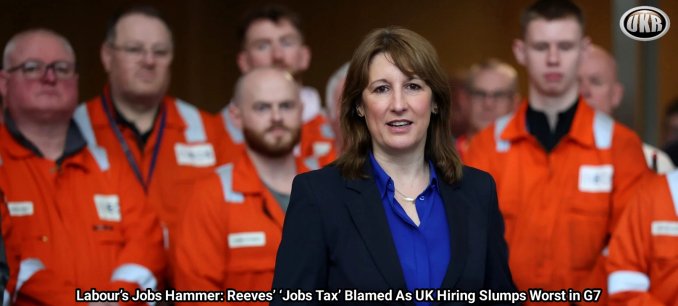
LABOUR’S JOBS HAMMER: Reeves’ ‘jobs tax’ blamed as UK hiring slumps worst in G7
CP
Rachel Reeves has been accused of hammering jobs after new figures showed Britain has suffered the biggest hiring slump in the G7 following Labour’s first Budget.
Data from recruitment platform Indeed reveal that new job adverts in the UK have plunged by 12.3 per cent since the Chancellor delivered her maiden Budget in late October last year.
The fall is by far the steepest among comparable G7 nations, underlining how Britain has been left trailing its peers under Labour’s tax-and-spend agenda. Comparable figures were not available for Japan.
Economists say the collapse in hiring confidence has been driven directly by Labour policies that make employing staff more expensive.
Jack Kennedy, a senior economist at Indeed, pointed the finger squarely at Ms Reeves’s decisions.
He told the Telegraph: “There are really three policy drivers to that. The employer National Insurance contribution increase was obviously pretty consequential. We’ve had fairly large minimum wage increases and the Employment Rights Act. It’s a triple whammy that’s been contributing to that caution.”
Indeed’s measure looks at job postings that are no more than a week old, acting as a proxy for new hiring. It shows a sharp drop since October 2024, when Labour took charge of the economy.
Other major economies have seen far smaller falls. Vacancies are down 5.4pc in Germany, 4.4pc in France, and 3.2pc in the US. Italy has seen a 1.9pc drop, while Canada recorded a 9.9pc decline. Across the euro area as a whole, hiring is down 4.5pc.
Recruiters say the figures confirm Britain is now stuck in a “hiring recession”, with jobseekers facing uniquely tough conditions.
Before the Budget, bosses warned Labour’s plans to hike employers’ National Insurance would act as a “jobs tax”. Those warnings now look prescient.
Firms have been hit with a £26bn tax raid, an inflation-busting rise in the minimum wage, and a further 4pc increase to £12.71 an hour in April. The UK now has one of the highest minimum wages in the world.
The impact has been especially brutal for sectors such as hospitality and retail, which rely heavily on low-paid and part-time staff.
Mr Kennedy said: “In the UK, we’ve now got low-wage jobs trending weaker than high-wage jobs, which is really quite contrasting to what we see in other European economies. In France, Germany and Italy, low-wage job postings are still holding up better.
That certainly speaks to the pressures that sectors that employ fairly large numbers of low-wage workers have been facing. For me, that’s quite a telling data point.”
Indeed’s international data also show Britain performing worse than other wealthy countries outside the G7. Hiring fell just 1.2pc in the Netherlands and 2.5pc in Ireland, while it surged 18pc in Spain and rose 1.5pc in Australia.
The grim figures directly contradict Ms Reeves’s recent claims in Parliament that she is boosting hiring and helping young people into work. The Chancellor has also insisted there is no link between her employer tax rises and rising joblessness.
In reality, unemployment has climbed to a near five-year high of 5.1 per cent, redundancies are at their highest since Covid, and the economy shrank by 0.1pc in October, having flatlined since May.
Surveys suggest young people and graduates are being hit hardest by the hiring freeze.
Mr Kennedy said lower interest rates could offer some relief after the Bank of England cut rates to 3.75pc, but warned against expecting a quick turnaround.
He said: “Hopefully, interest rate cuts will continue in 2026, as long as inflation continues to subside. We probably would hope to see a little bit more confidence in the market, but I don’t really see an imminent, strong recovery. Really, what we need to see is clearly more growth in the economy.”
For now, critics say Labour’s economic experiment is leaving Britain with fewer jobs, weaker growth and workers paying the price.
This article (LABOUR’S JOBS HAMMER: Reeves’ ‘jobs tax’ blamed as UK hiring slumps worst in G7) was created and published by Conservative Post and is republished here under “Fair Use” with attribution to the author CP
See Related Article Below
Reeves’s Job Taxes Trigger Biggest Hiring Slump in the G7
Rachel Reeves’s job tax raid and inflation-busting minimum wage increases have triggered the biggest hiring slump in the G7 – and this is before Labour’s jobs-destroying Employment Rights Act comes into force, ‘banter ban’ and all. The Telegraph has more.
Figures from recruitment platform Indeed show that the number of new job adverts posted in the UK has fallen by 12.3% since the Chancellor’s first Budget in late October last year.
This is by far the most severe drop among G7 countries, though comparable data were not available for Japan.
Jack Kennedy, a senior economist at Indeed, said the Chancellor’s policies helped explain why the UK’s job market had weakened so much more than those of other wealthy countries.
Mr Kennedy said: “There are really three policy drivers to that. The employer National Insurance contribution increase was obviously pretty consequential. We’ve had fairly large minimum wage increases and the Employment Rights Act. It’s a triple whammy that’s been contributing to that caution.”
The number of job postings no more than a week old when recorded has fallen by 12.3% in the UK compared with October 2024, when the Labour Government delivered its first Budget. The measure serves as a proxy for new hiring and indicates a marked decline.

Vacancies have fallen by 5.4% in Germany and 4.4& in France over the same period. In the US, new job adverts fell 3.2% over the same period; in Italy, 1.9%; and in Canada, 9.9%. Across the euro area as a whole, new hiring fell 4.5%.
The stark numbers underline just how uniquely challenging the situation is for jobseekers in the UK. Recruiters have described the prolonged downturn in vacancies as a “hiring recession”.
Bosses warned ahead of Ms Reeves’s first Budget that plans to raise employers’ National Insurance contributions would amount to a “jobs tax” that would put people off hiring. Employers have been hit with a £26 billion tax rise, an inflation-busting minimum wage increase and a further 4% jump to £12.71 in April.
The changes have made hiring significantly more expensive, especially for industries that rely on low-wage and part-time workers, such as hospitality and retail. The UK now has one of the highest minimum wages in the world.

Mr Kennedy said: “In the UK, we’ve now got low-wage jobs trending weaker than high-wage jobs, which is really quite contrasting to what we see in other European economies. In France, Germany and Italy, low-wage job postings are still holding up better.
“That certainly speaks to the pressures that sectors that employ fairly large numbers of low-wage workers have been facing. For me, that’s quite a telling data point.”
Indeed also tracks new job adverts in several other rich countries outside of the G7. None has experienced a hiring downturn on the same scale as in the UK.
The Netherlands and Ireland registered much smaller declines of 1.2% and 2.5% respectively. In Spain, hiring was up 18% over the same period, while in Australia it was up 1.5%.
Indeed’s figures contradict the Chancellor’s recent claim in Parliament that she was boosting hiring and helping young people enter the workforce. Ms Reeves also argued there was no link between her tax rises on employers and the recent increase in joblessness.
Unemployment has now risen to an almost five-year high of 5.1%, while redundancies are at their highest since Covid.
Meanwhile, the British economy shrank by 0.1% in October and has effectively flatlined since May.
Worth reading in full.
Featured image: The Daily Sceptic


Leave a Reply