James Cartlidge is Shadow Defence Secretary, and MP for South Suffolk
For any European NATO member, including the UK, I’d argue that the biggest challenge in Defence is the end of the ‘dependency era’.
I mean this in two ways: first, the hard economic reality that the expansion of welfare spending cannot go on; secondly, the hard military reality that we, and especially our NATO allies, cannot keep depending on the US to keep us free and safe.
The linkage should be all too clear: the self-evident priority under successive US administrations to focus on China means the rest of NATO needs to substantially increase defence spending, in order to bear a greater burden of deterring the threat that is closest to home – Putin’s ceaseless belligerence.
But that money has to come from somewhere.
Much has happened in the MOD brief since the election – from the bombing of Iranian nuclear facilities and attacks on Royal Naval vessels in Red Sea, to the India-Pakistan flare up, and above all, Putin’s ‘peace’ mirage and the ongoing brutality of the war he alone provoked, which last week reached NATO’s door.
But on the domestic front, whilst the publication of Labour’s Strategic Defence Review (SDR) was meant to be the defining moment for Defence this Parliament, I would suggest that Keir Starmer’s total U-turn on welfare reform was far more significant. At a stroke, he undermined the fiscal discipline of a government with a huge majority and called into question Labour’s fundamental ability to get a grip on the public finances, without which new cash for Defence will surely be far harder to deliver in practice.
In response, Labour would argue that they are increasing defence spending right up to 5 per cent of GDP – a level not seen since 1985.
Unfortunately, most of this increase is either wholly unfunded, or consists of the rebadging of other non-Defence spending that will not buy a single bullet, but which will be cynically used to make the amount we spend on the military look far bigger than it really is.
The rise to 5 per cent on ‘national security’ is over a decade, with 1.5 per cent of it ‘resilience and security’ spending drawn from other departments – for all we know this could include the DEFRA budget (food security) and civil nuclear (energy security). What this would not amount to is the 5 per cent on actual defence we saw in 1985, delivering 334,000 military personnel; hundreds of combat planes for the RAF; and tactical nuclear options in every domain.
But what of the promises on ‘core’ defence spending – the remaining bit after the 1.5 per cent so called ‘resilience and security’ element. In theory, this rises to 2.6 per cent in 2027/28; 3 per cent in the next Parliament and 3.5 per cent in the one after that.
The problem is, 3 per cent is an ‘ambition’ and 3.5 per cent is too far away to be taken seriously.
For neither figure is there an actual funded plan in the Treasury – not so much ambitions as wishful thinking. Like me, John Healey has been a Minister in both the MOD and HMT, and he will know perfectly well that the only spending pathway he can rely on is one which has been signed off by the Treasury.
But it is true that there is a plan, laid out in the spending review, to get to 2.6 per cent by 2027 and then stick there till 2029.
And yet, there’s another big problem with using this GDP figure. 2.6 per cent, 3 per cent, 3.5 per cent and 5 per cent – they all refer to our planned ‘NATO declared’ spending on Defence. None of them refer to the budget that really matters – the envelope of expenditure we have to fund the future capability of our armed forces.
The raw numbers determining our spend on future capability used to be known as the ‘Equipment Plan’, containing the full detail of all MOD spending on kit for the next decade. Labour haven’t yet published an Equipment Plan, but they have renamed it the ‘Defence Investment Plan’, or simply, the DIP. Labour’s first DIP is promised by Christmas recess.
Given that the DIP’s decade view will cover staggered rises in nominal defence spending, in a recent written question I asked what funding envelope – 2.6 per cent, 3 per cent or 3.5 per cent – would be used to determine the DIP’s budget. The answer: the amount spent on the DIP will be determined by “the MOD’s share of the Government’s commitment to spending 2.6 per cent of GDP on defence by 2027”.
The words ‘MOD’s share’ are critical. In a separate written question, I asked what the percentage of GDP would be for the actual MOD budget, rather than our declared NATO spend.
The answer for 2027 is 2.2 per cent. This means that 2.2 per cent of GDP – not 2.6 per cent, and certainly not 3 per cent or 3.5 per cent of GDP, let alone 5 per cent – will be the figure that actually determines the future defence spending that matters most.
Now, readers would rightly say that successive Governments have had a higher figure for overall ‘Defence spending’ (that which we declare to NATO) compared to the MOD budget. However, the gap between the MOD budget and the NATO figure has never been so big. By 2027 the gap will be 0.4 per cent of GDP, greater than any year since 2010, and happening at a time when the threat level is the most elevated, we’ve seen since the cold war.
With Putin’s drones threatening Polish airspace, putting NATO on full operational alert, you would have thought all possible resource would be going to the frontline – real cash, made by making difficult political decisions, driven by the absolute priority of Defence, supposedly the number one duty of any Government.
Instead, defence spending is growing in large part through smoke and mirrors, inflated by Treasury tricks, not actual cash. For example, in 2027 the entire Intelligence budget worth £5.1bn will be added to the Defence figure declared to NATO. But, unless I am much mistaken, none of that money will be used to fund urgent capability priorities like munitions replenishment or missile defence.
And all this at a time when procurement has been largely on hold since the election. The one step Labour could take that would have the greatest short-term impact on the lethality of our Army is also probably the one which would be cheapest and fastest – placing an order for drones from UK SMEs, to enable training in uncrewed warfare across our land forces. But all the talk at DSEI this week confirmed that our UK drone SMEs are just waiting and waiting for orders.
The current priority is penny-pinching, so not even orders for drones costing the low millions are taking place; but the future offers little better, given the actual reality of the MOD’s spending path.
So, I’m delighted that Kemi Badenoch has offered to work with the Prime Minister to deliver welfare reform, ‘in the national interest’. To build resilience rather than growing the dependency culture; to give a breathing space for our productive sector from the threat of ever higher taxes; and, above all, to deliver the kind of discipline on public spending without which adequate funding for Defence will remain an ambition, not a reality.
This article (James Cartlidge: Labour’s commitments on defence spending are smoke, mirrors and wishful thinking) was created and published by Conservative Home and is republished here under “Fair Use” with attribution to the author James Cartlidge MP
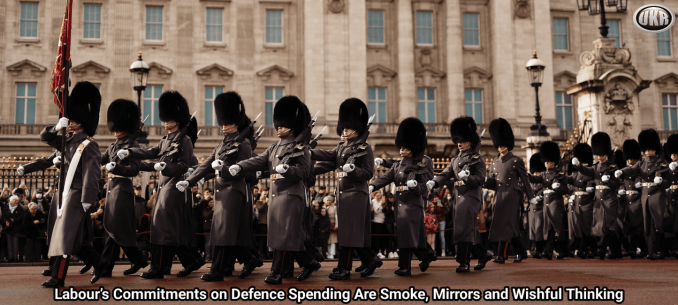
Featured image: Alamy





James Cartlidge is Shadow Defence Secretary, and MP for South Suffolk
For any European NATO member, including the UK, I’d argue that the biggest challenge in Defence is the end of the ‘dependency era’.
I mean this in two ways: first, the hard economic reality that the expansion of welfare spending cannot go on; secondly, the hard military reality that we, and especially our NATO allies, cannot keep depending on the US to keep us free and safe.
The linkage should be all too clear: the self-evident priority under successive US administrations to focus on China means the rest of NATO needs to substantially increase defence spending, in order to bear a greater burden of deterring the threat that is closest to home – Putin’s ceaseless belligerence.
But that money has to come from somewhere.
Much has happened in the MOD brief since the election – from the bombing of Iranian nuclear facilities and attacks on Royal Naval vessels in Red Sea, to the India-Pakistan flare up, and above all, Putin’s ‘peace’ mirage and the ongoing brutality of the war he alone provoked, which last week reached NATO’s door.
But on the domestic front, whilst the publication of Labour’s Strategic Defence Review (SDR) was meant to be the defining moment for Defence this Parliament, I would suggest that Keir Starmer’s total U-turn on welfare reform was far more significant. At a stroke, he undermined the fiscal discipline of a government with a huge majority and called into question Labour’s fundamental ability to get a grip on the public finances, without which new cash for Defence will surely be far harder to deliver in practice.
In response, Labour would argue that they are increasing defence spending right up to 5 per cent of GDP – a level not seen since 1985.
Unfortunately, most of this increase is either wholly unfunded, or consists of the rebadging of other non-Defence spending that will not buy a single bullet, but which will be cynically used to make the amount we spend on the military look far bigger than it really is.
The rise to 5 per cent on ‘national security’ is over a decade, with 1.5 per cent of it ‘resilience and security’ spending drawn from other departments – for all we know this could include the DEFRA budget (food security) and civil nuclear (energy security). What this would not amount to is the 5 per cent on actual defence we saw in 1985, delivering 334,000 military personnel; hundreds of combat planes for the RAF; and tactical nuclear options in every domain.
But what of the promises on ‘core’ defence spending – the remaining bit after the 1.5 per cent so called ‘resilience and security’ element. In theory, this rises to 2.6 per cent in 2027/28; 3 per cent in the next Parliament and 3.5 per cent in the one after that.
The problem is, 3 per cent is an ‘ambition’ and 3.5 per cent is too far away to be taken seriously.
For neither figure is there an actual funded plan in the Treasury – not so much ambitions as wishful thinking. Like me, John Healey has been a Minister in both the MOD and HMT, and he will know perfectly well that the only spending pathway he can rely on is one which has been signed off by the Treasury.
But it is true that there is a plan, laid out in the spending review, to get to 2.6 per cent by 2027 and then stick there till 2029.
And yet, there’s another big problem with using this GDP figure. 2.6 per cent, 3 per cent, 3.5 per cent and 5 per cent – they all refer to our planned ‘NATO declared’ spending on Defence. None of them refer to the budget that really matters – the envelope of expenditure we have to fund the future capability of our armed forces.
The raw numbers determining our spend on future capability used to be known as the ‘Equipment Plan’, containing the full detail of all MOD spending on kit for the next decade. Labour haven’t yet published an Equipment Plan, but they have renamed it the ‘Defence Investment Plan’, or simply, the DIP. Labour’s first DIP is promised by Christmas recess.
Given that the DIP’s decade view will cover staggered rises in nominal defence spending, in a recent written question I asked what funding envelope – 2.6 per cent, 3 per cent or 3.5 per cent – would be used to determine the DIP’s budget. The answer: the amount spent on the DIP will be determined by “the MOD’s share of the Government’s commitment to spending 2.6 per cent of GDP on defence by 2027”.
The words ‘MOD’s share’ are critical. In a separate written question, I asked what the percentage of GDP would be for the actual MOD budget, rather than our declared NATO spend.
The answer for 2027 is 2.2 per cent. This means that 2.2 per cent of GDP – not 2.6 per cent, and certainly not 3 per cent or 3.5 per cent of GDP, let alone 5 per cent – will be the figure that actually determines the future defence spending that matters most.
Now, readers would rightly say that successive Governments have had a higher figure for overall ‘Defence spending’ (that which we declare to NATO) compared to the MOD budget. However, the gap between the MOD budget and the NATO figure has never been so big. By 2027 the gap will be 0.4 per cent of GDP, greater than any year since 2010, and happening at a time when the threat level is the most elevated, we’ve seen since the cold war.
With Putin’s drones threatening Polish airspace, putting NATO on full operational alert, you would have thought all possible resource would be going to the frontline – real cash, made by making difficult political decisions, driven by the absolute priority of Defence, supposedly the number one duty of any Government.
Instead, defence spending is growing in large part through smoke and mirrors, inflated by Treasury tricks, not actual cash. For example, in 2027 the entire Intelligence budget worth £5.1bn will be added to the Defence figure declared to NATO. But, unless I am much mistaken, none of that money will be used to fund urgent capability priorities like munitions replenishment or missile defence.
And all this at a time when procurement has been largely on hold since the election. The one step Labour could take that would have the greatest short-term impact on the lethality of our Army is also probably the one which would be cheapest and fastest – placing an order for drones from UK SMEs, to enable training in uncrewed warfare across our land forces. But all the talk at DSEI this week confirmed that our UK drone SMEs are just waiting and waiting for orders.
The current priority is penny-pinching, so not even orders for drones costing the low millions are taking place; but the future offers little better, given the actual reality of the MOD’s spending path.
So, I’m delighted that Kemi Badenoch has offered to work with the Prime Minister to deliver welfare reform, ‘in the national interest’. To build resilience rather than growing the dependency culture; to give a breathing space for our productive sector from the threat of ever higher taxes; and, above all, to deliver the kind of discipline on public spending without which adequate funding for Defence will remain an ambition, not a reality.
This article (James Cartlidge: Labour’s commitments on defence spending are smoke, mirrors and wishful thinking) was created and published by Conservative Home and is republished here under “Fair Use” with attribution to the author James Cartlidge MP
Featured image: Alamy