


CP
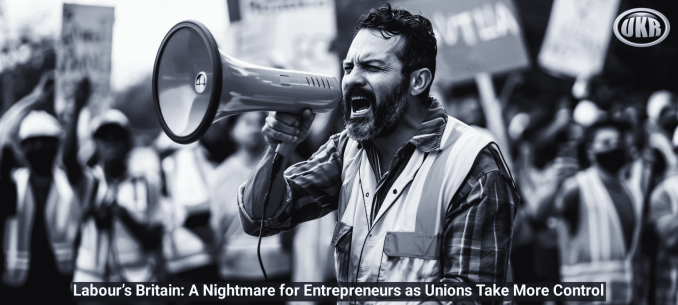
Britain’s small business owners are reeling after the Labour Government is pushing through sweeping changes to employment law, handing unprecedented power to trade unions.
The move, which enhances union influence over hiring, firing, and workplace regulations, has been met with celebration by union leaders – and outright despair from businesses.
The latest amendments to the Employment Rights Bill have triggered alarm among entrepreneurs and industry groups. The Federation of Small Businesses (FSB) has sounded the alarm, warning that the changes will have devastating effects on business confidence and hiring decisions.
“Two-thirds of small businesses are deciding that they’re not going to take on any future employees. About a third are saying they might reduce their workforce as a result of these changes… these will have really damaging effects, and if the government wants the economy to grow, they need small businesses on their side,” an FSB spokesperson cautioned.
Instead of supporting job creation and economic growth, Labour’s amendments are tying employers’ hands with layers of new red tape and restrictions. From banning workers from starting jobs before a union recognition ballot to doubling the protective period for ‘fire and rehire’ from 90 to 180 days, the measures prioritise union interests over business viability. The requirement for agencies to offer fixed-hour contracts instead of zero-hours arrangements will further undermine flexibility, a key element for many industries.
Unions Tighten Their Grip
Labour’s determination to empower the unions is evident in every line of the new amendments. Among the most controversial changes is the expansion of union ‘access provisions,’ allowing officials to enter digital workspaces like Slack and company intranets.
Another change has stunned business leaders: employers are now banned from hiring workers prior to a union recognition vote, a move unions argue prevents bosses from ‘flooding’ the workforce with anti-union staff. But with no cap on how low the recognition threshold can be, reports suggest as little as 2% of employees could trigger unionisation, forcing companies into union control with little say.
Labour has also removed the requirement for unions to prove that an ‘unfair practice’ influenced ballot outcomes, extending complaint deadlines from 24 hours to five days. This will likely open the floodgates for challenges against businesses, further deterring employers from expanding their workforce.
Punishing Business, Stifling Growth
In its previous form, the bill was already expected to cost businesses a staggering £5 billion. With these latest additions, companies are left wondering how much further they will be squeezed.
Employers also face increased surveillance under the new Fair Work Agency, which has been handed expanded powers, including the right to carry out covert investigations, access company data, and demand compliance with undefined ‘fair work’ practices. With vague guidelines and an empowered union watchdog breathing down their necks, business owners fear an era of regulatory overreach.
The changes are already having a chilling effect. “With these laws, it’s simply not worth hiring new staff. The risk is too high, the cost is too much, and the government seems determined to side against business at every turn,” one small business owner told the Conservative and Reformer Post.
Another business owner said: “We lost a couple of employees in January and I’m not replacing them. In fact I’m thinking of closing the business down. We’re only a team of nine now but we’ve been in business for 12 years. It’s sad my team are going to lose their jobs. But I can’t bear this Labour lot. To be honest we can’t afford the National Insurance rises let alone all this other stuff now. I think I might close up shop and head abroad for a few years. Who would want to be a business owner or entrepreneur in Labour run Britain?”
More Red Tape, Less Hiring
The amendments come as Labour pushes ahead with its ideological mission to dismantle business autonomy. A former Conservative MP said: “With no one in the Cabinet having ever run a business, it is no surprise that these changes reflect a fundamental misunderstanding of what it takes to create jobs and drive economic growth.
“Instead of fostering an environment that encourages investment, Labour’s new laws will see entrepreneurs holding back, hiring freezes implemented, and businesses looking to offshore their operations or automate roles wherever possible.”
The consequences of these reforms will be severe. At a time when Britain needs dynamic growth and innovation, Labour has chosen to burden businesses with regulation after regulation, ensuring that for many, entrepreneurship in the UK is simply no longer worth the risk.
Unions may be celebrating today – but for Britain’s job creators, the future under Labour looks bleak and will be felt across the country.
This article (Labour’s Britain: A Nightmare for Entrepreneurs as Unions Take More Control) was created and published by Conservative Post and is republished here under “Fair Use” with attribution to the author CP
See Related Article Below
Labour Enhances Trade Union Powers With Changes to Employment Rights Bill
GUIDO FAWKES
While everyone in SW1 is busy issuing a statement on JD Vance the government’s consultation response for its Employment Rights Bill has enhanced trade union powers and further punishes employers. Here are the key measures that will now come in via amendment:
- Agencies will be forced to offer workers a fixed-hours contract instead of zero hours.
- Parents given two weeks of bereavement leave after suffering a miscarriage before 24 weeks’ gestation. Already exists for after this point.
- Employers banned from bringing on workers prior to union recognition ballots. Unions claim that businesses ‘flood’ themselves to vote against them…
- ‘Streamlining the trade union recognition process.’ This is vague – there are rumours the requirement could be as low as 2% of employees seeking unionisation…
- ‘Fire and rehire’ protective period doubled from 90 to 180 days.
- Sick pay for those earning under £123 set at 80% of wages. Highest of three possible proposals…
- Fair Work Agency given extra powers including carrying out covert surveillance and intelligence and accessing communication data.
- New “fixed timeline for employers and trade unions to agree access arrangements for recognition purpose.“
- Requirement removed for unions to prove that an ‘unfair practice’ influenced voting behaviour in a ballot. No real details here either…
- Extending the unfair practice complaint timeframe from 24 hours to 5 days.
- Independent unions can apply for recognition “where an employer has voluntarily recognised a non-independent union following receipt of a formal request for voluntary recognition by the independent union.“
- Extension of trade union ‘access provisions’ which includes to digital spaces. The union official enters the company Slack chat…
- Ten-year ballot for trade union renewal vote for use of political funds removed. More cash to splash…
- “Simplify” information requirement for a strike ballot and notice to employers. So less information…
- Extension of the expiry of the mandate for strike action from six to 12 months. More strike mandates – unions laughing at this one…
The bill in its previous form was estimated to cost businesses £5 billion. There is no roll-back on day one protections and the “fire and rehire” ban, which businesses warned strongly against. They also warned against the extensive empowerment of the unions. Which has been enlarged in this latest stage…
Unions are celebrating while businesses express dismay at the enhancements to the bill. The Federation of Small Businesses points out “two thirds of small businesses are deciding that they’re not going to take on any future employees. About a third are saying they might reduce their workforce as a result of these changes… these will have really damaging effects and if the government wants the economy to grow they need small businesses on their side.” Just as Starmer claims SMEs will re-arm the nation…
Wonks aren’t happy either. Len Shackleton, Editorial and Research Fellow at the IEA and Professor of Economics at the University of Buckingham, tells Guido:
“It seems likely that unions representing a small number of employees will have rather greater power. This may mean more strikes, but not necessarily: the threat of strikes is itself enough to boost bargaining power and induce employers to make higher pay offers – which may be inflationary and/or discourage the expansion of employment. Unions will be better able to resist change – for example on the railways, where the productivity record is already abysmal and there is chronic overstaffing in some areas.”
Karl Williams, Centre for Policy Studies Research Director, attacks the zero-hours changes and tells Guido:
“Workers on zero-hours contracts often value the flexibility to accept shifts as and when. For agency staff, who work across a number of different sites and in different roles, this is even more critical. Labour speak as though they understand growth and then act in ways which seem designed to inhibit employment, not unlock it.”
Labour did call the draft of the bill the Employment Rights (Union) Bill. Anyone going to do a growth mission check on this one?
This article (Labour Enhances Trade Union Powers With Changes to Employment Rights Bill) was created and published by Guido Fawkes and is republished here under “Fair Use”

••••
The Liberty Beacon Project is now expanding at a near exponential rate, and for this we are grateful and excited! But we must also be practical. For 7 years we have not asked for any donations, and have built this project with our own funds as we grew. We are now experiencing ever increasing growing pains due to the large number of websites and projects we represent. So we have just installed donation buttons on our websites and ask that you consider this when you visit them. Nothing is too small. We thank you for all your support and your considerations … (TLB)
••••
Comment Policy: As a privately owned web site, we reserve the right to remove comments that contain spam, advertising, vulgarity, threats of violence, racism, or personal/abusive attacks on other users. This also applies to trolling, the use of more than one alias, or just intentional mischief. Enforcement of this policy is at the discretion of this websites administrators. Repeat offenders may be blocked or permanently banned without prior warning.
••••
Disclaimer: TLB websites contain copyrighted material the use of which has not always been specifically authorized by the copyright owner. We are making such material available to our readers under the provisions of “fair use” in an effort to advance a better understanding of political, health, economic and social issues. The material on this site is distributed without profit to those who have expressed a prior interest in receiving it for research and educational purposes. If you wish to use copyrighted material for purposes other than “fair use” you must request permission from the copyright owner.
••••
Disclaimer: The information and opinions shared are for informational purposes only including, but not limited to, text, graphics, images and other material are not intended as medical advice or instruction. Nothing mentioned is intended to be a substitute for professional medical advice, diagnosis or treatment.
Disclaimer: The views and opinions expressed in this article are those of the author and do not necessarily reflect the official policy or position of The Liberty Beacon Project.


Leave a Reply