

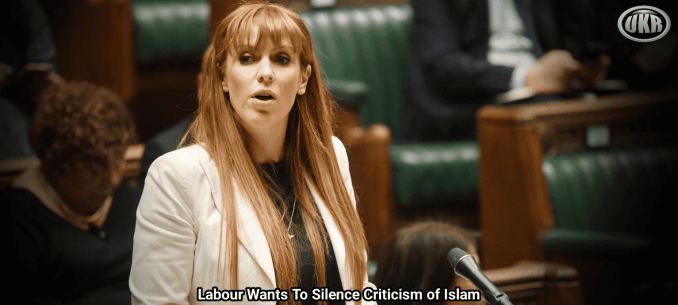
Angela Rayner’s secretive working group on Islamophobia has free speech in its crosshairs.
FREDDIE ATTENBOROUGH
Would you ask a panel of committed vegans to provide objective, balanced advice on a national dietary policy? Only if you were looking for an entirely biased response. Yet this is effectively what the British government is doing on the question of whether the public should be free to criticise Islam.
This is why the Free Speech Union (FSU) recently wrote to deputy prime minister Angela Rayner. In particular, the FSU is alaramed about the government’s new ‘Working Group on Anti-Muslim Hatred and Islamophobia’ – a miniature Labour quango tasked with articulating an ‘official’ definition of Islamophobia. It should concern anyone concerned about free speech.
Chaired by former Conservative MP and attorney general Dominic Grieve KC, the working group is marked by secrecy and ideological rigidity. Its terms of reference make clear that the advice it gives to ministers will remain private and unpublished – in direct contravention of the government’s own code of conduct. And the group’s members clearly believe ‘Islamophobia’ – that is, the criticism of Islam and related practices – represents a unique threat to British society. It is a recipe for censorship.
There are also serious concerns about the way the group has gone about ‘consulting’ the public. For example, a recent ‘call for evidence’ on Islamophobia was launched without notice, and only came to light after being leaked. Unsurprisingly, the consultation was skewed towards a pre-determined outcome – in this case, a definition mirroring that which the All-Party Parliamentary Group (APPG) on British Muslims cooked up in 2018. This defined Islamophobia as ‘rooted in racism and target[ing] expressions of Muslimness or perceived Muslimness’. It isn’t hard to see where the working group is going.
Unsurprisingly, the consultation provided no invitation for those concerned about how a government-sponsored definition of Islamophobia might impact free speech. Groups such as Christian Concern, Don’t Divide Us, the Council of Ex-Muslims of Britain and the Oxford Institute for British Islam – among many others – were all ignored by the working group.
You might think that conduct like this points to a distinct lack of objectivity on the part of the working group. And, dig a little deeper, and that is exactly what you will find. Of the five members whose names are publicly known, most have either endorsed the APPG definition or made statements closely aligned with its assumptions.
Grieve, for instance, was directly involved in the APPG’s 2018 report, authoring the foreword. He described it as ‘an important contribution to the debate as to how Islamophobia can best be addressed’. Another group member, Akeela Ahmed, who co-chairs the British Muslim Network, was cited in the same report calling for a definition ‘with legal power’ that could be ‘implemented by the government and the police’.
Most alarming is the presence of Baroness Shaista Gohir among the working group’s members. Not only has she publicly endorsed the APPG’s definition, she has authored a report linking ‘Islamophobia’ to the media reporting on the grooming-gangs scandal. The ‘disproportionate media coverage being given to British Pakistani offenders’, she argued in 2013, enabled ‘right-wing populist groups’ to exploit the issue to ‘fuel racism and Islamophobia’.
The attempt to recast criticism of Islamic beliefs and practices as a form of racial hostility raises the stakes considerably. Why? Because British law currently makes a clear distinction between the two. What is known as the ‘Waddington Amendment’ of the Public Order Act 1986 explicitly protects the right to criticise religion. It states that ‘nothing in this part’ should be interpreted as prohibiting ‘discussion, criticism or expressions of antipathy, dislike, ridicule, insult or abuse of particular religions or the beliefs or practices of their adherents’.
Adopting the APPG definition – and it’s hard to see the working group coming up with something radically different – would have a chilling effect on free speech. It would deter people from raising legitimate concerns about Islamist extremism, grooming gangs, even immigration, for fear they would be deemed racist. Its effect would be a modern-day blasphemy law, dressed up in the language of policing ‘hate speech’. Worse still, this is being developed behind closed doors, based on evidence gathered from a gerrymandered list of respondents, in a process overseen by an entirely unelected body.
Under Labour, the UK has enough problems as it is. The last thing we need is for blasphemy laws to be smuggled on to the statute books without any of us realising.
Freddie Attenborough is the digital communications director of the Free Speech Union.
www.spiked-online.com/2025/06/30/labour-wants-to-silence-criticism-of-islam/
See Related Article Below
Rayner faces legal challenge over ‘secret’ Islamophobia talks
Plans to revive a controversial racism definition risks ‘chilling’ effect on free speech, say campaigners
Angela Rayner faces a legal challenge over “secretive” plans to revive a definition of Islamophobia that will have a “chilling” effect on free speech.
The Free Speech Union (FSU) said the process would rubber-stamp a controversial definition of Islamophobia, which Labour would then adopt. The definition, which treats Islamophobia as a type of racism, has been criticised for being too widely drawn.
The FSU has written to the Deputy Prime Minister expressing concern the new definition is being drawn up behind closed doors.
The definition, which treats Islamophobia as a type of racism, has been criticised for being so expansive that it could threaten free speech, act as a de facto blasphemy law, and stifle legitimate criticism of Islam as a religion.
Lord Young of Acton, the FSU’s director, said: “The Free Speech Union is concerned that the rush to proscribe ‘Islamophobia’ will have a chilling effect on free speech.
“If the Deputy Prime Minister presses ahead, we won’t hesitate to bring a judicial review in the High Court, as we have with other decisions of this Government.”
In his letter, Lord Young said the consultation questions appeared “heavily weighted” in favour of a “predetermined outcome”, endorsing a definition “closely aligned” with that put forward by the all party parliamentary group (APPG) on British Muslims.
This was adopted by Labour and stated that “Islamophobia is rooted in racism and is a type of racism that targets expressions of Muslimness or perceived Muslimness.”
Lord Young said: “The consultation questions appear exclusively focused on justifying the adoption of a standard definition of Islamophobia, and on exploring the extent to which Islamophobia should be classified as a form of racism.
“There are no questions inviting concerns about potential impacts on the right to freedom of speech, nor does the call for evidence actively seek out alternative perspectives.”
Key groups that would challenge the impact on free speech and provide alternative views had not been invited to submit evidence – such as Christian Concern, The Christian Institute, Adam Smith Institute, and Equality and Human Rights Commission, said Lord Young.
‘Non-transparency and avoidance of accountability’
Most – if not all – of the five members of the working group had explicitly supported the controversial APPG definition of Islamophobia, including its chair Dominic Grieve, the former attorney general, who wrote a foreword for the APPG report.
Lord Young expressed concern that the working group’s advice to ministers will be kept secret. “Any attempt to refuse to disclose advice from the working group will indicate that scrutiny is not welcome on a topic that is fundamental to social cohesion and the rights of citizens,” he said.
“Any apparent or perceived bias will undermine confidence in the working group’s advice, which will be further exacerbated in circumstances where the advice is not published.”
Lord Young warned the secrecy and apparent exclusion of groups from the consultation risked breaching the Government’s principles and engagement standards, which govern the working group.
“Non-transparency and avoidance of accountability will undermine the legitimacy of the working group,” he added.
The Telegraph: continue reading
Featured image: metro.co.uk

••••
The Liberty Beacon Project is now expanding at a near exponential rate, and for this we are grateful and excited! But we must also be practical. For 7 years we have not asked for any donations, and have built this project with our own funds as we grew. We are now experiencing ever increasing growing pains due to the large number of websites and projects we represent. So we have just installed donation buttons on our websites and ask that you consider this when you visit them. Nothing is too small. We thank you for all your support and your considerations … (TLB)
••••
Comment Policy: As a privately owned web site, we reserve the right to remove comments that contain spam, advertising, vulgarity, threats of violence, racism, or personal/abusive attacks on other users. This also applies to trolling, the use of more than one alias, or just intentional mischief. Enforcement of this policy is at the discretion of this websites administrators. Repeat offenders may be blocked or permanently banned without prior warning.
••••
Disclaimer: TLB websites contain copyrighted material the use of which has not always been specifically authorized by the copyright owner. We are making such material available to our readers under the provisions of “fair use” in an effort to advance a better understanding of political, health, economic and social issues. The material on this site is distributed without profit to those who have expressed a prior interest in receiving it for research and educational purposes. If you wish to use copyrighted material for purposes other than “fair use” you must request permission from the copyright owner.
••••
Disclaimer: The information and opinions shared are for informational purposes only including, but not limited to, text, graphics, images and other material are not intended as medical advice or instruction. Nothing mentioned is intended to be a substitute for professional medical advice, diagnosis or treatment.
Disclaimer: The views and opinions expressed in this article are those of the author and do not necessarily reflect the official policy or position of The Liberty Beacon Project.


I have written one called “Hitler goes to Glastonbury”.Which might be topiocal.Can i send it by post ?
Hi Stuart. You can email it to [email protected]. Thanks!
I have written some topical whimseys which i think are relevent.But i havent the time to type them out.