
MAURICE GLASMAN
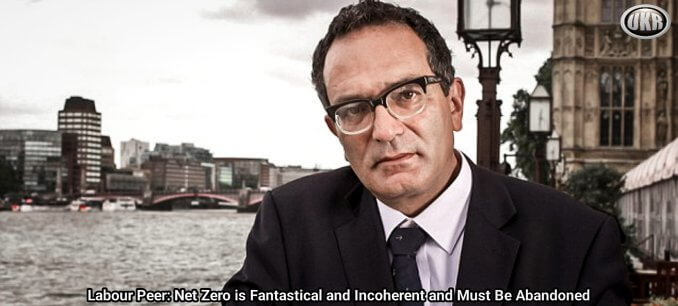
This is the text of Lord Glasman’s recent speech to the Global Warming Policy Foundation (watch here). To understand the first part, you need to know that the current Chair of the GWPF is Lord Mackinlay, formerly Craig Mackinlay MP, who had all his limbs amputated following a battle with sepsis, but who is nevertheless an active (and extremely mobile) member of the House of Lords.
Thank you for your invitation to speak here tonight. The story of my acceptance is a good lesson in the limits of liberalism and of choice. The best way to tell the story is that all I knew was that there was a man, with prosthetic arms and legs, who walked around Parliament with resolution and purpose. I had no idea who he was. All I knew was that I loved him for the strength of his stride. The fact that I had no idea of who he was tells you rather more about me than I would wish you to know. That I don’t read newspapers or watch the television. As a politician I am deeply aware that journalists, on the whole, have no idea what they’re talking about and the ones that do ring me up. If it’s important I’ll hear about it and I prefer to waste my time in other ways.
From the moment I saw Craig, I was stirred by instant admiration. I did have a couple of ideas as to who he might be. One was that he was a Brigadier in the Afghan war and had his limbs blown off extirpating a Taliban cell in a distant outpost of the Kandahar hills.
He only lost consciousness after the mission was successful and his first words on emerging from multiple amputations was “when can I return?” I detected something military in his gait, but I was wrong. The second scenario was that he was an Ulsterman who was nearly killed by an IRA bomb and was in Parliament in order to ensure that no further concessions were made. I love the Armed Forces and the people of Ulster so, whichever one of those two were true, I only loved him more. And imagine that this man, who had in my mind reached the status of a Parliamentary superhero, let’s call him ‘Prosthetic Man’, so to speak, walks up to me and asks me if I would give a talk to his foundation, which I immediately assume is some kind of military veterans thing. How can the idea of choice have any role? I was obliged to say yes.
Certain alarm bells started ringing in my inner ear when he said the words Global Warming Policy Foundation, but what are alarm bells compared to the heavenly chorus of the angels? I had never heard of this organisation, and I decided not to delve too deeply. And then this man wrote me an email, confirming dates and times and asking for a title.
At last I had a name and I could do what I don’t like doing, which is googling people. My Wikipedia page is a travesty of the truth and I assume that is true for everyone else. I was also attending to a rather insistent inner voice that was telling me to cancel. Aristotle said that courage is the middle way between cowardice and recklessness. And I tend to follow Aristotle in most things, particularly as concerns virtue, judgement and reason. I am not with Plato and the perfect forms in the caves. I prefer to start with the common sense of the people and work from there towards the good. We are all of us fallen, and all of us sinners. I prefer to start from there.
And I began to think that maybe this was a reckless move. I am intensely involved in conversations within my party and government on fundamentals of political strategy. Immigration, the armed forces, the police, industrial strategy, Al and welfare reform, to name a few. To open up a whole new front on energy and the environment when we have not prepared or organised around it began to look unwise.
The progressive Left is firmly wedded to guilt by association and conspiracy. All you need to do is read Byline Times to know that my conversations with Peter Thiel on artificial intelligence and Steve Bannon on the political strategy of MAGA reveal me as part of a far-Right conclave that wishes to destroy the rule of law, democracy and justice. The Global Warming Policy Foundation would then expose me as a ‘climate denier’ to boot.
A tribute to Craig and Kati
As my fantasies of Islamist terror cells and IRA bombs were exploded, and Parliament’s ‘Prosthetic Man’ turned out to be Clark Kent in the form of an accountant who supported UKIP, I moved harder towards that option, but then sepsis and Kati (Craig’s wife) entered the story. And it was a covenantal story where the hardship only strengthened the bond. Kati and Craig endured the grief together and they pulled through for each other. The circumstances changed but their commitment was eternal.
Oh no, my inner voice cried into the night. It was a love story. A true love story. And as a superhero, that is my green kryptonite.
For me, the greatest glory on God’s earth is love and family. Amor vincit omnium, love conquers all. That is truth for the ages, ever ancient, ever new. If you wish to know a good definition of Blue Labour, and I will say more about this, I would say that we are all sinners and we are only redeemed by love. That is what makes the world go round. The love of a good woman is the most sublime gift a man can receive, ever. Craig you are truly blessed and I honour you both with a humble heart and a certain devotion.
Given all that, I couldn’t exactly cancel. What I am saying is that I do not consider that I had any choice in this matter. I had a duty to honour Craig and his family before any political considerations or personal preferences. This talk is just my way of showing my respect for you and your family and I hope it is acceptable to you and to hell with them.
Blue Labour
So given that from my side this has all the features of an arranged marriage, where obligation overrides choice, and we have never met before, I should tell you a few things about myself.
The first thing is that I studied history at university, and this remains my first love. I studied Anglo-Saxon, Medieval, Early Modern and Modern and one thing that struck me, in all different times and different places, is that so many people thought the world was about to end. Whether it was the alignment of the stars, a passage from scripture, an earthquake or famine, or simply the numerology of the date or the name of a particular king, it seems that most people lived their lives walking through the valley of the shadow of death. The idea of the end times and the impending apocalypse, coming either through fire or water, seems to be prevalent as a shared belief across time and space. No matter how many times it didn’t happen, the belief was consistently maintained as a deep and cosmic truth.
The notion of the world hurtling to destruction came to be described by academics as eschatological, revolutionary or messianic belief but I prefer to the word apocalyptic. It was carried in Shia Islam, in all forms of Christianity, in certain traditions within Orthodox Judaism in which a messianic figure, Greta Thunberg perhaps, emerges, who survives the apocalypse and builds a world where the lion lies down with the lamb and we will know not of war.
None of this made any sense to me. All of their most sincerely held predictions were wrong: the world continued to exist through it all. And yet the belief in imminent apocalypse is a protean thing, like a cockroach, it endures through all changes. I was 18 and I went to university in 1979, the year Margaret Thatcher was elected. And when I got there, I realised that eschatological apocalypse had leapt out of the confines of religious faith and into the realm of science, or as I preferred to describe it, science fiction. I was told that given the present data and extrapolating from that, the world would end in the year 2000. And then there was the offer you could not refuse, either agree and follow me or be guilty of destroying the whole world.
Messianic, eschatological, apocalyptic faith had secularised itself, and with the collapse of revolutionary socialism had found its safe space in the environmental movement, on the revolutionary Left and still retained its energy on the Christian Right. When I was in America for the inauguration, there were many people who didn’t seem to know if they would see the end of the day. President Trump is still President; it doesn’t always work out.
If you doubt my words, take a look at Zack Polanski, the leader of the Greens. He is the perfect Platonic form of the archetype. A maniac who believes that men are women, that the boats are full of women and children and that we will be imminently destroyed by flood and fire, rising sea levels and the burning rays of the sun unmediated by the protective lens of the ozone layer unless we vote for him.
I built my entire life, my family, my politics and my ethics around opposition to this assumption, that the world was ending and the only alternative was revolution. I believe, in contrast, that the world will endure, and that nature and our institutions will adapt and flourish if we treasure our inheritance, natural and civic, so that it may be a blessing to future generations. The fact that I even exist is a remarkable testimony to the durability of the human race: that we should always think in an inter-generational way and that tradition should be consciously strengthened rather than carelessly discarded.
Chesterton’s Fence is always in my mind. You could say that Blue Labour is a counter-revolution against progressive orthodoxy in the private sector as well as the public. A resistance against the pieties of the lanyard class. You may think that this is a matter purely for what is called the Left, but I urge you to think again. Corporate capital is as infected with this doctrine as public sector unions and management. HR departments and the professional managerial class more widely are entirely committed to this ideology; we see it in both the public and private sectors. One way of putting all this is that I am much too conservative to ever be a member of the Conservative Party. We are only just emerging from the fog of progress in which up is down, bad is good, weird is normal; in which human rights mean you can’t tell the truth, justice is the defence of corporations, democracy is liberalism, sovereignty is obedience to multi-national treaties, freedom means compliance, creativity is marketing and diversity is homogeneity. Two generations have been sacrificed to this idiocy masquerading as reason, and universities have been the main incubators. And by the way, men are women. And if you don’t agree with all of that, we’ll take away your lanyard and you won’t have a job. Honestly. And this, ladies and gentleman, is an ideology of kindness.
The limits of the market
The Conservative Party, a great political party, is effectively dead. Conservatives are like ghosts, they speak to us but we cannot hear, they live amongst us but we cannot see them. They were born to resist the market and ended up as its butler. “All that is holy is profaned, everything solid melts into air,” to quote another great Conservative thinker. Nothing is sacred. The big crumbling factories turned out to be their mausoleum, unvisited and unmourned. Margaret Thatcher was a revolutionary, and revolutions are not only impossible they are also stupid and dangerous because they are blind to the continuities of memory and matter that of necessity endure through time, whatever you think.
“In the beginning God created the heavens and the earth” is the first line of holy scripture, but Conservatives now think God made a design mistake and should have privatised it first. That seems to be where the Conservative Party has got to theologically. And I can tell you, fiscal responsibility will not raise the dead to a restored Kingdom.
If the Conservative Party has died from an overdose of economic liberalism, then the Church of England has also been colonised by political liberalism and it always ends this way. Diversity before solidarity, process before action, choice before tradition – and its energy is only really found in acts of desecration.
Pope Francis said that we are not living through an era of change but a change of era. His words were prophetic and we are living through a volatile moment in that transformation.
Before I begin to describe the era that is forming now, it is necessary to describe what it is replacing.
I speak here very plainly to the memory of Nigel Lawson, so forgive me. It was a period of historical time that was mercilessly initiated by Margaret Thatcher in 1979 and immaculately consummated by Tony Blair in 1997 and I call it the Era of Progressive Globalisation. It was the common sense for 40 years and its assumptions still dominate our economy and government.
The problem is that no-one, except perhaps the Parliamentary Labour Party and the leadership of the Conservative Party, believes in it anymore. The tragedy for progressives is that the future is not what they thought it was going to be. The least true thing you can ever hear in your life is ‘things can only get better’. It’s just not true at any level. The more the future slips away the more they double down on their greatest weaknesses and follies. The more liberal, the more authoritarian, the more diverse, the more homogenous of thought. The future is dissolving before their eyes and so they fight to preserve their power by forcing through legislation based on their values and beliefs. And the more they do that, the more unpopular they become. The truth is not kind for them.
Restoration
This is an era of restoration; I call the era we’re in now the era of restoration. It really came home to me at the inauguration. I had never realised before the importance of the ‘Again’ in ‘Make America Great Again’. It was about a restoration of pride, a restoration of order, civic order, a restoration of police, of politics. It was a resurrectionist thing almost. And so I call this era one of restoration. I believe the people of our country want the integrity of Parliament to be restored, of our armed forces, of our police, of our borders, of our sovereignty, of our universities and our schools. They don’t want a revolution. They want a restoration. And this age of restoration is paradoxical: dark and light, loving and hateful, violent and holy, fearful and hopeful.
Let me try to explain by way of contrast the scale of the transformation we are living through. The old era was contractual, the new is covenantal. The old era was characterised by the domination of financial services in which money became the ultimate measure of value, whereas the new requires industry and a priority for national security. Free movement will be replaced by borders, corporate social responsibility by a national economic strategy, innovation by invention, reform by restoration, process by courage, diversity by solidarity, students by soldiers, TV production by weapons production. Most importantly, the old era was progressive and the emerging era is tragic, the previous era was procedural, legal and administrative, the new era will be political, democratic and volatile. It is also a shift from Protestant to Catholic, from individualism to institutions, from self-definition to the authority of tradition.
The election of Donald Trump was the final confirmation of the end of the old, which had been brewing for two decades, but it is only the beginning.
The fantasy is over and the truth is kind; only our delusions make us tremble. It enables me to say to you, without fear of being called nostalgic or outdated, that the first point to be made, ever ancient, ever new, is that the free market did not create the world. I think it’s very important to get that straight.
The second thing to bear in mind concerning why I am so contemptuous of the idea that the world is about to end in an apocalyptic blowout, is that I believe in God. I consider the Bible to be the greatest book of our shared civilisation, and the King James Bible the supreme achievement of our language. That means I hold certain things to be beyond price, in other words, sacred. I hold this to be true of Parliament and the common law, the monarchy and our armed forces, our liberty and our democracy. I also hold this to be true of human beings and nature.
The important Bible story for me in relation to this is that of Noah and the flood. After God had created creation, he rested on the seventh day because he thought that it was good. Turned out he was wrong about that. Before he could blink, Adam was blaming his wife for eating the apple and it is worth remembering that the original sin was not eating the apple but blaming your wife. The next thing we know, one brother is killing another, and when God enquired of Cain why Abel was lying in a pool of blood he answered: “Am I my brother’s keeper?” Not only did human beings have a tendency to not tell the truth and take responsibility for their actions but the worst thing about us was then to blame others and claim victim status.
Mitigating circumstances seem to be as eternal a malady as apocalyptic certainty. God did not know about that when he rested on the seventh day and thought that it was good. And it got worse from there; greed, vanity, stealing, violence, bearing false witness were so bad that it says in Genesis that evil was so widespread that it grew out of the earth and even the plants and vegetables were contaminated by it. That was the meaning of the flood. God was so disgusted by the human race that he wanted to utterly destroy his creation and for 40 days and nights the rain did not cease. It was like Manchester, but all over the world.
And then the rainbow appeared, and it was a sign of his promise that He would never again try to destroy the world. Que sera sera. Unlike Putin, God renounced the nuclear option. The rainbow was a sign of God’s eternal commitment to the continued existence of the world. One of my political missions, by the way, is to reclaim the rainbow from the ownership of transexuals. A rainbow is a miraculous thing that looks beautiful even when witnessed from the Holloway Road. The story of the flood assured me that my historical analysis was correct. The future is assured, the world will survive, but only we can make it a good one, that keeps people warm and honours the sanctity of creation and our traditional institutions.
Nature, subsidiarity and solidarity
As I have mentioned, “In the beginning God created the heavens and the earth” is the first sentence of Holy Scripture. Without following Aquinas too closely, we can define Creation as ‘human beings’ on one side and ‘nature’ on the other. The definition of capitalism is to turn both into a commodity. It is in the pressure to turn things that were not produced for sale, like human beings and nature, into commodities of fluctuating price in competitive markets in order to generate quick and maximum profit that the distinctive feature of capital is found. That is the definition of capitalism. It desecrates the human status of the person and most particularly the worker. It does the same to nature. The highest return at the greatest speed is its objective and the status of a worker as more than a commodity blocks that return. As I sometimes say in other places, capitalism is like diarrhoea, it liquidates solidarity.
Once again, I have to be the bearer of bad news. The free market did not create the world. Something of greater value existed prior to that and it is a common good, a shared inheritance. Nature and our natural inheritance belongs to us all. I cannot in good faith stand before you here and say that we are not all sinners, that all of us, me and you, share a responsibility for our present predicament. One of the more nauseating and infantile aspects of our present polarised politics is that neither side sees the sin in themselves.
The second truth is that the state did not create the world either. The preservation of the sacred status of human beings and nature is the primary role of politics. Subsidiarity, the exertion of power at the lowest level commensurate with its function, is the best way to temper the Pharaonic tendency of centralised state power. Sovereignty is necessary to resist the domination of capital, subsidiarity is required to resist the tyranny of the state, and all this is predicated on democratic solidarity as the fundamental ethic of society. Cain made a very big mistake. He was his brother’s keeper; we all are. This is the political position of Blue Labour in British politics, and it is based almost entirely on Catholic Social Thought.
The fundamental teaching of Catholic Social Thought is that tyranny is a real threat in the economy, in Amazon warehouses, in the way workers are treated, and it is present in the economy and in the state. Only a democracy founded upon solidarity, a genuine sense of neighbourliness, of fellow feeling, the sharing of the burdens of this hard and merciless life, can generate a virtuous politics through domesticating the demonic energy of the market and of the state.
Solidarity, the status of the person, subsidiarity and stewardship of nature are the four legs of this particular table of wisdom.
It is not only the Bible; our own English romantic tradition speaks to this. I love nature, I revere our countryside, its rivers, its lakes and its fields. I think the privatisation of water has been a catastrophe. I am resolute in the pursuit of clean water as a vital common good that should never be subordinated to profit – and certainly not owned by foreign companies. Blue Labour does not only read the Bible, Machiavelli, Karl Polanyi and George Orwell. We also read Coleridge, Wordsworth, John Ruskin, Wendell Berry and William Morris. We believe that we are of nature, and that each person flourishes by having a real relationship to the land and a share of the glory of our inheritance. We would describe ourselves as romantic realists, and that is what is required.
The new era is also an era of industrial production. It is an era of war and of weapons production. It is a time of the restoration of an effective sovereign state. It is also an era of artificial intelligence. The move to industry will require a new institutional settlement. For example, we have argued for a very long time that we should close half the universities and turn them into vocational colleges. The relationship between government, local government, the unions, universities and the church will be transformed by this.
Skilful action is a necessary attribute and working within the frame of subsidiarity will require strong vocational institutions embedded in particular places. My definition of virtue is not do-gooding, but good doing as in being a virtuoso, and the whole obsession with transferable skills that was the basis of the university system means that we now have two generations that can’t do anything. I mean, you go to university and what’s your reward? Email jobs, HR. That’s the reproduction of the lanyard class. Respect for labour and the dignity of labour is central to this.
In this new era the reality of war is inescapable. It is a tragic era. Without the capacity to defend ourselves, our borders and our allies we will become a colony of the United States, and that is not a good place to be. Ernest Bevin is a key thinker here. And modern industrial production requires a developed system of Al as a means of restoring state capacity and effectiveness. It is indeed a Rerum Novarum, a new thing. And in the same way as church teaching, the Arts and Crafts movement and the Labour tradition itself responded to the machine and industrial production by resisting the commodity status for human beings and nature through the resurrection of ancient virtues and institutions, through a defence of the human person as longing for love and relationship, through a defence of private property and freedom of association, through a deep defence of the dignity of labour so it is imperative to bring all that to bear now in relation to Al.
Energy sovereignty
Which also brings us to the issue I take it you are most concerned with. Energy and the generation of heat. None of what I have talked about is possible without that. It is not only keeping the lights on, it is the defence of our borders, our sovereignty, our prosperity, our industry that is at stake. China is not a friendly power. We cannot rely on it for our Green New Deal. We need a national economic strategy in which cheap and abundant energy is a constitutive feature of our self-sufficient system.
The stated goal of Government policy has been amended in the last year so that the goal is to have decarbonised electricity by 2030 and Net Zero by 2050. Although this could be seen as a step in the right direction it is still fantastical and incoherent.
In order to understand why, let’s begin with an object lesson in how not to pursue a national energy policy. Let me present to you the case of Germany. After the war, even my beloved Ernest Bevin accepted that West Germany should retain its industry and be the powerhouse of the Western European economy. Its industrial relations became part of its constitution and West Germany enjoyed three generations of unprecedented civic peace and prosperity. There were workers on boards, regional banks, a flourishing artisan or ‘handwerk’ sector tied to a remarkable vocational training scheme. Bingo. At last Germany was peaceful and stable. Let’s set aside the very significant fact that Germany pursued an EU policy that was entirely at odds with its domestic economy and was destined to undermine it. That is an important aspect of the German tragedy, but not our concern here.
What is of interest is that the most energy demanding industrial economy in Europe then decided, with a resolute political will that would brook no contradiction, to eliminate all of its domestic sources of energy. And being Germany, it delivered ahead of schedule. All of its mines have been closed. All of its nuclear power stations are now decommissioned. As well as being a human rights superpower, it was also the supreme European champion of the ‘Green Transition’. The beauty of its morality was underwritten by a constant supply of cheap and plentiful Russian gas, coal and oil which became the centrepiece of Schröder’s and Merkel’s energy and industrial policy. A fundamental reliance on President Putin’s goodwill came to define the German economic model. What could possibly go wrong? Germany committed industrial and potentially political suicide in front of our eyes and we all commended them for their morality.
What morality? Externalising your pollution to poorer countries, compromising your security and sovereignty, underwriting a tyrant and a gangster. To me the whole spectacle was one of posturing, reckless vanity. While all around me applauded, I sat in awed stupor at the intensity of its stupidity. While it does open up space for us to move into an industrial strategy built around weapons and medical production, ultimately this will not go well for anybody. The AfD is marching one way and the Greens the other, the pillars of the post-war settlement are crumbling with the Social and Christian Democrats lost in the rubble. One might say it is a condition of progressive super nuclear palsy and that is a very bad condition indeed. I do not suggest that we follow its example.
As concerns electricity, it is still reliant on gas, which is expensive and scarce, which makes the decision to scale down North Sea gas perplexing. The goal should be to reduce the dependency on gas, but this leaves the problem of the lack of effective grid-level storage.
Our country is blessed with wind, particularly on the east coast, but the structural incapacity to effectively store it means that there is a five-hour cut-off point. Even China, the world leader in this, still has an upper limit of five hours if fossil fuels and nuclear are excluded. This explains China’s rapid expansion of coal mining, as it is cheap and efficient.
The a priori elimination of coal as an energy source should at least be reviewed. It was the origin of industrial power, and I honour all the miners who kept us warm and made us strong, and coal should be back on the table, at least as an interim measure. Now this is a Left-wing meeting!
The Ratcliffe-on-Soar coal plant should be maintained until the policy is clarified. We’re just about to eliminate the major coal processing plant. While I understand that fossil fuels should be reduced in the energy mix, their eradication is impractical and counterproductive.
Further, the National Grid should be placed under the control of the Ministry of Defence as a matter of national security. It requires urgent restoration and expansion. My experience is that it is an opaque and taciturn institution utterly captured by the lanyard class and reluctant to fulfil its mission of cheap energy for the nation. The increase in defence spending must be shared with the National Grid so that its effectiveness and capacity are viewed as central to our national defence. At the moment, to coin a phrase, it is not fit for purpose.
This is a colossal national task that should also be integrated into the renewal of vocational training and industrial strategy.
The third of the three sources of energy is nuclear, which should be at the centre of the heat generation we require, but that is now very expensive and slow. My beloved Ernest Bevin built an entire national network of oil pipelines in two years between 1939 and 1941 that are still the oil pipelines that we use today. It was a time of war, and it indicates what can be done with effective political leadership when the need is clear. Compare that to the speed and cost of Hinckley C or HS2.
Our energy needs are immediate and severe. In order to intensify and speed up nuclear provision we should recognise that there is a war and we are involved in it. There is a need to eliminate consultants and consultation and present an immediate plan. We will not be able to lead Europe in Al, re-industrialise and pursue the volume and scale of weapons production required to restore the integrity and effectiveness of our armed forces without a radical change in state effectiveness. ‘Many are cold, but few are frozen’ cannot be the fate of our kingdom. Warm and cozy is the English way.
Heat and the generation of heat is a cornerstone of our civilisation. Nature is a sacred inheritance that should not be viewed as simply a source of profit. Cleaning the rivers and the air should be a priority for all of us. Generating clean, cheap energy should be a source of solidarity not of division, as we speak to restore the sovereignty and strength of this green and pleasant land. I thank you once again for the invitation and Craig, I honour you and Kati as always for your love and your courage.
Baron Glasman is Senior Lecturer in Political Theory at London Metropolitan University and a Labour life peer in the House of Lords. He is the founder of Blue Labour.
This article (Labour Peer: Net Zero is Fantastical and Incoherent and Must Be Abandoned) was created and published by The Daily Sceptic and is republished here under “Fair Use” with attribution to the author Maurice Glasman


Leave a Reply