

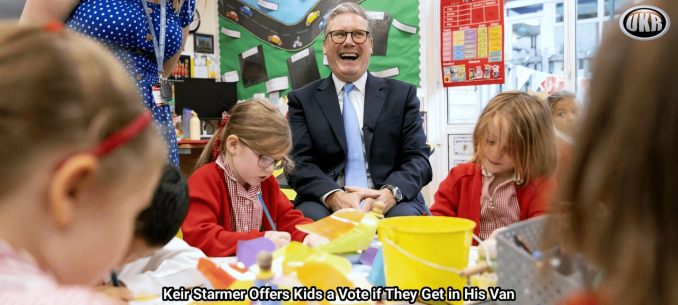
Labour leader promises that they will enjoy it.
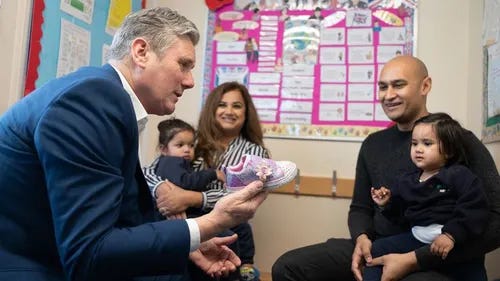
JUPPLANDIA
Parents expressed concern today that a middle aged male was touring the country in a van asking children to get in the back. The man in question was quickly identified as (self) serving British Prime Minister Keir Starmer. Evidence suggests that the Prime Minister has had several unconventional friendships with young men that have gone tragically wrong in a completely innocent way, as his private homes and former car were recently targeted for firebomb attacks by Ukrainian rentboys, a fate which has surely befallen many public spirited heterosexual men of impeccable character.
Reports of concern first start circulating as witnesses described suspicious activity in the vicinity of 10 Downing Street, where Mr Starmer lives in a State welfare provided property he doesn’t pay for. Eyewitness Sally Normal, 44, of East Cheam, described a harrowing encounter with a character many suspect to be Mr Starmer himself:
“I was walking down the street with my daughter, who is 12, when this big van pulled up alongside us. It was painted blood red and had all sorts of strange posters over it which looked political. There were bullhorns on the top. It pulled in to sort of block the path alongside us, which I thought was odd. The window rolled down and this man looked out. He had a shiny blue suit and a red tie. His hair was slicked back as if he was younger, like a sort of boyband look, but he was quite old and shifty looking. There was something about the way he was staring at my daughter that I didn’t like, but he still hadn’t really done anything so we tried to walk past. He licked his lips and said he had something very special he wanted to give to my daughter. I told him to leave us alone but he said she was a big girl now and I should let her make her own choices about who runs the country. Then he spoke directly to her and smiled and said if she jumped in the back of the van straight away he’d give her a very special thing called a vote. He said she’d love it and a beautiful little girl like her had every right to it. Just then three teenage boys came along and we only got away because he looked even more delighted and started talking to them.”
Sally Normal’s harrowing experience was not the only such incident. Over the course of the following week a whole series of reports flooded in of similar activity, not just in the vicinity of 10 Downing Street but elsewhere, both in Britain and abroad. At a popular tourist resort in the Mediterranean, several witnesses saw a man matching the Prime Ministers description trying to canvass schoolchildren in a queue for a theme park ride, urgently pressing pictures of himself into their hands before being driven off by a group of enraged parents.
Child welfare concerns are at a high level in Britain given the grooming gang child rape scandals of recent years and several instances of the British judiciary passing incredibly weak sentences against known child sex offenders. Mr Starmer belong to a demographic group who have been closely linked to child rape accusations and which are popularly believed to be disproportionately likely to harm children, namely the British legal profession. Mr Starmer entered politics after first establishing himself as a lawyer, and while it’s possible to practice the law innocently or simply for financial reward, the occupation has long been associated with an unsavoury element, particularly with regard to barbaric and perverse attitudes towards children. Mr Starmer’s legal experience and political history gives clear indications of a track record of possessing a sympathetic attitude towards child rapists, both in his work as a Director of Public Prosecutions advising that child rapists should not be prosecuted, and in his more recent habit of demanding that anyone critical of child rapists and murderers be imprisoned for hate speech offences.

.
Speculation is rife regarding whether the man pestering children on the street is indeed the Prime Minister, and the government have been forced by focus on the rumours to address the issue. In an unconvincing response, the government has suggested that it’s perfectly normal for middle aged men to approach children and offer them inducements to do something of benefit to the adult concerned, even if that means engaging in acts that have long been considered exclusively adult in nature. Angela Rayner, an alcoholic ginger Vicky Pollard who seems to have been accidentally employed as the Deputy Prime Minister, led the embattled government’s fightback against the growing scandal, once she was peeled off a a pavement and had the previous night’s vomit jet washed off her polyester power suit.

Miss Rayner released the following statement:
“This is all Tory bollocks, innit, typical Tory capitalist lies, right, and it’s just so Boooring! Of course we are gonna approach kids and get em to do stuff. Kids is fully grown these days, get with the times, and like, Modern Britain. Kids can dream, and kids can stick their tongues down each others throats and like grow and explore and develop and shit, OK, that’s what being a kid is, and besides it’s only cos you is all racist and have an outmoded western idea of what kids is that you don’t understand kids like what we do. When I was kid I was fucking on the grass on the school lawn when I was like 10, innit, and I had a proper great time finding shit out and like romancing and getting free ciggies and all that and you sad old bastards think kids can’t decide stuff just as good as what you do? Well they can and this government believes in them and believes in their dreams and stuff and won’t oppress them like what you guys do. We are going to give ‘em tha fucking vote and shit and if you shits don’t like it you can just get fucked, OK?”
Labour MPs rushed to endorse Miss Rayner’s heartfelt and incisive analysis of the situation, rallying behind her charismatic turn as one of the key stars of this administration, and Keir Starmer expressed his personal congratulations on the convincing defence she had presented in a manner suggesting that Rayner may be becoming his anointed and favoured successor.
Britain’s impecabbly neutral and objective Civil Service, a body firmly committed to the highest standards of impartial service without prejudice or favour towards any political party, took out a serious of adverts in major papers headlined “Why It’s Good to Groom Kids With Votes” and praising the statesmanlike performance of the current Prime Minister. The following is a typical passage:
“Is it not the duty of a Prime Minister to serve the needs of the people of this country, whatsoever those needs may be? Is it not his moral duty to care for and listen to the pubescent and the adolescent, as well as the elderly, the adult and the infirm? The Prime Minister has the whole country in his hand, and should he not prefer to stroke rather than strike, to lift up rather than push away? This Prime Minister has shown a personal, hands on interest in the lives of young men struggling to find their place in a new country, and offered them gainful employment in the process. That’s the kind of man he is.
How could any responsible Prime Minister not approach children to engage in previously adult activities? How could a good Prime Minister truly serve those who he will not allow to service him? Are their needs and desires for this great country not the same? It is time to trust our children, and we can only do that with a grown up and modern understanding that children do not need to be protected from rapists, but they do need to have a vote about who leads the country and they do need engagement in the political process, possibly accompanied by forced marriage to a Third World immigrant. That’s the kind of fresh, progrsssibe, modern thinking this country needs, and Keir Starmer is, in our completely neutral assessment, the man to provide it.”
By the next election, all 16-18 year olds in Britain will have a vote. The move accompanies suggestions that the current government is roundly despised by most adults, which of course has nothing to do with the motivations for the change. At the same time the mass importation of fresh new voters from other countries continues at an unprecedented rate, with those who share the government’s nebulous concepts regarding what point marks the difference between adulthood and childhood forming the vast majority of these new voters too.
Anti rape groups are advising people to keep their children away from fresh voters, London lawyers, and strange men from the Labour Party, no matter what inducements are offered to the contrary. Thus far, the British age of consent has not been formally brought into line with the standard of such things in Iran, but insiders suggest that comes next.
This article (Keir Starmer Offers Kids a Vote if They Get in His Van) was created and published by Jupplandia and is republished here under “Fair Use”
See Related Article Below
Votes for 16-year-olds is a bad joke
Democracy, having been devalued, is now being turned into a farce
SEBASTIAN MILBANK
Good news teenagers! Awkward stepdad Keir Starmer has arrived clutching a present, presumably in the hopes of ingratiating himself with you. What could it be? An Xbox? A new phone? Tickets to see Lana? Yeah don’t get too excited — it’s just the thankless right to vote in Britain’s depressing, pointless elections.
The expansion of the franchise should be a momentous occasion, accompanied by sober debate and at the end of a hard fought campaign. Yet whilst women sent letter bombs in order to win their vote, and working men faced cavalry sabres, the nation’s teenagers will largely be encountering participation in democracy as an entirely unlooked for, and certainly unfought for, consolation prize.
Historians looking at this epochal change might be surprised at the timing. 70 years ago, the average child left school at 15, and many 16 year olds were in work and preparing for their married lives. But there was no great clamour to enfranchise the youth then. Now, decades later, at a time when nearly half the population is still in education by age 21, we are inexplicably handing the vote to the least mature generation of all time. Between later marriage, the inability to buy a house, and the general millennial and zoomer “failure to launch” there is an increasingly plausible case for saying that independent adulthood begins somewhere in the mid 30s. Yet even as the age of maturity recedes ever further into the future, we are pushing the voting age down to 16 — at just the time modern teenagers are enjoying their first TikTok-induced mental breakdown.
Despite the occasional implausible read across from the existence of the cadets to claims that young Britons are old enough to die for their country (they aren’t) and should have the vote, there is ample evidence this generation is uniquely disengaged from national pride and defence. Just 41 per cent of Gen Z say they are proud to be British, representing a halving of patriotism amongst the young over the past 20 years, and “willingness to fight for your country” is at record lows. Compare this to World War One, in which a quarter of a million boys under the age of 18 volunteered to fight in the trenches, many of them lying about their age to do so. This at a time when the voting age was not 18, but 21.
If patriotism, along with trust in institutions and democracy, has withered amongst young people, it is not they who are to blame, but an older generation that has created a society that encourages cynicism, and thus proves itself worthy of such cynicism in the process. There are no civics lessons in Britain, nor any story of national culture and history told in its classrooms. Only the most abstract and anodyne of liberalism is osmotically imparted, with the consequence that young people are well versed in the idea of “human rights” (and how many of them they personally have and can assert) but have little notion of public or political life as densely woven net of laws and common obligations.
As if this generationally imparted cultural amnesia were not bad enough, young people have seen their economic prospects systematically squandered by older generations, who have relentlessly voted themselves higher pensions and higher house prices, even as they have cheerfully imposed higher taxes and tuition fee debt on their children and grandchildren. To add insult to injury, these same young people have been exposed to the social experiment that is smartphones and 24/7 unregulated internet access, with many traumatised and troubled as a consequence.
The very fact that the franchise is now being extended to 16 year olds should tell you how little it is valued
And what of the vote? Isn’t that some small compensation? To judge how much of a gift this measure is, see how much weight our political class has given it in the past few decades. Citizenship is no longer a sacred set of privileges and obligations, but is instead handed out freely to recent immigrants, even when their only contribution is to make outsize claims on our generous welfare system. As for the vote itself, with local government denuded of everything but bin collection and an impossible social care burden, and national politics frozen in a perpetual omni-party, democracy has been reduced to a largely symbolic exercise. The very fact that the franchise is now being extended to 16-year-olds should tell you how little it is valued: it is now a useless enough thing that it can be unthinkingly handed to children.
Young people should and probably will regard this as what it is: an insult. But it is also an opportunity, one which many may choose to take to vote for dissident parties of right and left, rather than rewarding the sweaty-palmed establishment that is enfranchising them. If so, it is no less than they deserve.
The TikTok Election: Why 2029 Will Be Won or Lost in the Feeds of 12-Year-Olds
In the years leading up to the 2029 General Election, Britain will witness the covert deployment of the most technologically advanced political campaigns in its history.
GABRIEL MCKEOWN
We are on the cusp of the most significant electoral shift in more than half a century, with the creation of a new youth coalition that will fundamentally re-engineer the political landscape and turn social media into the primary battleground for campaigns. Yet beyond the symbolic gesture of voting inclusivity, in the shadows, a new political playbook is being written, where the minds of this new generation are the ultimate target.
The decision, following precedents set in Scotland and Wales, will allow 16-year-olds to vote in the 2029 General Election, introducing approximately 1.5 million new voters into the system. This will present an opportunity for parties to forge the political identity of 12 and 13-year-old voters-in-training, making them the most fiercely contested and valuable group for strategists in the years ahead. They are digital natives from birth, raised in an era of profound economic anxiety, systemic distrust, and most importantly, all-encompassing hyper-personalised social media consumption. This is the window through which political ground will be gained or lost, as campaigns compete to flood their feeds with seemingly apolitical content that can subtly reinforce key political messaging. A trending meme or viral video that a child encounters today has the potential to ever so slightly mould their political outlook and subsequently influence how they vote when they turn 16.
For parties, the make-or-break nature of this cohort cannot be overstated, as political participation in this age group remains unmatched, especially for a first-vote event as will be the case in 2029. This has already been demonstrated in Scotland, which lowered the voting age for the 2014 Independence Referendum, and saw voter turnout among 16 and 17-year-olds reach 75%, dwarfing the 54% turnout for the 18 to 24 age group. Additionally, it has been found that by instilling a high level of participation in voters at 16, young people continue to vote in greater numbers as they move into their twenties. This will mean that effective campaigns can be expected to have a continued influence on the ballot box behaviour of a geographically balanced and highly engaged subset of voters in future election cycles, making them ideal targets.
However, while participation from the youth is fairly predictable, this is a generation profoundly alienated from mainstream politics, with disparate political allegiances that make the group far more complex than often modelled. The traditional view that a younger electorate is a de facto electoral gift to left-of-centre parties is a dangerous oversimplification that fails to appreciate the underlying political polarisation within the group itself. This generation is not a monolith, but is highly fractured, with notable drift occurring on both the far-left and far-right, driven by a rejection of the mainstream political establishment across the ideological spectrum. However, this innate fragmentation reflects a significant malleability in their political allegiances, presenting an opportunity for parties to pull youth voters towards their cause.
Furthermore, there is an inherent volatility within the new youth electorate due to a deeper crisis of faith in the existing political and economic systems. The cumulative effect of economic exclusion, social disenfranchisement and a profound sense of abandonment is pushing Britain’s youth towards a total rejection of the status quo. Growing numbers are turning to the ideological fringes in search of retribution against a broken system, not driven by a desire to shape future policy, but to totally overhaul the existing structure. So far, this has manifested itself as a distancing from mainstream parties, an alignment with radical narratives, and the proliferation of online movements that are believed to accelerate this dismantling process. Fueling the rise of digital activism and social media campaigning, which has allowed young people to fulfil their desire to be part of political protest movements, but requiring minimal direct involvement outside of the online realm. This will present a key mechanism through which parties will target political campaigning in the run-up towards the next election, shaping the youth vote via the deployment of highly issue-specific movements that appear organic but appeal to carefully selected segments of the group. This has been made possible by the youth’s embrace of entirely algorithmically driven social media platforms that can act as powerful delivery vehicles for highly personal campaign messaging disguised as content.
The likely campaign blueprint for the 2029 election will undoubtedly see the techniques pioneered in the Brexit referendum and the 2016 US election supercharged through a new arsenal of digital weaponry, and focused almost solely on the new youth voters. These two controversial campaigns were at the forefront of social media-driven political warfare, utilising psychological profiling and hyper-targeted messaging to deliver a desired electoral outcome from each target voter. Yet, despite being revolutionary for their time, the rapid advances in technological capabilities over the last decade, combined with increasingly malleable social media platforms, will mean that the techniques used in the run-up to 2029 will be far more sophisticated.
The secret weapon in these original campaigns was the ability to micro-target potential voters, with parties able to craft highly personalised advertisements that were most effective at triggering an individual’s subconscious motivations and biases in the run-up to making a voting decision. This strategy is cheaper and faster than ever before, following the widespread adoption of generative AI tools, making it possible to produce thousands of highly differentiated pieces of campaign material, each personalised to specific subsets of the target youth voter base. Additionally, this material can be refined and tweaked in real-time, following the move away from traditional polling and towards synthetic voter surveying, which uses a model that can mimic the political behaviour and preferences of a voter segment. Campaigns can now utilise these synthetic voter models to run simulations that test the potential impact of different messaging and deploy ever-evolving material that responds instantly to changes in voter behaviour. Most importantly, this will also ensure that campaigns can keep up with the ever-changing format of social media content, mimicking the same factors that drive organic content creation, to remain seamlessly aligned with the latest trends and topics.
Furthermore, while generative AI will play a vital role in creating content, the vast quantity of data now available on social media users will enable parties to target this content far more subtly than in previous campaigns. The material will be integrated into the algorithmically curated feeds of future youth voters, undetectable from other content, but designed to convey a particular message that will stick. Individuals, who on the surface may appear identical; same age, same location, same background, and even the same public interests, may experience vastly different content in their feeds. Consequently, political material will be crafted to resonate with their true online self, one that can only be determined after hundreds, if not thousands, of hours of demonstrated behaviour, only recently accessible through algorithmically driven platforms. For campaigns, this will allow coordinated messaging to be disguised as naturally viral content, shifting the ground on core issues without voters or opposing campaigns, realising.
These strategies, when contrasted with the typical vision of campaigning whereby a local MP diligently canvasses in their constituency, meeting voters at the doorstep with a leaflet in the hope of a photo-op, seem far-fetched and implausible. Yet these covert methods have been implemented and honed for over a decade, with a similar youth-targeted campaign being used in the 2010 General Election in Trinidad and Tobago. In the run-up to the election, the parent company of now infamous Cambridge Analytica was contracted by the opposition United National Congress party, and subsequently determined that to win the election, they needed to influence the voting behaviour of the youth. They implemented a strategy to suppress turnout from this group by creating an apolitical youth movement that reframed political abstention as an act of empowerment. This was catalysed through seemingly organic viral imagery and social media trends, allowing the core message to be disseminated totally undetected. By the time of the election, this campaign managed to drive a significant drop in voter turnout amongst the targeted youth demographic in key swing locations, delivering a victory in the closely contested national vote. In the years since this campaign, many of these same strategies have been enhanced significantly to deliver results more efficiently, and most importantly, more subtly.
In the run-up to the 2029 election, the anticipated youth vote will intensify competition in marginal constituencies, with parties, especially those on the fringes, increasingly focused on key battleground locations where the power of this newly enfranchised group will be most concentrated. Prior to the 2019 election, it was determined that in 56 marginal seats, the number of newly eligible 18-year-old voters alone was greater than the incumbent MP’s majority. Thus, highly targeted regional campaigns to favourably alter voting behaviour in young people could have an outsized impact, with Britain’s First-Past-the-Post electoral system acting as a vote multiplier. Despite the likely outcome being far more fragmented overall, making a single-party majority unlikely, capturing large swathes of the highly polarised youth vote in key battlegrounds could very easily be an election decider.
Those coming of age in the years ahead will experience an onslaught of political campaigning that is harder to detect and more insidiously personal than ever before. Their highly curated social media feeds will remain the preeminent political battlefield for campaigns whose sole purpose is to alter their future voting behaviour by any technical means necessary. This will be an election decided not by policy, but by the actions of a small number of first-time voters, whose ultimate voting decisions were engineered long before they saw the ballot box.

This article (The TikTok Election: Why 2029 Will Be Won or Lost in the Feeds of 12-Year-Olds) was created and published by Sad Rabbit and is republished here under “Fair Use”

••••
The Liberty Beacon Project is now expanding at a near exponential rate, and for this we are grateful and excited! But we must also be practical. For 7 years we have not asked for any donations, and have built this project with our own funds as we grew. We are now experiencing ever increasing growing pains due to the large number of websites and projects we represent. So we have just installed donation buttons on our websites and ask that you consider this when you visit them. Nothing is too small. We thank you for all your support and your considerations … (TLB)
••••
Comment Policy: As a privately owned web site, we reserve the right to remove comments that contain spam, advertising, vulgarity, threats of violence, racism, or personal/abusive attacks on other users. This also applies to trolling, the use of more than one alias, or just intentional mischief. Enforcement of this policy is at the discretion of this websites administrators. Repeat offenders may be blocked or permanently banned without prior warning.
••••
Disclaimer: TLB websites contain copyrighted material the use of which has not always been specifically authorized by the copyright owner. We are making such material available to our readers under the provisions of “fair use” in an effort to advance a better understanding of political, health, economic and social issues. The material on this site is distributed without profit to those who have expressed a prior interest in receiving it for research and educational purposes. If you wish to use copyrighted material for purposes other than “fair use” you must request permission from the copyright owner.
••••
Disclaimer: The information and opinions shared are for informational purposes only including, but not limited to, text, graphics, images and other material are not intended as medical advice or instruction. Nothing mentioned is intended to be a substitute for professional medical advice, diagnosis or treatment.
Disclaimer: The views and opinions expressed in this article are those of the author and do not necessarily reflect the official policy or position of The Liberty Beacon Project.


Leave a Reply