

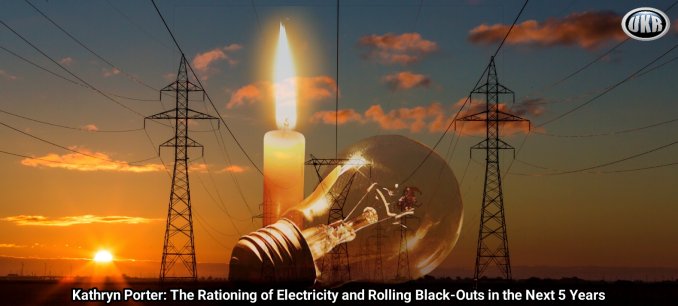
Respected industry expert Kathryn Porter details the path to the rationing of electricity and rolling black-outs in the NEXT 5 YEARS
because of “insane “net zero” policies and obsolete gas and electricity infrastructure – a life or death warning for the UK
PETER HALLIGAN
From here:
There are still many “energy realism” deniers out there that ignore basic facts.
In this video, Kathryn spells out the lies and fantasies these false prophet deniers are ignoring and who are condemning us all to energy poverty because of their wilful ignorance and malice.
Here is a link to the 26 minute video for those that want to hear the truth and the facts together with the first 16 minutes or so of the transcript.
“
Hi, I’m Katherine Porter. I’m an independent energy consultant. So, first of all, an apology for not having recorded any videos recently. I’ve actually had a pretty busy few months.
In September and October, I was speaking at some of the party conferences. I spoke at fringe events at both the Conservative and Reform Conference and I spoke at the SDP conference and a whole bunch of industry ones as well. And I’ve also done a lot of podcasts, quite a lot, two a week at one point. If you Google my name and click on video, uh you’ll find most of them there. Now, the most noteworthy one I think was probably the trigonometry podcast. It’s been quite widely viewed and the hosts there, Constantin and Francis were quite shocked with what I had to say. That’s been a general feedback that I’ve received from people who watched it who aren’t necessarily following what’s happening in energy all that closely. And I’m pretty glad because it was my objective to shock people.
What’s happening at the moment in energy policy is shocking and not least today’s announcements of the new subsidies AR7 – is extremely disappointing. I’ll be recording another video on that in the next few days.
We’re locking in I’m wateringly high prices for 20 years instead of 15.
The idea that this is in any way beneficial for consumers is simply a fantasy, but that’s for another video.
So, what else have I been doing? I’ve written two really big reports. One will be published next month by the Institute for Economic Affairs and that’s called “Can We Just Stop Oil.
They’re going to publish it when I come back from my travels. I’m currently in the United States. I’m recording this in Houston. I’ll be off to Austin and then to San Antonio for the Power Gen Conference. Then I’m going to head over to New York City for a symposium on nuclear financing and then I’ll be going up to Canada.
If there are any industry people who’d like to meet up while I’m on my travels in Canada, I’m visiting Toronto, Niagara, and Calgary.
Please let me know, send me a direct message or contact me through my website and we’ll see if we can schedule something. My other big report was called “Electrification can the grid Cope”.
It was published on Monday and we had a launch event that was very kindly hosted by shadow Secretary of State for Energy Security and Net Zero (DEZNEZ), Claire Coutinho.
Here is a hard copy of my report. You can see it’s a pretty thick document. I’ve got over 200 references in this document. It was not written by AI as somebody suggested. It was written all by me. I look at electrification and the impact it will have on our power grids and again it’s also had a fair bit of attention.
DEZNES very kindly told the world that I was scaremongering before they even read the report which was quite interesting. It’s good to know that they put so much rigor behind their commentary!!
So what do I say in my report? Now, electrification has become the default answer to pretty much every question on climate and energy, whether that’s heating, transport, or industry, the answer seems to be to electrify it.
Now, up until a couple of years ago, hydrogen was expected to play some kind of a role in this, but since the village trials were cancelled, that’s really fallen away, other than for maybe a few high temperature heat applications in industry. And similarly, there’s not that much belief that carbon capture is going to contribute. The National Energy System operator, NESO, does still feature it in in its scenarios, but you know, the climate change committee only really sees it playing a pretty small role. And I think I would
agree with that. Although Labour is throwing a lot of money at it, we’ve seen billions of dollars worldwide spent on carbon capture in in the last couple of decades, there’s really very little to show for it.
I don’t think it’s credible that Britain is going to suddenly change the tide on that irrespective of how many millions of pounds that Ed Miliband wants to throw in that direction.
So what are our targets then for electrification? My analysis shows that if we electrify heating, transport and industry in line with government targets, we’ll probably see between 7 and 10 GW of additional electricity demand to 2030.
Now I also include data centers in my analysis and that will add probably add another seven GW over the same time frame if government targets were met. The government has designated AI data centers as critical national infrastructure. So this is a pretty significant amount of new electricity demand that we could see.
And to put it into context our peak winter demand is somewhere around 45GW. In the cold weather a couple of weeks ago we actually went over 51 but that’s a little bit unusual. Normally on an average winter day, 45 GW would be our peak demand at dinnertime. And so if we electrified heating and transport and we had this additional demand from AI data sensors, we’d be adding another 25% to our electricity demand. So it’s a pretty significant amount.
Now, if we look at how those targets break out, the government’s very keen on heat pumps. They’ve introduced a boiler tax. But you know these targets are just not going to be met without actually imposing some sort of compulsion on consumers. And while this Labour government does seem to be quite keen on compulsion, it also is quite keen on U-turns when it realizes the extent of public opposition.
The current heat pump targets rely on a rate of deployment that is just not plausible under current conditions. Consumer resistance remains high. Installer numbers are growing too slowly. And as the capital and running costs for heat pumps are materially higher than for gas heating, it just doesn’t seem very credible that that’s going to change anytime soon. Even where heat pump subsidies cover the upfront cost of the heat pump itself and bring it to broadly par with gas boilers. Because heat pumps deliver low grade heat, you pretty much have to change the whole way that your house is configured for heating. Unless your house is already very well insulated, which isn’t the case for most people, you’ll need better insulation. And heat pumps deliver low-grade heat. So, you generally need to have a bigger emitter, the larger radiator or an underfloor system to deliver that heat. It just has to be bigger because the heating is low grade. And often that will also require additional pipe work. So, there’s quite a lot of cost that you have to go to and obviously that undermines people’s desire to do that work. It’s intrusive and expensive.
Now, if we look at transportation, you see similar challenges. Consumers are not racing out to buy electric cars. There’s still a lot of concern around range anxiety. And my report looks at the costs of owning an electric car compared with owning a conventional car. And finds that really only in the first year or so of ownership. If you can charge that electric car at home using a flexible tariff, will you actually achieve a cost saving versus a conventional car. After that first year or so, you see the costs of insurance and maintenance overtaking conventional car costs pretty quickly because those are just higher for electric cars. When it comes to larger vehicles, there are no current credible fast charging solutions for HGVs.
And you know, I had a meeting recently with a big logistics company. And they explained to me that if they were to electrify their operations, it would mean a radical change of the way they operate their business. They would potentially have to change the location of their depots, and that would be inefficient because they’re currently located for efficiency for their operations. and they would likely have to change the working patterns and employment contracts of all their drivers. At the moment, when you’re fuelling a vehicle, you are responsible for the vehicle. So, a driver cannot be on a break if they’re fuelling their vehicle away from the depot. And about 50% of their fuelling takes place away from the depot. So that will have a huge impact on their operations and the cost of their operations because they effectively have to pay their drivers to sit around just watching their vehicles charge and for trucks that can take several hours. So this was just really not plausible. Similarly, when you look at buses outside of large urban areas where buses can return to depots quite frequently, you you very quickly run into issues with charging infrastructure.
Industry is another area where electrification faces real challenges.
My report contains a case study that illustrates some of these. Industrial sites might not have the space for the electrical equipment and charging devices that they would need. But also they face issues with high prices. High electricity prices are driving de-industrialization at a record rate at the moment. We have the highest industrial electricity prices in the developed world. And we can tell we can see that in the data, de-industrialization is driving reductions in electricity demand that are larger than increases from electrification.
That’s the that’s the driving narrative of electricity demand across the entire economy at the moment.
And it’s just not credible that that’s going to reverse in the next 5 years. So across all of these sectors, the modelling assumptions used by both NESO and the climate change committee are based on behavioural and technological assumptions that just are not credible. and they’re also inconsistent across their scenarios.
My report doesn’t assume electrification won’t happen, but it does it does find that the targets are not going to be met without some form of compulsion. And that’s going to bring all sorts of political risks that are just not likely it just makes that pretty unlikely.
And this is just as well because the main finding of my report is that our electricity grid is going to struggle to cope with normal power demand, never mind additional demand from electrification and data centers.
The biggest risk that we face is from retirement of firm generation. Now, as I mentioned earlier, we’ve just had the new auction round for renewables and the government and renewable lobbies are very predictably banging on about how this is going to improve security of supply. It doesn’t. We still have the issue of when it’s not windy.
Right now, we have about 32,000 megawatts of wind generation connected to the grid. But over the autumn, we had several occasions where the actual electricity generated by those renewables fell down to 200 megawatt. So, 200 out of 32,000. That’s a tiny amount.
Now, for a joke, I asked Grok how much electricity could be generated if every person in the UK went and blew very hard into a wind turbine. and Grok’s at about 200 megawatt. Funny, but really not so much when you consider what happens when you run out of electricity.
So, we need to keep our firm power generation running. But we know there’s a lot of us at risk of closure. Now, definitely we’re going to lose just under 5 gigawatts of nuclear. The advanced gas coal reactors are coming to the end of their lives. And at the moment, they’re all scheduled to close by March 2030. Now I believe that two of them Torres and Hishian 2 might be able to run for another two years after that but I think 2032 is a hard limit.
So that will leave Sizewell B. Now we’re building Hinckley point C that’s currently scheduled to open the first unit in 2029. Nobody believes that’s going to happen. It’s far more likely to be in the early 2030s with the second unit following a year or two behind. So there’s 5 GW of uh nuclear generation likely to close with 3.2 gigawatt likely to open and I think we’ll probably see a couple of gigawatts of small gas fire generation opening. So that kind of evens out. But the real risk that nobody’s talking about is that the existing gas fleet can’t be reasonably assumed to remain open, in well it definitely won’t remain open indefinitely. The clean power 2030 plan requires that all 32 gigawatts of the gas fleet that we currently have will stay open. And even if it’s only used 5% of the time, that’s very crucial because when it’s not windy or sunny, we will rely on those power stations to meet demand. And here’s the rub. A third of those power stations were built in the1990s and are coming to the end of life. And another third were built in the 2000s.And we’re already seeing reliability issues with some of those assets. Now I take two of them, Peterhead and Langage in my report.
Now Peterhead was built in 2000 and Langage was built in 2010. Both are experiencing significant reliability issues and there are issues with other assets as well. And Im’ hoping to get funding for a follow-up report which will go into reliability data for all of the at risk power stations I’ve identified. And I’ve identified 12 gigawatt of at risk capacity. So that’s 12,000 megawatt, that that you know that could potentially close. Now the obvious response to that is well replace them or upgrade them. And that’s this is where the trouble comes in. Right now if you want to replace a gas fired power station with an entirely new gas fired power station, you’re going to wait seven to eight years to take delivery for of a gas turbine because of supply chain constraints. To get a new rotor to extend the life of an existing power station, it’s a five year wait. To even get the components for major maintenance is taking a year and a half. So these are significant constraints. We would really need to be acting now ordering this equipment to be sure that it comes by 2030 so that we still have it available and that isn’t happening. So we have this enormous risk that our gas generation will close due to old age and just simply won’t be able to run. The other problem is that running these types of machines for only 5% of the time actually creates reliability problems.
So the idea that you would take decades old machines that are nearing the end of their life and make them operate in a way they were never designed to and that they will just work and keep working just isn’t credible.
Now, Britain isn’t alone with facing these system adequacy concerns. my report looks at Norway,”…
end of transcript – sorry I’m tired correcting it! Here’s the rest of the 5 minutes of uncorrected transcript.
the Netherlands, and Germany to see
14:06
what’s happening in their power grids.
14:07
They have similar electrification
14:09
targets to us, and they’re also
14:11
identifying some concerns with system
14:12
adequacy. Norway assumes that it’s going
14:15
to meet those needs through a
14:17
combination of flexibility, demand
14:18
response, or batteries. The Dutch are
14:21
less confident and have said that they
14:23
intend to monitor the generation mix in
14:25
their neighboring countries to try and
14:27
make sure that they can keep importing
14:28
electricity on low wind days. But
14:31
Germany has come out and absolutely
14:33
acknowledged that it’s going to need to
14:35
build more gas fired generation if it’s
14:37
going to keep m meeting demand in the
14:39
coming years. Now, the target probably
14:41
isn’t enough. They’re probably going to
14:43
need more. But just in the last couple
14:45
of days, the news has come out that
14:47
Germany is going to need EU state aid
14:49
approval to actually build these power
14:51
stations. And that approval might be
14:52
withheld because the EU doesn’t want
14:55
people to build more gas fired power
14:56
stations. So it’s going to be
14:58
interesting to see how that plays out.
14:59
But of the four countries, Norway,
15:01
Netherlands, Germany, and Britain, only
15:03
Germany is really being explicit that
15:05
gas fired power stations are going to be
15:07
needed to meet demand on low wind days
15:11
if we’re going to actually meet all of
15:13
demand. And that’s the problem because
15:15
if you don’t meet all of demand, you
15:17
will learn how to ration it or you run a
15:19
risk of blackouts. Now
15:22
our uh the forecast the forecast that
15:25
Teniso and the CCT and the government
15:27
put out assume there will be a major
15:29
role for flexibility.
15:31
Now one of the main findings in my
15:33
report is that electrification doesn’t
15:36
increase demand evenly. Heat pumps,
15:38
electric car charging, industrial
15:41
electrification, all of these things
15:42
tend to concentrate demand both in time
15:44
and space. And so while average numbers
15:47
might talk about there being enough
15:49
electricity to cover all of that, we
15:51
don’t meet average numbers. We have to
15:53
meet the peaks. And so if we have low
15:56
wind, we could be very stressed um
15:59
trying to meet those peaks. Now f what
16:03
does flexibility really mean?
16:05
Essentially it means people moving their
16:07
consumption to fit in with system needs.
16:10
Now I have some uh ideological
16:12
objections to that. I think utilities
16:14
should exist to serve consumers and not
16:16
the other way around. And I think in
16:17
practice you’re going to have to
16:19
compensate people to quite a significant
16:21
degree and that would potentially erode
16:24
the economic benefits of flexibility in
16:26
the first place. There are also other
16:29
risks and challenges of that sort of
16:31
behavior. Now you hear Nisso talk very
16:34
enthusiastically about charging your car
16:37
in the middle of the night and about uh
16:39
doing work with appliances in the middle
16:42
of the night like your laundry for
16:43
example you would simply program your
16:45
washing machine to do a cycle at 2 in
16:47
the morning and everything will be
16:49
marvelous. Well, if you look at what
16:52
fire brigades have to say about this,
16:53
every fire brigade in the country says,
16:55
“Do not run your appliances at night or
16:57
leave them unattended because devices
17:00
containing electric motors can catch
17:02
fire.” You also have issues in multi
17:05
occupancy buildings. If you live in a
17:07
block of flats, you can’t generally run
17:09
your washing machine at 2:00 in the
17:11
morning. Your lease will tell you not to
17:12
because it’s a noise nuisance. So, there
17:14
are these real world constraints that
17:17
prevent you from doing this. a senior um
17:21
industry professional who I’m not going
17:22
to name in this video said that the
17:24
solution to this is better regulation of
17:26
white goods. I I find this to be quite a
17:31
privileged comment if you like that only
17:32
a person with great privilege would say
17:34
that. How would that work in practice?
17:36
Are you really going to introduce a law
17:38
that requires people on low incomes to
17:40
replace their appliances? And of course,
17:42
the people most likely to own old and
17:45
cheap appliances, which would be most at
17:47
risk of catching fire would be those on
17:49
low incomes. It just doesn’t seem
17:51
credible to me that you’re going to have
17:53
a policy that says all of these people
17:54
have to get rid of their appliances and
17:56
buy expensive new ones. And what are you
17:58
going to do? You know, arrest people if
18:00
they don’t? It just doesn’t doesn’t make
18:02
sense.
18:03
So I I really don’t see flexibility
18:06
doing more than shaving a little bit off
18:08
the peak at the margin, but I don’t see
18:10
it as being a major component uh to
18:13
security of supply. Now if we look more
18:15
broadly at our infrastructure away from
18:18
electricity generation, we also see
18:20
challenges. Our uh transmission and
18:22
distribution networks were really not
18:25
designed for the way that the system is
18:27
being set up for the future.
18:29
The distribution networks will actually
18:31
need huge amounts of upgrading if we’re
18:33
going to have heating and transport
18:35
electrified particularly at the domestic
18:37
level. And you know the timelines for
18:39
that sort of grid enforcement. It is
18:42
measured in years many years even decade
18:45
like over a decade in some cases. This
18:47
is not something that can be done
18:49
quickly and it’s not credible it’s all
18:50
going to be done by 2030.
18:53
And the other problem is with the age of
18:55
infrastructure. We had a huge spike in
18:58
grid investments in the 1970s and a very
19:00
significant proportion of transformers
19:02
and switch gear and power lines were
19:04
actually built before the 1980s and
19:06
coming to the end of their lives. Now
19:08
consistently offjem the energy regulator
19:10
is assigning more money for the network
19:13
operators that are regulated. So their
19:15
income uh what they can charge consumers
19:19
um is governed by regulation. They can’t
19:21
just charge what they want. and so often
19:24
approves far more investment in
19:26
connecting renewables and connecting
19:28
batteries than it does in upgrading
19:30
legacy equipment. And so there are some
19:32
real concerns about the way the asset
19:34
life is being managed and a real danger
19:37
that you’ll see failures of key
19:39
equipment like the transformer at North
19:41
Hyde which blew up in March and caused a
19:44
serious outage at Heithro airport and
19:47
that probably cost you upwards of 50
19:49
million pounds just for those hours that
19:52
were out. So, you know, you can you have
19:55
this big risk of critical network
19:57
infrastructure failing through old age
19:59
and and there not being an adequate
20:00
replacement plan.
20:02
Now, there’s also a risk with our
20:04
offshore gas infrastructure. In
20:05
November, on the same day that the
20:07
budget was announced, NISO published a
20:10
report about offshore pipeline networks
20:13
and how they can impact security of gas
20:15
supplies into Britain. Now, where we
20:18
have uh oil and gas fields in the North
20:21
Sea, they generally have pipelines
20:23
connected back to the shore to bring the
20:25
oil and gas back to shore. With oil, you
20:27
can also um produce them onto a ship,
20:30
but most of it comes through pipelines.
20:32
Now, we’ve already seen Inos that
20:34
operates the 40s pipeline, which is oil,
20:38
um saying that there’s not enough oil
20:40
going through that pipeline anymore for
20:41
it to be viable and they may close it.
20:43
And this is true also in the gas
20:45
infrastructure. If there’s not enough
20:47
gas going through the pipelines, the
20:49
pipelines then have they’ll have issues
20:51
with um their performance, but they also
20:54
become less economic because the cost of
20:56
operating them will be recovered through
20:58
fewer producers and it’ll just become
21:00
too expensive. So, this will have a
21:04
knock-on effect both on uh production
21:06
but also delivery of gas into Britain
21:09
because quite a lot of Norwegian gas
21:11
also comes through those pipelines.
21:13
The production forecasts that you see
21:15
for from just about everybody show a
21:18
smooth decline in oil and gas production
21:20
from the UK continental shelf. But if we
21:23
start seeing these pipeline systems
21:26
closing, any field that ties back to
21:28
that pipeline will also close whether it
21:30
was thought it was going to continue to
21:32
produce or not. So in practice, we’ll
21:34
actually see stepdowns rather than a
21:36
smooth curve in terms of production. and
21:39
NISO saying that this will potentially
21:42
cause shortages of gas in Britain on
21:44
cold winter days. Now, National Gas,
21:46
which operates the high pressure gas
21:50
grid in Britain, has said this risk
21:52
might manifest as early as next winter.
21:55
I think that’s probably a little bit
21:57
early in practice, but I do believe
21:58
it’ll stop before 2030. And so if we
22:01
don’t have enough gas on cold winter
22:03
days, we’re going to struggle to run
22:04
those gas power stations and also to
22:07
meet the heating needs where most
22:09
households still use gas for heating.
22:12
Now, you could prevent this in two ways.
22:14
One is don’t continue the decline of the
22:17
North Sea. There’s actually quite a lot
22:19
of oil and gas left in the North Sea. In
22:21
the last year, Norway has made some
22:23
really significant discoveries right
22:25
adjacent to the UK continental shelf.
22:28
But also just in the last week or so,
22:31
Norway has announced that it’s going to
22:33
increase production from existing fields
22:35
because technology advances mean that
22:38
fields that they thought were not viable
22:40
or had previously closed uh and now can
22:43
now be revisited and more product
22:45
extracted from those fields. So there’s
22:48
quite a lot that we could do. um there’s
22:50
no reason that we should be declining
22:53
the North Sea at the speed with which
22:54
it’s declining. So the cheapest and most
22:56
economic and also the most practical way
23:00
to address that risk is simply to
23:01
reverse the fiscal regime and to reverse
23:04
the ban on new drilling. The second best
23:06
approach would be to install floating
23:09
regification capacity which is
23:10
essentially what Germany did to try and
23:13
displace Russian gas off its system uh
23:15
after the invasion of Ukraine when it
23:17
stopped buying pipeline gas from Russia.
23:19
It installed floating regification
23:22
terminals around its coast so that it
23:24
could bring liqufied natural gas from
23:27
the United States primarily into the
23:29
German pipeline system. Now we could do
23:31
the same in Britain. We have spare uh
23:34
gas grid entry capacity at Eington and
23:37
St. Fergus, but you would have to build
23:39
the ship handling. You’d have to build
23:41
gas storage tanks. You’d have to build
23:43
additional pipeline infrastructure. And
23:45
all of that costs money and takes time.
23:47
So the better option would be just to
23:49
get as much out of the North Sea as
23:51
possible and really defer that type of
23:55
investment need for the future. So if we
23:58
put all of this together, my report
24:00
points to a very uncomfortable
24:02
conclusion. The British electricity
24:05
system is likely to struggle to maintain
24:07
even today’s level of demand reliably,
24:09
let alone accommodate the additional
24:11
demand implied by electrification
24:13
targets and AI data centers. Not because
24:17
of technological failure, but because
24:18
the grid is just not perceived as being
24:20
sufficiently reliable if we lose the gas
24:23
generation that realistically we could
24:26
lose over this time frame and the
24:29
government is just not factoring it into
24:31
this into its plans. The supply chain
24:34
constraints are real and significant. So
24:36
if we’re going to avoid this risk that
24:38
we can’t meet demand, we really need to
24:40
act now. And not meeting demand is quite
24:44
a polite and anodine way of saying that
24:47
if we don’t deal with this, we will be
24:49
having to ration electricity and have
24:51
1970s style rolling blackouts. And of
24:54
course, this that will be so much more
24:57
serious than it was in the 1970s. The
24:59
Iberian blackout cost 11 lives directly
25:02
and a study has shown that 165 excess
25:05
deaths over the two days in question
25:07
could be attributed to that event
25:09
primarily in women over the age of 85.
25:12
Mortality statistics are only car
25:14
collected on daily granularity. So
25:16
although the blackout only lasted about
25:18
15 hours, it went across two days. So
25:21
this is a very serious risk. 10 of those
25:25
11 um direct fatalities were caused
25:29
because of the failure of generators
25:30
that were powering medical equipment in
25:32
the home. That’s not something that was
25:34
happening in the 1970s. Our lives are
25:36
very much more electrified. So there
25:38
will be both a social and human cost to
25:41
blackouts and a huge obvious economic
25:44
cost. So we really need to do what we
25:46
can to avoid this. So I hope that you’ll
25:49
read my report um that you will ask me
25:51
any questions that you want about this.
25:53
I do try to respond to the uh comments
25:55
and questions uh left on the bottom of
25:58
my blog and that you will raise this
26:00
with your MPs, discuss it with industry
26:02
professionals because this is an
26:04
important topic and we really do need um
26:07
to stop the complacency that we have
26:10
around these critical risks. So, I hope
26:12
you enjoyed this video and I’ll see you
26:14
in the next
Onwards!
PLEASE take a paid subscription or follow/recommend my site to others you think might be interested. You may also donate via Ko-fi – (any amount three dollars and above here): https://ko-fi.com/peterhalligan
This article (Respected industry expert Kathryn Porter details the path to the rationing of electricity and rolling black-outs in the NEXT 5 YEARS) was created and published by Peter Halligan and is republished here under “Fair Use”


Leave a Reply