

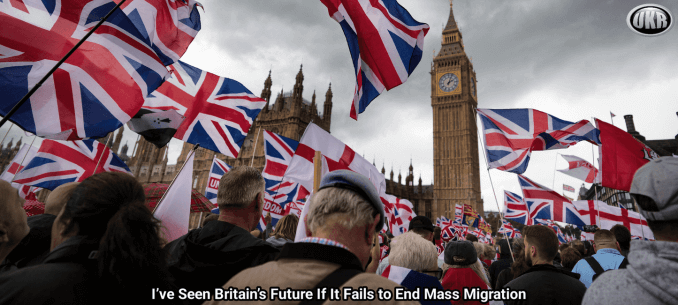
I’ve seen Britain’s future if it fails to end mass migration
As an outsider, it’s easier to spot how a country is changing. But the UK doesn’t have to accept its current, worrying trajectory
Changes to a country are easier to spot when you don’t live there. Born in London, I go back every so often and just returned. My impression is of a country at a crossroads. There is a tired, old Britain, resigned to continued cultural, societal, and economic decline. But there is also a growing movement willing to face the hard questions and plot a different course.
On migration, Britain and other Western countries have two major decisions to make. First, how many immigrants do they want? Second, who should they be? Once that’s determined, a third, equally important decision is necessary: will those countries do what it takes to control numbers, once the limit they set is reached?
The “how many” question matters because the world’s supply of people wanting a better life in a richer country is practically inexhaustible. The “who” matters because some populations seem to integrate and assimilate better than others. Some migrants contribute more than they take, others the reverse. And most controversially, nationals of some countries commit – on average – some crimes at rates many multiples those of the British-born. Allowing them to live among you is a choice, not a fate. I’ll save the “who” aspect for another article and focus on the “how many” here.
Up to now, Britain’s political leaders on both sides seem to have given up on limits, accepting mass migration as either a positive good, like Labour’s Tony Blair, or an unavoidable phenomenon to be mitigated, as Conservatives David Cameron, Theresa May and Rishi Sunak did.
But something seems to have changed. There is now a growing popular backlash across the British Isles against decades of unchecked mass migration and a failure to assimilate some of the new arrivals. Tapping into this popular anger is an entirely new party, Nigel Farage’s Reform, and a rising generation of Conservative politicians like Robert Jenrick, Katie Lam, and Chris Philp.
Those opposing mass migration are a coalition. Many are indigenous British – that is, those of English, Irish, Scottish, and Welsh ancestry – whose ancestors have been there for centuries. Others are patriotic, well-assimilated people from a variety of origins. They are led by a diverse group of politicians and activists from across the geographical and social spectrum.
And they have a plan. Pull out of the European Convention on Human Rights, which has been interpreted in ridiculous ways to thwart the enforcement of government deportation efforts. Pass laws drastically limiting legal work visas, family unification, and asylum claims by legal arrivals (eg students and visitors). Bar any foreigner arriving illegally from claiming asylum. And swiftly enforce immigration laws, including deportation orders.
That’s the least it will take for Britain to regain control of its borders and destiny. The Reform platform contains a lot of this, right up front. The Conservatives, who are at historically low polling partly due to a failure to keep promises to limit migration, are catching up.
Presently, an asylum seeker from Albania, Eritrea, Pakistan or many similar countries may think that, if he can get to the coast of France and thence to England on an illegal boat, he will be housed, fed, and allowed to remain until his asylum claim has been adjudicated. After that, he has multiple, slow avenues of appeal. Even if ultimately refused, he may never be deported.
To that illegal migration, the UK adds a significant legal migration every year via routes such as family re-unification, as well as allowing many foreigners on student visas and work permits to remain for longer. In addition, they accept asylum claims by those who arrive on non-immigrant, temporary visas. A large proportion of claims are approved, and appeals drag on for years.
Absent radical changes, with current migration and fertility trends, the demographic future of Britain could be for the indigenous people to be a minority within a generation or two. In that case, I see two likely scenarios for Britain’s future.
The best case is akin to the United Arab Emirates, where a native population controls the land, wealth, and politics, while vastly outnumbered by a non-Arab clerical and labour class.
Or Britain could end up like Lebanon, where no dominant political force or culture holds things together at the centre. Enclaves of prosperity and even comfort remain, but without the unifying history, faith, and collective identity that forms a strong nation.
To avoid either fate will require both massively reducing legal channels of immigration and ending asylum abuse. Parliament has the power to do both.
The Telegraph: continue reading

••••
The Liberty Beacon Project is now expanding at a near exponential rate, and for this we are grateful and excited! But we must also be practical. For 7 years we have not asked for any donations, and have built this project with our own funds as we grew. We are now experiencing ever increasing growing pains due to the large number of websites and projects we represent. So we have just installed donation buttons on our websites and ask that you consider this when you visit them. Nothing is too small. We thank you for all your support and your considerations … (TLB)
••••
Comment Policy: As a privately owned web site, we reserve the right to remove comments that contain spam, advertising, vulgarity, threats of violence, racism, or personal/abusive attacks on other users. This also applies to trolling, the use of more than one alias, or just intentional mischief. Enforcement of this policy is at the discretion of this websites administrators. Repeat offenders may be blocked or permanently banned without prior warning.
••••
Disclaimer: TLB websites contain copyrighted material the use of which has not always been specifically authorized by the copyright owner. We are making such material available to our readers under the provisions of “fair use” in an effort to advance a better understanding of political, health, economic and social issues. The material on this site is distributed without profit to those who have expressed a prior interest in receiving it for research and educational purposes. If you wish to use copyrighted material for purposes other than “fair use” you must request permission from the copyright owner.
••••
Disclaimer: The information and opinions shared are for informational purposes only including, but not limited to, text, graphics, images and other material are not intended as medical advice or instruction. Nothing mentioned is intended to be a substitute for professional medical advice, diagnosis or treatment.
Disclaimer: The views and opinions expressed in this article are those of the author and do not necessarily reflect the official policy or position of The Liberty Beacon Project.


Leave a Reply