
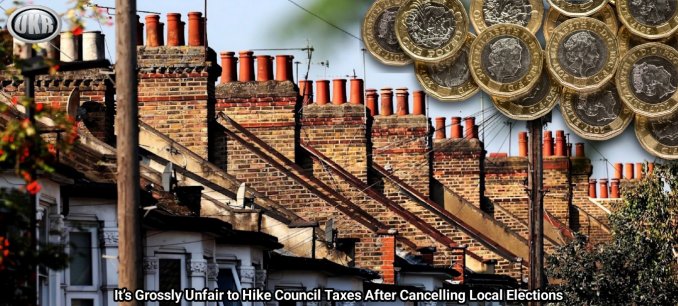
It’s grossly unfair to hike council taxes after cancelling local elections
TCW
IN MAY 2026, local elections in 29 councils across England will be delayed amid wider local government reorganisation.
This means that more than 4.5million residents will be unable to hold more than 660 of their councillors to account at the ballot box at a time when council tax bills continue to rise. Although the postponement of elections removes a key democratic check on local decision-making, it does not prevent councils from increasing taxes.
The principle of ‘no taxation without representation’ applies at every level of government, including local authorities. Council tax is one of the most direct and visible taxes faced by households, with the average band D home in England paying 16 per cent more in council tax in 2025-26 than in 2022-23.
Yet in these 29 authorities, councillors will be able to increase bills without seeking renewed assent from voters. Five of the councils delaying elections in May 2026 also postponed elections in 2025, during which time they increased council tax, raising additional revenue while normal electoral accountability was suspended.
The TaxPayers’ Alliance has examined the 29 authorities postponing elections in May, identifying the council tax increases they have and are expected to implement, and the additional revenue expected to be raised. It investigates the implications of allowing councils to raise council tax during periods of delayed electoral accountability. https://taxpayersalliance.com/briefing-delayed-elections-and-council-tax-rises/
Key findings
· The 29 local authorities delaying elections are forecast to raise £2.6billion in council tax in 2026-2027, up by almost £121million compared with 2025-26.
· Among all councils delaying elections, Blackburn with Darwen is expected to impose the largest increase on households in 2026-2027, with the average band D bill rising by £98 to £2,063.
· Among district councils delaying elections, Ipswich is expected to record the largest cash increase in 2026-2027, with the average band D bill rising by £13 to £432.
· Of the 29 councils, only Harlow and Lincoln are expected to freeze council tax in 2026-2027.
Among the 24 councils delaying elections for the first time, Peterborough is expected to see the largest increase in council tax income in 2026-2027, rising from £107.7million to £113.1million, an increase of nearly £5.4million.
Together, these 24 councils are forecast to raise an extra £15.2million in council tax in 2026-2027.
Blackburn with Darwen is forecast to raise an extra £3.8million in council tax in 2026-27, equal to £64 per household, the highest increase per household among first time election delayers.
Of the five councils delaying elections for a second time, West Sussex is expected to levy the largest increase in council tax income compared with 2024-2025, with receipts up by £61.3million.
Together, these five councils are forecast to raise an additional £105.4million in council tax in 2026-2027 compared with 2025-2026.
West Sussex is expected to raise an extra £31.4million in council tax in 2026-27, equivalent to £84 per household, the highest per household increase among all councils delaying elections in 2026.
This article (It’s grossly unfair to hike council taxes after cancelling local elections) was created and published by Conservative Woman and is republished here under “Fair Use” with attribution to the author TCW
See Related Article Below
Cancelling council elections means taxation without representation
For 350 years it has been established in the British constitution that taxes can only be levied for the crown with the consent of parliament. Ever since the Bill of Rights this principle – articulated most famously by the American revolutionaries in their call for no taxation without representation – has been core to our understanding of what it means to be a democracy.
Delaying elections, unless as a result of a national emergency, should be considered an extraordinary act
That principle is clearly being breached with the delay of local elections in 29 local authorities across England. These councils, many of them delaying elections for the second time, from May of this year can no longer be considered democratically elected. We would not consider a foreign government democratically elected once it exceeded its term limit, regardless of the circumstances of how it came to power. The same principle should apply here. There will be 250 councillors serving seven-year terms as a result of these delays, and many more serving five or six year terms.
Yet despite this, most if not all of these councils will be increasing council tax by the maximum amount allowed. They will be exercising the power, not just to levy a tax in the first place, but to increase that tax, adding as much as £100 to the average band D bill. The total amount added to council tax, according to our research at the TaxPayers’ Alliance, is expected to be as much as £121 million in 2026/27.
This is a gross violation of democratic principles. Local taxpayers have granted, at the ballot box, that local authority and the politicians leading it, the power to increase council tax for a set period of time – four years. For any council with a delay lasting two years, they will have already passed four budgets, with four sets of council tax rises. At the bare minimum, they should be obliged to freeze council tax. For any council delaying for the first time, they should be obliged at a minimum to freeze council tax next year.
But the government should really be stricter. Delaying elections, unless as a result of a national emergency, should be considered an extraordinary act, deserving extraordinary measures. These local authorities would usually be making their budgetary decisions for the upcoming financial year in the expectation that these would be almost immediately scrutinised just a few weeks later. Not so.
This should be an easy sell. Ministers are showing great flexibility by giving local authorities time to reorganise, although cynics may say that the true reason is to limit the hammering the government will take at the ballot box come May. To limit the democratic deficit that opens up as a result, they should also freeze tax raising powers for all councils delaying elections from and including the upcoming financial year of 2026/27.
It can’t stop at council tax, however. Councils have many other ways to squeeze funds out of residents. They can introduce new charges, or increase existing ones, on things like parking and the collection of garden waste. They may have rent-setting powers on local authority managed or funded accommodation. These should all be frozen as well.
The Spectator: continue reading

••••
The Liberty Beacon Project is now expanding at a near exponential rate, and for this we are grateful and excited! But we must also be practical. For 7 years we have not asked for any donations, and have built this project with our own funds as we grew. We are now experiencing ever increasing growing pains due to the large number of websites and projects we represent. So we have just installed donation buttons on our websites and ask that you consider this when you visit them. Nothing is too small. We thank you for all your support and your considerations … (TLB)
••••
Comment Policy: As a privately owned web site, we reserve the right to remove comments that contain spam, advertising, vulgarity, threats of violence, racism, or personal/abusive attacks on other users. This also applies to trolling, the use of more than one alias, or just intentional mischief. Enforcement of this policy is at the discretion of this websites administrators. Repeat offenders may be blocked or permanently banned without prior warning.
••••
Disclaimer: TLB websites contain copyrighted material the use of which has not always been specifically authorized by the copyright owner. We are making such material available to our readers under the provisions of “fair use” in an effort to advance a better understanding of political, health, economic and social issues. The material on this site is distributed without profit to those who have expressed a prior interest in receiving it for research and educational purposes. If you wish to use copyrighted material for purposes other than “fair use” you must request permission from the copyright owner.
••••
Disclaimer: The information and opinions shared are for informational purposes only including, but not limited to, text, graphics, images and other material are not intended as medical advice or instruction. Nothing mentioned is intended to be a substitute for professional medical advice, diagnosis or treatment.
Disclaimer: The views and opinions expressed in this article are those of the author and do not necessarily reflect the official policy or position of The Liberty Beacon Project.


Leave a Reply