

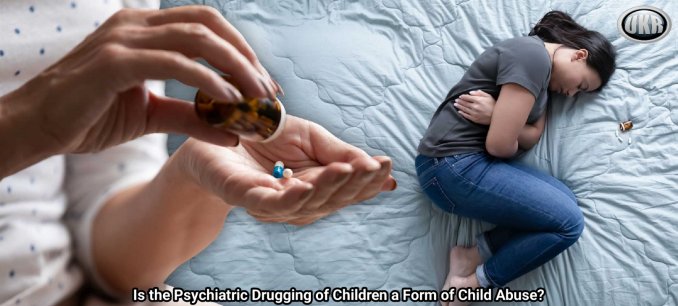
A case that becomes harder to dismiss the longer you look
DR. ROGER MCFILLIN
Let me be direct about something before we go any further.
We call them psychiatric “medications.” We say children are being “medicated” for their “conditions.” This language is a lie.
These are drugs. Chemical compounds made in a factory. They do not correct any known abnormality. They do not heal anything. They are not medicinal in any meaningful sense of the word. They are chemicals that alter brain function to that numb, restrict, and sedate.
We need to stop hiding behind medical language that implies these interventions are “therapeutic” and healing. They are not. They are chemical management of behavior with the potential for severe health consequences. Once we are honest about what we are actually doing to children, the ethical questions become unavoidable.
The Question We Must Answer
I have spent fifteen years in private practice as a clinical psychologist. Before that, I worked in psychiatric hospitals, community mental health, public schools and the juvenile justice system. I have watched what we do to young people in the name of treatment, and it’s a moral and ethical failure.
Federal law defines child abuse as “any act or failure to act on the part of a parent or caretaker which results in death, serious physical or emotional harm” or “an act or failure to act which presents an imminent risk of serious harm.”
The question I want to pose is straightforward: Does the prescription of mind-altering and mood-altering drugs, which carry significant potential for harm and frequently cause it, meet this legal definition?
I believe it does. Here is why.
Rationale #1: No Identifiable or Measurable Biological Foundation for Mental Disorders Exists
If we could identify a biological abnormality that a drug effectively corrects, we would have reasonable justification for the risks involved. We could measure responses empirically and adjust treatment accordingly.
But no such abnormality has been identified. Not for ADHD. Not for depression. Not for anxiety. Not for any psychiatric diagnosis given to children.
Psychiatric diagnoses fail the most basic standards of scientific measurement. They lack both reliability and validity.
Reliability means consistency. If a diagnostic system is reliable, different clinicians evaluating the same child should arrive at the same diagnosis. This does not happen in psychiatry. Studies repeatedly demonstrate that clinicians disagree at alarming rates. One psychiatrist sees ADHD. Another sees anxiety. A third sees oppositional defiant disorder. The same child, the same behaviors, wildly different labels depending on who is in the room. Field trials for the DSM-5 found that many diagnoses failed to reach acceptable reliability thresholds. The system cannot even produce consistent results.
Validity means the diagnosis corresponds to something real and distinct in the world. A valid diagnosis identifies a specific condition with a known cause, predictable course, and targeted treatment. Psychiatric diagnoses meet none of these criteria. There are no biomarkers. No lab tests. No imaging findings. No way to confirm or disconfirm the diagnosis through objective measurement. These categories were created by committees of psychiatrists voting on clusters of behaviors. They are descriptive labels masquerading as medical diagnoses.
The honest history is this: the Diagnostic and Statistical Manual was developed primarily to facilitate insurance billing within the broader healthcare system. It provided codes so that psychiatrists could be reimbursed like other physicians. The appearance of medical legitimacy was the point. Scientific validity was never established because it was never the priority.
The chemical imbalance theory has been formally abandoned. The former director of the National Institute of Mental Health publicly stated that psychiatric diagnoses lack scientific validity. Yet physicians continue telling parents their children have brain disorders based on no objective test whatsoever.
Consider the psychological impact on a child who begins to identify with a psychiatric label. They internalize the message that something is fundamentally wrong with how they think and feel. They believe they are different from other children. They conclude they need drugs to be normal.
Is this not a form of emotional harm?
Any genuine medical disease underlying psychiatric symptoms would be reclassified as a medical condition. If obsessive-compulsive symptoms stem from a streptococcal infection, we treat the infection with antibiotics. If attention problems result from nutritional deficiencies, we address the deficiencies through diet and supplementation.
When we affix psychiatric labels to children without objective confirmation, then drug them with chemicals that cause significant adverse effects and health concerns.
Rationale #2: No Psychiatric Drug Has Been Proven to Objectively Improve the Assigned Mental Disorder
I have spent fifteen years studying psychiatric drug trials, the FDA approval process, and the mechanisms through which these chemicals reach the market. What I have learned disturbs me deeply.
These trials typically last six to twelve weeks. Researchers measure effectiveness through symptom checklists, quantifying whether reported symptoms decrease. The critical problem is that many of these drugs primarily induce emotional numbing or sedation. A person who feels disconnected from their emotions will report fewer symptoms on a checklist. This is not the same as improvement.
The objective is to create enough of a drug effect to generate a statistical difference compared to placebo. That statistical variance should not be mistaken for evidence that a drug treats depression or stabilizes mood. By the same logic, alcohol could be considered an approved treatment for social anxiety.
Pharmaceutical companies have encountered significant challenges demonstrating that antidepressants and other psychiatric drugs outperform placebos in meaningful ways. The illusion that we possess effective pharmacological treatments for childhood emotional and behavioral challenges must be dispelled.
If we are honest about what happens in clinical practice, the primary approach involves attempting to induce emotional numbness and detachment in developing children. This truth is rarely communicated to families.
I hear the same descriptions from young people in my practice over and over. “I feel like a zombie.” “I feel nothing.” “I cannot cry anymore.” “I do not feel like myself.”
This is not treatment. This is chemical suppression of the full range of human emotion in a developing brain. And we call it medicine.
Rationale #3: Psychiatric Drugs Are Proven to Create Harm
Every psychiatric drug approved for children carries a substantial list of side effects. Many are severe. Some are potentially fatal.
Do you want to know the long term effects? Well so do I! However, if you fail to study the long term problems of a drug you do not have to report on it.
Selective Serotonin Reuptake Inhibitors, the most commonly prescribed class of drugs for childhood anxiety and mood disorders, carry a black box warning. This represents the most stringent cautionary label the FDA can issue. The purpose of black box warnings is to alert the public and healthcare providers to grave side effects, including risks of injury or death.
The FDA requires black box warnings when compelling evidence indicates a drug can trigger severe adverse reactions, when benefits do not outweigh risks, when the drug requires restricted usage to protect public safety, or when the drug poses heightened dangers to specific populations, including children.
The black box warning on SSRIs states that these drugs increase suicidality in children and adolescents.
I need you to fully absorb that statement. The drugs most commonly prescribed to treat depression in young people can increase their desire to end their own lives.
I have witnessed this pattern repeatedly in clinical practice. A teenager who was struggling but stable starts an antidepressant. Within weeks, they are engaging in self-harm. They are making suicide plans. They are hospitalized.
In the hospital, the response is often to adjust the drug or add another. The adverse reaction becomes evidence of how sick they truly were.
Within clinical settings, physicians frequently combine drugs in ways that have never been adequately studied. Polypharmacy in pediatric psychiatry is common practice, not the exception. The combinations given to children have often never been evaluated even in adult populations.
This is experimentation. It is conducted on those least able to advocate for themselves.
Rationale #4: Psychiatric Drug Reactions Are Misinterpreted as Mental Disorders, Leading to More Diagnoses and More Drugs
This is perhaps the most insidious aspect of the current system. It creates a self-perpetuating cycle that transforms episodic struggles into chronic disability.
The pattern begins when a physician attributes emotional or behavioral challenges to a simplistic chemical imbalance. Drugs are prescribed that alter brain chemistry and can create genuine neurological changes. When the child displays adverse reactions, these responses are interpreted as manifestations of mental illness.
The misinterpretation becomes justification for additional drugs, additional diagnoses, and further deterioration.
A child enters the system because her parents are divorcing and she is sad. Understandable. Her world has been disrupted. She is prescribed an antidepressant. It makes her agitated and unable to sleep. A second drug is added for the agitation. That causes weight gain and lethargy. A stimulant is added to counteract the lethargy. The stimulant triggers anxiety. A benzodiazepine is added for the anxiety.
Within a few years, this child is taking five psychiatric drugs. She has accumulated diagnoses of major depressive disorder, generalized anxiety disorder, and bipolar disorder. She has been hospitalized. She has dropped out of school. She believes she is fundamentally broken and will need psychiatric management for the rest of her life.
She did not have five psychiatric disorders. She had one: an adverse reaction to psychiatric drugs that was misinterpreted at every turn.
This system transforms episodic and even typical variations in behavior into chronic disabilities. It creates the very conditions it claims to treat.
This Is Child Abuse
I use this language deliberately.
When we label children with psychiatric disorders based on no objective biological evidence, we cause emotional harm.
When we prescribe drugs that carry black box warnings for suicidality, that cause neurological changes, sexual dysfunction, metabolic disruption, and emotional blunting, we cause physical harm.
When we interpret adverse drug reactions as evidence of worsening mental illness and respond with additional drugs, we perpetuate harm.
When we transform children experiencing normal human responses to difficult circumstances into lifelong psychiatric patients, we cause profound harm to their identity, their development, and their future.
The fact that this occurs in medical settings does not change what it is.
The fact that it is performed by credentialed professionals does not change what it is.
The fact that insurance covers it does not change what it is.
We are systematically harming children while calling it care. And until we name it clearly, nothing will change.
AWAKEN
I would not have dedicated my career to exposing these problems if I did not believe alternatives exist.
Children do not need to be diagnosed and drugged. They need to be understood.
Anxiety is not a disorder. It is information. A child’s nervous system communicates that something requires attention in their environment, their relationships, their nutrition, their sleep, their sense of safety and belonging. Many need to LEARN how to face and tolerate fear, uncertainty and anxiety provoking situations. It’s part of the journey.
Address the root causes. Create genuine safety. Build authentic connection. Teach skills for understanding and navigating difficult emotions. Support the family system. Examine what the child is eating, how they are sleeping, whether they are moving their bodies, whether they have purpose and meaning. If you are on your phone for 8 plus hours a day I guarantee you are going to be miserable. You do not have a genetic condition called “Major Depressive Disorder” and “ADHD”.
We have collectively lost our minds.
I have watched children labeled treatment-resistant transform when we stopped drugging their symptoms and started addressing their lives. Not occasionally. Repeatedly. Consistently.
The psychiatric system does not want families to know this is possible. Healthy children do not generate recurring revenue.
But it is possible. And families deserve to know.
A Challenge
If you are a prescriber who puts developing children on psychiatric drugs without exhausting other options, without providing genuine informed consent about the risks, without a clear plan for eventual discontinuation, I ask you to reconsider what you are participating in.
If you are a parent who was told your child has a brain disease requiring lifelong medication, please know that you were not given accurate information. Seek other opinions. Explore other approaches. Your child’s future may depend on it.
If you are a young person who was drugged into compliance and told there was something fundamentally wrong with you, I want you to hear this: There was not. There is not. You were a human being having a human experience within a system that profits from your suffering.
The psychiatric drugging of children is one of the defining moral failures of our era. I will continue saying so until something changes.
I try to keep RADICALLY GENUINE as free as I can, but it takes quite a lot of work. If you find some value in my writing and podcast I very much appreciate the paid subscription. It really helps me continue putting time aside for these pieces. Thank you.
This article (Is the Psychiatric Drugging of Children a Form of Child Abuse?) was created and published by Conservative Woman and is republished here under “Fair Use” with attribution to the author Dr. Roger McFillin

••••
The Liberty Beacon Project is now expanding at a near exponential rate, and for this we are grateful and excited! But we must also be practical. For 7 years we have not asked for any donations, and have built this project with our own funds as we grew. We are now experiencing ever increasing growing pains due to the large number of websites and projects we represent. So we have just installed donation buttons on our websites and ask that you consider this when you visit them. Nothing is too small. We thank you for all your support and your considerations … (TLB)
••••
Comment Policy: As a privately owned web site, we reserve the right to remove comments that contain spam, advertising, vulgarity, threats of violence, racism, or personal/abusive attacks on other users. This also applies to trolling, the use of more than one alias, or just intentional mischief. Enforcement of this policy is at the discretion of this websites administrators. Repeat offenders may be blocked or permanently banned without prior warning.
••••
Disclaimer: TLB websites contain copyrighted material the use of which has not always been specifically authorized by the copyright owner. We are making such material available to our readers under the provisions of “fair use” in an effort to advance a better understanding of political, health, economic and social issues. The material on this site is distributed without profit to those who have expressed a prior interest in receiving it for research and educational purposes. If you wish to use copyrighted material for purposes other than “fair use” you must request permission from the copyright owner.
••••
Disclaimer: The information and opinions shared are for informational purposes only including, but not limited to, text, graphics, images and other material are not intended as medical advice or instruction. Nothing mentioned is intended to be a substitute for professional medical advice, diagnosis or treatment.
Disclaimer: The views and opinions expressed in this article are those of the author and do not necessarily reflect the official policy or position of The Liberty Beacon Project.


Leave a Reply