

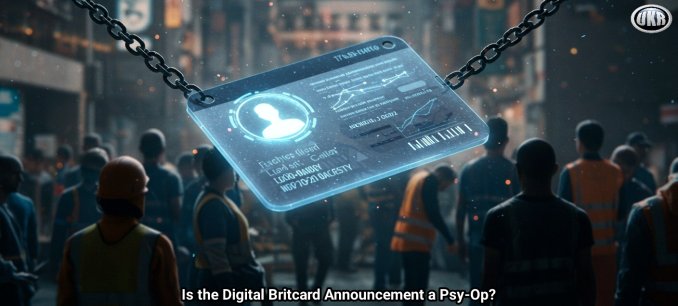
Is the digital Britcard announcement a psy-op?
CONSCIENTIOUS CURRENCY
While we all fixate on Keir Starmer’s announcement of the digital BritCard, the machinery of a full-blown surveillance state has already been quietly assembled. The digital ID infrastructure is not coming—it’s here. And disturbingly, millions are opting into it without even realising.
Behind the polished language of “streamlining services” and “modern identity verification” lies a psychological campaign that has been designed to normalise constant monitoring, behavioural profiling, and algorithmic governance. The BritCard is merely the visible tip of a vast, invisible system—one that’s embedding itself into daily life, app by app, click by click.
Watch this video to understand how manipulation is being weaponised to ensure compliance to the digital system that is already in place. Every tap, scan, and login is a step deeper into a digital labyrinth where autonomy is traded for access.
We must act now – before the last exit disappears – and extract ourselves from these systems whilst we still can.
Below is *most of* what I say in this video, in case you prefer to read it or print it out for future reference later.
I am picking up on my article on state-level psychological manipulation again today as it is a fascinating, yet extremely concerning, lens, for unpacking the policy rollout of digital ID.
I am going to call it now – we are already in a psychological operation as regards the digital Britcard announcement, whilst the actual architecture for digital ID is already in place, and people are opting in without even realising it – the “back door” dynamic.
The BritCard announcement dropped in late September 2025 as a bold, mandatory work-check scheme to “secure borders”. This has grabbed headlines and sparked a petition which has now over 3 million signatures. However, I want to somewhat controversially say that this is arguably a distraction from the quieter, more insidious integrations happening via legislation like the Data (Use and Access) Act 2025 (which got Royal Assent in June) and the Children’s Wellbeing and Schools Bill (still progressing through Parliament). These both embed digital ID elements into everyday systems—GOV.UK One Login for pensions and services, GOV.UK Wallet for document storage, NHS App expansions for health data, and mandatory unique child identifiers in education/social care. In addition identity proofs are soon to be required for company directors (established under earlier legislation with the identity verification process to become legally mandated from November 18, 2025), all without a big “digitial ID card” fanfare. In other words, people are signing up piecemeal for convenience, and suddenly opting out will be become impossible.
This soft implementation is textbook gradualism, leveraging the 12 techniques I wrote about in my last article and deployed to normalise surveillance and compliance. In today’s video I break this down by technique, mapping how each could (and likely is) being deployed across the aforementioned provisions. I focus on real-world hooks from the bills/apps, showing how they create a web of dependency and where it fits, I also note crossovers between techniques for efficiency.
1. Gaslighting (Making people doubt their perceptions of control/privacy)
- Deployment: Frame non-mandatory elements as “voluntary enhancements” while burying the lock-in effects.For instance, the Data Act’s GOV.UK One Login is pitched as a “secure single sign-on” for services like pensions or benefits—users think they’re just streamlining logins, but once verified (via photo ID, biometrics, or bank data), it’s linked to everything – from pensions and benefits to tax records . Doubt creeps in when people realise they can’t access pensions without it (”Did I agree to this they ask themselves?”), but official comms gaslight by insisting “no mandatory ID system exists.”Also, the NHS App’s widened provisions under the Data Use and Access Act (enabling “single patient records” shareable across trusts) similarly starts as “faster appointments,” but users are being gaslit because the data sharing they have agreed to is not optional – because its tied to care access.
- Back-door effect: BritCard is pitched as the “obvious threat” to rally against, distracting from how One Login/Wallet NHS app etc already verifies 90%+ of adults via smartphones.
2. Bandwagon Effect (Everyone’s doing it, so you should too)
- Deployment: Social proof via mass adoptionCampaigns highlight “millions already using GOV.UK One Login for seamless services,” creating peer pressure—for instance, parents see friends uploading kids’ data to the unique child identifier system (mandatory for education/social care tracking under the Children’s Bill, no opt-out for at-risk cases).For company owners, the “verify your identity” mandate at Companies House is normalised by marketing speak such as “all “legitimate” directors are complying to avoid fines.”
- Back-door effect: By the time 70%+ have NHS Apps, One log in etc, holdouts will begin to feel isolated, especially if pension dashboards require it for “finding lost pots or it is needed to access care or benefits.”
3. Scarcity Manipulation (Limited-time access or exclusion)
- Deployment: Time-bound rollouts creating urgency.For instance, the GOV.UK Wallet’s phased launch (Veteran Cards first, then perhaps driving licences etc) is likely to use“limited beta access” to hook early adopters, while commentary around the Data Act’s digital verification services will warn of “delays in benefits/pensions without it.”
- Back-door effect: Scarcity of “easy access” (e.g., NHS App for quick prescriptions) makes non-users feel locked out of timely care, pushing 93% smartphone owners into the ecosystem.
4. Framing (Shaping the narrative to emphasise benefits over risks)
- Deployment: Positive spin dominates over this whole area with marketing speak such as: “Streamline life admin” for One Login/Wallet or “one secure place on your phone” for docs, saving hours on pensions/tax, or “Save 140,000 NHS staff hours through the NHS app for better care”, or “the children’s unique identifier means “no child falls through cracks,” completely ignoring privacy erosion.Meanwhile BritCard itself is being framed as the “tough border tool,” completely overshadowing what is going on in the background as regards soft mandates like company ID proofs and children’s unique identifier.
- Back-door effect: Risks (e.g., data breaches in One Login, ransomware attacks etcare reframed as “teething issues in a privacy-first system.”
5. Guilt and Moral Shaming (Appealing to ethics to coerce)
- Deployment: Tug at parental/societal duty.For the Children’s Bill, non-compliance with the identifier/register could be implied as “risking child exploitation/abuse,” and holdouts as neglectful. As regards the NHS App uptake this is framed as “Don’t delay your family’s health data sharing is for thier safety and own good.”Likewise, company owners face “moral” pressure to verify via One Login to “fight economic crime” whilst simultaneously being told their company will simply be removed from companies house if they do not comply. No mention is made that company owners can actually complete some of the verification requirements by other methods, say at the post office, for this purpose – see here.
- Back-door effect: Ties into BritCard’s “stop illegal work” framing, guilting citizens into broader ID acceptance as “responsible patriots.”
6. FOMO (Fear of Missing Out) (Anxiety over exclusion from benefits)
- Deployment: Highlight perks like “free childcare apps” or “lost pension finder” via One Login, “faster and better child services and school support” with child ID’s and the risk of appointment delays or unavailability unless the NHS app is used for the same.
- Back-door effect: Creates FOMO loops—sign up for one (e.g., Wallet for driving licence), and it pulls in others (pensions, health).
7. Carrot and Stick (Rewards for compliance, punishments for resistance)
- Carrot: Convenience rewards—e.g., Wallet’s “save docs to phone” for quick verifications, or NHS data sharing makes for “personalised faster health care.”
- Stick: Fines/delays for non-use, like Companies House penalties for unverified directors.
- Back-door effect: Sticks escalate subtly (e.g., pension access blocks), while carrots normalise.
8. Othering (Dividing into “us” vs. “them”)
- Deployment: Pit “law-abiding citizens using secure IDs” against “illegal workers” or “neglectful parents evading registers” or “law breaking” company owners.”Amplify this by targeting migrants in particular but use other soft tools such as “privacy paranoids” being outliers blocking progress or “child safety.”
- Back-door effect: Makes resistance seem anti-social, isolating critics.
9.Cognitive Overload (Overwhelm with info/details to bypass scrutiny)
- Deployment: Use official means and documents for this.Bills and Acts of Parliament are dense and written in language difficult for the average person to understand. Legislation also cross references other legislation already in place making it really hard for people to understand what they are reading. Users also face app T&Cs and frankly no one reads all of this in depth and hence they do not know what they are agreeing to. In other words they CANNOT GIVE INFORMED CONSENT.
- Back-door effect: People click “accept” without reading, adopting piecemeal, and not having any real understanding of what they are signing up to.
10. Authority Bias Exploitation (Defer to “experts”/govt)
- Deployment: Proliferate messaging such as trust in “GOV.UK certified” systems—e.g., One Login’s “government-backed security” for pensions/company IDs.The Children’s Bill also leveraged DfE/Commissioner endorsements for identifiers and the NHS app is “doctor-recommended.”
- Back-door effect: You should distrusts “conspiracy” warnings about surveillance.
11. Emotional Priming (Evoke fear/hope to influence)
- Deployment: Fear of “missing kids” primes child ID uptake; hope for “healthcare revolution” sells NHS expansions, gov wallet taps into hope for “fraud-free and convenient life” and BritCard primes migration fears.
- Back-door effect: Emotions override privacy, surveillance and state overreach concerns.
12. Desensitisation (Gradual exposure to normalise)
- Deployment: Start small—One Login for one service, then pensions, then Wallet docs, NHS records, child tracking Stack a layer on every few months and seel it as progress.By 2027, digitial ID has become ubiquitous without a “big bang” and this is the REAL DANGER.
- Back-door effect: What felt invasive in 2025 (e.g., biometrics, online authentication etc), is routine by 2026. Then mission creep appears and it is no food or travel or internet access, if the central controllers of the digitial data that you have so freely handed over, decide that they do not like your politics, what you are saying online, or the fact that you buy more than 2 steaks a week.
In combo, all the above is a masterclass in manipulation: Desensitisation via overload, primed by authority and emotion, reinforced by bandwagon carrots/sticks—while gaslighting framing it as “your choice” when it is ANYTHING BUT. Hence, the Britcard decoy announcement has worked, because it has funnelled outrage AWAY FROM from the large percentage of people already onboard with digital ID through the architecture that is already in place and which I have discussed above. Without knowing this, people will continue to opt into digital ID systems without realising that they are doing so, and one day we will all wake up and paper ID’s will just no longer be acceptable.
Given this, the soft implementation of digital ID in the UK is actually just as much of a threat as digital Britcard and will be woven through systems like pensions dashboards, welfare benefits, banking, and employer right-to-work checks. This demands vigilance, as “convenience” is simply masking creeping control. Watch for nudge tactics in everyday interactions: GOV.UK One Login for pensions or, say, Universal Credit claims, will lure users with promises of “streamlined access” but then lock them into verified ecosystems, often requiring biometrics or bank data that feed into broader surveillance networks. Banks, quick to adopt Digital Verification Services (DVS) under the Data (Use and Access) Act 2025, will likely push “instant account openings” while sharing data across sectors. Employers, nudged by updated 2025 guidance to use DVS for faster right-to-work checks, may sideline paper-based options, pressuring workers into digital compliance. These touchpoints exploit FOMO, authority bias, and desensitisation, making opting out feel impractical—particularly for vulnerable groups like the unbanked or non-digital pensioners, who face exclusion from essential services. The dangers lie in this gradual erosion of choice, where interconnected systems create a de facto mandate without public debate.
Also, look out for escalating “sticks”—delayed benefits, job rejections, or account freezes for non-users of digital ID—paired with carrots like time-saving apps or fraud protection that normalise data sharing.
And be aware – as soon as pensions and welfare start a phased integration with DVS – via the Pensions Dashboards Programme aiming to connect all pensions to a single online location, providing personalised information about pensions and other benefits by October 31, 2026 – the unbanked (1.5 million adults) and tech-averse (10% of pensioners) risk being locked out. At the same time centralised data hubs will of course amplify breach risks, as seen in various ransomware attacks and hacks around the world. Finally, an employers’ shift to digital right to work checks will blacklist anyone without apps, deepening inequities.
For those resisting, the pressure to conform will only grow as paper routes vanish or become overly complicated or bureaucratic to adopt, whilst new digital systems are sold as “voluntary”, quietly reshaping autonomy into a privilege for the compliant.
So be prepared to be awkward, difficult and inconvenienced as we fight for our right to use paper and keep privacy, and be prepared for the pejorative attacks to caricature all critics of this tech as backward, anti-progress, and irrationally tech-phobic. These are just othering and moral shaming techniques discussed earlier, to marginalise dissent.
Stay strong everyone!
This article (Is the digital Britcard announcement a psy-op?) was created and published by Conscientious Currency and is republished here under “Fair Use”
See Related Article Below
The BritCard Digital ID Psyop
IAIN DAVIS
Following my recent article “The BritCard Digital ID Psyop” I was delighted to be invited by Paul Brennan to discuss the BritCard and all things digital ID on his Breakfast show for Reality Check Radio.
The BritCard has stimulated debate about digital ID. I’m sure Newsnight and Question Time will cover it. We can argue the pros and cons and consider if we want digital ID. Then we will either accept or reject the BritCard, imagining that it represents the totality of digital ID, and the issue will be resolved.
I believe this is the point of BritCard. It is not necessarily designed to convince us to accept digital ID, merely to resolve the issue, for the time being, in the public square.
Unfortunately, as I explore in the article, and as Paul and I discuss, the digital ID system that is already prepared for us does not require us to adopt a single digital ID card or app. If we reject the BritCard, as seems likely, this will simply instruct the state how to proceed with the rollout of digital ID in the UK.
A few topics came up and some additional relevant links are below:
Central Bank Digital Currency is the Endgame – Part 1
Central Bank Digital Currency is the Endgame – Part 2
The Trilateralist Keir Starmer
Exploring the Alleged Far-Right Riots
And here are a few more:
This article (The BritCard Digital ID Psyop Discussed) was created and published by Iain Davis and is republished here under “Fair Use”
Featured image: capwolf.com

••••
The Liberty Beacon Project is now expanding at a near exponential rate, and for this we are grateful and excited! But we must also be practical. For 7 years we have not asked for any donations, and have built this project with our own funds as we grew. We are now experiencing ever increasing growing pains due to the large number of websites and projects we represent. So we have just installed donation buttons on our websites and ask that you consider this when you visit them. Nothing is too small. We thank you for all your support and your considerations … (TLB)
••••
Comment Policy: As a privately owned web site, we reserve the right to remove comments that contain spam, advertising, vulgarity, threats of violence, racism, or personal/abusive attacks on other users. This also applies to trolling, the use of more than one alias, or just intentional mischief. Enforcement of this policy is at the discretion of this websites administrators. Repeat offenders may be blocked or permanently banned without prior warning.
••••
Disclaimer: TLB websites contain copyrighted material the use of which has not always been specifically authorized by the copyright owner. We are making such material available to our readers under the provisions of “fair use” in an effort to advance a better understanding of political, health, economic and social issues. The material on this site is distributed without profit to those who have expressed a prior interest in receiving it for research and educational purposes. If you wish to use copyrighted material for purposes other than “fair use” you must request permission from the copyright owner.
••••
Disclaimer: The information and opinions shared are for informational purposes only including, but not limited to, text, graphics, images and other material are not intended as medical advice or instruction. Nothing mentioned is intended to be a substitute for professional medical advice, diagnosis or treatment.
Disclaimer: The views and opinions expressed in this article are those of the author and do not necessarily reflect the official policy or position of The Liberty Beacon Project.


Leave a Reply