DAN FRIETH
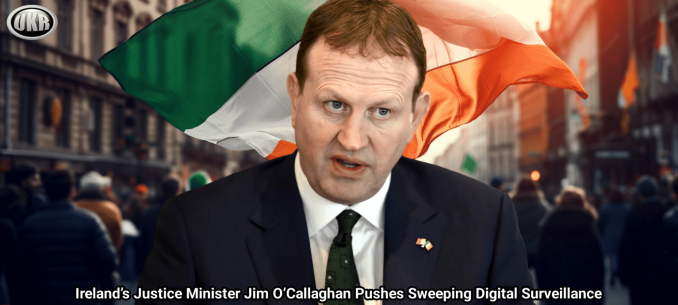
Ireland’s Justice Minister Jim O’Callaghan, who has already made headlines for advocating a backdoor to encrypted messaging, is now talking about advancing a broader set of surveillance expansions that signal a growing shift in state powers over digital privacy.
Under the idea of combating online child exploitation and enhancing public security, O’Callaghan is supporting measures that would compel digital platforms to scan users’ private files and photographs. He acknowledges this would “impinge on the right to privacy,” but argues such compromises are necessary.
O’Callaghan’s agenda is based on a stark proposition: that privacy must routinely be subordinated to vague notions of collective security. His legislative blueprint seeks to dramatically expand state surveillance capabilities; encompassing personal communications, encrypted services, and biometric identification, under a framework that offers little more than rhetorical nods to oversight.
Promises of “judicial authorisation” and “safeguards” do little to counter the alarming scale of intrusion being proposed.
O’Callaghan’s plan includes a sweeping embrace of facial recognition technology (FRT) in multiple forms. One proposed change would amend the Recording Devices Act 2023, enabling the Gardaí to retrospectively process biometric data.
Another forthcoming bill aims to legalize both retrospective and potentially live biometric analysis. This includes the creation of a national facial image database aligned with the EU’s Prüm II Regulation for cross-border policing, and a path to real-time biometric surveillance permitted under the EU AI Act, though subject to judicial approval.
Addressing the IIEA, O’Callaghan delivered remarks defending these proposals by framing them as careful balancing acts between privacy and public safety. While acknowledging that the technologies and laws he promotes could infringe on civil liberties, he suggested these tensions are an unavoidable part of governing. “There is a need to grapple with the question of what data we will permit Gardaí to access,” he stated, casting doubt on whether privacy can continue to take precedence when lives may be at stake.
One of the more contentious areas of his plan involves updating the Interception of Postal Packets and Telecommunications Messages Act of 1993. This outdated law doesn’t cover encrypted or internet-based messaging, which O’Callaghan considers a major gap. He pointed to EU-level concerns over the increasing reliance on digital evidence in criminal investigations and expressed interest in expanding interception powers to include end-to-end encrypted services.
A new legislative package, the Communications (Interception and Lawful Access) Bill, is in development, and would introduce judicial oversight for the first time, alongside provisions specifically targeting encrypted communications.
Despite international warnings about the security and human rights risks of weakening encryption, O’Callaghan insists such powers are vital for national security. “Some companies and commentators argue that it is not technically possible to provide for lawful interception of encrypted digital communications or… it should not be permitted,” he said, but maintained that the state cannot allow technology to outpace law enforcement’s reach.
O’Callaghan has also voiced strong support for an EU Child Sexual Abuse Regulation that would obligate companies to scan digital content for illicit material. Framing opposition as a dangerous prioritization of privacy over child safety, he said, “I am not blind to the fact that this proposal will impinge upon the right to privacy,” but insisted that companies should not be allowed to opt out. This would mark a significant expansion of state surveillance over private communications, if adopted.
On the subject of biometric surveillance, O’Callaghan claims the debate has been distorted by what he called misinformed fears. The new FRT legislation, he asserted, would be used strictly for serious crimes, national security, and missing persons investigations, and would be accompanied by public codes of conduct and human rights impact assessments. Still, he made clear that this is only the beginning. Once the initial system is in place, broader powers are expected to follow.
Throughout his speech, O’Callaghan stressed that individual privacy must sometimes yield to collective interests, especially when technological change challenges traditional forms of law enforcement. He took issue with what he described as an overemphasis on privacy at the expense of other rights, cautioning that treating it as “more significant than any of the others” could result in policy failures.
This article (Ireland’s Justice Minister Jim O’Callaghan Pushes Sweeping Digital Surveillance) was created and published by Reclaim the Net and is republished here under “Fair Use” with attribution to the author Dan Frieth






Leave a Reply