

A couple of years ago (July 2023) the Telegraph carried a piece reporting that the International Energy Agency was warning of the need to step up mining of lithium, copper and nickel if international Net Zero targets are to be met.
In May 2024, Tom Stevenson, also writing in the Telegraph said that key growth sectors have an insatiable appetite for the conductive metal, and warned of an impending copper crisis:
Think about today’s growth sectors – renewable energy generation, electric vehicles, AI – and the one thing they all have in common is an insatiable appetite for copper. To take one example, it requires three times as much copper to generate the same amount of electricity on a solar farm as in a gas-fired power station. Nearly eight times as much using offshore wind.
In fact, the price rises aren’t linear, and they are affected by other factors. Trump’s latest 100% tariffs on China have caused a significant drop, according to the Trading Economics website:
Copper futures plunged more than 4% to below $4.90 per pound on Friday after President Trump warned of a “massive increase” in tariffs on Chinese goods.
There is a limit to what customers will pay for copper, especially the big ones like China, and it may well be that AI demand has “been overstated” says Goldman Sachs, cited here.
Nevertheless, despite a levelling off, the long-term trend is upwards, says Trading Economics:
Over the past month, Copper’s price has risen 4.07%, and is up 7.81% compared to the same time last year, according to trading on a contract for difference (CFD) that tracks the benchmark market for this commodity. Historically, Copper reached an all time high of $5.94 per pound in July of 2025.
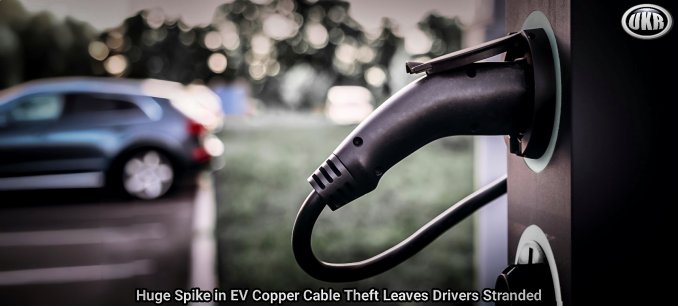
But the cost of copper has exposed the Achilles heel of EVs. Unlike petrol stored in underground tanks at filling stations, EV chargers have nicely accessible dangling copper charging cables vulnerable to any thief with a pair of clippers. And, as more and more of us know to our cost in Britain, anything not nailed down or riveted to concrete is likely to be nicked. The Telegraph reports a rising spate of cable thefts that could compromise EV sales, in this instance apparently using an EV to avoid suspicion:
Shortly before midnight on a Friday two weeks ago, a man in a black hoodie and shorts emerged from the trees near a roadside pub in Chelmsford, Essex, brandishing a pair of garden shears.
One by one, he cut the cables attached to four electric car charging stations before disappearing back into the darkness.
A few minutes later, a black Ford Mustang Mach E pulled up to the chargers. CCTV footage shows the same man getting out of the car, grabbing the charging cable as if to plug in, before quickly bundling it into his boot.
A similar car was spotted at another theft from a Morrison’s filling station in Farnborough, Hants:
It could not be confirmed that the car or driver was the same, but this time, the individual was not so lucky.
Remote security staff called the police after spotting him. Officers arrived on the scene as the driver was attempting to cut a second cable and apprehended him.
Police searched the 32 year-old and found class A drugs, a flip knife and shears. They also seized false number plates and a collection of severed cables in the car’s boot. He has been released as the investigation continues.
It’s not clear what is more remarkable about the second theft, that the police turned up at all or that having done so they released the culprit. James Moat, the Chief Executive of charging company Evyve, whose Essex site was the one hit, estimates that:
Of Evyve’s 300 chargers, around 100 have been hit in the last 12 months, in some cases repeatedly. Each replacement costs him around £30,000, plus thousands of pounds extra in security measures. “It’s become a national problem, and really kind of has started to ramp up at scale,” he says. “There doesn’t seem to be any deterrent to stop an individual from doing it.”
The rise in thefts has been attributed to the soaring price of copper.
The metal, widely used in electric cables, last week climbed to $11,000 (£8,200) a tonne, up from around $7,500 three years ago.
Although each cable only has around £30 worth of copper, bays of six or more chargers mean it can add up.”
The problem is spreading across Britain and of course there is only one way the charging companies are going to try and recover the cost:
At a peak this summer, Osprey [one of the largest UK charging networks] estimates that one in 10 of the UK’s 17,000 rapid and ultra-rapid chargers were out of action due to cable thefts.
InstaVolt, Britain’s biggest rapid charging network, says 990 cables have been stolen since 2023 – the majority of them this year.
All sorts of initiatives are being tried, including GPS trackers attached to the cables and armoured sheathing, but they all ratchet up the costs to say nothing of the hapless EV driver who turns up to find a collection of impotent amputated chargers.
The market only exists because of scrap dealers prepared to ask no questions.
But the story is an excellent example of how grand schemes conceived in places like Whitehall can founder on all sorts of detail that wasn’t considered. EVs are already vulnerable to higher purchase costs, questions about battery life, software upgrades enforcing premature obsolescence, charger availability, and now vandalised chargers.
The question then is whether these thefts are going to help slow further the sale of EVs. There would be nothing like driving up with a nearly flat battery to a slashed charger on a dark rainy night to wish you’d hung on to that petrol SUV a little bit longer. Let’s not forget, under the last and present governments’ plans to destroy the British car industry, there will be no more conventional petrol cars on sale in Britain by 2030.
The Telegraph’s piece is worth reading in full.

••••
The Liberty Beacon Project is now expanding at a near exponential rate, and for this we are grateful and excited! But we must also be practical. For 7 years we have not asked for any donations, and have built this project with our own funds as we grew. We are now experiencing ever increasing growing pains due to the large number of websites and projects we represent. So we have just installed donation buttons on our websites and ask that you consider this when you visit them. Nothing is too small. We thank you for all your support and your considerations … (TLB)
••••
Comment Policy: As a privately owned web site, we reserve the right to remove comments that contain spam, advertising, vulgarity, threats of violence, racism, or personal/abusive attacks on other users. This also applies to trolling, the use of more than one alias, or just intentional mischief. Enforcement of this policy is at the discretion of this websites administrators. Repeat offenders may be blocked or permanently banned without prior warning.
••••
Disclaimer: TLB websites contain copyrighted material the use of which has not always been specifically authorized by the copyright owner. We are making such material available to our readers under the provisions of “fair use” in an effort to advance a better understanding of political, health, economic and social issues. The material on this site is distributed without profit to those who have expressed a prior interest in receiving it for research and educational purposes. If you wish to use copyrighted material for purposes other than “fair use” you must request permission from the copyright owner.
••••
Disclaimer: The information and opinions shared are for informational purposes only including, but not limited to, text, graphics, images and other material are not intended as medical advice or instruction. Nothing mentioned is intended to be a substitute for professional medical advice, diagnosis or treatment.
Disclaimer: The views and opinions expressed in this article are those of the author and do not necessarily reflect the official policy or position of The Liberty Beacon Project.


Leave a Reply