
IAIN DAVIS
In Part 1, responding to David Lammy’s attempt to deny our constitutional right to trial by jury, we discussed the fact that the UK government is a franchise of the global public-private partnership (G3P). The UK G3P-state—represented by the executive branch of government, the legislative branch, and the bulk of the judiciary—is one among many functional oligarchies.
We outlined how “representative democracy” (RD) is not democracy. Democracy is a system of governance of the people, by the people, and for the people administered through jury-led trials where the jury’s objective is to maintain and restore natural justice—the rule of law.
We considered just a few of the many legislative steps the UK G3P-state has been able to inflict on us to lay the foundations for its UK dictatorship. We pointed out that all of this legislation, and much more besides, is contrary to the rule of law and therefore constitutes a form of domestic lawfare.
In this article, we’ll discuss how we can defend ourselves against the G3P-state’s unlawful attack on our ancient rights and liberties.
*******************
There is a clear distinction between what is lawful—the rule of law—and what is legal—legislation, regulations and case-law precedents. The useful website LegalClarity explains:
“Legal” refers to that which is permitted, required, or sanctioned by written, codified law. This encompasses statutes enacted by legislative bodies, regulations issued by governmental agencies, and judicial precedents established through court decisions. [. . .] “Lawful” extends beyond mere adherence to written rules, encompassing broader principles of justice, morality, natural law, or generally accepted societal norms and customs. It suggests a sense of rightness or ethical propriety that may exist independently of, or in tension with, codified law. Actions considered lawful are morally permissible, just, or align with fundamental rights and principles, even if not explicitly written into statute. [Emphasis Added]
That which is legal, such as G3P-state legislation or common law case precedents, may not be lawful. We have no lawful obligation to comply with any “legal” decision, such as legislation, that is not lawful.
It is only we, the people, who decide what is lawful or unlawful. This truth is reaffirmed in our written codified constitution, which the G3P-state refuses to acknowledge, and in the G3P-state’s preferred legal system.
The principle that we are all equal before the law is revered in the Universal Declaration of Human Rights (UDHR). The preamble acknowledges that “the equal and inalienable rights of all members of the human family is the foundation of freedom, justice and peace in the world.” That is to say, there cannot be freedom, justice and peace in the world if the equal and inalienable rights of any one of us are ignored, denied or abused.
Article 1 of the UDHR states: “All human beings are born free and equal in dignity and rights.” Article 3 declares: “Everyone has the right to life, liberty and the security of person.” Article 6 says: “Everyone has the right to recognition everywhere as a person before the law.” And Article 7 determines that “All are equal before the law and are entitled without any discrimination to equal protection of the law.”
The UDHR, agreed by the United Nations General Assembly in 1948, is not legally binding. The UDHR did, however, form the basis for the European Convention on Human Rights (ECHR) which has been legally enforceable across Europe since 1950 and was incorporated into UK legislation in 1998. Again, the principle of equality before the law is clearly noted in the preamble the ECHR which reiterates that our equal rights and freedoms before the law are “the foundation of freedom, justice and peace in the world.”
ECHR Article 5 determines that we all have “the right to liberty and security of person.” Article 8 decrees that we all have a right to privacy including in all correspondence. Article 9 states that we all have the right to freedom of thought and Article 10 establishes our legal right to freely express those opinions, including the freedom to “receive and impart information and ideas without interference by public authority and regardless of frontiers.”
While there is no doubt that the rule of law dictates that all are equal before the law, and despite that lawful principle being the foundational premise upon which our society is based, and regardless of that principle being exalted, the concept of equality before the law is ignored completely by the subsequent legal declarations set forth in the ECHR and other seminal legal documents.
For example, while ECHR Article 10 claims to guarantee our inalienable right to freedom of expression, it then adds that this right is limited by certain legal criteria and “may be subject to such formalities, conditions, restrictions or penalties as are prescribed by law and are necessary in a democratic society.” [Emphasis added]
The ECHR misuses the word “law” and wrongly infers that legality is the whole of the law. Once determined legally, our inalienable freedoms and rights can supposedly be “permitted” or “sanctioned.”
This reveals a major problem we have to confront. The G3P-state and its serving kakistocrats deceitfully insist that legal and lawful are synonymous. As the G3P’s puppet kakistocrats claim the authority to command and control legality, they deceptively imply they also control the law. The reason for this treachery is transparent.
Everyone is equal before the law and the sovereign rule of law does not bestow additional authority of any kind on any individual or group. Whereas, the legal system centralises power in the hands of G3P-Establishment’s appointed “lawmakers.” By pretending that legal means lawful, the UK G3P-state has unlawfully elevated itself above the law. This trick has been successful, to date, because we have allowed the Establishment to get away with it.
The tactic of pretending that everything that is legal is therefore lawful is exemplified by the UK Human Rights Act 1998 (HRA). The HRA is based on the European “convention rights” but makes no mention of the inalienable rights which the ECHR ostensibly holds sacrosanct.
By conflating legal with lawful, these legal documents flagrantly disregard the principle in law that there are no exceptions to equality before the law and that we all have “equal and inalienable rights.” This subterfuge recasts our lawful rights as legally proscribed “human rights” that are merely behavioural permits. Human rights are restricted by whatever conditions the G3P-state and its servile kakistocrats allege they have the right to impose.
The asserted legal authority to arbitrate our rights and freedoms, whether written in the ECHR or copied onto the UK statute books, is unlawful. No such authority exists.
Inalienable rights are not human rights granted by some G3P-state official, a European Court or any Establishment appointed “lawmaker.” Inalienable rights are rooted in “justice, morality, natural law, or generally accepted societal norms and customs.”
*******************
Natural law is the foundation of both our rule of law and, supposedly, our legal system—or so we are told. Restoring natural justice is a duty we all share equally. That collective responsibility is clearly stipulated in our written codified constitution. The UK parliament falsely proclaims that the British people don’t have a written codified constitution. We’ll get to this deceit too, in a moment.
Regrettably, due to centuries of being subjected to obfuscating propaganda, most Brits don’t understand natural law, imagining it some nebulous theoretical concept. In truth, natural law is rock-solid and very easy to understand.
Natural law repudiates moral relativism. Morality is the “quality of being right” and is defined as “[the] personal or social standards for good or bad behaviour and character.” It is by our actions and through our conduct—not our thoughts, feelings or beliefs—that we are either moral or immoral human beings. Our behaviour and our actions are either right or they are wrong—moral or immoral.
Over hundreds of years, we have been taught by those who desire to rule—today embodied by the G3P-state—that we are either too weak or too stupid to live moral lives or to deal justly with people who are immoral. According to the most immoral class of human beings that has ever lived, we must submit to their alleged legal authority in order to maintain a functioning society. This is devious babble—or propaganda.
The Establishment has peddled the myth of moral relativism for centuries. While we believe this pabulum, we are left in a self-delusional state. We are condemned to collectively conceive ourselves incapable of determining right from wrong. We accept the lie that determining right from wrong is dependent upon what we believe—our individual perspective—and the task of judging right from wrong is, therefore, beyond us.
The Establishment has deceived us because, if we don’t understand objective morality—natural law—we can easily be coerced by the G3P-Establishment’s kakistocrats to tolerate, support and even commit morally reprehensible acts. This explains why the G3P’s gatekeepers (see Part 1) keep trying to convince us that morality is subjective.
One of the worst among the propagandist gatekeeper organisations, the BBC, is currently teaching our children:
There is no set of rules, because what might be considered immoral in one situation could be considered the most moral thing to do in another.
This is a malevolent lie. Through our understanding of natural law, there is unquestionably a clearly defined and easily comprehensible “set of rules.”
Innately, the vast majority of us—perhaps with the exception of sociopaths, psychopaths, and megalomaniacs—know what is right and we naturally feel guilt when we do something wrong. As highlighted by researcher, author and independent film maker Mark Passio, there are just seven identifiable acts that natural law objectively determines to be immoral and therefore “wrong”:
Murder, Assault, Rape, Theft, Trespass, Coercion, and Deception
It is self-evident that these acts are wrong. All of these acts are objectively immoral and nearly everyone can easily grasp that fact. No one on earth, nor any government, has any lawful “right” to perpetrate any of these acts—to indulge in these behaviours.
The lie of moral relativism is spun by immoral G3P-state propagandists, such as the BBC, because it supposedly justifies the need for some sort of “legal” system—administered by a judge or a politician or approved regulator—to make the allegedly difficult moral judgments and decisions for us. The additional and superfluous legal complexity centralises and consolidates power in the hands of kakistocrats who obviously have no interest in either morality or justice.
Contrary to state propaganda, it is not beyond humanity’s wit to appreciate the simple “set of rules” emanating from natural law. We can construct a society based upon the objective principle that committing immoral acts—to cause harm or loss to another, or to act dishonourably—is wrong.
We do not even need written laws to understand this principle. It really isn’t rocket science.
*******************
Our acceptance of idiotic moral relativism also inculcates the belief that, just like natural law, our inalienable—or unalienable—rights are similarly impossible for us to discern or defend. Therefore, the moral relativist population largely agrees that our rights have to be determined legally. Thus, the majority concedes that our useless, legally defined human rights are the only rights that can possibly be enforced in any practical legal sense. This widely held belief constitutes a mass derangement.
The only actions or behaviours that are objectively wrong are immoral acts. Every other act is not immoral, is not wrong, and must therefore be right by definition. We all have equal inalienable rights, under natural law, to do all that is not immoral. Our inalienable rights stem from objective morality—natural law. This is an objective truth—reality.
Bearing in mind the distinction between law and legality, the “legal” definition of inalienable rights reads:
The term given to the fundamental rights accorded to all people. [Emphasis added]
Again, the unavoidable truth is that we are all equal before the law and we all have equal rights. These fundamental rights—our duty to do that which is morally right—are our real rights.
Foundational legal documents, such as the ECHR, have no option but to acknowledge this truth. Otherwise, the entire concept of the so-called democratic state would be a blatant unlawful fraud.
Unlike behavioural permits—human rights—it is impossible for our inalienable rights to be limited, amended or rescinded by anyone who claims the alleged legal authority to do so. All of us are equal before the law and no one is above the law. The claimed authority, asserted by some, to define our rights does not exist in nature, in law, or in reality—in truth.
We are constantly told that equality before the law underpins the democratic societies we supposedly live in. Yet we simultaneously accept the antithetical alleged legal authority of those who say they have special, additional rights that are uniquely reserved for them. They falsely proclaim that they are more equal before the law than the rest of us. The great tragedy is that so many of us believe them.
Legally redefining our inalienable rights as if they were human rights is a power grab that is contrary to the rule of law. It is not a claim grounded in the truth. This is why deceptive legal documents tie themselves up in self-contradictory, illogical knots. Purported “representative democracy” is also self-contradictory for the same reason.
Unless we have to restore justice after a wrong has been committed, no one has any just cause to exercise lawful authority—the only authority that exists—over anyone else. None of us has any authority to tell any other moral adult what to do.
Therefore, it is impossible for us to devolve nonexistent political authority to any other human being. We cannot give to anyone that which we do not possess.
It makes no difference how many millions of us put a cross on a bit of paper in a voting booth in the erroneous belief that we can thereby bestow authority that does not exist on our favoured kakistocracy. A billion times nothing is still nothing.
There is no such thing as the consent of the governed or the social contract. These are propagandist myths used by oligarchs and their pet politicians to control our behaviour and our lives.
Regardless of whatever fake legitimacy they claim, no one possesses the magical right to rule. We are all equal before the law. There are no exceptions in natural law and we all live as equals under the resultant rule of law which is the only legitimate form of ruling authority.
*******************
Over the centuries the principles of natural law—some refer to it as God’s Law—have been introduced into the legal system through binding Common Law precedents and various legislative measures (statutes) to produce the Rules of Equity. These are often expressed as the Maxims of Equity.
In a common law jurisdiction, such as the UK, the lower courts are bound to follow the rulings of higher courts. The judge’s discretion is limited. As we’ll discuss, the jury’s discretion, whose lawful authority overrules the judge, is not limited in a court of law.
In addition to the tendency of judges to be corrupt or dishonourable, the supremacy of the higher court rulings can result in injustice being served. In some cases, the higher court’s judgment is too rigid to account for the circumstances evidenced in a trial.
Equity, which stresses the primacy of natural justice—natural law—in all proceedings against any person, is superior wherever a conflict emerges between the strict application of the the legal version of law and the sovereign rule of law. In civil disputes, Section 49 of the Senior Courts Act 1981 determines:
[E]very court exercising jurisdiction in England or Wales in any civil cause or matter shall continue to administer law and equity on the basis that, wherever there is any conflict or variance between the rules of equity and the rules of the common law [case precedent] with reference to the same matter, the rules of equity shall prevail.
Even from a legal standpoint, delivering natural justice is the primary lawful principle that must be observed in “any civil cause or matter.” Not that you would know it, given the rampant injustice regularly inflicted on us by the British legal system’s bench judges.
Now Lammy and his fellow kakistocrats want to further remove our best protection against injustice—jury trials—in criminal cases.
*******************
Neither the G3P-state, nor its puppet kakistocrats, are more equal than any solitary, individual British citizen. Constitutionally speaking, we can all use the rule of law to hold the G3P-state to account. But there is another enormous sociopolitical hurdle we have to recognise and overcome first.
The G3P-state is immoral. The kakistocrats we foolishly think we can empower to rule us—on behalf of oligarchs—don’t give a damn about our constitution, our rights, our law or even their own alleged legal principles. As a result, miscarriages of justice are not unusual.
We only need to look at the dishonourable conduct of David Lammy, the Lord Chancellor and nominal “Justice Secretary,” to recognise the sociopolitical problem we all face.
In 2020, while in opposition, Lammy said:
Jury trials are a fundamental part of our democratic settlement. Criminal trials without juries are a bad idea.
Lammy knows that jury trials are “fundamental” to the representative democratic (RD) system he says he values. Yet, he is now willing to casually brush those fundamental RD principles aside. Observably, he doesn’t care about said principles at all. Lammy is evidently a moral relativist whose only commitment is to Machiavellian pragmatism, a perspective shared by the G3P-state he represents and the vast majority of his fellow kakistocrats.
In 1943, Winston Churchill rightly warned:
[H]abeas corpus [unlawful detention and imprisonment] and trial by jury [. . .] are the supreme protection invented by the English people for ordinary individuals against the state. The power of the Executive to cast a man in prison without formulating any charge known to the law [habeas corpus], and particularly to deny him the judgment of his peers [trial by jury] is in the highest degree odious and is the foundation of all totalitarian government.
Now in office, Lammy and the government have eschewed our democratic settlement—we’ll cover the settlement shortly. He reportedly told MPs that we, the British people, have “no right” to trial by jury. If so, Lammy was misleading parliament.
Lammy and the UK G3P-state want to bring back Star Chambers and the UK kakistocracy is openly seeking to establish “totalitarian government.” This is the enslavement of the British people. Ignoring and denying our inalienable rights is immoral. The G3P-state’s conduct is inconsistent with natural law and the consequent constitutional rule of law.
*******************
As a functional oligarchy, the immoral G3P-state routinely uses coercion, deception and force to deny our inalienable rights and the rule of law. It is not, therefore, surprising that the UK Parliament declares:
Parliamentary sovereignty is a principle of the UK constitution. It makes Parliament the supreme legal authority in the UK, which can create or end any law. Generally, the courts cannot overrule its legislation. [. . .] Parliamentary sovereignty is the most important part of the UK constitution.
While elements of this statement are true and others not, the overall impression given is entirely false. Parliamentary sovereignty does not exist and certainly is not the “most important part of the UK constitution.” Embellishing this deception further, parliament adds:
The UK constitution is often described as ‘partly written and wholly uncodified’. (Uncodified means that the UK does not have a single, written constitution.)
This is also false. Just like the architects of the ECHR, parliamentary scribes have to offer convoluted, irrational arguments to cover up the kakistocracy’s legal deception.
Parliament also acknowledges:
Magna Carta was issued in June 1215 and was the first document to put into writing the principle that the king and his government was not above the law.
The word “issued” means to “produce or provide something official,” where the word official means “announced publicly with authority.” The Magna Carta codified, in writing, the principle in law that neither the head of state nor the government were “above the law.”
Evidently, it makes absolutely no logical sense to claim parliament—the legislative branch of government—“can create or end any law” while simultaneously acknowledging that it is a principle in law that government is “not above the law.” A mutually exclusive contradiction is created because parliament’s claimed sovereignty, allegedly empowering it to “create or end any law,” is not real.
In a similar vein to the ECHR, parliament conflates legal with the lawful. Parliament can create or end any legislation (statute law), but statute law is merely administrative law. Administrative law is indisputably made “under” the superior rule of law. Parliamentarians are duty bound to observe and uphold the law, not create or end it, or otherwise amend it, as they want us to believe.
The suggestion that they can is an unbelievably audacious and wholly immoral deceit.
*******************
The original Magna Carta, signed on the 15th June 1215, is the codified written constitution of the English. The British political establishment has suppressed this fact for more than 800 years. Key aspects of Magna Carta have subsequently been legally adopted and incorporated into the uncodified and preferred constitution of the UK G3P-state.
Over the centuries, the plethora of lies we have been told about our codified written constitution—Magna Carta—has formed a complex, defrauding narrative. The story told, that we don’t have a codified written constitution, is demonstrably false.
The Magna Carta was a contract between twenty five selected rebel barons and the head of state—King John. Parliament did not exist at the time and national governance was overseen by the “Great Council” or “Curia Regis”—King’s Court.
Magna Carta—the Great Charter of Liberties—was not “signed” by the man called King John, it was “sealed” by the head of state represented by King John. The barons did not formally propose any Royal personage to replace or succeed John. Their purpose was to contractually oblige the head of state, and thus the state itself, to abide by and uphold the rule of law as it had been bound to do, but had failed to honour, since the Charter of Liberties 1100.
The Establishment’s approved history of the Magna Carta also says that the rebel barons did not represent the people, only themselves. This too is unreservedly wrong—a fable or a lie. We need only look at the Medieval rule of law to identify the falsehood.
Contrary to popular myth, the medieval period—Middle Ages—was not a lawless time. The 9th century Curia Regis of Alfred the Great implemented the system of law —the common law—that had been operating in Northern Europe for centuries. Once applied in England, this system enabled civil disputes and criminal cases to be heard in the hundred courts. The public could access the hundred courts and deliberated on the restoration of justice.
As the common law evolved, borough courts, county courts, and manor courts emerged. The evidence clearly shows that these courts did not empower any judges, nor any court administrators, nor any appointed political officials or representatives to dictate the law. A systematic review of Medieval documents revealed:
This was not simply a top-down process involving the transmission of practices from the king’s courts of common law, or the communication of external rules by legal professionals or landlords. Instead, the suitors, litigants and jurors of the manor courts played a decisive role in this process. The manorial personal actions thus provide an important instance of the fundamental role of experienced laypeople in simultaneously shaping and exploiting key institutions of medieval governance and law.
The common law courts, where the people were decisive in restoring natural justice, was the custom of the people prior to the sealing of the Charter of Liberties and the Magna Carta—The Great Charter of Liberties.
The rebel barons succeeded in their attempt to establish the written codified constitution of the English—Magna Carta. The constitution affirmed the rule of law as the liberty and custom of all of the people, not just the barons.
Among the most preposterous historical diversions is the notion that the Magna Carta was only “legally binding” for three months because Pope Innocent III annulled it by papal bull. This fantastical account of history does not reflect the historical record.
For a start, the Magna Carta is not a legal document, it is not a statute. It is a lawful constitutional charter and all legality is subservient to it. Legal decisions are bound by it, not the other way around. To that extent it is “legally binding” but there is no legal process that can repeal it. Regardless of this fact, the notion that the Pope could possibly annul the Magna Carta is ridiculous.
The English head of state was personified by the King, not the Pope. When the Magna Carta was sealed, the papacy had no authority and was not even party to the constitutional contract Magna Carta created. Annulment by papal bull was purely a symbolic act. That approved historians still forward this myth today, as if it were legal “history,” illustrates how comprehensive the denial of our lawful codified constitution has been.

Because the constitutional rule of law, protecting the liberties and customs—the common law—of the people, was beyond their jurisdictional reach, the so-called “elite” of the day were embroiled in numerous, protracted conflicts in their attempt to reassert their unconstitutional power. Desperate to recast the Magna Carta as a legal statute—thereby claiming the fake authority to amend, limit or rescind it—they eventually came up with the Confirmation of the Charters 1297.
The 1297 Confirmation merely copied parts of the Magna Carta into statute. This legal maneuver had no impact on the Magna Carta at all.
The original 1215 Magna Carta is “authoratative”—it represents a higher law than mere legislation; it is “entrenched,” practically impossible to amend or abolish, and it is “judiciable,” meaning other laws, including legislative statutes, can be judged against it to determine if they are constitutional.
The 1215 Magna Carta stands united and annexed as our written codified constitution. It established the sovereignty of the rule of law and it is constitutionally impossible for any legal decision to lawfully contravene the Great Charter of Liberties.
This explains why, try as they might, the immoral and the corrupt could not negotiate their way out of acknowledging the supremacy of the constitutional rule of law. Said “charters,” in the 1297 Confirmation of the Charters, refers to “the Great Charter of Liberties [Magna Carta] and the Charter of the Forest.”
From the statutory, or legal perspective, Article 2 of the 1297 Confirmation binds every subsequent government to uphold the Magna Carta. This Article can supposedly never be repealed. Assuming, that is, there is anything of any social value in the legal system, which, unfortunately, there isn’t.
Rewritten in modern English, Article 2 decrees:
And we will that if any judgment be given from henceforth, contrary to the points of the charters aforesaid, by the justices or by any other our ministers that hold plea before them against the points of the charters, it shall be undone and holden for naught. [Emphasis added]
This is confirmation that the rule of law, defined as the rights, liberties, and the custom of the people in our codified constitution—Magna Carta—is supreme. No judicial ruling, nor any government legislation, can ever contravene the constitutional rule of law. If it does, then the ruling or the legislation is unlawful and “holden for naught.”
This is also confirmation that the Magna Carta set in stone the binding principle in law that all of us are equal before the law. The written constitution stipulates that every single one of us—absolutely no exceptions—is duty bound to uphold the rule of law.
In modern English, Article 39 & 40 of Magna Carta states:
NO freeman shall be taken or imprisoned, or be desseised of his Freehold, or Liberties, or free Customs, or be outlawed, or exiled, or any other wise destroyed; nor will We not pass upon him, nor [condemn him,] but by lawful judgement of his Peers, or by the Law of the Land. We will sell to no man, we will not deny or defer to any man either Justice or Right. [Emphasis added.]
As conceded in the 1297 Confirmation, and as articulated in the “the Great Charter of Liberties,” the common law is the “Law of the Land.” Under the constitutional rule of law, the only lawful way to restore natural justice when a man or woman is suspected of committing a wrong, be it a civil claim against them or an accusation of criminality, is “by lawful judgement of his Peers, or by the Law of the Land.”
Furthermore, the word “desseised” means to wrongfully or forcefully deprive a person of their possessions or property, including land. Therefore, the only way to agree taxation is through the lawful judgment of a jury of the people—a Grand Jury. Claiming the unconstitutional authority to tax anyone, absent the lawful consent derived from a decision of a people’s jury, is unlawful.
*******************
Today, farcically, the UK parliament alleges “most of the 1297 Magna Carta was repealed.” Again, because this claim is thoroughly misleading, parliament’s offered rationale is incoherent dross.
There is only one Magna Carta and it was sealed in perpetuity in 1215. The 1297 statute is called the “Confirmation of the Charters” because it confirmed the supremacy of the Magna Carta—The Great Charter—that preceded it. Parliament tells us that the 1297 legal facsimile of our written codified constitution was largely “repealed” but also admits:
The Magna Carta only took what we would now regard as statutory form in 1297.
Begging the question, how was any part of the 1215 Magna Carta legally repealed in “statutory form” if it is a charter and not a statute—not administrative law?
Not bothering to explain this impossible feat, and in an attempt to brush the 1215 constitutional charter aside, which it begrudgingly admits is named “the Great Charter,” parliament simply trots out the papal annulment fiction and then wanders off into the realm of absurdity.
Relying on some carefully selected and completely wrong historical interpretations, Parliament claims:
[The Magna Carta] did not immediately give us trial by jury, although when jury trial did evolve it came to be regarded as based on the Charter’s guarantee of trial by one’s peers.
In a tangential sense, it is true to say that the Great Charter—Magna Carta—did not “immediately give us trial by jury” because various models of trial by jury were already practiced before it was sealed. But, to be clear (as if it needed to be said): trial by jury is a trial by one’s peers.
This explains why, in 1943, Winston Churchill emphasised that the “supreme protection invented by the English people for ordinary individuals against the state” was the guaranteed “judgment of his peers.” According to parliament, Churchill wasn’t talking about our constitutional right to a trial by jury. What was he referencing then?
If we follow parliament’s proffered logic, the obvious question is how, in 1215, Magna Carta could possibly guarantee a “trial by one’s peers,” if the barons who presented it had no concept of jury trials?
As the historical record shows, the lawful judgement of one’s peers was already the custom of the people at the time. It is glaringly obvious that the barons and the head of state understood what a trial of one’s peers meant. Parliaments denial is illogical, historically illiterate and, evidently, nonsense.
Parliament then discusses the three statutes of the 1297 Confirmation it has not repealed. Parliament describes one of the three unrepealed statutes as “a right to due legal process (clauses 39 and 40 in the 1215 charter, clause 29 in the 1297 statute).”
Despite trying to convince the public otherwise, parliament plainly understands that the written codified constitution of the 1215 Great Charter is not a statute. Consequently, no part of it can ever be repealed by parliament unless we, the people, issue our collective Petition for Surrender of our written codified constitution to the head of state.
We haven’t, by the way.
Having said that, Article 39 & 40 of the Magna Carta, which observably does guarantee trial by jury as a constitutional right—despite ludicrous parliamentary denials—hasn’t been repealed in its “statutory form” in any event. Not that it would make any difference if it was, because legal is not lawful and all law is judged solely and exclusively by a jury convened of the people. We’ll clarify this point later.
Consequently, attempts by the G3P-state, and its fawning kakistocrat lackeys like Lammy, to deny our constitutional right to freedom, justice and peace, is not only unlawful it appears to be illegal to boot. This brings us squarely back to the immoral and deceptive nature of both the historical state and its modern iteration, the G3P-state.
Legal constructs, such as Article 2 of the 1297 Confirmation, which forbids any future judge or legislature from ever overruling or attempting to repeal any part of the Great Charter, are lawfully meaningless. They are naked seizures of unconstitutional powers and nothing more. Regardless of what it says, Article 2 is among the many Articles of the 1297 statute parliament has repealed.
There have been a few conscientious individuals throughout British history who have at least tried to use their influence to get their venal, immoral counterparts to abide by our constitution. Though parliament will only acknowledge the constitution in its legal and ultimately valueless form, that we have any kind of constitutional arrangement at all is purely the result of the efforts of moral human beings.
*******************
Because the UK state is immoral and usually dominated by self-serving oligarchs and their pet kakistocrats, the struggle to get the British state to act honourably—to treat people fairly and lawfully—is a constant and ongoing one.
The “democratic settlement” Lammy mentioned is the January 1688 issued Bill of Rights. This contract agreement constituted the settlement concluding the Glorious Revolution (1688). At the time, March was the first month of the year and, today, many people date the Bill of Rights to 1689.
As noted in the Bill of Rights preamble, the legal contract was offered to the head of state as a “Declaration” by “the Lords Spiritual [Bishops] and Temporal [the Lords] and Commons assembled at Westminster [MPs].” They claimed to represent “all the Estates of the People of this Realme” amounting to “this Nation” as a whole. We are consequently contractually referred to as “Subjects”—plural—or “the people.”
The head of state accepted and agreed to honour the declared legal contract: the 1688 Bill of Rights.
The Bill of Rights is a statute and can therefore be amended, which it has, or repealed completely, which is entirely possible. Nevertheless, in “statute form,” the Bill of Rights does offer us legal, or human rights. These are effectively worthless but the document is supposedly the bedrock of our uncodified legal version of the constitution, so it is worth familiarising ourselves with it.
The Bill of Rights establishes the “legal” supremacy of parliament but, as we shall see, it does not elevate parliament above our constitutionally guaranteed rule of law.
The Bill of Rights declares:
[T]he said Lords Spirituall and Temporall and Commons pursuant to their respective Letters and Elections being now assembled in a full and free Representative of this Nation takeing into their most serious Consideration the best meanes for attaining the Ends aforesaid Doe in the first place (as their Auncestors in like Case have usually done) for the Vindicating and Asserting their auntient Rights and Liberties.
The word “auntient” is an obsolete form of the word “ancient.” The Bill of Rights acknowledges that our “Rights and Liberties” predate the contract. It further declares that the best way for us to “assert” our ancient rights and liberties is by electing representatives to parliament. This is not true but, even so, from the uncodified constitutional perspective, parliament concedes that it exists to serve and protect our ancient rights and liberties. This is the legal constitutional basis of our “representative democracy.”
The Bill of Rights adds:
And they [the Bishops, Lords, and Parliamentarians] do claim, demand and insist upon all and singular the premises as their undoubted rights and liberties, and that no declarations, judgments, doings or proceedings to the prejudice of the people in any of the said premises [House of Lords and the Commons] ought in any wise to be drawn hereafter into consequence or example. [Emphasis added]
According to our “democratic settlement,” the legislature—parliament—has no legal authority to do anything to the prejudice of the people, where “prejudice” means to disadvantage us in any legal proceedings or otherwise ignore, override or abuse our “auntient Rights and Liberties.”
This is reaffirmed in the Bill of Rights and legally determined—for what it’s worth—to stand in perpetuity:
[T]he said Declaration and the Articles Clauses Matters and Things therein contained by the Force of a Law made in due Forme by Authority of Parlyament doe pray that it may be declared and enacted That all and singular the Rights and Liberties asserted and claimed in the said Declaration are the true auntient and indubitable Rights and Liberties of the People of this Kingdome and soe shall be esteemed allowed adjudged deemed and taken to be and that all and every the particulars aforesaid shall be firmly and strictly holden and observed as they are expressed in the said Declaration And all Officers and Ministers whatsoever shall serve their Majestyes and their Successors according to the same in all times to come. [Emphasis added]
Our ancient rights and liberties, codified in our written constitution—Magna Carta—are legally “indubitable.” There can never be any legal doubt on this point and our rights and liberties must be “strictly” observed and upheld in all legal proceedings.
Parliament legally declared that neither it, nor any court (“adjudged”) has any authority to issue any legislation or ruling that prejudices our constitutional rights and liberties. To do so is illegal—“by the Force of a Law made in due Forme by Authority of Parlyament.” Parliament’s legal commitment to uphold our constitutional rule of law shall supposedly be maintained “in all times to come”—forever.
Representative democratic (RD) parliamentary sovereignty is certainly a legal principle. But, by its own legal declaration, this does not authorise either parliament or the judiciary to do anything that violates our rights and liberties which are inviolably protected under the rule of law.
Manifestly, as we discussed in Part 1, parliament has consistently prejudiced—violated—our constitutional rights and liberties. Kakistocrats have repeatedly demonstrated that they have no interest in adhering to their own uncodified shadow constitution.
Nonetheless, from 1535-1542, the Curia Regis under the English King Henry VIII, incorporated Wales into the Kingdom of England via the Laws of Wales Acts. In 1542 Henry also created the English puppet King of Ireland, thus making Ireland an effective protectorate under English rule. Following the Glorious Revolution, in 1707, the Act of Union ratified the treaty that extended legal parliamentary sovereignty to Scotland. Thus, the nascent United Kingdom (UK) was created.
Regardless of the state’s unconstitutional shenanigans, across the modern United Kingdom of Great Britain and Northern Ireland, all are indubitably equal under the rule of law, including all parliamentarians and judges. This is among our ancient rights or liberties and if ever denied or contravened by “lawmakers”—contrary to our written codified constitution—that denial or contravention is supposedly both illegal and, most assuredly, unlawful.
Notwithstanding modern devolution, this is declared to be the established legal position across the entire UK.
*******************
The UK is a common law jurisdiction. It is also a constitutional monarchy where the monarch serves as the head of state. The BBC—the chief propagandist gatekeeper for the UK G3P-state—wants us to imagine the head of state’s role is “symbolic and ceremonial.” This is yet another malevolent deceit.
Like the government, the BBC is compelled to fabricate spurious arguments because it cannot tell the truth. The BBC is immoral and this results in it presenting silly, self-contradictory gibberish. Ergo, thoroughly disproving its own propaganda, the BBC tries to downplay reality and casually admits:
Appointing the government: The leader of the party that wins a general election is usually called to Buckingham Palace and invited to form a government. The King [the head of state] also formally dissolves Parliament before a general election. [. . .] Royal Assent: When a piece of legislation is passed through Parliament, it must be formally approved by the King in order to become law.
The de jure—according to law—head of state has the constitutional authority to appoint a government and can dissolve it. No legislation becomes administrative law in the UK unless it receives the approval of the head of state.
The salient question: where does the head of state get this constitutional authority from?
Before the paedophile defender King Charles could become the head of state, he was required to make the Coronation Oath. Both constitutionally and legally, this is a solemn promise between the head of state and the people. In other words, it is indisputably a contract whereby we, the people, allow the monarch to serve as our head of state.
In 1753, Sir William Blackstone, arguably the most influential law scholar in British history, wrote:
I proceed next to the duties, incumbent on the king by our constitution; in consideration of which duties his dignity and prerogative are established by the laws of the land
Again, to be clear: our constitution imposes duties on the head of state and these duties and prerogatives are established, meaning created, by the rule of law—the laws of the land. That is to say, the rule of law—under natural justice (natural law)—is the supreme sovereign: not the monarch, not parliament, and not us.
Blackstone continued:
[. . .] by the convention in 1688, when they declared that king James had broken the original contract between king and people [. . .]; it was, after the revolution, judged proper to declare these duties expressly, and to reduce that contract to a plain certainty. So that, whatever doubts might be formerly raised by weak and scrupulous minds about the existence of such an original contract, they must now entirely cease. [Emphasis added]
Despite weak and scrupulous minds suggesting otherwise, the Coronation Oath is a lawful and a legal contract “between [the head of state] and [the British] people.”
So what are the terms of the contract?
Will you solemnly promise and swear to govern the Peoples of the United Kingdom of Great Britain and Northern Ireland, your other Realms and the Territories to any of them belonging or pertaining, according to their respective laws and customs? [Emphasis added]
The head of state replies:
I solemnly promise so to do.
The Archbishop—the proposer—then asks the new head of state:
Will you to your power cause Law and Justice, in Mercy, to be executed in all your judgements? [Emphasis added]
The incumbent head of state has to agree:
I will.
We, the British people, permit the G3P-state to govern us under constitutional contract providing it does so “according to [our] respective laws and customs.” If it doesn’t, the state is acting unlawfully. Even from the legal point of view, neither parliament nor judges can ever deny us our codified inalienable right to freedom, justice, and peace.
To demonstrate this fact, consider that when any member of parliament (MP) takes their seat they have to either swear their oath or make an affirmation to “bear true allegiance” to the head of state. That is, they make an oath to abide by the constitutional contract between the people and the head of state.
Parliamentarians must act “according to law,” they must “uphold the law,” and they must “act in the interests of the nation as a whole.” This isn’t a choice. They cannot be parliamentarians unless they swear to abide by these principles. Parliamentarians are contractually obliged to uphold the constitutional rule of law, meaning defend the principles of law.
By virtue of this constitutional contract, the legislature—parliament—is subservient to the people. Again, parliament’s averred sovereignty is an immoral deceit and is both unconstitutional and unlawful. Parliament is the “supreme legal authority in the UK,” but it is not sovereign. Parliamentary sovereignty is not a constitutional principle at all, let alone “the most important part of the UK constitution.”
Furthermore, under our constitution, those who declare themselves the state’s lawmakers—judges—have no constitutional authority to pass any judgements on us that are unlawful, unjust, or merciless.
The rule of law—the customary common law of the land—stands above mere legality and above all of us, including all judges and every parliamentarian.
Clearly, for the best part of a millennia, the state has gone to quite extraordinary lengths and has used all manner of coercion, deception and force, to conceal and obfuscate our constitution. It is palpably terrified that we might exercise our lawful and constitutional rights and liberties.
Why?
*******************
Under both our codified, written constitution and under the pale imitation of it—the legal uncodified variant—no one can have any authority exerted over them by anyone else unless it is “by lawful judgement of his Peers, or by the Law of the Land.”
Parliament demonstrably has no authority whatsoever over “the Law of the Land.” All branches of government—the executive, the legislature, and the judiciary—are utterly controlled by and subservient to the law of the land. Just like the rest of us.
It is through our use of our “laws and customs” that the law of the land is formed. We unavoidably develop and advance the law by applying the principles of natural justice in common law jury-led trials. There is no other rightful mechanism by which the law evolves. This is perhaps the most important of our “auntient Rights and Liberties.”
By virtue of our constitution, government is contractually compelled to abide by the decisions we make in jury-led-trials. Through the constitutional rule of law, we, the people, can overrule any legislation (statute) wherever we find it wanting in jury-led-trials. This lawful duty, shared equally by everyone, is called “annulment.”
Annulment by jury, or jury equity, is a constitutional right and a liberty the G3P-state can never afford to concede if it hopes to continue to rule us unjustly. This is why it and its state predecessors, in service of the oligarch-led Establishment, has desperately tried to to cover up the truth about our constitution and claim fake constitutional authority for itself.
Adopting its customary deception, the immoral UK state misleadingly calls annulment by jury “jury nullification” or, for good propagandist measure, a “perverse verdict.”
There remains a plaque in the Old Bailey—the central criminal court in England and Wales—commemorating the annulment by jury in the 1670 trial of Penn and Meade.
The accused pair were arrested and charged with ‘unlawful and tumultuous assembly.’ At the trial, despite the defendants having technically broken the statute law—or administrative law—the jury, acting on their conscience, refused to find either men guilty and exercised their constitutional rights and liberties to find Penn and Meade “not guilty.” The jury annulled the statute.
In an effort to force them to uphold an unlawful statute and find the men guilty, the trial judge imprisoned the jury. Upon his release, the foreman of the jury Edward Bushel pursued common law justice and insisted that the rule of law must be observed. Bushel’s claim was heard by Chief Justice John Vaughan at the Court of Common Pleas. Vaughan’s ruling reaffirmed the absolute constitutional right of free trial by jury, famously stating:
The jury must be independently and indisputably responsible for its verdict free from any threats from the court.

The Old Bailey plaque reminds us of “the right of juries to give their verdict according to their convictions.” Legislation is merely advisory.
In 2023, an activist called Trudi Warner, stood outside a UK crown court—where her fellow climate activists were being tried—with a placard informing the jury:
Jurors: You have an absolute right to acquit a defendant according to your conscience.
This peaceable and lawful act, by a lone women stood outside a court, constituted such a grave threat to the G3P-state that then Attorney General Victoria Prentis was dispatched to commence contempt of court proceedings against Warner.
Prentis is a barrister by trade and you might imagine that she knew there was no lawful basis for the state’s claim against Warner. As the Juries Act 1974 makes no mention of annulment by jury, perhaps Prentis was clueless. But ignorance is no defence in law.
During the subsequent High Court hearing, Warner’s barrister told the court that Warner was simply highlighting a “vital constitutional, if occasionally used, safeguard against unjust prosecutions.”
Dismissing the G3P-state’s case against Warner, High Court Justice Saini remarked:
[I]it is fanciful to suggest that Ms Warner’s behaviour falls into this category of contempt. [. . .] [W]hat her Placard said outside the Court reflects essentially what is regularly read on the Old Bailey plaque by jurors, and what our highest courts recognise as part of our constitutional landscape.
It is exclusively the jury, not the judge, which is free to make rulings based upon their conscience, in observance of natural law. The judge has no authority to coerce the jury to do anything other than judge for themselves if they consider the application of parliament’s so-called law to be “equitable.” Where the jury judges that the strict application of statute-law does not deliver natural justice, a lawfully convened jury of the people can annul any and all parliamentary legislation.
So much for parliamentary sovereignty!
This is why parliament makes the disingenuous mealy-mouthed claim that “[g]enerally, the courts cannot overrule its legislation.” Courts “generally” don’t because all three branches of government have been consistently trying to withhold our constitutional rights and liberties from us for hundreds of years. Even in jury trials, state appointed judges never “advise” the jury that they have the ancient right and are at liberty to annul parliament’s administrative law if they deem it necessary to restore justice.
Today, the vast majority of cases are heard without a jury in bench trials. There is no chance of maintaining our constitutional safeguards against tyranny in such trials. All such judgements are unlawful and have been since 1215.
Contrary to parliament’s manipulative claims, there is no doubt what our “constitutional landscape” really is:
- Natural law determines natural justice which is legally referred to as equity. Restoring natural justice is the prevailing principle in law.
- The people’s natural inalienable rights and liberties are maintained and reaffirmed through jury-led trials where the jury’s primary objective is to ensure natural justice is restored—equity—when a wrong is committed. This is the custom of the people. It is an ancient right and a constitutionally guaranteed liberty.
- It is exclusively through jury-led trials that the people set common law precedents that adapt and evolve the Law of the Land. The judge has no authority over the jury. The jury is free to make any verdict it chooses and decide any punishment it deems appropriate in strict observance of natural law and natural justice.
- The judgement of the jury is based solely on the evidence heard in the case and, though common law precedents and legislation may advise the jury, the people of the jury are free to set new precedents and annul legislation—statute law—if they judge it necessary to serve natural justice.
- All are equal before the law and all are under the rule of law. Legal precedents and parliamentary legislation is constitutionally subservient to the sovereign authority of the people to apply and advance the Law of the Land. This authority is constitutionally united and annexed exclusively and indubitably in the hands of the people through jury-led trials.
*******************
We can peaceably and lawfully resist the UK dictatorship. But, in order to do so, we have to be realistic about the immorality of the G3P-state and those who prop it up.
Somehow, we have to deter the kakistocrats—that a minority of us elect to rule all of us—from usurping the rule of law with unconstitutional legislation they then wield as a weapon against us. If we are all equal under the law, then let’s collectively insist that these appointed kakistocrats honour their oaths and let’s collectively hold them to it.
This is not only something we can do, it is something we have already done whenever we have annulled legislation in jury-led trials. We must restore jury-led trials and Grand Juries as the only means by which any lawful ruling can possibly be made.
In order to demand that the rule of law be observed, we need to have an open and honest conversation with the majority of the population that refuse to accept that we are all equal before the law.
These statists maintain that they have the right—from where they got this alleged right, no one knows—to empower an elective aristocracy to assume some kind of magical authority to tell the moral majority what we should do. This is unconstitutional and unlawful. Assuming, that is, we are all equal before the law.
If we are all equal before the law, a democratic right guaranteed by our constitution, then the only people who judge the law are the people through jury-led trials. Neither statists nor the G3P-state are above the law of the land.
Statists can’t have it both ways. The G3P-state and its statist electorate either accept we are all equal before the law or they don’t.
Statists cannot claim we are all equal before the law—and have equal rights—while simultaneously exercising their additional claimed right to elect people who then assert they “can make or end any law.” If we are not equal before the law, then whatever they claim their favourite state system is—the one they insist the rest of us have to suffer—it is unconstitutional, unlawful and no kind of democracy.
If we are going to continue to live under the unnecessary yoke of “representative democracy”—as the statist majority plainly wishes—then the least we can expect of statists is that they dispense with all their unconstitutional pretensions.
Assuming we are not all equal before the law, as statists evidently believe, those of us who are objectively moral do not have to give any credence to the statists’ pipe-dream that their G3P-state is lawful. We don’t have to accept the kakistocrats fraudulent claim that they value democratic principles and the rule of law when it is glaringly obvious that they don’t.
The definition of society is “the community of people living in a particular country or region and having shared customs, laws, and organizations.” Thanks to our constitution, it is already possible for us Brits to rebuild a society that is based upon our shared sense of justice—objective morality—reflecting our knowledge and appreciation of natural law.
If the statists still think they need other people to tell them what to do, we could potentially reestablish the law of the land in an RD system. However, for that RD system to be constitutional and lawful, whomever the statists elect to order them about, they will need some sort of control mechanism that compels their favourite kakistocrats to honour their oaths and obey the rule of law forever.
Absent equality before the law, quite how the statists could achieve this appears to be an unsolvable problem. Good luck to them.
Thankfully, we don’t need representative democracy. All we need is democracy.
Democracy—natural law administered by the people through jury-led trials—enables us to live without rulers under simple, easily understandable and universally accepted rules—objective moral justice.
In a real democracy, there is no government authority. Instead, each of us—having equality under the rule of law—has no option but to take full responsibility for our moral conduct and the naturally lawful defence of ourselves and our society from immoral others.
In a real democracy, “representatives” are randomly selected via sortition, to serve, on a temporary basis, as a form of legislature. Their task is to try to legislate in order to find solutions to wider social problems. But whatever legislation they deem necessary has to be lawful. If found wanting in any court by a jury, then the legislation is annulled. A new random sortition of different people would then have to rethink the offending legislation to address the reason for the annulment.
The writer, film maker and successful activist Michael O’Bernicia succinctly described the only overarching principle we need to observe in order to live in freedom, justice and peace under the rule of law:
Cause no harm, injury, damage or loss but defend yourself, your family, your community and your property with all reasonable force necessary, from all those that seek to do you wrong.
Thus, living in freedom, justice and peace is entirely possible when we exercise our inalienable rights, apply the law through jury-led trials and lawfully defend ourselves against those who are incapable of acting morally, including all unjust, self-titled judges and mythical authority grabbing kakistocrats—politicians.
Perhaps our first and most important task is to refuse to comply with unlawful legislation in order to retard the rollout of the UK dictatorship. This could give us time to demand that the rule of law be observed by all and to reassert and reaffirm our constitutional right to decide how the law of the land is applied through the only lawful mechanism that exists:
Trial by jury.
Happy New Year.
*******************

*******************
Please Note: This post is also available on my website.
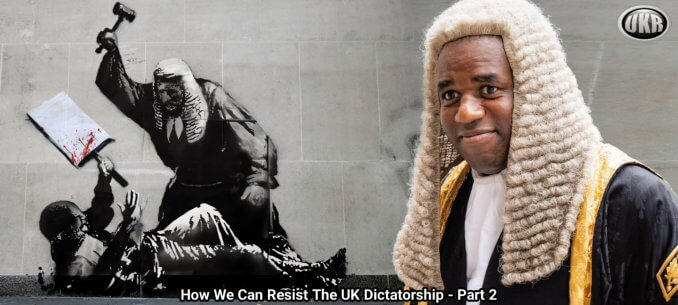
This article (How We Can Resist The UK Dictatorship – Part 2) was created and published by Iain Davis and is republished here under “Fair Use”

••••
The Liberty Beacon Project is now expanding at a near exponential rate, and for this we are grateful and excited! But we must also be practical. For 7 years we have not asked for any donations, and have built this project with our own funds as we grew. We are now experiencing ever increasing growing pains due to the large number of websites and projects we represent. So we have just installed donation buttons on our websites and ask that you consider this when you visit them. Nothing is too small. We thank you for all your support and your considerations … (TLB)
••••
Comment Policy: As a privately owned web site, we reserve the right to remove comments that contain spam, advertising, vulgarity, threats of violence, racism, or personal/abusive attacks on other users. This also applies to trolling, the use of more than one alias, or just intentional mischief. Enforcement of this policy is at the discretion of this websites administrators. Repeat offenders may be blocked or permanently banned without prior warning.
••••
Disclaimer: TLB websites contain copyrighted material the use of which has not always been specifically authorized by the copyright owner. We are making such material available to our readers under the provisions of “fair use” in an effort to advance a better understanding of political, health, economic and social issues. The material on this site is distributed without profit to those who have expressed a prior interest in receiving it for research and educational purposes. If you wish to use copyrighted material for purposes other than “fair use” you must request permission from the copyright owner.
••••
Disclaimer: The information and opinions shared are for informational purposes only including, but not limited to, text, graphics, images and other material are not intended as medical advice or instruction. Nothing mentioned is intended to be a substitute for professional medical advice, diagnosis or treatment.
Disclaimer: The views and opinions expressed in this article are those of the author and do not necessarily reflect the official policy or position of The Liberty Beacon Project.


Leave a Reply