

TILAK DOSHI
In Aberdeen, the warning sirens are no longer coming from offshore rigs but from the unions themselves. A recent study cited by the GMB union paints a stark picture: the North Sea’s offshore workforce, roughly 115,000 strong today, could be slashed to around 57,000 by the early 2030s if Britain’s headlong rush to Net Zero continues. For a city already bleeding skilled jobs — some 18,000 lost since 2010 — this is not an abstract climate model but the prospect of a living community turned into another deindustrialised ghost of Britain’s past.
The GMB’s Scotland Secretary, Louise Gilmour, has broken ranks with the political class by calling Ed Miliband’s policies “delusional” and warning that they risk “arguably the most destructive industrial calamity in our nation’s history”. Yet her intervention raises an uncomfortable question: how did a movement born to defend the English working class against economic dispossession become complicit in the very policies that now threaten to hollow out Aberdeen just as surely as coal-mining towns were once gutted across England and Wales?
From there, the story must go backwards before it can go forwards.
From Chartism to Labour
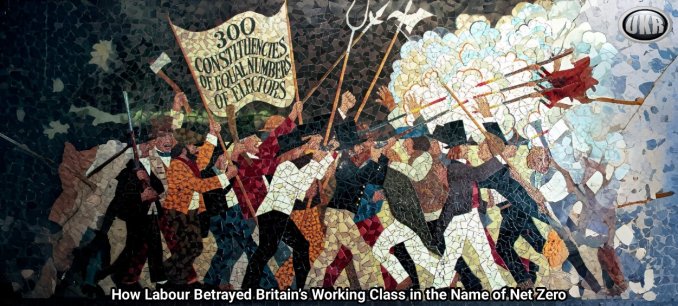
The English working class was not dreamed up in Marx’s study: it was forged in the mills, furnaces and pits of the early Industrial Revolution, then politically awakened through Chartism in the 1830s and 1840s. Chartism’s six demands — universal male suffrage, secret ballots, equal constituencies, annual Parliaments, payment of MPs and the abolition of property qualifications — were radical only in insisting that politics should serve those who laboured as much as those who governed.
Though their great petition of 1848 failed, the Chartists created a template for mass working‑class politics and helped pave the way for reforms that gradually extended the franchise to urban workers. Out of this ferment emerged powerful trade unions and, ultimately, the Labour Representation Committee of 1900, later the Labour Party: an explicitly class‑rooted vehicle intended to turn working‑class organisation into working‑class representation.
For much of the 20th century, that bargain held. Unions fought for shorter hours, safer workplaces and secure industrial jobs, while Labour in government under Clement Attlee created the NHS, the welfare state and public ownership of coal, steel and rail — ‘triumphs’ which secured Labour’s bond with the working class, even though by foisting the welfare state on the Exchequer it assured Great Britain of slower future growth in productivity and incomes. For a time, it seemed as if the material interests of workers and the political instincts of Labour and the unions were at least broadly aligned: strong industry, affordable energy, national prosperity and social mobility.
Yet, as E.P. Thompson showed in The Making of the English Working Class, this identity was never inevitable. It had to be constructed and could just as easily be deconstructed by elites whose priorities drifted away from the shopfloor. That drift has now matured into what can only be called betrayal.
Blair, managerialism and luxury beliefs
The decisive rupture did not come with Margaret Thatcher, as the standard Left‑wing narrative claims, but with Tony Blair’s New Labour in the 1990s. David Starkey has argued that Blair did not renew Labour’s founding mission but negated it, remaking the entire political sphere around managerialism and technocracy rather than democratic accountability.
Under New Labour, power migrated from a sovereign Parliament to an archipelago of quangos, supranational courts such as the European Court of Human Rights, NGOs and expert committees, all operating at arm’s length from voters. Labour ceased to be the political arm of the working class and became instead the party of a credentialed managerial elite, fluent in the idiom of ‘human rights’, ‘sustainability’ and global governance but increasingly tone‑deaf to the practical concerns of welders in Aberdeen or machinists in the Midlands.
Rob Henderson’s concept of “luxury beliefs” captures the new Labour mood: ideas and opinions that confer moral status on the affluent at little personal cost, while imposing heavy burdens on the lower classes. Green ideology and Net Zero orthodoxy fit this pattern perfectly. For university‑educated professionals in London, higher energy bills are a badge of virtue; for low‑income households in Sunderland or Oldham, they are the difference between modest comfort and genuine hardship.
Since Blair, both Labour and Conservatives embraced an increasingly absolutist green agenda, selling a painless ‘energy transition’ away from fossil fuels to renewables. Labour, the party that once promised to own the ‘commanding heights’ of the economy, now presides over their systematic dismantling, especially in energy, outsourcing production and emissions while awarding itself moral credit for decarbonisation. The English working class found itself redefined as a problem to be managed under energy austerity and managed decline, not a constituency to be served.
Unions, Net Zero and the principal-agent betrayal
The harshest irony is that this shift has been bankrolled and legitimised by trade unions themselves. Organisations that once embodied collective self‑interest — defending jobs, wages and communities — have spent two decades largely acquiescing in policies that erode the economic foundations of working‑class life.
At its core, the betrayal of the English working class reflects the age-old principal-agent problem. In economic theory, the principal (say, a shareholder) hires an agent (company management) to advance his interests. But agents have their own incentives — prestige, comfort, ideological commitments — and, without discipline, will drift away from the principal’s goals. In corporate life, we mitigate this through performance‑linked pay, independent boards, disclosure rules and, in extremis, takeovers or bankruptcy.
In the labour movement, the principals are union members; the agents are union leaders and officials. Members pay dues in exchange for protection of their material interests: secure jobs, decent wages, affordable energy. Yet the leaderships of major unions like Unite and GMB increasingly occupy the same conferences and social circles as Labour MPs, NGO staff and green activists, internalising the same luxury beliefs about ‘sustainable jobs’ and ‘just transitions’.
The numbers tell their own story, as my colleague Ben Pile noted in these pages. Unite, with around 1.2 million members, takes in roughly £260 million each year in dues; over 20 years, something like £5 billion has flowed through its accounts during the very period when the UK’s green agenda gathered pace. GMB, with about 560,000 members, used to give over a £1 million a year to the Labour Party — meaning that oil and gas workers in Aberdeen have been financing a party whose energy spokesman is determined to shut down their industry. This amount has recently been significantly reduced to £150,000, reflecting concerns over reforms in union funding and the number of members likely to affiliate with Labour individually.
Since the Climate Change Act of 2008, Britain has engaged in a rolling experiment in unilateral decarbonisation, closing coal plants, restricting North Sea licensing and subsidising intermittent renewables at great cost. Offshore wind rights were auctioned at ever higher guaranteed prices in the latest AR7 auction bidding round. Gaslighted by the government as a job-creating ‘sustainable’ energy investment, expensive offshore wind will keep adding to higher consumer power bills and offers only a fraction of the long‑term employment provided by oil and gas. Once turbines are built, they are tended by small maintenance crews, not the sprawling workforces associated with exploration, drilling, servicing, refining and petrochemicals.
While Britain destroys high‑value, high‑skill energy jobs, Norway has continued to license its offshore fields (which lie just beside UK’s own sanctioned fields), employing around seven times more energy workers per head than the UK and using the proceeds to build a sovereign wealth fund now over £1.8 trillion. In other words, Oslo has chosen energy abundance and national wealth; Westminster, cheered on by Labour and significant parts of the trade union movement, has chosen energy penance and managed decline.
The GMB’s late revolt over Aberdeen is therefore welcome but deeply revealing. Only now, as the scale of potential job losses becomes undeniable, have senior union figures started to challenge the fiction that there is no conflict between Net Zero absolutism and working‑class prosperity. For 20 years, the same organisations were willing partners in a green consensus that jacked up energy costs, accelerated de‑industrialisation and left Britain more dependent on imported fuels and Chinese‑manufactured solar panels and wind turbines.
This pattern is not unique to Britain. In the United States, the Democratic Party — once the party of blue‑collar America — has become the political wing of the professional class, prioritising climate crusades, identity politics and cultural causes over industrial jobs. This mirrors what Victor Davis Hanson observed about the US Democratic Party’s Leftward drift under Obama — considerably hastened under Biden — prioritising greens, LGBTQ rights and minorities over blue-collar concerns.
Donald Trump’s MAGA Republicans – traditionally the ‘country club’ party of America – repositioned themselves as champions of “energy dominance” and captured much of the working‑class vote in the process. The parallel is imperfect but instructive: where agents drift into a universe of symbolic and luxury politics, principals (voters) eventually look elsewhere for disruptive outcomes against the status quo. President Trump’s re-election for a second term is the case in point.
Whither the North Sea riches?
If today’s crisis in Aberdeen is the visible tip of a larger failure, the remedy lies in restoring discipline to the relationships between principals and agents. That means, first, making political funding genuinely voluntary and transparent: union members should have to opt in explicitly to any levy that supports a political party, and unions should have to justify those transfers in terms of measurable gains for their members, not sentimental tradition.
Second, unions must be forced to confront reality rather than rhetoric. Before endorsing Net Zero packages, they should commission and publish independent analyses of the impacts on jobs, wages and energy bills for their own members, sector by sector and region by region. If a policy means that 50,000 oil and gas jobs will be destroyed in exchange for a few thousand short‑term construction roles in wind, members deserve to see that arithmetic in black and white.
Third, internal democracy must be deepened. Regular ballots on strategic questions (such as backing continued North Sea licensing), term limits for senior officers and credible recall mechanisms would make it harder for a small activist cadre to drag entire unions into supporting ideological projects at odds with members’ material interests.
Finally, Britain needs to rediscover an energy policy rooted in abundance and realism rather than in virtue-signalling of the sort that Ed Miliband seems to excel at. That means recognising that oil and gas remain indispensable for decades to come. For both economic and energy security objectives, it is better to produce energy efficiently at home – blessed as Great Britain is with the North Sea and onshore coal and gas fields.
Why would any government outsource both production and responsibility abroad if not for virtue-signalling on the backs of the nation’s working class? In his speech at the World Economic Forum at Davos, President Trump specifically targeted Sir Keir Starmer’s stance on North Sea oil and gas.
Trump, a vocal critic of what he labels the green energy “scam”, contended that the UK Government has made it “impossible” for oil companies to develop North Sea reserves.
The United Kingdom produces just one-third of the total energy from all sources that it did in 1999 – think of that, one-third – and they’re sitting on top of the North Sea, one of the greatest reserves anywhere in the world, but they don’t use it, and that’s one reason why their energy has reached catastrophically low levels, with equally high prices. High prices, very low levels. Think of that – one-third and you’re sitting on top of the North Sea.
A Norwegian‑style model of continued licensing, sensible taxation and long‑term investment would do more for workers in Aberdeen and across industrial Britain than any number of sanctimonious speeches at climate summits. It is time trade union officials realise that.
This article was first published in the Daily Sceptic https://dailysceptic.org/2026/01/29/how-labour-betrayed-britains-working-class-in-the-name-of-net-zero/
Dr Tilak K. Doshi is the Daily Sceptic‘s Energy Editor. He is an economist, a member of the CO2 Coalition and a former contributor to Forbes. Follow him on Substack and X.
This article (How Labour Betrayed Britain’s Working Class in the Name of Net Zero) was created and published by Tilak Doshi and is republished here under “Fair Use”
Featured image: Part of the Chartist mural in Newport (Source: https://www.socialistparty.org.uk/articles/33380/24-11-2021/chartism-the-world-s-first-working-class-movement/

••••
The Liberty Beacon Project is now expanding at a near exponential rate, and for this we are grateful and excited! But we must also be practical. For 7 years we have not asked for any donations, and have built this project with our own funds as we grew. We are now experiencing ever increasing growing pains due to the large number of websites and projects we represent. So we have just installed donation buttons on our websites and ask that you consider this when you visit them. Nothing is too small. We thank you for all your support and your considerations … (TLB)
••••
Comment Policy: As a privately owned web site, we reserve the right to remove comments that contain spam, advertising, vulgarity, threats of violence, racism, or personal/abusive attacks on other users. This also applies to trolling, the use of more than one alias, or just intentional mischief. Enforcement of this policy is at the discretion of this websites administrators. Repeat offenders may be blocked or permanently banned without prior warning.
••••
Disclaimer: TLB websites contain copyrighted material the use of which has not always been specifically authorized by the copyright owner. We are making such material available to our readers under the provisions of “fair use” in an effort to advance a better understanding of political, health, economic and social issues. The material on this site is distributed without profit to those who have expressed a prior interest in receiving it for research and educational purposes. If you wish to use copyrighted material for purposes other than “fair use” you must request permission from the copyright owner.
••••
Disclaimer: The information and opinions shared are for informational purposes only including, but not limited to, text, graphics, images and other material are not intended as medical advice or instruction. Nothing mentioned is intended to be a substitute for professional medical advice, diagnosis or treatment.
Disclaimer: The views and opinions expressed in this article are those of the author and do not necessarily reflect the official policy or position of The Liberty Beacon Project.


Leave a Reply