

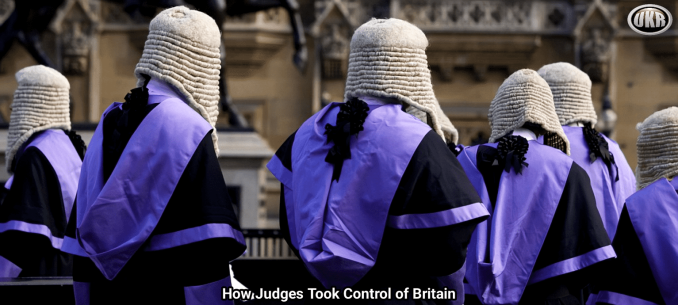
Britain’s politicians can barely get anything done without a judge stepping in, leaving Parliament sidelined and policy tied up in court, argues Sam Ashworth-Hayes in the Telegraph. Here’s an excerpt:
Trust in Britain’s legal system is at a low ebb. Two thirds of the public believe that the criminal justice system has become politicised, and that judges make some decisions in line with their personal views rather than the law, according to a survey by pollsters Merlin Strategy. The constant flow of boats across the Channel, meanwhile, appears increasingly to be fuelled by a judicial system which actively works to undermine attempts to remove those arriving from Britain.
It is perhaps a measure of the heat of public feeling that Sir Keir Starmer – former Director of Public Prosecutions, Left-wing human rights lawyer – became, briefly, the public face of revolt against the courts. When Conservative leader Kemi Badenoch raised the case of the Palestinian family granted the right to live in the UK even after applying for a scheme designed for Ukrainians, Sir Keir Starmer agreed that the decision was “wrong”, adding that “it should be Parliament that makes the rules on immigration; it should be the Government who make the policy”.
This is an uncontroversial statement of the United Kingdom’s constitutional settlement, or at least it should be. To Lady Chief Justice Sue Carr, however, it looked like a challenge. She said that “both the question and the answer were unacceptable”, and that it was “for the Government visibly to respect and protect the independence of the judiciary”.
Had Sir Keir been in the mood for a real row, he might have answered in turn that it was for the judiciary to visibly respect and protect the sovereignty of Parliament, and the executive authority of the Government. And if he had really wanted to set the cat among the pigeons, he could have answered with a question: who, actually, is running the country?
That Britain has a welfare problem is well-established. This year, spending on the personal independence payment (PIP) alone is set to cost £29 billion, up £13 billion in five years since the pandemic. Attempts to cut it, however, came unstuck in spectacular fashion, with a major row between Sir Keir Starmer and his backbenchers.
The strangest part of this is that a great deal of the increase was never intended by the Government in the first place. In fact, the introduction of PIP was supposed to cut the number claiming benefits by 600,000, saving £2.5 billion. Instead, caseloads and spending soared. Some of this was poor policy design. But some was the result of judicial decisions.
In 2016, in the case of MH vs the Secretary of State for Work and Pensions, a panel of judges decided that “psychological distress” should be considered when deciding whether applicants should receive additional payments to help with mobility, opening up these funds to a large number of applicants with mental health issues. The Government, surprised, introduced regulations to undo this decision, clarifying that its policy was not to make these awards.
This resulted in another round of legal action, and in 2017 the High Court ruled that these regulations were also unlawful as they discriminated against the disabled in breach of the convention on human rights, and had not been sufficiently consulted on. The Government backed down, and set about backdating claims. A rough estimate for the end result could today be in the region of £1.4 billion of spending per year. This is far from the only case, however, where human rights claims have shredded common sense.
The same convention which underlay the PIP decision has made our immigration system all but impossible to enforce. Supposedly “exceptional” human rights claims now account for around 30% of deportation cases, triggering Home Secretary Yvette Cooper’s plans to crack down on their use.
Beyond the Gazan applicants to the Ukraine scheme, one striking example concerned a Nigerian woman who joined a terrorist group banned in Nigeria, but not proscribed in the UK. The judge decided that the woman had joined the organisation specifically “in order to create a claim for asylum”. However, as this had in turn created “a well-founded fear of persecution”, asylum was granted. …
The most visible manifestation of this dysfunctional relationship between Westminster and the courts is on Birmingham’s streets. The city is effectively bankrupt, and a lengthy bin strike has seen piles of rubbish accumulate in the street while apocalyptic tales of giant rats spread. Birmingham was not a well-run council, but what finally tipped it over the edge was a court ruling.
Over the period from 2012 to 2023, Birmingham City Council paid out almost £1.1 billion in equal pay claims, with a bill of £760 million still to settle. The council hadn’t paid women less for the same work as men. Instead, it had paid them less for work “rated as equivalent”.
The argument went something like this: people of both sexes working as cooks, cleaners, catering or care staff were not paid bonuses awarded to roles that were traditionally more male: refuse collectors, street cleaners, road workers and grave diggers. This was a contravention of the principle that people should be paid the same for equivalent work. As a result, hundreds of millions of pounds of compensation should be paid out.
This case arose because Parliament placed a duty on courts to enforce this concept of equal value. The only notable oddity was that the case made it to court in the first place. When issued, the claim had long exceeded the time limit for submission to an employment tribunal. No matter; the Supreme Court decided that loose phrasing within the Act meant the claim could instead be taken directly to the courts. …
The strand that runs through these cases is the retreat of Parliament and the Government from dealing directly with complexity. One of the downstream consequences of handing sweeping powers to judges to make political decisions is that they have now grown used to doing so. …
Some of this is down to Parliament failing to decide, passing the buck to the judges. Some of it is down to legislators failing to rebuff this judicial tendency. Some of it speaks to the sheer complexity of the legislative environment Westminster has created, where it is all too easy to trip on a previous law. But the result is clear.
As one legal figure put it: “Westminster kept asking judges, and one day they started answering.” If the judges are running the country, it’s because Parliament has chosen not to.
Worth reading in full.
Featured image: Alamy

••••
The Liberty Beacon Project is now expanding at a near exponential rate, and for this we are grateful and excited! But we must also be practical. For 7 years we have not asked for any donations, and have built this project with our own funds as we grew. We are now experiencing ever increasing growing pains due to the large number of websites and projects we represent. So we have just installed donation buttons on our websites and ask that you consider this when you visit them. Nothing is too small. We thank you for all your support and your considerations … (TLB)
••••
Comment Policy: As a privately owned web site, we reserve the right to remove comments that contain spam, advertising, vulgarity, threats of violence, racism, or personal/abusive attacks on other users. This also applies to trolling, the use of more than one alias, or just intentional mischief. Enforcement of this policy is at the discretion of this websites administrators. Repeat offenders may be blocked or permanently banned without prior warning.
••••
Disclaimer: TLB websites contain copyrighted material the use of which has not always been specifically authorized by the copyright owner. We are making such material available to our readers under the provisions of “fair use” in an effort to advance a better understanding of political, health, economic and social issues. The material on this site is distributed without profit to those who have expressed a prior interest in receiving it for research and educational purposes. If you wish to use copyrighted material for purposes other than “fair use” you must request permission from the copyright owner.
••••
Disclaimer: The information and opinions shared are for informational purposes only including, but not limited to, text, graphics, images and other material are not intended as medical advice or instruction. Nothing mentioned is intended to be a substitute for professional medical advice, diagnosis or treatment.
Disclaimer: The views and opinions expressed in this article are those of the author and do not necessarily reflect the official policy or position of The Liberty Beacon Project.


Didn’t the KKK dress a bit like this?