

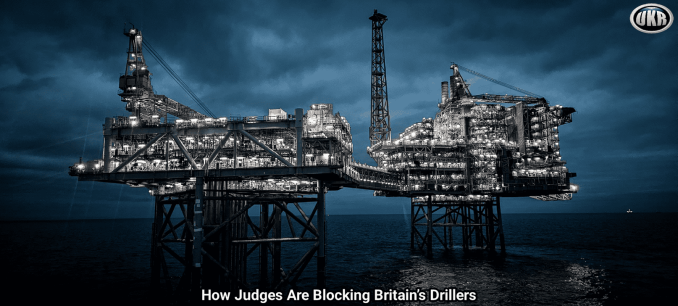
How judges are blocking Britain’s drillers
ALEXANDER TAIT
Evidence of Britain’s deleterious energy policy continues to pile up. Earlier this week, Ineos Energy announced an end to all investment in Britain. This comes after the closure of the Grangemouth refinery, the UKs’s oldest, earlier this year by Petroineos, and a warning from the wider Ineos conglomerate – the world’s fourth-largest chemical company, which is headquartered in London – that Britain’s entire petrochemical industry faces extinction in the face of exorbitant energy costs. Ineos Energy now turns its focus towards the United States, which, according to chairman Brian Gilvary, ‘understands the importance of domestic supplies and how you can drive economic growth off the back of it’.
In this context, it is understandable that the subject of North Sea oil and gas continues to attract such attention. It seems odd for a country facing Britain’s difficulties to refuse to make use of its natural resources. This certainly seems to be the view of President Trump, who has urged Keir Starmer to unlock ‘the treasure chest’ of North Sea oil by ‘incentivising the drillers’.
Similarly, Kemi Badenoch recently took aim at Labour’s energy policy on a visit to Aberdeen, where she made a speech vowing to ‘get all our oil and gas out of the North Sea’. Doing so, she claimed, would restore ‘common sense to energy policy… unlock billions in revenue, secure our supply and rebuild confidence in the UK economy.’
This is not the first time a Conservative leader has made such a pledge. Only two years ago, Badenoch’s predecessor Rishi Sunak announced his government’s intention to ‘max out’ North Sea oil reserves. The Jackdaw and Rosebank fields, granted approval in 2022 and 2023, were justified as necessary for Britain’s energy security in a new age of international uncertainty.
Rosebank, estimated to contain up to 500 million barrels of oil, is the largest untapped field in UK waters, while Jackdaw, where development was already well under way, was projected to provide enough fuel to heat 1.4 million homes in the UK. However, both developments were blocked by the Scottish Court of Session this year.
It is for this reason that the most important part of Badenoch’s speech in Aberdeen may have been her promise to end ‘judicial overreach’, which pointed to a genuine break with past failures. Any future government serious about making proper use of Britain’s natural resources will have to confront the courts.
Ultimately, Jackdaw and Rosebank were blocked as a consequence of the Supreme Court decision in Finch v Surrey County Council, which arguably stands as the apogee of successful environmental lawfare in a UK court. The case concerned the expansion of an existing oil well site at Horse Hill. A judicial review was brought on the grounds that the council had not taken into account the full environmental impacts that the expansion would entail. After dismissal by both the High Court and Court of Appeal, the claim was upheld by a majority of the Supreme Court in June 2024, and the permission was quashed, nearly five years after it had been granted in 2019.
The court’s rationale rested upon a maximalist interpretation of the environmental impact assessment (EIA), which all developers are mandated to submit for major projects. Where previously producers would have to account only for the emissions generated by extraction, the court ruled that EIAs would now have to include the effect of downstream emissions – those which occur when the extracted hydrocarbons are subsequently used as a product, for example in internal combustion engines, as was the case in Finch.
These downstream emissions are then assessed in the light of global emissions and Britain’s Net Zero commitments. The decision was not unanimous. Lord Sales, in the minority, observed that this would amount to ‘an artificially wide interpretation’ and ‘would distort’ the intention of the legislation. Nonetheless, in the words of former Supreme Court justice Lord Sumption, the majority appeared more interested in ‘influencing the substance of policy’ than ‘the proper distribution of constitutional functions’.
Jackdaw and Rosebank are not the only developments which have fallen foul of the Finch ruling. Another victim is Woodhouse Colliery, Britain’s would-be first new coal mine in 30 years. Granted permission in 2022, it was set to produce 3.5 million tonnes of coking coal per year, providing critical supply to Britain’s moribund steel industry.
One might assume that the British economy’s demand for coking coal would have to be supplied from elsewhere anyway, and so its contribution to global emissions should not be used as reason to block it. This was ruled out by the Supreme Court, which, in Finch, cited the UN’s Production Gap Report’s claim that every barrel of oil left undeveloped in one region would lead to a drop in global consumption.
Badenoch’s primary justification for greater drilling, namely that ‘strangling’ our own oil supply simply makes us more reliant on imports, has thus already been declared insufficient by the highest court in the land.
The High Court had rejected the initial challenge in Finch on the grounds that there was no obvious limit and it would in effect ‘open the floodgates’. The development of a steel plant, for instance, would have to account for all the emissions caused by any goods that would be manufactured from the steel and their contribution to climate change, which it would be impracticable to assess.
The Supreme Court sought to temper these fears by recognising this distinction in terms of practicality when looking downstream for steel, adding that there was no requirement to assess the impossible. However, the judges left open the issue of how far downstream to go in assessing emissions. This is to be determined on a case-by-case basis – a field day for lawyers and activists seeking to challenge projects on these grounds.
This uncertainty will extend beyond energy projects. In April, King’s Lynn and West Norfolk Borough Council denied permission for a mega-farm on the grounds that the food producers had failed to provide sufficient information on its impact on climate change, and, citing Finch, claimed that approval would place the council at legal risk. The floodgates, as the High Court feared, do appear to have opened.
Shell and Equinor, the energy firms working on the Jackdaw and Rosebank projects, can reapply for licences, providing they comply with the new post-Finch guidelines. Yet campaigners now delight in pointing out that these new requirements should render projects such as Rosebank, Jackdaw and many others incompatible with Britain’s net zero commitments. While retaining discretionary powers, ministers will almost certainly face judicial challenges if they try to sidestep these commitments, not to mention overwhelming pressure from activists.
Ed Miliband, who has previously described Rosebank as ‘climate vandalism’ and a ‘colossal waste of taxpayer money’ will face pressure from some Cabinet colleagues – not least the Prime Minister and the Chancellor – to act in the other direction, prioritising economic growth. But with a pressing need to shore up support from the Labour Party’s Left, Keir Starmer and Rachel Reeves might have to let Miliband win the day.
Ineos is not the first major company to rule out further investment in UK energy and industry. But as things stand, it is unlikely to be the last. Even leaving aside the question of tax rates, any future government interested in pursuing energy abundance must, as an absolute minimum, push back on judicial overreach.
Click here to subscribe to our daily briefing – the best pieces from CapX and across the web.
This article (How judges are blocking Britain’s drillers) was created and published by CAPX and is republished here under “Fair Use” with attribution to the author Alexander Tait
Featured image: Shutterstock

••••
The Liberty Beacon Project is now expanding at a near exponential rate, and for this we are grateful and excited! But we must also be practical. For 7 years we have not asked for any donations, and have built this project with our own funds as we grew. We are now experiencing ever increasing growing pains due to the large number of websites and projects we represent. So we have just installed donation buttons on our websites and ask that you consider this when you visit them. Nothing is too small. We thank you for all your support and your considerations … (TLB)
••••
Comment Policy: As a privately owned web site, we reserve the right to remove comments that contain spam, advertising, vulgarity, threats of violence, racism, or personal/abusive attacks on other users. This also applies to trolling, the use of more than one alias, or just intentional mischief. Enforcement of this policy is at the discretion of this websites administrators. Repeat offenders may be blocked or permanently banned without prior warning.
••••
Disclaimer: TLB websites contain copyrighted material the use of which has not always been specifically authorized by the copyright owner. We are making such material available to our readers under the provisions of “fair use” in an effort to advance a better understanding of political, health, economic and social issues. The material on this site is distributed without profit to those who have expressed a prior interest in receiving it for research and educational purposes. If you wish to use copyrighted material for purposes other than “fair use” you must request permission from the copyright owner.
••••
Disclaimer: The information and opinions shared are for informational purposes only including, but not limited to, text, graphics, images and other material are not intended as medical advice or instruction. Nothing mentioned is intended to be a substitute for professional medical advice, diagnosis or treatment.
Disclaimer: The views and opinions expressed in this article are those of the author and do not necessarily reflect the official policy or position of The Liberty Beacon Project.


Leave a Reply