

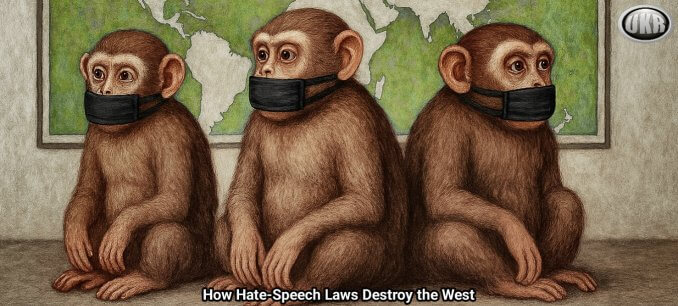
Freedom of expression is under worldwide attack. If this does not stop, the shadows from a very dark past will soon block out the beacon of liberty.
SVEN R. LARSON
Imagine this: You have a group of friends over for dinner. You are sitting around the table having a nice conversation about current events. You mention that you don’t like it when immigrants take advantage of social welfare instead of getting a job; you explain that your taxes would be lower if immigrants weren’t so lazy.
Now imagine this: Your teenage daughter has found herself a boyfriend, and you sit her down to have a conversation about the potential consequences of being intimate with him. Your daughter dismisses your concerns by saying that she can always get an abortion, whereupon you reply that abortions are immoral.
Would you be surprised if, in either of these cases, the police came to your house and arrested you for illegal speech?
For those of us who live in a country where freedom of speech is sacrosanct, the very idea of being arrested for speaking your mind is absurd. Yet, the creeping expansion of free speech restrictions in many other countries is bringing the Western world closer to a point where—as the Swedish saying goes—speaking is silver, but silence is gold.
The attacks on free speech generally follow two tracks, one where government directly imposes speech bans and one where it invents a new category of crime victims. The latter is better known as ‘hate speech’ legislation and seems to be the preferred path for mission-creep encroachments on freedom of expression. In a report from 2023 titled The Free Speech Recession Hits Home, the American think tank Future of Free Speech notes that the “landscape for freedom of expression” is facing “severe challenges” globally:
Even open democracies have implemented restrictive measures. The European Union’s Digital Services Act (DSA) exemplifies this trend, the European Commission’s aggressive enforcement of which has raised concerns among rights groups. The Commission demands the removal of content classified as “hate speech,” “terrorist content,” or “disinformation” from major social media platforms, threatening significant fines for non-compliance.
Things do not look much better at the national level. Using Britain as an example, the report points to the Online Safety Act, which
has raised alarms about potential censorship. The Act’s stringent regulations and substantial financial penalties for not removing illegal content could inadvertently lead to the suppression of lawful speech.
Other countries mentioned are Italy, where a journalist was penalized for voicing criticism against Prime Minister Meloni; Chile, where a journalist was charged for pointing to a public official’s “excessive pay”; and Denmark, where, in 2023, the legislature revived the nation’s erstwhile blasphemy law.
These are not the only countries that Future of Free Speech criticizes. In their report Global Handbook on Hate Speech Laws from 2020, the think tank reveals with chilling clarity just how widespread across the world speech-restricting laws actually are.
The United States of America is a notable exception. Our First Amendment to the Constitution has protected our freedom of expression since 1791; it remains unsurpassed globally as a beacon of individual freedom.
Considering the long and constitutionally deeply established history of liberty in the United States, it is particularly troubling to watch Canada go the opposite way. According to the website LifeSiteNews, the federal government in Ottawa is hoping to pass two legislative bills, designated C-9 and C-16, into law. Together, these two bills would allow the government to narrow the path for Canadians to express their faith; the explicit purpose is to
remove the religious exemption for prosecutable hate speech; [Member of Parliament] Marc Miller specifically cited Bible passages as examples. With Bill C-16, they could open the door to criminalizing conversations between family members after the fact.
The bill also proposes a drastic expansion of the definition of “coercive or controlling conduct” under federal Canadian law. That expansion would apply to “non-violent behaviors” that are otherwise not criminal. LifeSiteNews quotes MP Leslyn Lewis as she explains what this means:
“It criminalizes a pattern of otherwise lawful and often common behaviour that may later be perceived as threatening by an intimate partner,” Lewis continued. “That means ordinary family interactions could be re-interpreted as criminal after the fact.”
On her X page, MP Lewis exemplifies the kind of speech in the private home of a family that could fall under C-16: questions for a spouse about where he or she has been when coming home late; concerns about over-consumption of alcohol; disagreements over finances or junk food; concerns about parental absence; normal parental boundaries and expectations of their children.
This latest Canadian aggression against free speech is concentrated on the hate speech track of government encroachments. This track is the most nefarious of the two, but the other one is not exactly child’s play either: again, it is focused on using buzzwords like ‘disinformation’ and ‘terroristic content’ to outright ban speech.
By openly making some speech illegal—and by gradually expanding the realm of illegal speech—government charts a course right into open dictatorship. As the definition of ‘disinformation’ in the EU’s DSA expands, it becomes increasingly difficult to distinguish the ‘democratic’ European Union from ‘authoritarian’ countries.
The other speech-banning track to a large degree serves the same purpose, but the dagger is aimed more directly at the heart of Western civilization. By creating the category of ‘hate speech’ and making it criminal, government creates a new class of victims of crime: those who have been on the receiving end of ‘hate speech.’ Person A reports person B to the police for hate speech, and person B is arrested.
Here is where the ominous shadows of darker eras in human history start making themselves known. In order to prove that a person is guilty of a crime, a court of law must be able to determine the accused person’s guilt—and to do so independently of the alleged victim’s statements. This principle of the independent judiciary eliminates prejudice and personal bias as influencers on the final judgment.
It is also necessary to guarantee that we are all innocent until proven guilty.
The role of the independent judiciary is to conceptually separate the crime from the victim. In the process of proving or disproving the guilt of the accused, the court takes ownership of the crime away from the victim, applies its own rules and procedures, and reaches a conclusion on guilt or innocence—again independently of both the victim and the accused.
None of this is possible when ‘hate’ becomes a crime. A crime of hate cannot be conceptually separated from the victim. Where the investigation into, e.g., an assault, looks for independent information regarding the act, it is by definition impossible to obtain independent information regarding ‘hate’ speech.
The reason is not that the speech cannot be documented. It can; all we have to do is record person X saying something to person Y. But the hate crime is not defined by the words spoken: it is defined by the emotional reaction of the victim, or the inferred intention of the ‘perpetrator.’ If Y feels offended by X’s words—in other words believes they were spoken with hateful intent—then Y’s subjective judgment becomes the primary ‘evidence’ of the crime. With subjective sentiments taking on the role as decisive evidence, the standard of proof departs from what Western judicial tradition aspires to: a rational, objective standard of adjudication.
Since the victim’s feelings are inextricably a part of him, it is impossible for an independent judiciary to do its job; based on what information would a court of law possibly rule that the victim’s statements about hurt feelings are false?
From the viewpoint of scientific logic, the distinction between separating a crime from its victim and treating them as inseparable marks the difference between proper scientific inquiry and rumors or hearsay.
There is one way for a speech-ban-prone legislature to get ‘out’ of this erosion of the sacred, independent judiciary. It can write hate speech laws in such a way that they fall into the same category as ‘disinformation.’ By listing speech that is illegal, government can expand its speech ban more directly. This does not in any way stop the attacks on freedom of speech, but at least it means that the authoritarian government takes full responsibility for its reprehensible ambitions.
*

••••
The Liberty Beacon Project is now expanding at a near exponential rate, and for this we are grateful and excited! But we must also be practical. For 7 years we have not asked for any donations, and have built this project with our own funds as we grew. We are now experiencing ever increasing growing pains due to the large number of websites and projects we represent. So we have just installed donation buttons on our websites and ask that you consider this when you visit them. Nothing is too small. We thank you for all your support and your considerations … (TLB)
••••
Comment Policy: As a privately owned web site, we reserve the right to remove comments that contain spam, advertising, vulgarity, threats of violence, racism, or personal/abusive attacks on other users. This also applies to trolling, the use of more than one alias, or just intentional mischief. Enforcement of this policy is at the discretion of this websites administrators. Repeat offenders may be blocked or permanently banned without prior warning.
••••
Disclaimer: TLB websites contain copyrighted material the use of which has not always been specifically authorized by the copyright owner. We are making such material available to our readers under the provisions of “fair use” in an effort to advance a better understanding of political, health, economic and social issues. The material on this site is distributed without profit to those who have expressed a prior interest in receiving it for research and educational purposes. If you wish to use copyrighted material for purposes other than “fair use” you must request permission from the copyright owner.
••••
Disclaimer: The information and opinions shared are for informational purposes only including, but not limited to, text, graphics, images and other material are not intended as medical advice or instruction. Nothing mentioned is intended to be a substitute for professional medical advice, diagnosis or treatment.
Disclaimer: The views and opinions expressed in this article are those of the author and do not necessarily reflect the official policy or position of The Liberty Beacon Project.


Leave a Reply