

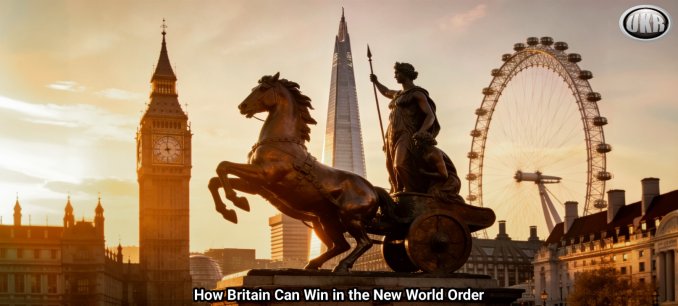
Britain could thrive in the new world that is taking shape – but only with a radical new set of military, economic and diplomatic set of policies!
BRITISH PATRIOT’S SUBSTACK
Welcome to the new world order – which looks remarkably similar to the old one. And by that I mean the world of the 19th century. But with one major difference: instead of the UK being the world hegemon it is now the US. And instead of Germany being the rising threat to world peace it is now China. OK, that’s two differences, but don’t be pedantic – I’m principally interested in how we here in Britain can navigate this new world order, so it is the first point which I am focused on.
So let’s jump in the DeLorean and go Back to the Future. As it happens, the DeLorean was manufactured here in Britain, and the future can, to a large extent, be created here too – if we play our cards right. But this won’t happen under Labour – or the Conservatives.
For years British politicians have drivelled on about the liberal ‘rules-based international order’ and how we had to obey ‘international law’. I have pointed out many times that this is a fallacy. There is no such thing as international law! There are international agreements (treaties, conventions, etc) which may then be incorporated into national law. Only then do they have any legal force. And a country can, of course, amend or scrap such agreements at any time, just by changing its domestic law.
Constantly whining about ‘international law’ is a sign of a pathetic country and a pathetic leader. Only the weak and powerless need to beg for ‘international law’ to protect them. Strong countries defend their own interests. And that, of course, is the problem. For decades Conservative and Labour politicians have cut defence spending and diverted it to subsidise parasites – both here and abroad – so that they could buy votes and smugly proclaim how morally superior they are.
After all, we don’t need to spend money on defence, do we? The US will do that for us. So we can get a free ride and, if there’s any trouble, hide behind their skirts. That was the policy of successive governments, both blue and red – because in reality they were exactly the same: the filthy, useless, cowardly, treacherous UNIPARTY.
But now, with Trump as US President, the world suddenly looks very different.
Speaking to the European parliament, the European Commission’s president, Ursula von der Leyen, said: “We now live in a world defined by raw power, whether economic or military, technological or geopolitical. In an increasingly lawless world, Europe needs its own levers of power.” You really have to give the EU first prize when it comes to hypocrisy and chutzpah. It was the EU, as of course you will recall, that tried to bully and blackmail Britain after Brexit!
And here is what Mark Carney, the Canadian prime minister, had to say when speaking at Davos: “great powers have begun using economic integration as weapons. Tariffs as leverage. Financial infrastructure as coercion. Supply chains as vulnerabilities to be exploited.” He was talking about the US, but his words apply just as accurately to the EU and China. He went on: “It seems that every day we’re reminded that we live in an era of great power rivalry. That the rules-based order is fading. That the strong can do what they can, and the weak must suffer what they must.” And he admitted that “what we called the rules-based international order” was in reality a “fiction”.
Of course it was. And the truth is that everybody knew this, and tried to use it to their advantage – apart from Britain. We are the worst-led country in the world. We really are.
So when Barmy Carney whines that we now have “a system of intensifying great power rivalry where the most powerful pursue their interests using economic integration as a weapon of coercion”, he is ignoring the fact that Canada refused to agree a free-trade deal with Britain (either bilateral or multi-lateral) in order to try (unsuccessfully) to bully us into accepting low-quality Canadian beef – until Trump imposed tariffs on Canada and then he suddenly realised that Canada needed the UK more than we needed them! So it’s doubly hilarious to hear Smarmy Carney complain that “middle powers criticise economic intimidation from one direction but stay silent when it comes from another”.
But putting aside the hypocrisy and crocodile tears, Carney was right in this analysis: “Over the past two decades, a series of crises in finance, health, energy and geopolitics have laid bare the risks of extreme global integration. You cannot “live within the lie” of mutual benefit through integration when integration becomes the source of your subordination. And as a result, many countries are drawing the same conclusions — that they must develop greater strategic autonomy: in energy, food, critical minerals, in finance and supply chains. This impulse is understandable. A country that cannot feed itself, fuel itself or defend itself has few options. When the rules no longer protect you, you must protect yourself.”
Quite so. And Trump, also speaking at Davos, explained exactly how a country should act. “We lowered our corporate tax rate from 35% all the way down to 21%”, he said. “We have undertaken the most extensively regulatory reduction ever conceived. … We are lifting self-imposed restrictions on energy production to provide affordable power to our citizens and businesses and to promote energy security”.
“We will defend our citizens and our borders. We are also securing our immigration system as a matter of both national and economic security”, he continued. “We must replace our current system of extended family chain migration with a merit-based system of admissions that selects new arrivals based on their ability to contribute to our economy, to support themselves financially, and to strengthen our country”.
I don’t know about you, but these sound like pretty good policies to me. He summed up his approach like this: “I believe in America. As president of the United States I will always put America first, just like the leaders of other countries should put their country first also”.
If only we did have a prime minister who believed in Britain and put Britain first! But how would this work in practice? Again, Trump explained: “as president of the United States, I will always protect the interests of our country, our companies, and our workers.” In other words, ‘it’s the economy, stupid’. Back to the Future, again! Of course you need a powerful military, but it’s only by being economically successful that you can afford to pay for it!
Trump’s economic strategy is the key to how he is ‘Making America Great Again’. So how could a British government ‘Make Britain Great Again’?
As it happens, The Times published an interesting article on this recently. They described Trump’s economics as a combination of what they called ‘state capitalism’ and good old-fashioned mercantilism.
‘State capitalism’, they explained, is “a strategy where the state – in this case the executive more than other branches of government – wants to act as an economic player and assert its power over the market and the private sector in pursuit of its goals. State capitalism is nothing new for most of the rest of the world” and Trump is doing this by “using the levers of the state to buy stakes in private companies, exploring ideas like a sovereign wealth fund to put taxpayer money into enterprise, and a general penchant for intimidation and threats to bend the private sector to the will of the White House.”
As for Trump’s mercantilism, this is “prioritisation of exports over imports, creating a positive trade balance through the hyper-competitive selling of goods abroad and deliberate under-consumption at home. Like state capitalism, there is nothing new about countries embracing mercantilism. In the postwar era, versions of neo-mercantilism have been the economic playbook for Japan, Germany and, since the 2000s, most obviously China.”
As I said at the start, the new world order is exactly the same as the old one, but whereas the US has learnt the lessons we taught them, the spastics in charge of Britain have either forgotten everything or deliberately, and treacherously, turned their back on the policies that made Britain so successful.
As The Times points out: “The heyday of mercantilism was the imperial age of the 17th to 19th centuries, when western nations — led by Britain — expanded their colonial reach driven by mercantilist fervour. As the emerging superpower of the age, Britain exploited its colonies as sources of cheap raw materials such as cotton, wool, sugar, tea, tobacco and gold. Colonies doubly served as “import sinks” for finished goods from Britain.”
“Albert Hirschman, a German political economist who fled Nazi Germany for the US, said trade between nations was invariably about power rather than just exchange of goods and services … trading relationships were always prone to exploitation by the stronger party. We are back in Hirschman’s world.” Of course we are – and everyone is doing this, even the EU, despite all their high-faluting talk of being a rules-based organisation, and their criticism of Donald Trump.
In July 1990, Nicholas Ridley, then the Secretary of State for Trade and Industry under Margaret Thatcher, described the European Community’s (as the EU was then known) Economic and Monetary Union as a “German racket designed to take over the whole of Europe“, claiming they were using economic means to achieve the same hegemony they had previously attempted through military force. He said he would rather have air-raid shelters and the chance to “fight back“ against a military invasion than be “taken over by economics“. The EU today is just continuing these policies, as China is doing, and now Trump has joined in.
So how do we “fight back” and avoid being “taken over by economics”?
Very simply, by untying the hands behind our back and adopting the very same policies as our adversaries!
The grand old sage of political and economic journalism, Andrew Neil, explained it in a nutshell: “Britain needs a step change in its energy, food and defence policies. The billions earmarked for net zero need to be diverted to rearming the nation. We need an energy policy that couples secure supplies with lower prices so that we can start to rebuild some of our heavy industry, essential to defence. And we need a farm policy that champions growing food once more rather than prioritising various fashionable environmental wheezes. None of this is likely to happen under the Starmer government. The PM has no vision or aptitude for such a strategy. His party is a prisoner to old 20th century ways of thinking, as is much of British politics on the left and right.”
It’s true: neither Labour nor the Tories will ever adopt the necessary policies, as they are wedded to the failed and treasonous liberal globalism and national surrender.
To be a wealthy country, able to afford a strong military, as well as the services that citizens in a civilised country expect (from good healthcare to modern transport to efficient utilities to a quality environment), you need to have successful companies that provide well-paid jobs and contribute to the national exchequer through their exports and taxes. So one of the main duties of any government is to protect not only its citizens but its businesses too.
And it is here that both Labour and the Tories have failed. Abysmally. And it wasn’t through incompetence: it was by design. Yes, they failed because they intended to fail. Because they believe that protecting and promoting British business is wrong. Because they are traitors.
Every other country in the world understands the need to protect and promote its domestic companies and industries. Labour have done the very opposite. You may find this incredible, but I promise it’s true: Labour have given a Turkish company a £100 million loan to finance a new glass factory in Belgium – instead of in Wales. This is a deliberate policy of national economic suicide.
Some years ago, when Danone, the French yogurt company was the target of an American rival, the French government stepped in to block this, claiming that this was a strategic industry. Here, on the other hand, we have allowed all our largest, our best and our most iconic chocolate companies – Cadbury, Rowntree and Terry’s – to be taken over, asset-stripped and ruined by filthy French, Swiss and American competitors.
If you shrug your shoulders at our wonderful chocolate-makers, what about the Royal Mail? Founded in 1516 by Henry VIII, it was originally only for royal use, but was opened to the public in 1635 by Charles I. It provides a vital public service, but now it is owned by Czech billionaire Daniel Kretinsky, who bought it last year in a very controversial and highly leveraged bid, saddling the company’s balance sheet with a £1.1billion medium-term facility, a bridging loan of a further £750million, another bridging credit of £500million and a multi-currency loan of £500million. Oh, and of course there is also the small matter of the £142 million of fees they will have to pay, too. With the resulting interest payments, as well as the dividends that Kretinsky will suck out of the Royal Mail, what will be left for investments in the service? The Royal Mail is a vital public service, and while people are posting far fewer letters than in the past, there is a huge and rapidly growing parcel delivery market it could benefit from. Royal Mail should never have been privatised. If it had remained a public service we would have saved over £2 billion which has been sucked out of it in dividend payments!
Every British company is being gobbled up by foreign rivals, from the oldest and most historic, like Royal Mail, to the newest – Deliveroo, which delivers our takeaways, was recently bought by DoorDash, based in San Francisco, for £2.9bn. Some are famous – like all our car manufacturers, from Rolls Royce to Bentley to Mini to Jaguar and Land Rover, all foreign-owned – to those behind-the-scenes companies like packaging giant DS Smith, which was acquired by US rival International Papaer for £5.8 billion.
This is not – as globalists would want you to believe – a question of supporting free-market economics as opposed to socialism, or being open to business and investment to grow the economy, this is just common sense protection of the national interest. So when, in 2006, P&O ports was sold to Dubai Ports World, the US – that most capitalist country – stepped in and ordered that US ports owned by P&O be excluded from the deal for security reasons.
No other country – regardless of their politics – is as stupid as we are, or is governed by such vile traitors. So virtually all our most important companies – including in vital sectors like AI, quantum computing, pharmaceuticals, electronics, and even defence – have been bought by foreign asset-strippers who are allowed to steal our economic jewels and rape our economy at will.
Companies like biotech pioneer Verona Pharma (sold for a whopping £7.4 billion to American giant Merck); Dechra Pharmaceuticals (snapped up by Swedish private equity firm EQT for £4.5 billion); the rump of British Steel (snaffled up by China’s Jingye in 2020 and now threatened with closure); DeepMind, probably the greatest AI company in the world (stolen by Google in 2014 for a measly £400 million); cyber-security experts Darktrace (sold to US private equity outfit Thoma Bravo); aerospace pioneers Cobham and submarine sonar group Ultra Electronics (both raped by another US private equity company, Advent); cutting-edge quantum computing experts Oxford Ionics (plundered for £800 million by the US company IonQ); chipmaking company Alphawave (swallowed up by US rival Qualcomm for £1.8 billion); precision and testing equipment specialist Spectris (bought by KKR, yet another US private equity giant, for £4.7 billion); industrial software champion Aveva (gobbled up by France’s Schneider for £9.9 billion); satellite firm Inmarsat (raped by US rival Viasat for £5.4 bilion); electric vehicle drivetrain specialist Dowlais (snapped up by American Axle & Manufacturing for £1,2 billion); world-beating chip designing company and AI pioneers Arm (bought in 2016 by Japanese company Softbank for £28 billion – and now worth over £100 billion!); specialist semiconductor innovator Graphcore (also bought by SoftBank – they can spot a good thing when they see one); Newport Wafer Fab, the UK’s largest semiconductor plant (bought by US firm Vishay Intertechnology); YASA, the manufacturer of the world’s most efficient electric motors (acquired by Mercedes-Benz for a song at less than £200 million); Pilkington, a world leader in glass (bought by the Japanese Nippon Sheet Glass despite this being a smaller glass producer).
I could go on, I really could: Smiths Aerospace was bought by America’s General Electric; Hanson, an aggregates company, by Heidelberg; concrete producer RMC by Mexico’s Cemex; Blue Circle, another cement producer, by France’s Lafarge; BPB, a plasterboard-maker, by the French Saint-Gobain; Britvic (which includes the iconic Robinsons squash) to Danish brewer Carlsberg. In 2024, British companies worth £74 billion were gobbled up by overseas buyers. This is a 21% increase from 2023 and represents 51% of all British companies taken over.
You get the picture by now: all our best technology companies are being lost. And the list grows longer almost by the week. Many more companies, even if not bought up by foreign competitors, are voluntarily leaving Britain – often for the US – because they just can’t get the necessary funding here. Companies with bleeding-edge technology like Cambridge Quantum Computing and Psiquantum, for instance, that are created in our universities, funded by the government, but then have to leave the country due to lack of support when they need to grow into multi-billion pound industries. These are the modern companies that will shape the future, but the government just doesn’t give a damn. And now the papers are reporting that Orbex, one of Britain’s only space rocket businesses (and which was planning to launch the UK’s first rocket), is on the brink of falling into foreign hands, in a fire-sale to their German rival The Exploration Company.
So there’s the problem. It’s not creating great businesses, it’s keeping them. The UK has no shortage of either genius or dynamism. In terms of Nobel prizes, Britain comes second only to the US, which has a population five times bigger. Cambridge alone has nurtured 124 Nobel laureates. If Cambridge was a country, it would outrank every other nation except the US and UK, and is responsible for world-changing discoveries ranging from DNA to penicillin.
We have world-class research universities, not only Cambridge, but also Oxford, Imperial, UCL, Kings and many others, all with world-beating science, medicine, technology, artificial intelligence and quantum research. These are our nation’s scientific crown jewels, equal to anything in the US and far superior to the whole of the EU put together. These are the nurseries of our future global champions and national economic success.
But it’s no good creating these brilliant, innovative, vital industries of the future if we allow foreign asset-stripping scum to come here and rape our economy. Technology brought to market by firms spun out of our great research universities is being plundered daily. We lose the patents, the technology, the manufacturing, the jobs and all the wealth. We end up poor while our global enemies grow rich at our expense.
But British governments – both Tory and Labour – are obsessive free-market extremists who believe that all you need is competition between companies and this will inevitably deliver the most efficient resource allocation. An industrial policy is therefore not just unnecessary, but wrong in principle. This laissez-faire approach is combined with a quasi-religious belief in the primacy of shareholder rights.
The government’s duty is to protect the public interest. There is no reason at all to expect the pursuit of shareholder value by corporations to coincide with the self-interest of the UK. So even if a foreign take-over is in the financial interests of the shareholders, it does not follow that it is in the country’s interest. The interest of the shareholders is in maximising their personal wealth. The job of the government is to maximise the national wealth.
Those who support the government’s open-door takeover regime claim that this is a strength, making Britain more attractive to inward investment. These people are morons who do not understand the true meaning of the word “investment”. Of course I want more foreign investment in Britain. But true foreign investment is when a foreign firm comes and opens up a new factory. One that did not exist before. One that increases the UK’s total production.
When a foreign company comes and buys an existing British company this not investment. It is the rape of our technology and industrial base. It does not increase Britain’s total production. It does not increase the corporation tax receipts of the government. It does not increase the net wealth of Britain and of the British people. It does not benefit Britain. It damages Britain.
Laissez-faire globalists say that protecting British firms from foreign takeover prevents inefficient or poor-performing firms from being acquired and improved. This is nonsense. Thay can be acquired and improved by other British companies.
Chancellor Rachel ‘Retard’ Reeves – the over-promoted tea girl – stated that takeovers by foreign firms were a “vote of confidence“ in the UK and show “the UK remains one of the best places in the world for business”. The cretin Theresa May said exactly the same thing when Softbank raped Arm. These politicians are brain-dead UNIPARTY traitors, robotically reading from the same moronic script.
Retard Reeves also recently said “Jaguar Land Rover is an iconic British company which employs tens of thousands of people – a jewel in the crown of our economy.” But JLR has paid out £835 million in dividends to its Indian parent company Tata in the last 18 months alone! This is money STOLEN from Britain, from the British economy and from the British people. TATA ARE SCUM.
Brexit was a fantastic opportunity to protect and promote British businesses. But this was never taken. Of course it wasn’t – we were ruled by Bozo Boris and his circus of Tory Traitors.
So what’s the answer? Actually, it’s very simple. It’s the policy of every other country in the world, and best exemplified by President Trump: first, protect your companies from being taken over by filthy foreign asset-stripping scum; second, create a pool of investment funds (both private and state) for our brilliant new companies to grow; and third, ensure that they receive the contracts and orders they need to become successful.
These are the policies we need to re-industrialise Britain. To grow our manufacturing industry and make Britain strong and rich again. Britain was once known as “the workshop of the world”. Given our size and population it is unrealistic to suppose we can ever achieve this title again, but there is absolutely no reason for our manufacturing sector to be smaller than those of France, Italy, Germany, South Korea or Japan.
Sadly, re-industrialisation is not on this government’s agenda. Nor is it part of Conservative party thinking. But there is a glimmer of hope: because it is the stated policy of Reform UK.
I don’t know what policies they plan to introduce to achieve this goal, but at least it is their objective. And that’s a start. I doubt they will go as far as I would like, and aim for strategic autarky, where Britain is self-sufficient in all those areas that are the most vital for national survival and for global strength and power, but ‘every journey of a thousand miles starts with a single step‘ – and Reform’s policy is a step in the right direction.
So what would I like to see?
Firstly, I want the government to invest in high-tech champions and take a shareholding, including a ‘golden share’. There is a precedent for this: the government has ‘golden shares’ in BAE Systems and Rolls-Royce, allowing ministers to block undesirable takeovers. This should be widely expanded. Instead of cheering the takeover of Arm, for instance, Theresa May should have invested in it and acquired a golden share. This is a win-win policy, that helps companies that need funding to grow, and protects the UK’s national interest. As it happens, Rene Hass, Arm’s CEO, has complained that startups in the UK struggle to grow because of a dearth of investors willing to bet on British entrepreneurs.
By becoming a shareholder in the great companies of the future the government will also earn dividends, and thus make a long-term profit. In other words, what I want is a national wealth fund, that specifically invests in British companies. The government does, already, provide some investment in start-ups, through a body called Innovate UK, who actually do a great job, but its budget is a measly billion pounds a year. But we currently spend over a billion pounds every month just on welfare benefits to foreigners. How about using this money to invest in British companies and Britain’s future instead? Imagine what Innovate UK could do with a budget 12 times larger! And instead of giving grants to start-ups the government should take a strategic shareholding. Government and industry should work hand-in-hand, as partners for the benefit of Britain and the British people.
And government investment would also encourage private sector investment. Instead, Labour are doing the very opposite. Just look at their refusal to back a new £450 million vaccine plant on Merseyside by British pharmaceutical giant AstraZeneca. Instead of seeding this investment with the £90 million of support which AstraZeneca had asked for, the government spat in their face. So AstraZeneca has publicly given up on Britain, scrapping planned R&D and manufacturing investment here, and is instead deciding to invest £11 billion in China and over £36 billion in the US. What an appalling own-goal by Labour.
One of Retard Reeves’ first decisions as Chancellor was to axe a project for a super-computer at Edinburgh University. This just shows the government have no genuine interest in promoting Britain’s vital industries of the future, such as robotics, AI, quantum computing, nuclear energy, semiconductors, batteries, biotechnology and pharmaceuticals, aerospace, new materials and defence. They say they care but their actions prove otherwise. Germany, on the other hand, is setting aside €1 trillion over the next decade to invest in its defence industries, support its technology development and increase its energy independence.
If Reform are serious about re-industrialising Britain then there are plenty of industry experts they can call upon for advice. The Times, for instance, recently reported “the AI expert and venture capitalist Ian Hogarth” as saying that “ministers should concentrate on a select group of future British stars” in order to create British £100 billion-plus tech champions. He wants the same as I do: for the government to give contracts to British firms, not their foreign rivals. This is the next policy that Reform should adopt: the use of government contracts to boost British firms.
Ian Hogarth gives as one example the NHS: “If we made a national mission to figure out how to accelerate our best medical start-ups via procurement through the NHS, I think we would create something extraordinary. That requires state capacity, but it is a challenge a great government should set itself.” This should, frankly, be obvious – but sadly it isn’t. Take the increase in defence spending the government has announced. This would be the perfect opportunity to create a huge BRITISH defence industry, boosting our technology and our security by investing in BRITISH companies, but instead Retard Reeves has said she will not “pull up the drawbridge” to foreign manufacturers. So instead of ‘buying British’ we will be funding foreign countries that hate us instead! The government doesn’t even demand that all Royal Navy ships and submarines be made with British steel.
It wouldn’t cost a single penny to create loads of great, successful British companies. Take the photovoltaic industry, for instance. While I oppose solar panels being placed in fields which should be producing food, it makes perfect sense to put these on our roofs. Of course their output is limited to daylight hours, but this is also when we consume the most energy. So make it a legal requirement that every new house, office, factory, school, etc have solar panels, and stipulate that these must be made in Britain. At the moment we import virtually all the solar panels we install in Britain, but there is a great British company called Oxford PV, spun out of Oxford university (which means that British government money was spent supporting the development of their technology) and which makes the most efficient solar panels in the world. The only problem is that they make them in Germany! This is because Germany offers support to these high-tech companies whereas the UK doesn’t. But Oxford PV have said they would obviously be happy to manufacture in Britain if this made economic sense. And the way to do this cost-free is to create a huge market here, by making the use of British-made solar panels a legal obligation on all new-builds. Just as Trump has a “Made in America” policy we should have a “Made in Britain” one.
Another policy that is an absolute must is a law making it compulsory for all goods and food to be labelled with the country of origin. Polls show that a majority of Britons would like to ‘Buy British’, but generally can’t do so because it isn’t clear where things come from. In February 2024, when she was Business Secretary, Kemi Badenoch opposed plans for mandatory country-of-origin food labels because these might ‘cause tension with trade partners’!!! WHAT A FILTHY TRAITOR.
If we want a patriotic industrial policy we can’t vote either Labour or Conservative. Will we get this from Reform? Who knows. But at least they seem to realise the importance of this issue. I hope you do now too! This has always been a major concern of mine and I’m delighted that it now seems to be rising up the political agenda. Let’s see what develops!

———–
If you liked this article then please share it on Facebook, Twitter/X, and by email to your friends.
Spread the word!!
And make sure you SUBSCRIBE to this blog – it’s FREE!
Thank you 🙂
This article (HOW BRITAIN CAN WIN IN THE NEW WORLD ORDER) was created and published by British Patriot’s Substack and is republished here under “Fair Use”

••••
The Liberty Beacon Project is now expanding at a near exponential rate, and for this we are grateful and excited! But we must also be practical. For 7 years we have not asked for any donations, and have built this project with our own funds as we grew. We are now experiencing ever increasing growing pains due to the large number of websites and projects we represent. So we have just installed donation buttons on our websites and ask that you consider this when you visit them. Nothing is too small. We thank you for all your support and your considerations … (TLB)
••••
Comment Policy: As a privately owned web site, we reserve the right to remove comments that contain spam, advertising, vulgarity, threats of violence, racism, or personal/abusive attacks on other users. This also applies to trolling, the use of more than one alias, or just intentional mischief. Enforcement of this policy is at the discretion of this websites administrators. Repeat offenders may be blocked or permanently banned without prior warning.
••••
Disclaimer: TLB websites contain copyrighted material the use of which has not always been specifically authorized by the copyright owner. We are making such material available to our readers under the provisions of “fair use” in an effort to advance a better understanding of political, health, economic and social issues. The material on this site is distributed without profit to those who have expressed a prior interest in receiving it for research and educational purposes. If you wish to use copyrighted material for purposes other than “fair use” you must request permission from the copyright owner.
••••
Disclaimer: The information and opinions shared are for informational purposes only including, but not limited to, text, graphics, images and other material are not intended as medical advice or instruction. Nothing mentioned is intended to be a substitute for professional medical advice, diagnosis or treatment.
Disclaimer: The views and opinions expressed in this article are those of the author and do not necessarily reflect the official policy or position of The Liberty Beacon Project.


Leave a Reply