

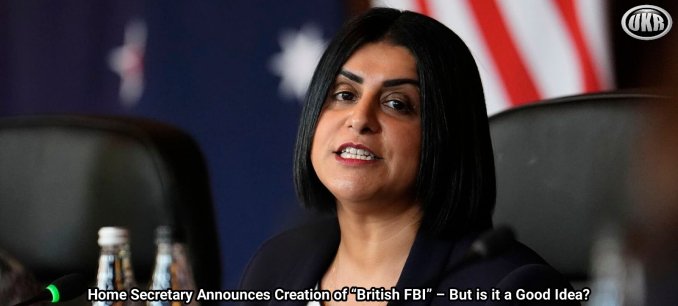
Shabana Mahmood has announced she wants to merge the 43 police forces in England and Wales and create a new National Police Service, which she has dubbed a “British FBI”. (BBC News has more.) She insists this is “absolutely not” but about fixing our “broken” police service, describing it as “the most significant reforms to policing this country has seen in 200 years”. In the Sunday Times, Robert Colville is sceptical.
Back in 1964 the Police Act slashed the number of forces in England and Wales from 117 to 49, which was gradually winnowed down to the 43 we have today. Mahmood wants to amalgamate those into a dozen or so regional super-forces while creating a separate, national force to cover big things like terrorism, fraud and gangs, and a new layer of local policing to deal with day-to-day crime.
The plan is bold. It’s logical. And it’s almost certainly doomed.
Let’s start at the beginning. There is obvious inefficiency in having 43 police forces with overlapping and duplicated functions. And traditional policing boundaries make less and less sense in an age of online fraudsters and county lines drug gangs. That’s why senior coppers have been arguing for mergers for years.
But at the same time, if people have been calling for something for a generation, there’s probably a reason it hasn’t happened. In fact, a very similar plan was introduced by Mahmood’s Labour predecessor Charles Clarke in 2006. It was an utter fiasco. As for creating a “British FBI” to fight crime at a national level, we’ve had versions of the same announcement in 1995, 2004, 2011 and 2016. And I may have missed a few.
The first and most obvious problem is operational. Any reorganisation like this is inherently disruptive. All the more so when bringing together organisations with different ways of working, different software systems and all the rest of it.
And the precedents are not encouraging. In 2013 the SNP merged eight Scottish police forces into one. Frontline officers complained that their views were ignored throughout, and that methods and personnel from Glasgow were being imposed on the rest of the country. In the decade that followed, the proportion of Scots saying their local force were doing a good or excellent job fell from 61 per cent to 45 per cent.
More recently, in 2018, the Metropolitan Police amalgamated 32 boroughs into 12 multi-borough units. An official review by Baroness Casey in 2023 was utterly damning: the front line had been “deprioritised”, connections between communities and police had been weakened, local policing had been “fractured”, there was less knowledge of local crime patterns, response times had gone up. Her brutal conclusion was that “London no longer has a functioning neighbourhood policing service”.
The Home Secretary will protest that her plans are different — that the savings from reducing duplication will be ploughed back into genuine neighbourhood policing. But it’s impossible to be confident. Because every speech by a chief constable calling for mergers makes clear that the primary justification is saving money — just as it was in Scotland, and indeed in Norway and the Netherlands.
All the evidence is that the public are increasingly frustrated with the police. The most serious crimes may be going down, but on every main indicator — are local police doing a good job, do you have confidence in them, do you see police on the streets, are you satisfied with how the police responded when you were a victim of crime, and so on — satisfaction has fallen sharply.
There is a prevailing sense that when you are a victim of low-level crime, the police simply don’t bother to investigate unless an algorithm somewhere spits out the right answer on “solvability”. Moving to regional forces can only exacerbate that.
There’s also a constitutional issue. Mahmood has talked a lot about the contract between police and citizens. Even when she was abolishing elected police and crime commissioners — a Tory innovation that never quite caught on — she said it was because they had not provided enough democratic oversight.
But pulling powers into a national police force, answerable to the Home Secretary, hardly follows the Peelite principles of community consent — even if she already controls many of the areas it will have responsibility for. Nor does giving yourself the power to fire chief constables, as a knee-jerk response to the Maccabi Tel Aviv scandal in the West Midlands.
Worth reading in full.

••••
The Liberty Beacon Project is now expanding at a near exponential rate, and for this we are grateful and excited! But we must also be practical. For 7 years we have not asked for any donations, and have built this project with our own funds as we grew. We are now experiencing ever increasing growing pains due to the large number of websites and projects we represent. So we have just installed donation buttons on our websites and ask that you consider this when you visit them. Nothing is too small. We thank you for all your support and your considerations … (TLB)
••••
Comment Policy: As a privately owned web site, we reserve the right to remove comments that contain spam, advertising, vulgarity, threats of violence, racism, or personal/abusive attacks on other users. This also applies to trolling, the use of more than one alias, or just intentional mischief. Enforcement of this policy is at the discretion of this websites administrators. Repeat offenders may be blocked or permanently banned without prior warning.
••••
Disclaimer: TLB websites contain copyrighted material the use of which has not always been specifically authorized by the copyright owner. We are making such material available to our readers under the provisions of “fair use” in an effort to advance a better understanding of political, health, economic and social issues. The material on this site is distributed without profit to those who have expressed a prior interest in receiving it for research and educational purposes. If you wish to use copyrighted material for purposes other than “fair use” you must request permission from the copyright owner.
••••
Disclaimer: The information and opinions shared are for informational purposes only including, but not limited to, text, graphics, images and other material are not intended as medical advice or instruction. Nothing mentioned is intended to be a substitute for professional medical advice, diagnosis or treatment.
Disclaimer: The views and opinions expressed in this article are those of the author and do not necessarily reflect the official policy or position of The Liberty Beacon Project.


Leave a Reply