

DR NICHOLAS TATE
Roger Scruton was the first to coin the word ‘oikophobia’ to describe fear of home (Greek oikos) in a political context. He used it to refer to disdain for one’s country, culture or majority population. He was not the first to use its sister word ‘xenophilia’, meaning love of stranger or foreigner (Greek xenos), but showed how the words were two sides of one coin. For Scruton, Jean-Paul Sartre was the archetypal oikophobe, a man contemptuous of the bourgeois culture that had enabled him to become France’s most famous philosopher but a xenophilic apologist for Mao’s Cultural Revolution in which Chinese intellectuals like himself were publicly humiliated and put to work in the paddy fields.
Scruton first wrote about oikophobia in 1993, at a time of concern both in Britain and the USA at the spread of a form of multiculturalism based on negative stereotypes of the majority and positive ones of minorities, and of a ‘political correctness’ designed to police the speech of those unhappy about these trends. Elite disdain for the majority was not new. John Carey’s study of the English intelligentsia over the period 1880-1939, published the year before Scruton coined ‘oikophobia’, illustrates the contempt that so many of our great intellectuals had for the masses among whom they felt they had the misfortune of living. Showing that this was by no means a Right-Left split, the socialist George Orwell in 1941 similarly summed up his fellow intellectuals as people who “took their cookery from Paris and their opinions from Moscow”, were ashamed of their country and sniggered at British institutions.
The oikophobia and xenophilia of large parts of our current elites are thus nothing new. It is just much more in the public’s face because of the extent and speed of current communications. Hardly a day passes without a new example.
What drove the recent deal with Mauritius over the Chagos Islands? The interests of the Chagossians, many of whom are British subjects? Concern for British security? The wish to reduce financial burdens on British taxpayers? No, a wish to be seen in the international community as compliant with international law, even when there was no obligation to do so. As a result, the Chagossians are left high and dry, British taxpayers over the next century look set to fund a £30 billion-plus payment to Mauritius and we hand over ownership of the islands to a power in league with a potential enemy (China).
What drove the recent trade deal with the EU, with its granting of free access to our waters to EU fishermen until 2038, subject to major penalties if we break the agreement? Concern for our coastal and fishing communities, many of them in a depressed state? A wish to honour the Brexit promise to re-establish rights previously granted to our former EU partners? A patriotic desire to give priority to an iconic part of our identity and way of life as an island nation? No – a wish to secure a minor trade deal and to take the first step towards an ever-closer relationship with the EU, in return for a humiliating concession, together with photo opportunities for a Prime Minister who has said he is happier talking to international partners in Davos than having to engage with messy tribal politics at home.
These are just two recent and more visible bits of the iceberg of oikophobia and xenophilia that lies deep inside our institutions.
Universities have long been Oikophobia Central, with an estimated 90% of academics thought to have voted ‘Remain’ in 2016. Academics who have refused to go along with the latest progressive ideologies and been bold enough to express views shared by the majority of the population have been ostracised or driven out altogether (ask Eric Kaufman, Kathleen Stock, Matthew Goodwin and Nigel Biggar among many others). Universities have also been quick to impose restrictions on the traditional everyday speech used by ordinary people, Manchester recommending students not to say ‘mother and father’ and Newcastle banning the affectionate colloquialism ‘pet’.
Schools are not dissimilar, a 2008 survey of the attitudes of teachers finding that three-quarters agreed with the statement that it was their responsibility to warn pupils not to feel good about their country. In the context of views like these, an opinion poll seven years later among 18-24 year olds – a group these teachers would have taught – found, unsurprisingly, that only 15% felt “very patriotic” and 30% “slightly patriotic”. This is a figure higher than one might have expected and gives one hope that all may not be lost, as does the girl who recently turned up at school on a Cultural Celebration Day wearing a Union Jack dress and with a prepared speech about Britishness, only to be banned from taking part. Schools have been so brainwashed into prioritising the interests of minorities that they end up, in this case, telling the girl that the celebration was for other cultures, not hers, as if hers did not count.
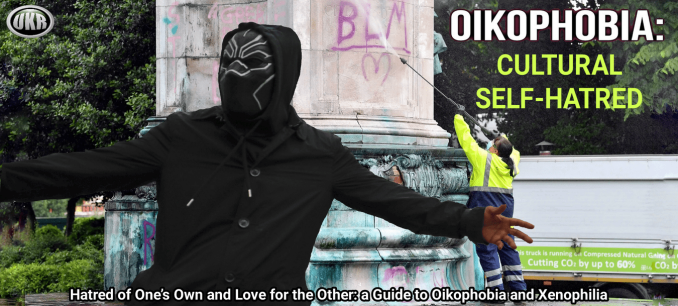
Private schools are also far from immune to these pressures. Only fear and panic can explain in 2020 the extraordinary phenomenon of head teachers of leading schools, like so many lemmings, rushing unnecessarily to review their curriculum in light of the death of a man at the hands of the police 4,000 miles away in a country with a history and culture different from that of England. As a result curricula have been ‘decolonised’, Eton College has rushed to appoint a “Director of Inclusion Education“, and the name of Sir Walter Raleigh, a national hero who helped to save England from the Spanish Armada, has been removed from the walls of Exeter School because, in the sanctimonious words of the head teacher, he “no longer represented the values and inclusive nature of the school“.
The cultural bodies that schools look to for support are also deeply embedded in what, tongue in cheek, one might call the Oikophobia Industrial Complex, through which huge sums of public money are granted to projects that are either not even taking place in this country or only affecting a tiny (but ‘oppressed’) minority. Two recent ones stand out in my memory, both from the notorious Arts and Humanities Research Council: £781,276 for ‘Embedding Gypsy Roma Traveller Month in the Public History Calendar’ and £249, 001 (one has to admire the precision of the budgeting) for ‘Theatre-making in careless times: arts-based approaches to care in Mombasa, Kenya’. Think how useful such sums might be for a non-ideological arts-based project in some run down part of the UK, or left in people’s pockets as a result of lower taxation. Even century-old major cultural bodies have succumbed. Look at the Historical Association’s webinars on decolonising the secondary school curriculum or the Classical Association’s guidance on how to ensure that, in classical education, one “queers the past“.
How does one explain the pervasive presence of oikophobia within British elites? In the case of individuals, occasional boredom with one’s inheritance and the attraction of the different and exotic are understandable, but surely unsustainable as a long-term lifestyle choice. Within institutions, oikophobia can easily become a habit carried forward unthinkingly. If one is always prioritising minorities and ‘victims’ and insensitive to the implications this has for the rest of society, one is liable to end up doing something egregious, as with the poor girl in the Union Jack dress.
Scruton traced some of oikophobia’s origins to the Enlightenment as one source of the globalism that aims to replace national citizenship with global citizenship and – dear to the hearts of Starmer and Hermer – aspects of national governance with transnational institutions. Oikophobia that downplays national identity and focuses on the subordinate identities of race, colour, gender and sexuality also shows traces both of Marxism applied to phenomena other than class and of Christianity, whose concern for ‘the poor, and mean and lowly’ is easily distorted into a deification of victimhood. The legacy of empire, the crude association of patriotism with xenophobia and fascism, and the prevailing currents of ethical, cultural and epistemological relativism also play their part in undermining a traditional love of country.
Is there any chance that elite oikophobes are likely to turn into oikophiles any time soon? Scruton believed that “the diseases which are created by thought can be cured by thought” and that this might be achieved long term through a transmission-based liberal education. He may be right, but this would mean radical review of the purposes of education and radical change of mindset across the worlds of media and culture, which at the moment seem inconceivable.
Starmer’s public recognition in May that we risked becoming “an island of strangers” suggested for one short moment that the Government might finally have understood the feelings of ordinary people about how mass immigration they never voted for has turned their familiar world upside down. The phrase was later disavowed and has since been redacted from the speech on the Government website and excised from the public record. That action, by itself, tells us how little to dare to expect from the remaining years of a Labour Government in which oikophobia and xenophilia are deeply engrained.
Dr Nicholas Tate is the author of The Conservative Case for Education and adviser to Mathias Corvinus Collegium (MCC) in Hungary. He was a member of France’s Haut Conseil de l’évaluation de l’école 2001-2007, an advisory body to the French minister of national education.
This article (Hatred of One’s Own and Love for the Other: a Guide to Oikophobia and Xenophilia) was created and published by Daily Sceptic and is republished here under “Fair Use” with attribution to the author Dr Nicholas Tate

••••
The Liberty Beacon Project is now expanding at a near exponential rate, and for this we are grateful and excited! But we must also be practical. For 7 years we have not asked for any donations, and have built this project with our own funds as we grew. We are now experiencing ever increasing growing pains due to the large number of websites and projects we represent. So we have just installed donation buttons on our websites and ask that you consider this when you visit them. Nothing is too small. We thank you for all your support and your considerations … (TLB)
••••
Comment Policy: As a privately owned web site, we reserve the right to remove comments that contain spam, advertising, vulgarity, threats of violence, racism, or personal/abusive attacks on other users. This also applies to trolling, the use of more than one alias, or just intentional mischief. Enforcement of this policy is at the discretion of this websites administrators. Repeat offenders may be blocked or permanently banned without prior warning.
••••
Disclaimer: TLB websites contain copyrighted material the use of which has not always been specifically authorized by the copyright owner. We are making such material available to our readers under the provisions of “fair use” in an effort to advance a better understanding of political, health, economic and social issues. The material on this site is distributed without profit to those who have expressed a prior interest in receiving it for research and educational purposes. If you wish to use copyrighted material for purposes other than “fair use” you must request permission from the copyright owner.
••••
Disclaimer: The information and opinions shared are for informational purposes only including, but not limited to, text, graphics, images and other material are not intended as medical advice or instruction. Nothing mentioned is intended to be a substitute for professional medical advice, diagnosis or treatment.
Disclaimer: The views and opinions expressed in this article are those of the author and do not necessarily reflect the official policy or position of The Liberty Beacon Project.


Leave a Reply