

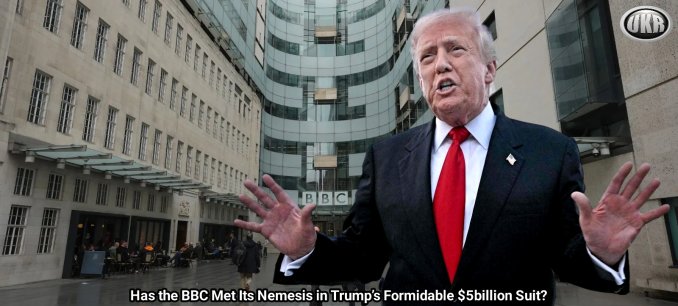
Has the BBC met its nemesis in Trump’s formidable $5billion suit?
DAVID KEIGHLEY
MAKE no mistake, Donald Trump’s $5billion (£3.7billion) defamation lawsuit against the BBC, filed yesterday, is a formidable document: it is a tightly constructed, meticulously argued claim that accuses the Corporation not merely of error but of intentional deception on a scale that, if proven, could be the most damaging legal defeat in its history.
Filed in the US District Court for the Southern District of Florida, the complaint names the BBC, BBC Studios Distribution, and BBC Studios Productions as defendants. It seeks $5billion in damages for defamation and for alleged violations of Florida’s consumer protection laws.
What makes the filing so potent is that it weaves the BBC’s factual admissions, internal whistleblowing, patterns of bias in BBC coverage, timing, motive and governance failure – caused essentially by the BBC acting as its own judge and jury – into a coherent narrative of wrongdoing.
(Under US law, if President Trump is successful in proving defamation, the court could also award punitive optional damages. The British press are speculating that this could add a further $5billion to the damages bill.)
At the centre of the case is Panorama’s now-infamous edit of Trump’s January 6, 2021, speech on Capitol Hill. The programme, Trump: A Second Chance?, broadcast on October 28 2024 included a sequence in which Trump appears to urge his supporters to ‘fight like hell’ in the context of a march to the Capitol.
In reality – to the BBC’s shame – the two statements were made nearly an hour apart. The editorial splice compressed time and meaning in a way that, as the BBC now acknowledges, totally altered the sense of Trump’s words. It looked like Trump was directly inciting violence. The BBC has already apologised for this edit. It is this apology that functions as the first pillar of Trump’s claim: the BBC has admitted the factual falsity of the broadcast.
But Trump’s lawyers go far beyond that. It is argued that the edit was not an accident. The lawsuit contends that Panorama producers knowingly rearranged the footage to create an inflammatory and electorally damaging narrative, and that this was done in the week before the 2024 US presidential election with the intention of influencing voters.
This is where the document becomes explosive, because Trump relies not on conjecture but on the BBC’s own internal evidence. The Prescott dossier – the 19-page document written by senior independent editorial adviser Michael Prescott for the BBC Board and exposed by the Daily Telegraph – is quoted extensively.
Prescott’s words, in which he describes the Panorama edit as ‘shocking’, ‘misleading’, and among the most serious editorial breaches he had ever seen, appear unfiltered in the complaint. The effect is devastating: the BBC’s internal whistleblower has become Trump’s star witness.
To strengthen his argument that the Panorama edit was not a one-off lapse but part of a pattern, Trump cites earlier BBC behaviour. He points to a 2022 Newsnight segment that used a similarly doctored Trump speech. He highlights three BBC news programmes in which presenters claimed that Trump wanted Liz Cheney ‘shot in the face’ – a claim flatly contradicted by the transcript. He dissects the contributor balance of the Panorama programme itself, noting that ten critics of Trump were featured against a single, mild defender. All this is marshalled to demonstrate what American defamation law calls ‘actual malice’: not personal hatred, but reckless disregard for the truth.
The complaint also argues that the timing of the broadcast was purposeful. The programme aired one week before the election. Trump claims that the BBC, by presenting him as a man who incites political violence, sought to depress support and influence the outcome. The narrative is sharpened by the further claim that the BBC offered no equivalent scrutiny of the Democrat presidential candidate Kamala Harris, thereby amplifying the sense that Panorama was a political intervention rather than balanced journalism.
The lawsuit then turns to jurisdiction. Trump insists that the BBC can be sued in Florida because it operates offices in the state, distributes BBC content to Floridians through BBC Studios and BritBox, and because BBC iPlayer is accessible in the US via VPN. He also emphasises that he resides in Florida and that the alleged reputational damage – political, commercial and personal – occurred there. This is an astute piece of legal positioning: Florida courts and juries are likely to be significantly less sympathetic to the BBC than courts in New York or California.
What follows is an equally damaging argument: that the BBC caused financial harm to Trump’s brand. In American law, a public figure claiming defamation must show that the falsehood caused real injury. Trump asserts that portraying him as a violent insurrectionist injured his commercial reputation, his political standing and the value of the Trump brand itself. The claim of $5billion may sound eye-watering, but the valuation of Trump’s global commercial identity is, in the logic of US courts, not implausible.
Crucially, the lawsuit devotes several pages to dismantling the BBC’s pre-litigation defence letter, written by the BBC’s US lawyers Ballard Spahr. The BBC had insisted the edit was inadvertent, that the broadcast was geo-restricted to the UK, and that Trump could not show harm or malice. Trump replies point by point: the apology proves falsity; the Prescott memo proves awareness; prior misconduct proves pattern; resignations of the Director-General and head of news indicate institutional failure; and geo-restriction is meaningless in a world of VPNs and social media amplification. In short, the BBC’s own explanations are turned against it.
The broader significance of the lawsuit is hard to overstate. For perhaps the first time, the BBC will face a legal process in which discovery is compulsory. Panorama producers and editors will have to surrender emails, messages, programme logs, editing notes, compliance paperwork and internal warnings. Witnesses will be questioned under oath. The Corporation cannot rely on the British media class, the Guardian, or sympathetic judges rallying to its defence in the US. It will not be acting in matters of alleged malfeasance – as it does in the UK – as its own judge and jury. It cannot run its internal inquiry and call the matter closed. The US legal system does not recognise the BBC’s cultural mythology. It cares only about evidence, motive and harm.
What Trump has done, perhaps unwittingly, is expose the same pathology that Andy Webb’s book Dianarama has revealed in spades: the BBC’s belief that because it believes its intentions are pure, its distortions are excusable. In 1996, the Corporation protected Martin Bashir and buried the truth about Diana for 25 years. In 2024, it spliced Trump’s speech and buried the truth in the Prescott memo. Then, as now, the BBC placed its moral self-image above its journalistic obligations. The courtroom in Florida is about to determine whether that habit has finally collided with a force it cannot resist.
The stakes could hardly be higher. If Trump wins – even partially – the BBC will face not just severe financial pressures, but a fundamental crisis of credibility. It will no longer be able to insist that its errors are isolated, its critics unhinged, its intentions noble. It will have been found, in a court of law, to have deliberately defamed a US President and to have attempted to manipulate a US General Election.
This article (Has the BBC met its nemesis in Trump’s formidable $5billion suit?) was created and published by Conservative Woman and is republished here under “Fair Use” with attribution to the author David Keighlry

••••
The Liberty Beacon Project is now expanding at a near exponential rate, and for this we are grateful and excited! But we must also be practical. For 7 years we have not asked for any donations, and have built this project with our own funds as we grew. We are now experiencing ever increasing growing pains due to the large number of websites and projects we represent. So we have just installed donation buttons on our websites and ask that you consider this when you visit them. Nothing is too small. We thank you for all your support and your considerations … (TLB)
••••
Comment Policy: As a privately owned web site, we reserve the right to remove comments that contain spam, advertising, vulgarity, threats of violence, racism, or personal/abusive attacks on other users. This also applies to trolling, the use of more than one alias, or just intentional mischief. Enforcement of this policy is at the discretion of this websites administrators. Repeat offenders may be blocked or permanently banned without prior warning.
••••
Disclaimer: TLB websites contain copyrighted material the use of which has not always been specifically authorized by the copyright owner. We are making such material available to our readers under the provisions of “fair use” in an effort to advance a better understanding of political, health, economic and social issues. The material on this site is distributed without profit to those who have expressed a prior interest in receiving it for research and educational purposes. If you wish to use copyrighted material for purposes other than “fair use” you must request permission from the copyright owner.
••••
Disclaimer: The information and opinions shared are for informational purposes only including, but not limited to, text, graphics, images and other material are not intended as medical advice or instruction. Nothing mentioned is intended to be a substitute for professional medical advice, diagnosis or treatment.
Disclaimer: The views and opinions expressed in this article are those of the author and do not necessarily reflect the official policy or position of The Liberty Beacon Project.


Leave a Reply