

This is How Tyranny Grows
IAIN HUNTER
The Lord Chancellor in the Fabian regime which has Britain in its grip, David Lammy, has announced significant reforms that will limit the right to jury trials. This is part of an effort, Lammy says, to address a severe backlog in the criminal justice system. These changes, officially revealed in early December 2025, aim to create a more efficient system capable of handling the rising caseload. The are a result of a report produced by Sir Brian Leveson in response to a request made to him by the then Lord Chancellor, Shabana Mahmood.
I’m not going to go through all the Leveson recommendations. If you wish to read them you can do so here.
Lammy claims that these reforms are essential for maintaining public trust in the justice system, citing the significant backlog exacerbated by the COVID-19 fake pandemic. Currently, around 80,000 cases are pending, with some defendants potentially waiting several years for trial. He and his supporters argue that the legal system must adapt to the realities of long delays, which discourage victims from pursuing justice.
Critics, however, emphasize that the backlog is primarily due to neglect of the courts’ infrastructure, chronic underfunding and administrative inefficiencies, rather than the trial-by-jury system itself. There is certainly no shortage of reports of proceedings cancelled or delayed because of broken heating systems, leaking roofs or double-booking of court rooms and so on.
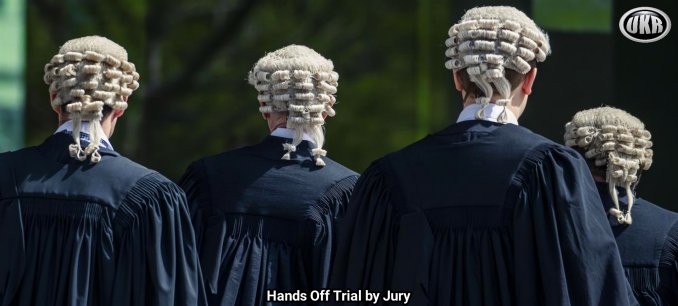
There has been a storm of protest from the legal profession and opposition politicians. While some of the barristers protesting are no doubt doing so out of self-interest because they see that it will reduce their earning opportunities, many are not. They criticise the announced reforms as an erosion of important legal rights, realising that it is another assault on the more than 800-year-old right to a Trial by Jury which is enshrined in Magna Carta. They say further eroding this right undermines the foundations of British justice. They have argued that ‘Jury Trials’ serve as a vital check against potential government abuse and that reducing access to jury trials may disproportionately affect marginalised communities.
These planned reforms have instigated a heated debate about the balance between expediency in the justice system and the fundamental right to a trial by jury, suggesting that this is a pivotal moment for the future of legal practices in Britain. The reform’s opponents are not wrong.
However, the political response has been pathetic, to say the least. The leader of the ‘Blue Wing’ of the Uniparty, Kemi Badenoch, criticised the proposal, arguing that reducing the right to trial by jury is unnecessary and harmful, calling it an ‘ancient right’. She left it to the Shadow Justice Secretary Robert Jenrick to accuse the Fabian government (my description, not his) of undermining a longstanding legal institution without a mandate from the public. It was a weak response and he missed the point entirely. In the House of Commons, Jenrick pointed out that Lammy was back-tracking on his own earlier remarks about ‘Jury Trials’
“His past is catching up with him, because the best opponent of the Justice Secretary’s plans to curb jury trials is the Justice Secretary himself.
“In 2020 he said, ‘Criminal trials without juries are a bad idea. You do not fix the backlog with trials that are widely perceived as unfair’. In 2017, in his report into prejudice in the criminal justice system, he found juries, and I quote, ‘act as a filter for prejudice’. But now he’s become Justice Secretary, he’s scrapping the very institution he once lauded. Which is it? Will the real David Lammy please stand up?”
Jenrick added:
“And what about this? ‘There should be a right to trial by jury in all criminal cases’. Any ideas, Mr Speaker? Who else but the Prime Minister this time. Does this Government have no shame?”
Reform UK, on the other hand, has expressed strong opposition to the proposed jury trial reforms in England and Wales, arguing that limiting jury trials undermines public confidence in the justice system and could lead to miscarriages of justice. They believe that the focus should be on addressing the underlying issues causing court backlogs rather than removing the right to jury trials. Which is good as far as it goes but it completely misses the point again.
The strong oppostion which shows any real understanding of what is at issue has been on social media or come from the podcast sphere, whether from among lawyers or simply from those who have a deep interest in the British Constitution and Common Law. Several individuals have hit the nail squarely on the head, probably none better than S. Tominaga who posted his thoughts on ‘X’. They were brought to my attention by Will Keyte of commonlawconstitution.org in his own podcast response. I have lifted them from the transcript of Will’s video, tidied them up and reproduce them here:
What is being proposed is not a reform. It is a confession of contempt for the very people from whom the state claims its legitimacy. The jury is not a sentimental relic. It is the practical assertion that the citizen is sovereign in judgment that the state must persuade the governed before it may punish them. Remove that and you do not streamline justice. You sever the moral tendon that binds power to consent. For eight centuries, the jury has been the visible line of demarcation between law and command. It is the one institution that tells authority in plain and humiliating terms that its conclusions are not self-authenticating.
Twelve ordinary minds, un-bought and un-appointed, are required to say, “Yes, this accusation has met the standard of proof.” That is not romanticism. That is civilisation’s hard-earned distrust of concentrated power. The moment judgment becomes the private monopoly of professional tribunals, the citizen is no longer a participant in justice but a subject of administration. The pretexts are always pathetic. Efficiency, cost, backlogs. These are the slogans of a managerial class that cannot imagine any value higher than its own convenience.
Liberty is not a line item to be trimmed when spreadsheets grown. If a state cannot afford the safeguards that prevent tyranny, then it cannot afford to call itself legitimate. The cost of juries is the cost of freedom. The price of abolishing them is paid in fear, silence, and the quiet normalisation of arbitrary rule. And notice the timing. We are told to accept this surrender just after a crackdown in which speech itself was treated as a prosecutable impurity. and people received grotesque sentences for words on a screen while violent criminals walked out early under the same government’s capacity regime. This is the logic of a state that has come to mistake dissent for danger and obedience for virtue.
To place the whole weight of criminal judgment into the hands of a politicised bench after it has already shown how cheaply it values conscience is not merely reckless. It is the deliberate construction of a soft police order dressed in robes and euphemism. A compulsory digital ID system hand-in-hand with the shrinkage of juries completes the picture. Identification to watch you, tribunals to convict you, and a public square trained to keep quiet, lest it be denounced as harmful. That is not a free society drifting by accident into error. That is a society being led quite purposefully into managed submission.
If Scotland has any remaining instinct for self-respect, it should leave the Union rather than be dragged further into this antiseptic authoritarianism. A nation that values its own moral agency does not consent to be ruled by strangers who fear the verdict of ordinary citizens. Better an independent country with the courage to preserve trial by peers than a subordinate province in a kingdom that barters ancient liberties for bureaucratic tidiness.
Juries are critical because they embody the only political principle worth defending that the individual is not livestock in the state’s corral. They are the institutional reminder that justice is not what officials declare, but what free men and women hearing evidence under law are willing to affirm. Take that away and you have not improved the law. You have replaced it with an authority’s monologue. And a monologue is always the language of tyrants, whether they whisper it in velvet tones or shout it through sirens.
The paragraph about Scotland is there because S Tominaga has been concerning himself with Scottish matters and it adds to a powerful condemnation. What is being proposed by David Lammy is unconstitutional. It runs directly counter to Magna Carta article 39. Here is the relevant article from legislation.gov.uk which is Art XXIX of the unrepealed parts of Magna Carta 1297.

There are those who insist that Magna Carta 1215 is still in force because it is a Peace Treaty between the King and the Barons representing all free men and women and Parliament has not the power to remove it because Parliament did not exist in 1215. Here is Article 39 from Magna Carta 1215:

Which translates as:
No free man is to be arrested, or imprisoned, or disseised, or outlawed, or exiled, or in any other way ruined, nor will we go against him or send against him, except by the lawful judgment of his peers or by the law of the land.
The 1297 version adds to the original but the most important clause is the last:
except by the lawful judgment of his peers or by the law of the land.
Lawful judgement of his peers is Trial by Jury which had been practiced in England since pre-Norman times; the law of the land refers to ancient rights and customs then in force so it cannot refer to any act or statute that has been created by Parliament since its inception. Parliament has no power to over-ride this. Apart from anything else, it is an article of a constitutional document that no minister of the crown can vary simply by fiat or even by a vote in Parliament.
Furthermore, juries have the power to determine guilt or innocence according to their consciences, not just by blind adherence to any part of an Act of Parliament or any other statutory instrument. A jury may also judge the legislation under which a defendant has been brought to court. It must establish that the law or legislation the defendant is accused of breaching is not against common right and reason or repugnant, or impossible to comply with. For example, a defendant may be guilty of an act which infringes a law or legislation, but the jurors may judge that the law or legislation is unjust, unfair or infringes upon the inalienable rights of the defendant. They then have the obligation to render void that law or legislation in the case before them which may be inferred for other similar cases. This is known as annulment by jury or jury nullification . It is a fundamental part of our constitution, a fundamental part of democracy which enables us to keep a check on the power of a government.
Far from jury trials being further restricted, they should be extended to all those cases which are not at present heard before a jury; no person charged with any offence which may lead to a punishment involving loss of freedom or pecuniary charge or loss of property should be denied a trial by jury if he or she requires it. It follows that no one should plead guilty to any charge which will lead to a trial solely before a judge and/or magistrates. Trial by jury is a constitutional right which no minister has the power to remove and no agent of the state should be empowered to act as judge, jury and the executioner of punishment.
However, let us be under no illusions. We can see why and how this has arisen. The state has created the backlog of cases in order to provide the convenient rationale for the extension of judge-only trials under the guise of expediting justice more efficiently. In so doing it will expand the power of the state and it will be at the direction of those shadowy powers which are attempting to destroy our democracy and nation . Let the words of S Tominaga be a warning to them that we see them.
This article (Hands Off Trial by Jury) was created and published by Iain Hunter and is republished here under “Fair Use”
See Related Article Below
Judges turn on Lammy’s plans to scrap jury trials
Labour’s proposal described as ‘harmful distraction’ that would not fix court backlog
Judges have described David Lammy’s plans to curb jury trials as a “harmful distraction” that will fail to reduce court backlogs.
The judges – both serving and retired – have spoken out amid a backlash from both Labour and Tory MPs against the Justice Secretary’s plans to halve the number of jury trials.
Mr Lammy is proposing to axe jury trials for defendants facing prison sentences of less than three years. They will instead have their cases heard by magistrates or by a new Canadian-style tier of judge-only courts.
Lord Thomas, the former lord chief justice of England and Wales, said the reform “won’t fix the backlog quickly enough”.
“Our system depends upon someone having to make a choice to plead guilty or not guilty quickly, and if you delay that you will go on increasing the backlog,” he said.
He also criticised Mr Lammy’s decision for not taking up former appeal judge Sir Brian Leveson’s recommendation to have an intermediate court of a judge and two magistrates.
“We ought to pause long and hard before we remove the lay element from trying the more serious cases,” he said. “It produces balance, it brings to a court what a jury brings, which is some experience of people with everyday knowledge of life.”
Paul Dodgson, the former circuit judge, said: “I have no doubt whatsoever that jury trial is the fairest and most effective means of deciding whether someone is guilty of an offence.
“I can honestly say that I only remember one verdict from a jury that I fundamentally disagreed with and although I disagreed with the verdict I understood why the jury came to it.”
‘Unnecessary battle lines’
Geoffrey Rivlin KC, a former senior circuit judge, said: “In this time of crisis, it a great pity that any reform of the jury system should arise at all. It is not necessary; it can only do harm.
“Yet, it inevitably means that juries have taken, and will remain, centre stage – a distraction, creating unnecessary battle lines and efforts to save face. It will soak up valuable time and energy when there is much vitally important work to be done.”
Serving judges are historically barred from making political comments but after passing judgment on a case this week, Judge Richard Marks said: “We are very proud of the jury system in this country – long may it remain.”
The Telegraph: continue reading


Leave a Reply