

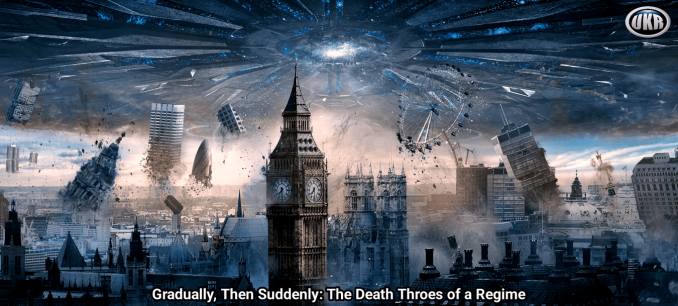
Gradually, then suddenly
The death throes of a regime
DAVID MCGROGAN
For the first time in my life I began to realize that it is not evil and brutality, but nearly always weakness, that is to blame for the worst things that happen in this world.
-Stefan Zweig
Now, as Antonio Gramsci might have put it, is the time of monsters. Our wassail is over; the Graces, my friend, have abandoned the earth; there below, the Greek ships wait. In short – Britain’s ruling regime is kaput. The only thing left to do is to wait and see how the decline plays out and plan as positively as possible for the aftermath.
There is nothing particularly controversial about me saying this. It is rapidly turning into the consensus view. As I put it a few months ago, you just have to live here. But on Tuesday this week the Deputy Prime Minister, Angela Rayner, circulated a so-called ‘Cabinet read-out’ to journalists which nicely summarised both the nature of the problem and the cause of the coming cataclysm.
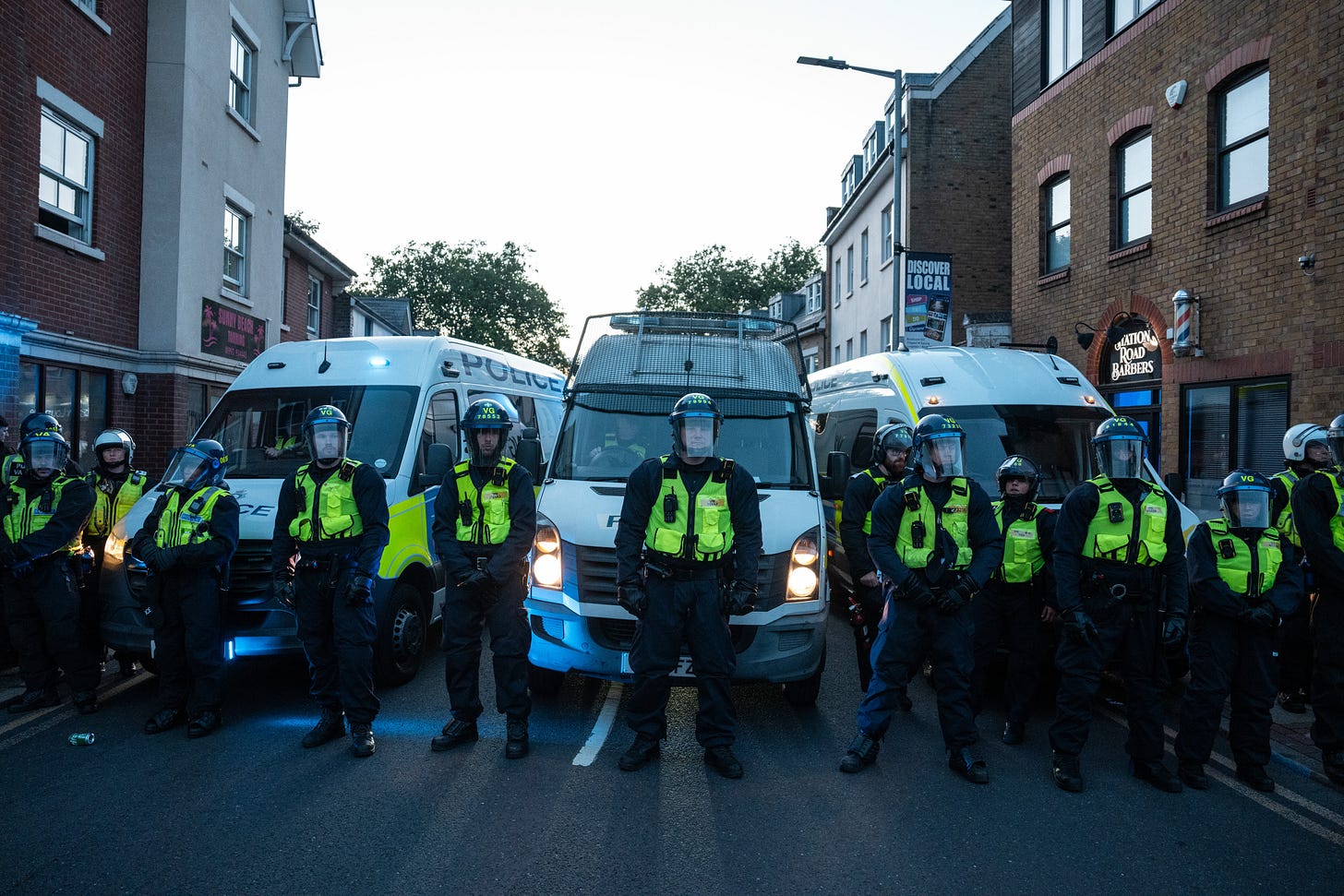
The immediate trigger for Rayner’s comments was the springing up of a series of demonstrations that are currently threatening to transmogrify into a gilets jaunes style mass movement. This concerns the use of ‘asylum’ hotels to house illegal migrants, mostly young men – a practice which I have written about before, and which is spreading to very unlikely areas of what you might call ‘L’angleterre profonde’: sleepy, prosperous and very English places like Epping and Diss. The tactic of slandering these protests as the work of the ‘far right’ has been deployed by the usual suspects (the Socialist Worker has even described them as ‘pogroms’) but the label isn’t sticking: the truth of the matter is that the population are increasingly simply sick of being governed in the indefensible way we are. We all know that this is the source of the frustration, and feel it keenly. The forced imposition of large numbers of deracinated and often sexually aggressive young men from foreign climes on relatively small and settled communities is simply the most visible aspect of the basically contemptuous and high-handed operating modality of our, decaying and flatulent, ruling regime. And the kick-back is not ‘far right’ – it is rather to be understood as the reaction of the population to a governing apparatus that does not understand, and cannot fulfil, the most elementary task of the sovereign.
Rayner’s comments speak to this issue directly (although, of course, she does not grasp this). Here is how they were reported by Huffington Post:
[Rayner] told her cabinet colleagues that ‘economic insecurity, the rapid pace of de-industrialisation, immigration and the impacts on local communities and public services, technological change and the amount of time people were spending alone online, and declining trust in institutions are having a profound impact on society’.
The deputy PM also pointed out that 17 of the 18 areas where there was a high rate of disorder last summer were among the most deprived places in the country.
She told cabinet: ‘While Britain was a successful multi-ethnic, multi-faith country, the government had to show it had a plan to address people’s concerns and provide opportunities for everyone to flourish.’
Rayner pointed to Labour’s upcoming Plan for Neighbourhoods, meant to deliver billions of pounds of investments over a decade to the most deprived areas.
Asked if this meant Rayner saw a connection between high levels of immigration and the disorder, the prime minister’s spokesperson said: ‘She sees a link between concerns people have about where the government is acting on their behalf and on their interests with a range of factors [sic].’
Got that? Britain is a successful multi-ethnic, multi-faith country, and the government has to show it has a plan to address people’s concerns and provide opportunies for everyone to flourish. And, er, there is a link between concerns people have about (checks notes) ‘where the government is acting on their behalf and on their interests with a range of factors’.
You have to laugh, even through the tears: these are the people who are in charge. Britain is a successful country? And this government has a…plan? But the important point to emphasise here is that Rayner, and the people around her, are simply constitutionally incapable of recognising the problem itself, or the solution. They actually think that ‘immigration and the impacts on local communities and public services’ is just one of a ‘range of factors’ destabilising society, alongside ‘economic insecurity, the rapid pace of de-industrialisation, technological change and the amount of time people were spending alone online, and declining trust in institutions’. And they actually think that the remedy for this is just ‘investment’ in ‘deprived areas’ so as to allow people to ‘flourish’.
British readers are familiar with this mindset: typically what it means is that money gets funnelled into regeneration schemes that kit out otherwise forgotten places like Newport, Dundee or Middlesborough with nice new shopping precincts and art galleries nobody visits. The idea, more or less, is that opposition to uncontrolled immigration is really just a feature of economic insecurity and, perhaps, a lack of civic pride. And if government can therefore just press the ‘grow’ button a bit harder, people will feel better off and pride will re-emerge, and our ‘successful multi-ethnic, multi-faith country’ will simply become more successful yet.
What to say to help Angela Rayner out of her unfortunate predicament? Who will break the news to her? At first glance it seems incredible that otherwise purportedly intelligent people could think and say things that are so stupid – that somebody could fail to see that uncontrolled immigration is a phenomenon of vastly different nature to ‘economic security’ or ‘the amount of time people spend alone online’. Yet this failure gets us to the heart of the matter because it brings us to the focal point: the issue that lies at the centre of regime politics in 2025 and the issue that will determine its fate.
Let us take a step back then, for a moment, and examine the current British regime. A regime, to cite Harvey Mansfield, comprises the ‘some’ who govern the ‘many’. Wider than a government or legislature, it really comprises what I once described as ‘anybody who is broadly connected with the exercise of governing – whether in the executive branch itself broadly understood (the civil service, police, etc.), or within the great penumbra of academics, teachers, and other public sector employees who either enforce, replicate, or elaborate’ a set of particular values. This, I continued:
[I]s a conceptual grouping rather than a formal one. Any society is constituted to give effect to certain givens, norms, ideas. And the regime can be thought of, then, as that class of people who benefit from, and enforce, a particular set of constitutive values. (Indeed one could almost go so far as to say that a regime is synonymous with the values which sustain and justify it.) They arrange society in accordance with their preferences. And they present their preferences as not just essential, good, decent and right – but as justifications for their own status. The regime governs on the basis that its values are always necessary to enforce.
Britain has been governed continuously since 1997 by a regime with a relatively focused set of constitutive values that can be understood chiefly as a positive response to globalisation. The end of the Cold War and technological innovation (the incipient internet, cheaper air transport, etc.) combined to generate a fairly rapid shift towards global openness. And this brought into the political mainstream a set of ideas that had been ‘lying around’, to use Milton Friedman’s expression, for some time: free trade, open borders, multiculturalism, and so on. These values had, it is safe to say, already been imbibed by the chattering classes, beginning really in the 1960s, and the elite fairly rapidly embraced them politically when globalisation began in earnest, staring in the very early 1990s.
The result of this was that Britain’s ruling regime became strongly characterised by a set of norms that emerged from the consensus the ‘some’ who ruled the ‘many’ had about the values of a modern society. And we are of course all aware of what those norms are and how they find expression: everybody is not so much equal as interchangable; culture is purely aesthetic in the most superficial sense; borders and distinctions are always bad; commercialisation is always good; openness is the supreme virtue; closedness is the most deadly sin; and so on.
Support for open borders is the lodestar of this regime because it is the intersecting node, as if it were, of all of these different vectors. If you believe that everybody is interchangeable, that culture is purely aesthetic, that borders and distinctions are always bad, that commercialisation is always good, that openness is the supreme virtue, and that closedness is the most deadly sin, then free movement will become the literally quintessential element of your value system – the one that permeates them all and holds them together.
The problem with this, however, is that it has confronted the British regime with a contradiction. This is because in the end political authority cannot rest on the mere idea of openness – at least, not in the long run. Political authority that rests only on openness, and on deliberate repudiation of any connection to a land, or a people, is purely transactional or (to use one of my favourite Foucauldianisms), ‘synthetic’. It can maintain loyalty only by in effect handing out sweeties – or by staving off displeasure in a Hobbesian sense. Anyone in the world may come, and go, but the relationship between individual and State is coldly commercial: contingent on mutual benefit and therefore resting on thin and barren soil.
This can sustain goings-on for a little while if economic conditions are good, but is no proper grounds on which authority can rest, and not just because it makes government hostage to economic fortune (though it does). It is because in the end the nature of sovereignty itself is precisely to form the basis for the territorial unity of a people – that is really what it is for – and, ironically, it is the consequences of the very embracing of globalisation that are causing this to unravel.
I elucidated this in greater detail in a recent paywalled post, but the essence of the matter is really in the description of the sovereign, shared by both Carl Schmitt and Hannah Arendt, as he who has purview over not just the exception, but also the norm. The sovereign is that power who, through granting himself the sole license to use violence, determines where the metaphorical city wall lies around the polity, and protects it. And in so doing, he also determines what is normal (i.e., what is within the walls) and what is exceptional – who are the friends (those within) and who are the enemies (those to be ejected). Through doing this – through exerting oversight of the border around the polity – he creates the space within which the citizens can engage in politics freely as friends, and thereby indeed makes politics as such possible. And in so doing he both binds together and reflects the underlying normative unity between people and place.
This roots his authority precisely in the territory itself and its relationship to those who live in it. This is what provides it with genuine permanence. And the post-97 British regime, in flagrantly and indeed wholeheartedly abandoning a commitment to the core task of the sovereign through its chaotic immigration policy, is thereby undermining the only claim to possess genuine authority that it could in the long run make. It has transformed the relationship between British government and the people occupying the territory into a transactional and synthetic one; the only plea it can in the end make to the populace is something like, ‘Please let us remain in charge and we’ll provide opportunities for everyone to flourish.’ But this is thin gruel that cannot sustain a polity across time, and we are now seeing the inevitable consequences play out.
How do we explain, then, what happens next? In Chapter XXIX of Leviathan, Hobbes lays out a list of things that ‘weaken, or tend to the dissolution of a commonwealth’. And at the top of the list, aptly (if a little surprisingly), is the voluntary weakness of the ruler – the fact that he has become ‘content with less power, than to the peace, and defence of the commonwealth is necessarily required’.
This would seem a suitable way to describe our crop of current leaders, who have managed to convince themselves that all of our problems would go away with a bit of ‘investment’ in ‘deprived areas’, and who are completely unwilling to exercise the ruthlessness and psychological toughness required to do what is necessary to secure Britain’s borders. The perception that people appear to be able to freely come and go from the UK whether legally or otherwise, and that the State will even facilitate them doing so illegally by putting them up in hotel rooms, is not just one problem among a ‘range of factors’. It goes to the heart of what sovereignty is all about because it casts government as being incapable of delineating the inside from the outside, norm from exception, friend from enemy. And it is therefore now condition critical, code red, squeaky-bum time for the survival of the regime – yet those in charge are absolutely incapable of even recognising this to be the case, let alone doing anything about it. This means it will, fairly rapidly, arrive at a point of system failure.
The consequences of this will be ugly. Something bad is going to happen. One can almost smell it. The regime that has governed Britain since 1997 is coming to an ignominous end. With its end there is likely to come a considerable amount of pain. It is extremely unlikely that the current government will survive until 2029, the point at which the next general election will nominally have to take place. Sir Keir Starmer already stinks of crisis, and the stench that clings to him will get worse until it becomes intolerable. What happens when he is replaced is anyone’s guess. But things will simply not get better until sane immigration policy, craved by all citizens of whatever racial background, is restored and implemented with the necessary rigour – because that is in the end what is absolutely fundamental in grounding the authority of the sovereign.
[You can refer News from Uncibal to friends. If three sign up, you will receive a month of paid subscription for free. If five sign up, you will receive three months of paid subscription for free. If fifteen sign up, you will receive a year’s paid subscription for free.]
This article (Gradually, then suddenly) was created and published by News From Uncibal and is republished here under “Fair Use”
See Related Article Below
The Civil War Debate – Betz v Kisin
PAUL COLLITS
The popular British podcast, Triggernometry, recently hosted the seemingly now everywhere civil war scholar, David Betz. Betz has recently been arguing that Britain – where the Canadian-born academic has been living for several decades – and other Western countries are currently at risk of imminent civil wars.
Triggernometry is run by two British (one a semi-Russian) smart and funny comedians, Francis Foster and Konstantin Kisin, who have carved out a significant space in intelligent interviews. They have over a million subscribers. They get noticed. Kisin, in particular, is now a favourite on the conservative lecture circuit and is, himself, a popular interviewee with the likes of John Anderson.
David Betz’s thesis, repeated at Triggernometry with scholarly embellishments suited to the high-brow ambience of the show, is pretty simple and to be intuitively understood by those even half-awake. It is that countries like Britain and many Western European have at present the objective pre-conditions for imminent civil war. The likely character of the war will be inter-ethnic, with a strong sub-current of elites-versus-outsiders enmity. The powder-keg atmospherics are driven by rapid cultural changes, the feeling of a loss of power by long-time native residents, a decades-long war on everyday citizens by woke, progressive, overbearing elites, and an ongoing ignoring of the wishes of the people on critical issues by those in government.
In short, it is all about (or mostly about) mass immigration. If there was a slogan appropriate to the restless mood, it would be – “we want our country back”. But it isn’t just about migrants, legal or otherwise. It is about their sheer number, the ease of their arrivals, the generosity of benefits offered new arrivals, courtesy of the taxpayer, the fact they hate the locals, their propensity for violent sexual crimes against local minors, the total lack of intention to integrate and to value Western mores, and the sheer insouciance of the governing class in the face of blatant threats to the polity and civil society caused by the invasion.
To say that the ruling class is simply ignoring the problem is to misdiagnose the system-problem, by the way.
Betz admits to not being a political scientist, but for a cognate-scholar, he is pretty spot-on on the political theory. He rightly judges the people to have given up on the system, the polity to which they have been previously disposed to accept, and the capacity of the system to right itself in the face of crisis. Betz could have mentioned political obligation, the social contract, Locke and Hobbes. He didn’t need to. When citizens come to the conclusion that they are not heard, that their concerns are not even registering with their rulers, that the rulers actually ignore and despise them, well, they then have to decide what can be done, and what can be done legitimately, within the existing system. When this ceases to be a possibility, you get dissidents and dissidence, polite protest, passive resistance, insurgency, and, at worst, civil unrest.
This is not to be confused with electoral grumpiness. We lost and we have the shits. We don’t like this or that outcome, but we accept that we lost this one and we live to fight another day. We don’t like the other side or its arguments but we accept its right to govern, for the moment.
No, this is a belief that the system has lost legitimacy. Has lost the rulers’ right to our compliance with the system itself. Betz’s conclusion is that many Western countries have reached this position.
Not surprisingly, Betz’s message is seeping seamlessly into the British consciousness, it seems. You expect the red carpet then rape my daughter, I will be pretty pissed off. You get the picture. The protests are increasing. They are manic in Spain. The French are being very French. Even though they have been dim-wittedly been voting for decades for leaders who keep inviting the invaders in in an apparent attempt to make Michel Houellebecq’s fictional predictions come true.
The people are on the streets. They are restive.
There was (civil) pushback on the Triggernometry podcast against what Kisin (in particular) saw as Betz’s pessimism. It revolved around the system’s ability to self-correct. Kisin’s faith is in Trump and Reform UK-like resistance to the deep state.
Betz doubts that resistance of this (parliamentary) kind, operating within the constraints of the current regimes as they are constructed, can act sufficiently quickly and consequentially, and in the face of inevitable resistance by the elites to insurgent policies, to assuage the restless masses. The election of a reform administration, Betz believes, would only raise the stakes and grow the masses’ demand for action. Which it would be hard pressed to meet.
Not to mention the sheer the logistical constraints and the size of the insurgent task. Like the off-loading of millions of bedded-in illegal migrants, for example. Betz especially noted the power of the elite-driven bureaucracy to stonewall and resist, as they did to great effect, post-Brexit.
These are powerful arguments. But there are others to which Betz did not refer, taking the UK as the best case study:
· Reform UK currently has only five members in the UK parliament out of around 650 seats, depite very positive polling prior to the 2024 General Election;
· Good polling now does not mean electoral victory in 2029;
· Starmer will probably be gone by then – Labour may recover;
· Labour may come to its senses, or at least partially so, on the issues of most concern to voters – perhaps Angela Rayner is already on the case, however imperfectly and cynically;
· Reform UK might implode, a scenario not out of the question given the current conniptions;
· Reform UK may go native and tack to the political centre, comfortable with the whiff of ministerial leather; there are already suggestions that this very thing is happening already, in opposition, and years out from an election;
· I still don’t think that Reform UK will ever govern; they may be ever destined to finish second in individual seats and simply peter out;
· The suggestion that the grievances of the insurgents are just about mass immigration is flawed; correcting mass immigration, even if achieved, would simply be answering one grievance and ignoring the others – the mass intrusion in individual lives of the deep state, with its surveillance, woke culture, silencing of dissident voices, cancel culture, plandemic planning, crushing of rights, digital ID, legalised killing of the infirm, relentless warmongering, net zero madness and all the rest – and there is no confidence that the opposition parties are committed and able to overturn all or even most of these system failures.
It isn’t just Betz on the case. The sense of imminent system crash is everywhere. The excellent David Mcgrogan has weighed in as well, with some deep analysis, concluding:
Britain’s ruling regime is kaput.
He doesn’t say, though, how he thinks this will play out, and end. He doesn’t speak of civil war, for example. He says, though:
The consequences of this will be ugly. Something bad is going to happen. One can almost smell it. The regime that has governed Britain since 1997 is coming to an ignominous end. With its end there is likely to come a considerable amount of pain. It is extremely unlikely that the current government will survive until 2029, the point at which the next general election will nominally have to take place. Sir Keir Starmer already stinks of crisis, and the stench that clings to him will get worse until it becomes intolerable. What happens when he is replaced is anyone’s guess. But things will simply not get better until sane immigration policy, craved by all citizens of whatever racial background, is restored and implemented with the necessary rigour – because that is in the end what is absolutely fundamental in grounding the authority of the sovereign.
Gradually, then suddenly – by David McGrogan
Few would disagree. System breakdown is in our faces. Another summer of crisis and ugly protest is almost certain. Gradually, then suddenly.
Ultimately, the Betz-Kisin debate is an argument about what is likely to happen next. At one level, it is anyone’s guess what comes next. The world we now inhabit is hyper-VUCA – volatile, uncertain, complex and ambiguous. New political movements are happening at the speed of the post-modern 2020s.
I think that Betz and Kisin might both be wrong. Kisin overestimates the capacity of dissident parties to deliver the outcomes that would calm the anger of the punters and deliver the reset that is needed to steady the ship of state and preserve the belief in the system that, clearly, has evaporated.
I very much doubt the system will seamlessly self-correct.
But Betz may himself be overestimating the propensity of the insurgent masses to escalate their current discontents to civil war.
Speaking as an Australian, I just don’t see the next stage as he does. Certainly not down under, and Australia seems not to be on Betz’s radar to date. Europe, ever more volatile and suffering far more and more insufferable attacks on its society, may blow.
But haven’t we already experienced the greatest ever provocation by the state to incite its citizens to rise up?
The willingness to erupt was surely tested to the max during Covid. And the elites-driven polity survived. The system didn’t blow. Despite the lies. The lockdowns. The enforced mandates. The vaccine tyranny. The crippling of human rights. The smashing of the innocent on the streets of our cities. The sickening bureaucracy. The abandonment of parliament and due process. The legacy media’s bullying. The corrupt behaviour of in-the-pay academics. On the take from Big Pharma. The endless lies from on high. Medical regulatory agencies not doing their jobs, but rather taking their orders from supra-national bodies and corporates.
The police state came to town. And we didn’t rise up against it. Not in Britain, and not in Australia. To our eternal shame. A million marched on Canberra. Yes, one million people. They set up camp. Then they just went home. That didn’t feel much like a revolution. The nation’s leaders had literally ignored them.
It is interesting that Covid was never mentioned in the whole Betz podcast. Yet this has been the single most egregious attack on the citizenry by the state that has occurred in our lifetimes. In every Western nation considered by Betz to be a powder keg now.
It seems that Aldous Huxley and his depiction of the future spelled out in Brave New World might just be the model. We are drugged, we are distracted, we are now conditioned to a tyranny that has slowly and silently crept up on us without our noticing. We are provided with what we think we want, especially by way of toys. And the state simply rolls on. We are paper-rich. We don’t much care about the democratic privations of the elite model of governance that we seem so happy to have inherited.
The emerging ethnic tensions now experienced in many Western countries may change that. Civil war may be coming. I just don’t see it, despite David Betz’s eminent common sense and obvious scholarship. Not yet, anyway.
Paul Collits
24 July 2025
This article (The Civil War Debate – Betz v Kisin) was created and published by Paul Collits and is republished here under “Fair Use”
.

••••
The Liberty Beacon Project is now expanding at a near exponential rate, and for this we are grateful and excited! But we must also be practical. For 7 years we have not asked for any donations, and have built this project with our own funds as we grew. We are now experiencing ever increasing growing pains due to the large number of websites and projects we represent. So we have just installed donation buttons on our websites and ask that you consider this when you visit them. Nothing is too small. We thank you for all your support and your considerations … (TLB)
••••
Comment Policy: As a privately owned web site, we reserve the right to remove comments that contain spam, advertising, vulgarity, threats of violence, racism, or personal/abusive attacks on other users. This also applies to trolling, the use of more than one alias, or just intentional mischief. Enforcement of this policy is at the discretion of this websites administrators. Repeat offenders may be blocked or permanently banned without prior warning.
••••
Disclaimer: TLB websites contain copyrighted material the use of which has not always been specifically authorized by the copyright owner. We are making such material available to our readers under the provisions of “fair use” in an effort to advance a better understanding of political, health, economic and social issues. The material on this site is distributed without profit to those who have expressed a prior interest in receiving it for research and educational purposes. If you wish to use copyrighted material for purposes other than “fair use” you must request permission from the copyright owner.
••••
Disclaimer: The information and opinions shared are for informational purposes only including, but not limited to, text, graphics, images and other material are not intended as medical advice or instruction. Nothing mentioned is intended to be a substitute for professional medical advice, diagnosis or treatment.
Disclaimer: The views and opinions expressed in this article are those of the author and do not necessarily reflect the official policy or position of The Liberty Beacon Project.


Leave a Reply