

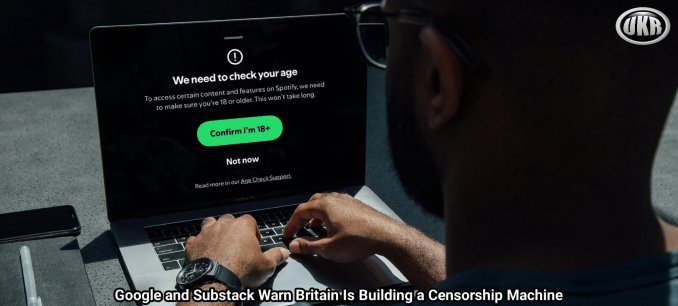
US companies say the UK’s Online Safety Act forces platforms to police lawful speech under the guise of protecting users.
CINDY HARPER
Major American companies and commentators, including Google and Substack CEO Chris Best, have condemned the United Kingdom’s censorship law, the Online Safety Act (OSA), describing it as a measure that risks censoring lawful speech while failing to make the internet safer for children.
They argue that the law normalizes digital surveillance, restricts open debate, and complicates how global platforms operate in the UK.
Their objections surfaced through The Telegraph, which published essays from Best and from Heritage Foundation researchers John Peluso and Miles Pollard, alongside new reporting on Google’s formal response to an Ofcom consultation.
That consultation, focused on how tech firms should prevent “potentially illegal” material from spreading online, closed in October, with Ofcom releasing the submissions in December.
Google’s filing accused the regulator of promoting rules that would “undermine users’ rights to freedom of expression” by encouraging pre-emptive content suppression.
Ofcom rejected this view, insisting that “nothing in our proposals would require sites and apps to take down legal content.” Yet Google was hardly alone in raising alarms: other American companies and trade groups submitted responses voicing comparable fears about the Act’s scope and implications.
Chris Best wrote that his company initially set out to comply with the new law but quickly discovered it to be far more intrusive than expected. “What I’ve learned is that, in practice, it pushes toward something much darker: a system of mass political censorship unlike anywhere else in the western world,” he said.
Best describes how the OSA effectively forces platforms to classify and filter speech on a constant basis, anticipating what regulators might later deem harmful.
Compliance, he explained, requires “armies of human moderators or AI” to scan journalism, commentary, and even satire for potential risk.
The process, he continued, doesn’t simply remove content but “gates it” behind identity checks or age-verification hurdles that often involve facial scans or ID uploads.
“These measures don’t technically block the content,” Best said, “but they gate it behind steps that prove a hassle at best, and an invasion of privacy at worst.” He warned that this structure discourages readers, reduces visibility for writers, and weakens open cultural exchange.
Best, who emphasized Substack’s commitment to press freedom, said the OSA misdiagnoses the problem of online harm by targeting speech rather than prosecuting actual abuse or criminal behavior.
“This is how you end up with ‘papers, please’ for the internet,” he wrote, warning that the law could become a model replicated by other governments.
In its submission, Google contended that Ofcom’s interpretation of the OSA would “stifle free speech” by imposing vague obligations on platforms to police “potentially illegal” posts.
It cautioned that these measures would “necessarily result in legal content being made less likely to be encountered by users,” extending the law’s reach beyond what lawmakers intended when it passed in 2023.
Ofcom, meanwhile, pointed to incidents of online unrest such as posts that spread following the Southport killings and subsequent riots and protests to justify its approach.
The regulator argued that recommender systems should withhold questionable material until moderators review it, to prevent harmful content from going viral during crises.
Yet this example has since become contentious. Following those events, authorities made several arrests, including that of Lucy Connolly, under laws critics say were applied in an excessively heavy-handed way leading to international condemnation.
The use of the Southport unrest to defend tighter speech controls has therefore raised further questions about how the government interprets and enforces the boundaries of “illegal” online communication.
The regulator argued that recommender systems should temporarily withhold questionable material until moderators review it, to prevent viral dissemination of possible hate or violence.
The OSA’s enforcement has created new friction between the UK and the US. Negotiations over a £31 billion technology partnership were recently frozen after Washington voiced concern about Britain’s direction on online regulation.
US Vice President JD Vance has accused the UK of following a “dark path” on free speech, while Elon Musk’s X platform declared that “free speech will suffer” under the new rules.
An Ofcom spokesperson reiterated that its goal is to protect both safety and liberty online, stating: “There is nothing in our proposals that would require sites and apps to take down legal content. The Online Safety Act requires platforms to have particular regard to the importance of protecting users’ right to freedom of expression.”
However, this line of defense sidesteps the real issue. While Ofcom insists that legal material will not be removed outright, the regulator’s approach effectively requires platforms to limit how widely such content can spread.
By obliging companies to restrict “potentially illegal” posts before any clear determination of their status, the policy would lead to broad suppression of lawful speech.
The UK’s legal landscape already (and unfortunately) criminalizes categories of expression that would fall under constitutional protection in the United States.
As a result, any automated or large-scale moderation system built to comply with the OSA may inevitably block lawful content in order to ensure that no illegal material slips through.
The distinction between taking content down and throttling its visibility is, in reality, far narrower than the regulator is pretending.
This article (Google and Substack Warn Britain Is Building a Censorship Machine) was created and published by Reclaim the Net and is republished here under “Fair Use” with attribution to the author Cindy Harper

••••
The Liberty Beacon Project is now expanding at a near exponential rate, and for this we are grateful and excited! But we must also be practical. For 7 years we have not asked for any donations, and have built this project with our own funds as we grew. We are now experiencing ever increasing growing pains due to the large number of websites and projects we represent. So we have just installed donation buttons on our websites and ask that you consider this when you visit them. Nothing is too small. We thank you for all your support and your considerations … (TLB)
••••
Comment Policy: As a privately owned web site, we reserve the right to remove comments that contain spam, advertising, vulgarity, threats of violence, racism, or personal/abusive attacks on other users. This also applies to trolling, the use of more than one alias, or just intentional mischief. Enforcement of this policy is at the discretion of this websites administrators. Repeat offenders may be blocked or permanently banned without prior warning.
••••
Disclaimer: TLB websites contain copyrighted material the use of which has not always been specifically authorized by the copyright owner. We are making such material available to our readers under the provisions of “fair use” in an effort to advance a better understanding of political, health, economic and social issues. The material on this site is distributed without profit to those who have expressed a prior interest in receiving it for research and educational purposes. If you wish to use copyrighted material for purposes other than “fair use” you must request permission from the copyright owner.
••••
Disclaimer: The information and opinions shared are for informational purposes only including, but not limited to, text, graphics, images and other material are not intended as medical advice or instruction. Nothing mentioned is intended to be a substitute for professional medical advice, diagnosis or treatment.
Disclaimer: The views and opinions expressed in this article are those of the author and do not necessarily reflect the official policy or position of The Liberty Beacon Project.


Leave a Reply