

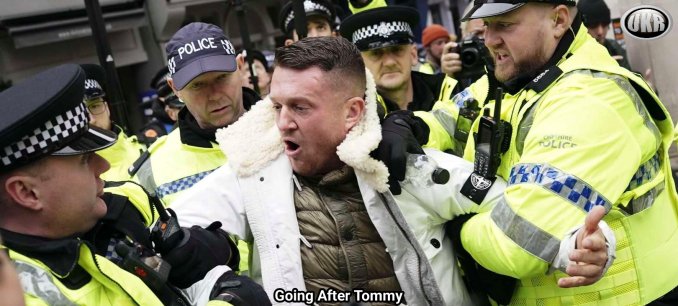
Why the British police’s obsession with Mr. Yaxley-Lennon?
PAUL BIRCH
Tommy Robinson has had yet another day in court.
This time, he appeared at Westminster Magistrates’ on the 6th of November in order to answer a charge under Schedule 7 of the UK Terrorism Act 2000, no less. He had been stopped, in July 2024, at the Channel Tunnel in Folkestone. When asked by ports police—specialist counter-terrorism officers—to disclose his phone’s pin number, Robinson refused, claiming that journalistic material was stored on it. Under the Terrorism Act, this refusal is, in itself, an offence.
The judge’s comments were telling. He declared he could “not be sure” that the initial police stop was lawful, citing that political or philosophical beliefs were protected characteristics under the UK Equality Act 2010.
“I cannot put out of my mind that it was actually what you [Tommy Robinson] stood for and your political beliefs that acted as the principal reason for this stop,” said Judge Goozee.
These observations perfectly encapsulate the British police’s attitude to Tommy Robinson. From the moment he entered the public consciousness in 2009, it’s fair to say they’ve been absolutely obsessed with him.
Robinson, whose real name is Stephen Yaxley-Lennon, is best known as the founder of the English Defence League (EDL). The EDL emerged in 2009, formed as a direct consequence of Islamist demonstrations that took place in Robinson’s hometown of Luton. Those protests had been held as a response to a homecoming parade of the British Army’s Royal Anglian Regiment, following their operational deployment to Afghanistan. Such local events played a significant role in shaping Robinson’s anti-Islamist worldview and launched him onto the world stage.
You don’t have to align with Tommy Robinson’s views or actions to acknowledge that he’s one of the most extraordinary and charismatic protest figures of post-war Europe. His singular ability to articulate what many ordinary people think and, crucially, to galvanise them to action, marked him out at an early stage for attention from the authorities.
To say that the rise of the EDL caused alarm in the police is an understatement. At the time, my team played a central role in organising and overseeing national policing deployments. We were tasked with coordinating responses to a multiplicity of issues that arose across the country. The emergence of the EDL, seemingly out of nowhere, immediately rendered everything else inconsequential.
But, of course, it wasn’t out of nowhere. It was because one individual struck such a chord with people that they felt inspired to form their own, regional groups. They were working-class men who, like Robinson, felt they’d been left behind by an elite who despised them; an elite who, as they saw it, afforded Islamists more tolerance than them. Largely comprising football supporters, the early incarnations of EDL had long felt the derision of the commentariat anyway.
It was interesting to be in operational meetings with senior officers who just resorted to the usual lazy insults and cliches without bothering to understand why people were protesting in the first place, even if those protests did warrant a significant police response.
The pivotal moment for Robinson, and the one which probably sealed his fate, was his BBC Newsnight interview with Jeremy Paxman. This was clearly meant to be a hit job on him. Paxman, the perma-smug establishment attack dog, thought he’d run rings around this uneducated ruffian, but, to the horror of the clerisy, it was very much the other way round. The infamous Paxman quote from the interview (which has aged like milk) goes thus:
“You are seriously suggesting that young white girls are being sexually exploited by what you say are gangs of Muslim men? Is that what you are suggesting? Seriously?”
Once the decision was made that action needed to be taken against Robinson, the police began to intervene in a series of ways that ensured the legal process itself became a form of punishment. As we have seen, this approach is not uncommon when the state deems certain individuals to be problematic.
In 2011, Robinson was convicted for using threatening, abusive, or insulting behaviour, stemming from a fight that had taken place the previous year. Later that same year, following an EDL demonstration in Tower Hamlets, he was arrested once more, this time for breaching bail conditions. This period also saw Robinson appear at Preston Magistrates’ Court, where he was found guilty of assault.
The legal challenges continued into November 2012, when Robinson was charged with three counts of conspiracy to commit fraud by misrepresentation in connection with a mortgage application. As a result of these charges, he was sentenced to 18 months in prison.
There have been a number of other court appearances and convictions. Tommy Robinson has unquestionably brought a good deal of it on himself, and I’m not trying to lionise him. But in an age where we can all refer to cases where justice has been dispensed somewhat ‘leniently’ to others, the relentless pursuit of Robinson tends to stand out.
Everything he does still provokes disproportionate scrutiny from the mainstream media. Even though mainstream media influence is declining, it still plays a significant role in shaping public perception. There was a widespread belief that Robinson had played a part in provoking riots after the 2024 Southport atrocity, even though he was out of the country and had nothing to do with what we now know to have been spontaneous, local protests.
Even though the EDL and its associated groups have long since ceased to be any kind of cultural or political force in the United Kingdom, we’ve seen many of their concerns become part of the national conversation. This is due, in no small part, to the slow realisation that maybe Tommy Robinson had a point after all. The enormous turnout for his Unite the Kingdom rally demonstrated that Robinson’s concerns have gained societal, cross-cultural appeal—to the extent that Elon Musk spoke via video link and went on to fund his latest set of legal costs.
The EDL was always notable for having members from different ethnic communities and its support for Israel, a particularly knotty problem if you’re trying to paint a group as a bunch of neo-Nazi thugs. Since the Hamas attack on Israel in 2023 and the rabid pro-Palestinian marches we have endured henceforth, Robinson’s outlook has become even more normalised. Most of his predictions that were once dismissed as ‘right-wing hate’ have subsequently come to pass, and the Overton Window has shifted to the right—due in no small part to Robinson.
The authorities are still remarkably interested in Tommy Robinson. He’s become representative of a type of person that the great and the good would rather not hear from. But, then again, nothing frightens the state like someone who’s working class, resilient and persuasive.
This article (Going After Tommy) was created and published by European Conservative and is republished here under “Fair Use” with attribution to the author Paul Birch
Featured image: standard.co.uk

••••
The Liberty Beacon Project is now expanding at a near exponential rate, and for this we are grateful and excited! But we must also be practical. For 7 years we have not asked for any donations, and have built this project with our own funds as we grew. We are now experiencing ever increasing growing pains due to the large number of websites and projects we represent. So we have just installed donation buttons on our websites and ask that you consider this when you visit them. Nothing is too small. We thank you for all your support and your considerations … (TLB)
••••
Comment Policy: As a privately owned web site, we reserve the right to remove comments that contain spam, advertising, vulgarity, threats of violence, racism, or personal/abusive attacks on other users. This also applies to trolling, the use of more than one alias, or just intentional mischief. Enforcement of this policy is at the discretion of this websites administrators. Repeat offenders may be blocked or permanently banned without prior warning.
••••
Disclaimer: TLB websites contain copyrighted material the use of which has not always been specifically authorized by the copyright owner. We are making such material available to our readers under the provisions of “fair use” in an effort to advance a better understanding of political, health, economic and social issues. The material on this site is distributed without profit to those who have expressed a prior interest in receiving it for research and educational purposes. If you wish to use copyrighted material for purposes other than “fair use” you must request permission from the copyright owner.
••••
Disclaimer: The information and opinions shared are for informational purposes only including, but not limited to, text, graphics, images and other material are not intended as medical advice or instruction. Nothing mentioned is intended to be a substitute for professional medical advice, diagnosis or treatment.
Disclaimer: The views and opinions expressed in this article are those of the author and do not necessarily reflect the official policy or position of The Liberty Beacon Project.


Leave a Reply