

When Social Media Becomes the State’s Spy
THE RATIONALS
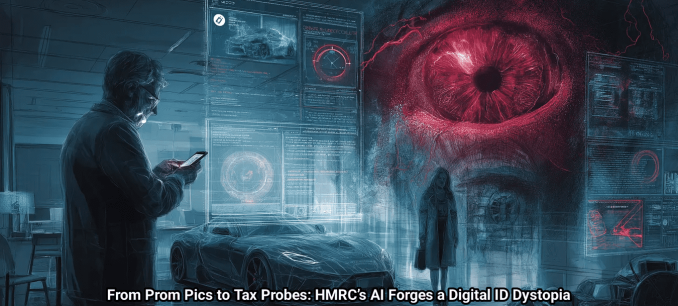
Imagine you’ve rented a sleek supercar for a weekend to give your daughter a glamorous send-off to her school prom. You stand beside the gleaming vehicle, snap a proud photo, and post it on Instagram with the caption, “My new car!” The likes pour in, but so does an invisible observer: an algorithm at Her Majesty’s Revenue and Customs (HMRC). Its artificial intelligence, quietly scanning social media, flags your post as evidence of undeclared wealth. Weeks later, a letter arrives demanding proof you didn’t buy the car, a costly, stressful audit you never anticipated. This is no dystopian fiction. HMRC’s AI is weaving digital identities from our online lives, and without transparent oversight, it risks violating the Human Rights Act 1998 (HRA) while laying the groundwork for a surveillance state where every post could reshape your civic fate.
The Taxman’s Digital Net
HMRC’s use of AI to monitor social media is no secret, confirmed in its internal manuals. Employing image recognition and data analytics, it scours public posts for signs of tax evasion, luxury purchases, exotic holidays or your rented supercar mistaken for a personal asset. These posts are cross-referenced with the Connect system, a data colossus processing billions of records from bank accounts, property registries and online marketplaces. The goal is to close a £46.8 billion tax gap, largely driven by offshore evasion, as HMRC’s 2023-24 annual report notes. Yet the method, building a de facto digital ID by linking online behavior to financial records without consent, raises profound questions about privacy and accountability. With a tribunal deadline of September 18, 2025, looming for HMRC to disclose its AI use in tax credit claims, the stakes for freedom and fairness are mounting.
Privacy on the Brink
The HRA, embedding the European Convention on Human Rights (ECHR) into UK law, demands restraint from state intrusion. Article 8 protects the right to respect for private and family life, allowing interference only if it is lawful, necessary, and proportionate. HMRC’s AI, harvesting social media to construct digital profiles, skirts this boundary. Public posts may not be legally private, but using them to infer financial status, without notifying taxpayers or clarifying algorithmic logic, challenges Article 8’s “lawfulness” requirement. The ECHR case S and Marper v UK (2008) ruled that retaining personal data without clear justification violates Article 8, a precedent that could apply if HMRC’s data practices lack transparency. HMRC’s internal manual (EM1350) insists surveillance must be “proportionate,” but its silence on AI specifics leaves taxpayers like you exposed to misinterpretation.
Justice in the Dark
Like privacy, the right to a fair trial under Article 6 is at risk. If your supercar post triggers an audit, HMRC’s opaque AI, acknowledged in its guidance (ECSH110200) to carry “criminal” penalties under ECHR definitions, demands transparency for fairness. Yet proprietary algorithms, as the Joint Committee’s AI inquiry (evidence deadline September 5, 2025) notes, often defy explanation. How do you challenge a system that misreads a rented car as evasion? The Post Office Horizon scandal warns that such opaque AI could repeat crushing injustices, leaving taxpayers exposed and eroding Article 6’s fair trial protections.
A Surveillance Blueprint
Beyond individual audits, a darker future looms with HMRC’s scalable AI ambitions. Its 2025 Transformation Roadmap targets 90% digital interactions by 2030, with AI as its core. HMRC’s advanced analytics, including image recognition for social media scans, signals plans beyond tax enforcement, as seen in its growing surveillance tools. The Data (Use and Access) Act 2025, enacted June 19, 2025, fuels this by enabling cross-agency data-sharing. Picture a 2030 where your digital ID, built from HMRC’s social media scans, flags a celebratory post as fraud, prompting the Department for Work and Pensions to cut your benefits without warning. A job loss post could unleash a cascade of state scrutiny, all tied to an algorithmic profile you never authorised.
Shadows of a Social Credit State
This path recalls China’s social credit system, where a 2023 State Council report outlines how digital IDs monitor behaviour across financial, social, and legal spheres. HMRC’s system is narrower, but its lack of public consultation echoes a troubling pattern. The UK’s Digital Identity and Attributes Trust Framework, debated in 2022 stalled amid privacy fears, yet HMRC’s AI operates as a de facto digital ID without such scrutiny. The Equality and Human Rights Commission (EHRC) in its 2022 AI guidance, warns that biased algorithms can discriminate, violating Article 14 of the HRA. If HMRC’s AI misreads cultural nuances, say, mistaking a celebratory post for wealth, it could unfairly target minority or lower-income groups who often lack resources to contest audits.
The Taxman’s Case
HMRC defends its approach, claiming in its 2023-24 report that AI detects 20-30% more evasion cases than manual methods, justifying its role in tackling the £46.8 billion tax gap to fund public services. But this argument wanes when you consider that most of the gap stems from offshore accounts, not social media boasts. Is surveilling your prom photo proportionate when the real culprits lurk in tax havens? The Information Commissioner’s Office (ICO), in its 2025 plan, stresses that AI must not infer traits from behavior without rigorous safeguards. HMRC’s manuals (CH201700) offer little clarity, noting only that internet checks require “careful consideration.” Public voices on social media, calling HMRC’s AI “Orwellian,” reflect unease about this vagueness, hinting at broader distrust.
A Fork in the Digital Road
The September 18 tribunal, sparked by tax expert Tom Elsbury’s FOI request, could compel HMRC to unveil the inner workings of its AI, shedding light on the machinery that turned your prom post into a tax probe. Yet transparency is a half-measure without robust oversight. The Joint Committee’s ongoing AI inquiry, with its evidence deadline of September 5, 2025, warns of threats to HRA rights, from privacy (Article 8) to fairness (Article 6). Without stringent checks, HMRC’s digital ID, woven from your social media and the Connect system’s vast data, could morph into a tool of total control where every post, from a proud prom snapshot to a LinkedIn boast, feeds a state-managed profile. The EHRC’s 2022 guidance demands that public sector AI be fair and transparent, yet HMRC’s secrecy casts a long shadow. Your supercar photo shouldn’t bring a crushing financial burden, but in this algorithmic age, it might. As you weigh this, share your thoughts below and think ‘if a joyful moment shared online can become the taxman’s weapon against you, how far will you let the state’s algorithms reshape your freedom?
This article (From Prom Pics to Tax Probes: HMRC’s AI Forges a Digital ID Dystopia) was created and published by The Rationals and is republished here under “Fair Use”
Featured image: The Rational Forum

••••
The Liberty Beacon Project is now expanding at a near exponential rate, and for this we are grateful and excited! But we must also be practical. For 7 years we have not asked for any donations, and have built this project with our own funds as we grew. We are now experiencing ever increasing growing pains due to the large number of websites and projects we represent. So we have just installed donation buttons on our websites and ask that you consider this when you visit them. Nothing is too small. We thank you for all your support and your considerations … (TLB)
••••
Comment Policy: As a privately owned web site, we reserve the right to remove comments that contain spam, advertising, vulgarity, threats of violence, racism, or personal/abusive attacks on other users. This also applies to trolling, the use of more than one alias, or just intentional mischief. Enforcement of this policy is at the discretion of this websites administrators. Repeat offenders may be blocked or permanently banned without prior warning.
••••
Disclaimer: TLB websites contain copyrighted material the use of which has not always been specifically authorized by the copyright owner. We are making such material available to our readers under the provisions of “fair use” in an effort to advance a better understanding of political, health, economic and social issues. The material on this site is distributed without profit to those who have expressed a prior interest in receiving it for research and educational purposes. If you wish to use copyrighted material for purposes other than “fair use” you must request permission from the copyright owner.
••••
Disclaimer: The information and opinions shared are for informational purposes only including, but not limited to, text, graphics, images and other material are not intended as medical advice or instruction. Nothing mentioned is intended to be a substitute for professional medical advice, diagnosis or treatment.
Disclaimer: The views and opinions expressed in this article are those of the author and do not necessarily reflect the official policy or position of The Liberty Beacon Project.


Leave a Reply