

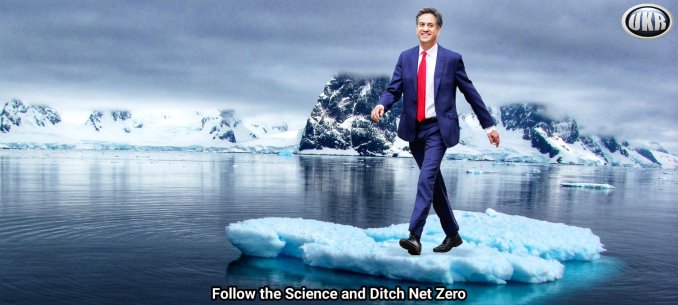
None of the catastrophic climate predictions have come to pass, and Ed Miliband was left out in the cold at COP30 so why are we still aiming for Net Zero?
DAVID TURVER
When the facts change, I change my mind. What do you do sir?
Attributed to JM Keynes
Introduction
The totalitarian Net Zero agenda that arises from the Climate Change Act 2008 (CCA) comes from the exhortation to Follow The Science™. However, it is a little-known fact that the Climate Change Act 2008 makes provisions for changing the emissions reduction targets if there are significant developments in the scientific knowledge about climate change. There are also clauses that set out what needs to be considered when setting or amending carbon budgets.
In the run up to the passing of the CCA, the media was full of scaremongering stories about climate and the implications if we did not reduce our emissions of greenhouse gases. However, none of the catastrophic predictions came to pass. Moreover, US Department of Energy released a new report from its Climate Working Group (CWG) this summer that synthesised recent climate science papers and demonstrates things are nowhere near as bad as we have been told.
It is time to look at the actual climate developments compared to the scare stories and the new information from the CWG. We can argue that we now have sufficient evidence to challenge the carbon dioxide emissions targets and so amend the the Climate Change Act and ditch Net Zero.
Safeguards in the Climate Change Act
There are two safeguards in the Climate Change Act we can use to challenge the Net Zero dogma. Section 2 of the CCA makes provision for changing the percentage reduction in emissions if there are significant developments in the scientific knowledge about climate change, see Figure 1.

Section 10(2) sets out the matters to be considered when setting or amending carbon budgets, see Figure 2.

These matters include scientific knowledge about climate change; technology relevant to climate change; economic circumstances; social circumstances and the impact of carbon budgets on energy policy. Section 21 covers the rules for amending carbon budgets after they have been set. Carbon budgets can only be amended if “there have been significant changes affecting the basis on which the previous decision was made.”
If the latest science is less alarming than previously thought, then this ought to be grounds for reducing the emissions targets. If the technical and economic basis for setting carbon budgets has changed since the decisions were made, there ought to be grounds for amending carbon budgets too.
Inconvenient Truths about Climate Predictions
There are several inconvenient truths that have emerged since the CCA was adopted as law. It is true that temperatures and carbon dioxide concentrations have continued to rise. However, current CO2 concentrations are not unprecedented compared to the geological records (see Figure 3 from here) and according to ice core data CO2 follows temperature, not the other way round.

Recent discoveries also show that recent temperatures are not unprecedented. A 5,900-year-old ancient pine forest has been discovered emerging from under a melting glacier in the Rocky Mountains. The trees were found at an altitude of 3,100m, some 180m above the current treeline so temperatures must have been warmer when these trees were growing. Similar discoveries have been made in Iceland, Alaska, Canada and Switzerland, indicating that this is not some local anomaly.
Despite 50 years of false climate alarmism, none of the apocalyptic predictions have come to pass. In 1972, George Kukla and R K Matthews wrote to President Nixon warning of global cooling and the onset of glacial temperatures within a century (see download).

The fears of global cooling continued until the late 1970s and then in the 1980s the narrative flipped to warning of global warming. In 1988, it was thought that the Maldives would be underwater by 2018. In fact the land area of the Maldives has grown and they are building new airports to bring tourists to the islands. All that climate funding has to go somewhere. In 1989, New York’s West Side highway was supposed to be underwater by 2019 and of course Manhattan is still above water.
Since 2008, there have been several claims that the Arctic will be ice free by 2013, 2014, 2015 and 2018. In fact, there has been no trend in the minimum Arctic sea ice extent since 2007. In his film An Inconvenient Truth, Al Gore warned about the fate of polar bears, but recent estimates show the global polar bear population has increased since the 1960s.
The alarmists also make claims that are contradictory because in 2000, our children were not going to know what snow is, yet by 2004 we were being warned that Britain will be Siberia by 2024. Of course neither prediction has come true.
We are constantly warned of the dangers of extreme weather yet there is no trend in global hurricane frequency or accumulated energy. Moreover, the death rate from extreme weather events has plummeted over the past century, see Figure 4 using data from Our World in Data.

We have used our skill, ingenuity and energy to adapt and better combat extreme weather.
None of the apocalyptic predictions have come to pass and there is no evidence of a climate crisis, so we must conclude that much of the Climate Science™ was wrong.
Department of Energy Climate Working Group Report
The overall air of climate doom has been lifted by the recent Climate Working Group (CWG) report authored by eminent scientists who have refused to toe the alarmist line.
They found that there have been global greening benefits from increased carbon dioxide concentrations that have also increased agricultural productivity. Although they acknowledge we have seen some warming caused by CO2, they say that future emissions scenarios are over-stated and the models that predict future warming run too hot and overstate the danger.
They found no long-term trends in the frequency and intensity of US hurricanes, tornadoes, floods and droughts. They acknowledge that sea levels have risen by some 8 inches since 1900 but find no evidence of acceleration in sea level rise from US tide gauges.
They conclude by saying “both models and experience suggest CO2-induced warming might be less damaging economically than commonly believed, and excessively aggressive mitigation policies could prove more detrimental than beneficial.” In other words, the Net Zero cure is worse than climate change disease.
Climate Catastrophe Narrative is Collapsing
All these failed predictions and new scientific interpretations have taken their toll in other areas too. A 2024 paper published in Nature entitled “The Economic Content of Climate Change” has just been retracted because two commentaries about the paper raised questions about the study’s data and methodology. The paper was withdrawn because original authors acknowledged the changes required to the paper are too substantial for a correction. The paper predicted climate change would cost $38 trillion per year by 2049. The paper was adopted by the Network for Greening the Financial System (NGFS), a consortium of central banks from around the world to update its damage function and was cited by the OBR in its assessment of climate change risks. In other words, the “climate crisis” is not going to be as costly as they first thought so the central banks and the OBR need to change their analysis of the risks.
In another portent of things to come, the recent COP30 has been the subject of much controversy. Amazon forest was destroyed to make way for the access road, it was blockaded by indigenous people demanding an end to invasions of their land and the venue caught fire at one point. In what must be the final dénouement, the conference ended without an agreement to cut fossil fuels, despite Ed Miliband making two 12,000-mile round trips demonstrate his climate leadership. Poor Ed is a leader without followers. It is clear the world wants to continue burning fossil fuels and the UK removing its 0.8% of the global total will make no difference to the weather.
These developments come hot on the heels of Bill Gates backtracking on climate alarmism and the Net Zero Banking Alliance shutting down after some of the biggest banks in the world like JP Morgan, Goldman Sachs and Citigroup headed for the exit door. Without favourable financing rates, Net Zero is finished. BP and Shell are turning away from renewables and returning to their roots as oil companies. BP has also cancelled a hydrogen project on Teesside due to lack of demand and planning problems. So much for Beyond Petroleum.
Renewables Costs Rising
As we have covered before, the cost of renewables is rising, not falling as we have been led to believe by the Climate Change Committee (CCC). As Claire Coutinho pointed out to the new chair of the CCC, Nigel Topping, the Government is offering 20-year index-linked prices of £117/MWh for fixed bottom offshore wind in the current Allocation Round 7 (AR7). Yet, the CCC is claiming that offshore wind will cost less than a third of that, just £38/MWh, for projects delivering in 2030. Floating offshore wind is being offered £280/MWh, more than seven times the CCC estimate, and solar is being offered more than double their estimate for 2030.
The economic case for Net Zero contained the CCC’s sixth and seventh carbon budgets is built on sand. Their models are from the realms of fantasy and if realistic costs were used their alleged savings would simply evaporate. The country is being hoodwinked by a false prospectus.
Conclusions
Perhaps the only wise things about the Climate Change Act were the clauses that gave a mechanism for a graceful exit. If The Science™ changes, we can change the targets. If the economics of the proposed technology changes, we can amend the ruinous carbon budgets. And let us not forget, we have the highest industrial electricity prices in the developed world, so we should be able to argue that the economic and social consequences of Net Zero are very damaging.
There were some people with foresight who opposed the CCA and were sceptical of “climate science” even before the CCA passed through Parliament. What we can all see now with hindsight, is those sceptics were right. None of the alarmist predictions of catastrophe have ever come true. Manhattan and the Maldives are still above water; the Arctic ice has stopped shrinking; there is no trend in extreme weather events like hurricanes and the death rate from such events has plummeted as countries have got richer and better able to protect themselves. And the poster children of climate alarmists, the polar bears are doing just fine. The new CWG paper effectively undermines climate alarmist narrative and concludes that mitigation “solutions” are worse than the climate change problem they are trying to solve. More broadly, the climate alarmism narrative is collapsing before our eyes and Emperor Ed Miliband has been left alone, shivering half-naked on the rapidly shrinking net zero iceberg.

Together, these developments ought to be enough evidence to demonstrate that scientific knowledge about climate has changed sufficiently to cut the 2050 emissions reduction target. The change from an 80% reduction to Net Zero (100% reduction) was carried out by statutory instrument without even a formal vote in Parliament. Presumably re-setting the target to say a 20% reduction by 2050 could be done with similar ease. The beauty of this approach is that Net Zero can be neutered quickly without primary legislation or elaborate processes to repeal the Act. As we have already delivered more than a 50% reduction in emissions, we have plenty of headroom to allow for a sensible energy policy to be implemented. Full repeal of the CCA can follow shortly afterwards.
There is also sufficient evidence to show that the CCC’s carbon budgets have been set on a false prospectus. Parliament and voters have been hoodwinked into believing renewables are cheap and will save us money when nothing could be further from the truth. Industry and households are suffering badly from high energy prices. There is certainly sufficient evidence to demonstrate there have been significant changes affecting the basis on which the decisions to approve earlier carbon budgets were made. This too ought to be sufficient to change the carbon budgets retrospectively and adopt a far more rational and sensible energy policy.
It is time to follow the science and ditch Net Zero..
This Substack now has over 4,900 subscribers and is growing fast. If you enjoyed this article, please share it with your family, friends and colleagues. Please consider utilising the seasonal offer and signing up for or gifting a discounted paid subscription.
This article (Follow the Science and Ditch Net Zero) was created and published by David Turver and is republished here under “Fair Use”

••••
The Liberty Beacon Project is now expanding at a near exponential rate, and for this we are grateful and excited! But we must also be practical. For 7 years we have not asked for any donations, and have built this project with our own funds as we grew. We are now experiencing ever increasing growing pains due to the large number of websites and projects we represent. So we have just installed donation buttons on our websites and ask that you consider this when you visit them. Nothing is too small. We thank you for all your support and your considerations … (TLB)
••••
Comment Policy: As a privately owned web site, we reserve the right to remove comments that contain spam, advertising, vulgarity, threats of violence, racism, or personal/abusive attacks on other users. This also applies to trolling, the use of more than one alias, or just intentional mischief. Enforcement of this policy is at the discretion of this websites administrators. Repeat offenders may be blocked or permanently banned without prior warning.
••••
Disclaimer: TLB websites contain copyrighted material the use of which has not always been specifically authorized by the copyright owner. We are making such material available to our readers under the provisions of “fair use” in an effort to advance a better understanding of political, health, economic and social issues. The material on this site is distributed without profit to those who have expressed a prior interest in receiving it for research and educational purposes. If you wish to use copyrighted material for purposes other than “fair use” you must request permission from the copyright owner.
••••
Disclaimer: The information and opinions shared are for informational purposes only including, but not limited to, text, graphics, images and other material are not intended as medical advice or instruction. Nothing mentioned is intended to be a substitute for professional medical advice, diagnosis or treatment.
Disclaimer: The views and opinions expressed in this article are those of the author and do not necessarily reflect the official policy or position of The Liberty Beacon Project.


Leave a Reply