

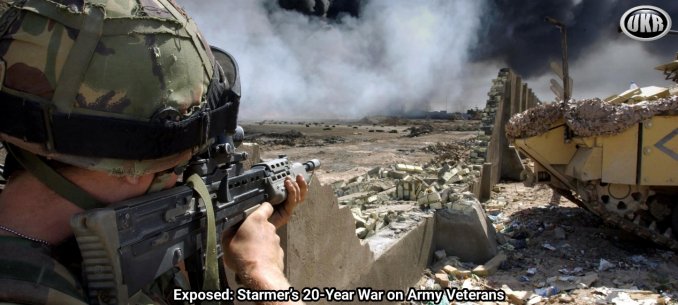
Exposed: Starmer’s 20-year war on Army veterans
BRUCE NEWSOME
SIR Keir Starmer’s war on Britain’s military personnel isn’t limited to his Government’s quest to reduce their immunity against prosecution for use of force in Northern Ireland. The campaign goes back 20 years to when he was a lawyer in private practice. That’s the revelation in the Daily Telegraph’s latest investigation.
Now realise the revelation within the revelation: the rest of the media didn’t care to expose Starmer’s record, even after he entered government service or after he entered politics.
In 2007 three lawyers intervened, pro bono, on behalf of Liberty and the Law Society of England and Wales, to lobby Britain’s judiciary to re-examine the killing of Iraqis by British personnel. The most junior of the three was Phil Shiner, whose firm, Public Interest Lawyers, generated thousands of complaints against armed forces personnel. Shiner was struck off in 2017 over pursuing soldiers for fake war crimes and convicted of fraud in 2024. The middle-ranker of the three was Richard Hermer, now Lord Hermer and Attorney General for England and Wales. The most senior was Starmer, then Hermer’s superior in Doughty Street Chambers.
Their argument was not derived from British law Iraqi law, or military law, but from the European Convention on Human Rights.
Starmer’s submission includes the following slippery argument: ‘The duty of effective investigation has not been fulfilled . . . [Prior investigations] were perfunctory, lacking independence, and wholly inadequate. Any suggestion that they satisfied the requirements of Article 2 ECHR is unarguable.’
Starmer’s submission was dismissed by the House of Lords in 2007. Nevertheless, the Labour government appointed Starmer (remember: a human rights lawyer, not a dedicated criminal lawyer) as Director of Public Prosecutions.
From 2008 to 2013, Starmer presided over a Crown Prosecution Service that undermined sovereign immunity for British officials and military personnel on the basis that immunity undermines the ‘rule of law’.
The CPS sought to re-open cases and raise conviction rates for military personnel accused of war crimes, and men accused of rape, including by hiding exculpatory evidence (a practice which has Starmer denied).
In 2009, a year after Starmer took over, the CPS re-opened allegations that soldiers of the Princess of Wales’s Royal Regiment tortured and killed insurgents captured in May 2004 during an attack on a checkpoint known as ‘Danny Boy’ in southern Iraq. These allegations became known collectively as the Al-Sweady allegations, after one of the claimants.
Although earlier reviews had raised doubts about the claims, the CPS under Starmer launched a full public inquiry, chaired by Sir Thayne Forbes, which ran from 2009 to 2014.
The inquiry concluded that the allegations were ’deliberate lies’. The cost to the taxpayer was approximately £24million. The accused had endured:
· Years under suspicion of war crimes
· Repeated police interviews
· Public vilification
· Loss of employment and career prospects
· Crippling legal expenses
· Severe mental health consequences
None was compensated in proportion to what they endured. No one who made or championed the false allegations was meaningfully punished. No senior official was held accountable for allowing the cases to drag on for years in spite of evidence that they were baseless.
The Al-Sweady allegations exposed a perverse system:
· Accusers, lawyers and activists faced no downside and accrued lots of legal aid for advancing false claims
· Soldiers bore all the negative risks
· Public prosecutors were biased against British personnel and negligent of the evidence
· Final exoneration came only after military reputations and careers were destroyed
This is why veterans describe the process not as justice but as punishment by investigation.
The soldiers’ lot only got worse. Their domestic abusers gained international validation. In 2011, the House of Lords decision of 2007 was overturned by the European Court of Human Rights. The ECHR enabled hundreds of investigations into British soldiers for supposed war crimes in both Iraq and Afghanistan even where they followed rules of engagement, were deployed on the orders of the government and in agreement with the host country’s government (which granted foreign personnel immunity from local jurisdiction).
One of the soldiers reinvestigated was Sergeant Richie Catterall. In November 2003, he was serving in Basra, Iraq, with 1st Battalion, The King’s Regiment, when he shot a ‘civilian’, Muhammad Salim, who was armed with an AK-47 and whom Catterall believed to present an immediate threat. He acted in conformity with the rules of engagement and was cleared of any wrongdoing by his unit and the Royal Military Police.
Nevertheless, the Iraq Historical Allegations Team opened a charge of murder, which dragged for three years, until it exonerated him.
The Iraq Fatality Investigations opened its own inquiry in 2015, which dragged into 2016, until it ruled that Iraqi witnesses had lied and that Mr Catterall was innocent.
Mr Catterall suffered four investigations over 13 years. During that period, he was divorced, diagnosed with post-traumatic stress disorder, medically discharged (one week short of 22 years of service, which meant he could not immediately draw full pension), drank heavily, attempted suicide and was hospitalised with a stroke. This week Mr Catterall said: ‘Keir Starmer is now the Prime Minister, and he owes me an apology.’
Starmer and Hermer were not satisfied with the civil and criminal liability they had pushed 20 years ago. Once in government, they legislated to expand criminal liability.
They wish to repeal the Northern Ireland Troubles (Legacy and Reconciliation) Act of 2023, which grants immunity for those who co-operate with a reconciliation committee and to push the Northern Ireland Troubles Bill that moves the immunity.
If the Bill becomes statute, it will be weaponised against British military personnel more than against terrorists, who are not subject to the same institutional constraints, and have already avoided or survived criminal prosecution because of the high threshold for ‘beyond reasonable doubt’ (partly in over-compensation for miscarriages of justice against accused terrorists in the 1970s and 1980s).
Starmer and Hermer declared their intent to repeal the Act during the election campaign in 2024. Their justification remains international human rights, not British, foreign or military criminal law. Specifically, the legislation opens up prosecution for violating the human right to life, even if personnel obey orders and rules of engagement.
The personnel now most at risk are those who engaged Northern Irish terrorists, not just in Northern Ireland but anywhere terrorists operated, such as around British official sites in Germany and Belgium.
The risks are highest for UK Special Forces, who deploy most often and most widely. A former SAS regimental Sergeant Major says that ‘service with the regiment is maybe ten or 15 years – and the rest of your life is being chased by lawyers’.
The suppressive effects are felt by not just UKSF and personnel who served in the past but Britons serving or considering joining.
On Armistice Day last year, nine four-star generals signed an open letter ‘to warn that the government’s Northern Ireland Troubles Bill, and the legal activism surrounding it, risk weakening the moral foundations and operational effectiveness of the forces on which this nation depends’.
‘Today every deployed member of the British Armed Forces must consider not only the enemy in front but the lawyer behind,’ they said.
GB News reported that the Government’s leverage of the ECHR poses a ‘threat to national security’.
Of course, British personnel should be held accountable for illegal use of force. But the system normalised in the 2010s and retrenched this Parliament reduces accountability on one side in order to increase it on the other, and reduces accountability at the top in order to increase accountability at the bottom.
The Government’s revival of ‘allegations’, ‘historic abuses’ and ‘systemic wrongdoing’ is aimed at junior personnel and not at the ministers ultimately responsible for missions, rules of engagement, and status of forces agreements.
Furthermore, the system reduces accountability for terrorists, insurgents and fake victims while it reduces the rights of British service members to legal certainty, due process and single jeopardy.
The Government’s shift is less about accountability and more about scapegoating and virtue signalling.
While the Government pledges increased spending on defence, it out-sources recruiting and training, selects and promotes according to DEI, wishes to impose inheritance tax on death-in-service payments and wages lawfare against its own personnel.
Not surprisingly, the military is shrinking in quantity and quality, to the further disadvantage of Britain’s national security, and the advantage of Britain’s enemies.
This article (Exposed: Starmer’s 20-year war on Army veterans) was created and published by Conservative Woman and is republished here under “Fair Use” with attribution to the author Bruce Newsome


Leave a Reply