


CP
Official figures blow apart Labour’s ‘accountancy trick’ to hide the true cost of their humiliating giveaway to Mauritius.
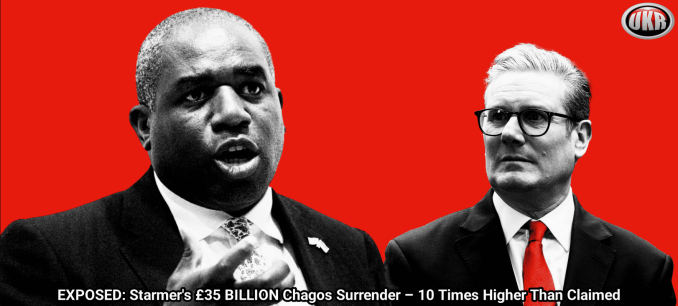
As reported in The Telegraph today, Keir Starmer and David Lammy have been caught red-handed misleading the British public over the staggering price tag of Labour’s surrender of the Chagos Islands, a deal that will cost Britain TEN TIMES more than they admitted.
Documents prised from the Labour Government under the Freedom of Information Act reveal that the true cost of the agreement is £34.7 BILLION, not the £3.4bn figure Keir Starmer has peddled in Parliament and to the press.
The deal will see Britain hand over the British Indian Ocean Territory to Mauritius by year’s end, leasing back the Diego Garcia military base, a jewel of strategic importance built in the 1970s and used for decades by UK and US forces.
Labour’s spin machine claimed the cost was just £3.4bn “in today’s money”, using a series of dubious accounting manoeuvres to slash the official total on paper. But the raw cash cost, the amount Britain will actually pay Mauritius over the next century, is nearly £35 billion, enough to buy ten Queen Elizabeth-class aircraft carriers or fund half the nation’s annual schools budget.
A Cover-Up in Broad Daylight
Civil servants were reportedly ordered to reduce the headline figure through inflation adjustments, then slash it further using the Treasury’s so-called “Social Time Preference Rate”, a controversial method to downplay long-term spending. The result? A 90% haircut on the public number, allowing ministers to sell the deal as a bargain when, in reality, it is an eye-watering giveaway.
When MPs pressed for the true figure earlier this year, Starmer dismissed estimates between £9bn and £18bn as “absolutely wide of the mark”, a statement now shown to be false.
Dame Priti Patel, the shadow foreign secretary, blasted the deception:
“Labour have used an accountancy trick to claim the amount was only £3.4bn. We’ve all known it’s a terrible deal with huge costs to hard-pressed taxpayers. But for months, ministers have sought to cover up the truth.”
A Diplomatic Disaster
Critics warn that Labour’s Chagos capitulation is not just a financial scandal — it is a direct assault on Britain’s national security. Under the terms of the deal, the UK will be compelled to hand over sensitive operational intelligence about Diego Garcia to Mauritius — a nation increasingly in the orbit of China, Russia and Iran.
Mauritius even signed a new cooperation agreement with Moscow days before the treaty was inked, yet Starmer and Lammy ploughed ahead, insisting the arrangement was “vital for security” and that Britain’s adversaries opposed it. In fact, Beijing, Moscow and Tehran have all welcomed the treaty.
Even more alarming, Mauritius is a signatory to the Pelindaba Treaty, which could force the removal of any UK and US nuclear weapons from the base, effectively disarming the West in a critical theatre and handing our adversaries a strategic victory without firing a single shot.
“Giving away a critical military base to a friend of our enemies is a supreme act of self-harm,” Patel warned.
Taxpayers Funding Foreign Tax Cuts
While Labour plans tax hikes at home to plug what critics say is a £50bn black hole in the public finances, Mauritius will use Britain’s payments to slash its own taxes and pay down debt. As Patel put it:
“Just think — British taxpayers will be paying for tax cuts in a foreign country.”
The Conservatives say that if the £35bn were spent at home, it could pay for 70 new hospitals, fix the entire £17bn pothole backlog twice over, or cut income tax by 5%.
‘When Labour Negotiates, Britain Loses’
Kemi Badenoch, Tory leader, said:
“Labour’s Chagos surrender is costing the country another £35bn. Add that to their £50bn black hole, and it’s clear — when Labour negotiates, Britain loses.”
The Government insists the Diego Garcia base is “essential” to UK and allied security, and claims the costs are in line with other international base agreements. But critics note that no other Labour projects have used the same creative accounting, raising questions about why only this politically toxic treaty was massaged down on paper.
As Parliament returns on September 1, the Conservatives are demanding Starmer apologise and release all details of the agreement. But with Labour doubling down and refusing to admit wrongdoing, the fight over Britain’s future in the Indian Ocean is only just beginning.
Worth reading in full in The Telegraph: https://www.telegraph.co.uk/politics/2025/08/10/revealed-chagos-deal-to-cost-10-times-what-starmer-claimed/
The real scandal in the Chagos spending story is how government generally cooks its numbers
HENRY HILL
This morning’s Daily Telegraph provides a fascinating insight into what we might call the ‘post-truth’ age we live in when it comes to government spending with a story about how the Government appears to have massaged the figures over its abject deal to hand over the Chagos Islands to Mauritius.
Ministers managed to produce a figure ten times lower than the nominal sum by first adjusting it for inflation (reasonable enough, at first glance) and then applying something called the Social Time Rate Preference, a Treasury mechanism which values money spent today more highly than money spent in the future, presumably on the basis that a rabbit in the hand is worth two in the bush, and so on.
On the face of it, this isn’t really the ‘gotcha’ it might appear; whatever one’s views of the STRP, adjusting any long-term spending commitment for inflation is reasonable. Or rather it would be, if it were consistently done. Yet as the paper reveals, that is very much not the case:
“However, other projects announced by Labour have not used the same method, which has allowed ministers to advertise higher spending on popular policies. Angela Rayner has since launched a 10-year affordable homes plan that included inflation-level increases in government spending as part of the cost of the policy – a method not used with the Chagos deal.”
Obviously Labour aren’t the only party to do this. To pick just one example which springs immediately to mind from the previous government, Rishi Sunak’s defence spending commitment was worth about £20bn in real terms, but that didn’t stop Grant Shapps bandying about much higher figures when he was defence secretary. Or there was that ‘rolling’ deficit reduction target which continually pushed back the date by which the Government needed to rein in spending…
But whether for partisan reasons or simply because the arc of the national doom-spiral is tightening, this does seem to be getting more egregious. One thinks of the Government’s bold posturing about ‘renationalising the railways’ when it is merely allowing the passenger franchises to lapse on their contracted schedules.
Then, in February, Steve Loftus wrote on this site about Labour taking credit for recycling Conservative water policies. Last month, they did it again, if anything even more egregiously; as I noted over at UnHerd:
“Feargal Sharkey, no Conservative apologist, has handily listed all those policies that Labour has simply re-announced. These include full sewage monitoring (2023) and the attendant outflow reduction plan (2022); the £104 billion of new investment (2023); phosphorus reductions (2022); and nature-based solutions (also 2022).
“Two policies were in fact finalised in the run-up to last year’s general election: reinvesting company fines into local projects was announced that April, and Ofwat was prevented from announcing plans to ring-fence consumer bills for water infrastructure upgrades by the purdah period.”
So little of what was announced was actually creditable to the Starmer Government that I described the whole thing as a ‘pseudo-event’, a term coined in 1962 by Daniel Boorstin to describe an event staged primarily for creating images for the media. It worked, too: most newspapers wrote up Labour’s announcements without mentioning that they had all previously been announced or even enacted. From the Government’s perspective, that was job done.
This has pretty serious implications for the health of a representative democracy. It is one thing for politicians to massage public spending figures up or down as suits their preference, which they presumably always have done; but if the popular press doesn’t actually notice, and government spending can be announced on completely different bases and more than once to boot, it becomes extremely hard to see how the public could be expected to make an informed decision at the ballot box.
One of those problems is easier to solve than the other: it would be an obvious improvement if all government spending announcements were made in real terms. Monitoring the number of times a given item of spending is announced is trickier, because sometimes a later government really does deserve at least a share of the credit – for example, if it confirms and locks in spending a previous one had merely planned for.
Likewise, there is not obviously a tidy and impartial way to resolve things like the Treasury’s STRP. It may well make sense, from one point of view, to weigh money spent in the here and now more heavily than monies committed to being spent in the future.
But there is an obvious counter-case: that given the decaying arc of Britain’s public finances, money spent in the future will be drawn from a state with less fiscal wriggle-room than today, and a nation with an ever-smaller working-age tax base. If the NHS, social care, and pensions continue on their current trajectory, every scrap of government spending on other things will be more and more painfully acquired, at a steeper and steeper opportunity cost. That seems worth factoring in.
Such broader systems are, like George Osborne’s creation of the Office for Budget Responsibility, never going to be politically neutral; people can legitimately take different positions on what they think worth factoring in, and in such differences will always lie scope for some massaging of the message on public spending.
But the bare minimum we could do would be to ensure that every government spending announcement is made on the same comparable basis, and is made only once. But which party is ever, in office, going to have principles sufficient to bind its hands that way?
This article (The real scandal in the Chagos spending story is how government generally cooks its numbers) was created and published by Conservative Home and is republished here under “Fair Use” with attribution to the author Henry Hill
******
‘Is Keir Starmer Stupid or a Liar?!’ | Calls for PM to Resign As Chagos Deal Hidden Costs Revealed
‘Is our Prime Minister a liar or is he stupid?!’
Dawn Neesom reacts to news Keir Starmer’s Chagos Islands deal could cost ten times more than previously thought, and whether Labour ‘massaged the figures’.
WATCH:

••••
The Liberty Beacon Project is now expanding at a near exponential rate, and for this we are grateful and excited! But we must also be practical. For 7 years we have not asked for any donations, and have built this project with our own funds as we grew. We are now experiencing ever increasing growing pains due to the large number of websites and projects we represent. So we have just installed donation buttons on our websites and ask that you consider this when you visit them. Nothing is too small. We thank you for all your support and your considerations … (TLB)
••••
Comment Policy: As a privately owned web site, we reserve the right to remove comments that contain spam, advertising, vulgarity, threats of violence, racism, or personal/abusive attacks on other users. This also applies to trolling, the use of more than one alias, or just intentional mischief. Enforcement of this policy is at the discretion of this websites administrators. Repeat offenders may be blocked or permanently banned without prior warning.
••••
Disclaimer: TLB websites contain copyrighted material the use of which has not always been specifically authorized by the copyright owner. We are making such material available to our readers under the provisions of “fair use” in an effort to advance a better understanding of political, health, economic and social issues. The material on this site is distributed without profit to those who have expressed a prior interest in receiving it for research and educational purposes. If you wish to use copyrighted material for purposes other than “fair use” you must request permission from the copyright owner.
••••
Disclaimer: The information and opinions shared are for informational purposes only including, but not limited to, text, graphics, images and other material are not intended as medical advice or instruction. Nothing mentioned is intended to be a substitute for professional medical advice, diagnosis or treatment.
Disclaimer: The views and opinions expressed in this article are those of the author and do not necessarily reflect the official policy or position of The Liberty Beacon Project.


Leave a Reply