

CP
“Complain to your MP, write to your local newspapers, tell everyone you know about how Labour is planning to allow the EU to make UK laws and how this will push up the price of food and industrial goods in the UK, limit our imports and make our exports more expensive,” urges leading economist Catherine McBride OBE.
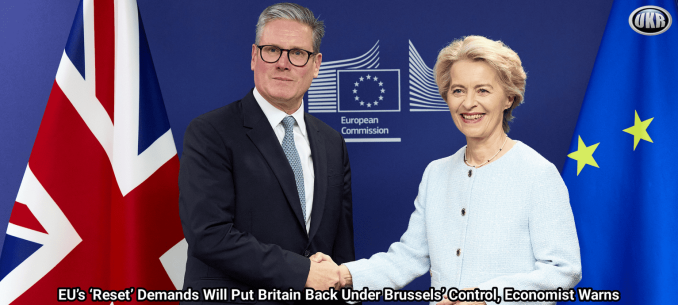
In July, the European Commission published its full list of demands for the UK’s proposed “Reset” deal, a document that sets out the EU’s conditions for new negotiations with Britain.
Although the Commission describes the paper as simply authorising talks, it effectively outlines how Brussels wants the future relationship to work.
According to leading economist Catherine McBride OBE, the plan would reverse much of what was achieved through Brexit. “This EU Demand Document is, in fact, the EU pushing the ‘factory reset’ button on Brexit and returning the UK to the EU’s Customs Union and Single Market, but without any ability to make the rules,” she said. “We would become, as Boris Johnson so aptly put it, the EU’s gimp.”
McBride argues that the proposals would hand sweeping powers back to the EU, including control over UK trade policy, import regulations, and even parts of domestic law.
“A Blank Cheque” for Brussels
Under the EU’s demands, the Commission would have the right to set the rules on goods entering the UK and could determine how much the UK pays for this new arrangement. “The amount of the payment will be determined by the EU – our government has written them a blank cheque,” McBride said.
The European Court of Justice would act as the final authority on trade disputes. “The EU will be the lawmaker, the policeman and the Judge – there will be no jury,” she warned.
The document also includes what the EU calls “cross-retaliation” measures, meaning that if the UK fails to follow new Customs Union rules, the EU could retaliate by restricting trade under the existing Trade and Cooperation Agreement (TCA).
McBride points out that this demand comes despite inconsistent enforcement of EU rules within the bloc itself. She cites the US Trade Representative’s report, which found that “differences in interpretation of EU legislation by Member State authorities also create legal uncertainty and often result in trade disruptions, creating additional burden for U.S. exporters.”
Threat to UK’s Independent Trade Deals
McBride says the most worrying part of the plan is its impact on Britain’s trade with the rest of the world.
The EU’s proposals would give Brussels control over the UK’s agricultural and industrial imports through EU supervision of food standards, animal welfare, pesticide regulations, organic certification, and emissions rules.
The EU’s Carbon Border Adjustment Mechanism (CBAM), which already covers imported steel, aluminium, cement, fertilisers, hydrogen, and electricity, could also extend to maritime transport.
“All of these regulations will now be set by the EU, not by the UK’s elected government,” McBride said. “Despite voting to leave the EU in 2016, and despite the UK rolling over or improving all of the old EU trade deals and signing new trade deals with Australia, New Zealand, the CPTPP, India, and the US… the EU will now be able to control the trade the UK conducts with these countries.”
“What Is the Point of the UK’s Government?”
McBride accuses the government of handing over control without public debate or parliamentary scrutiny. “Without any parliamentary debate or public discussion, the UK’s Minister for EU Relations, Nick Thomas-Symonds, has decided to throw away the UK’s sovereign powers and return the UK to a captive market for EU farmers, EU food manufacturers, and EU industrial manufacturers of steel, aluminium, cement, fertiliser, hydrogen, and electricity,” she said.
The Myth of a “Level Playing Field”
The EU’s document claims that regulatory alignment will ensure a “level playing field” for trade. McBride strongly disputes that.
“The EU has a massive advantage in trade of both agricultural goods and industrial goods presently covered by its CBAM regulations,” she said.
In 2024, the UK imported far more agri-food products from the EU than it exported, in some cases over 1,000 per cent more. Britain’s only trade surplus was in seafood, but McBride warns that even this may vanish as the government has given the EU control over UK fishing grounds for another twelve years.
“The UK is not self-sufficient; when the UK was a member of the EU, we used to import about 40% of the food that we consumed each year. Now that figure has dropped to 35%. The UK is producing more of its own food, which should be encouraged.” she said. “Agreeing to the EU’s Demand Document will ensure that the UK returns to being a captive market for EU producers.”
In 2024, the UK imported 277,000 tonnes of Brazilian sugar at an average price of $449 per tonne, while UK imports of French sugar fell to 132,000 tonnes at $892 per tonne.
“The EU Does Not Follow International Product Regulations”
McBride points out that the EU does not always comply with global trade standards. The US Trade Representative’s report on Foreign Trade Barriers stated that the EU has failed to follow Codex Alimentarius rules on pesticide residues, trade certificates, and product names. “So why are we letting the EU make our trade rules?” she asks.
Disease and Animal Welfare Concerns
The economist also notes the EU’s track record on animal diseases. “Three EU countries have had outbreaks of foot-and-mouth disease so far this year, and 13 of the 27 EU members have had outbreaks of African Swine Fever,” she said. “The UK does not have either of these diseases, but without border checks, it will only be a matter of time before they cross the Channel.”
She also highlights differences in animal welfare. “The UK has banned live animal exports, is phasing out the EU’s ‘enriched’ cages, and CCTV is mandatory in English slaughterhouses,” she said. “However, across the Channel, five EU countries still permit the force-feeding of ducks and geese. Most EU members allow caged farming of hens, rabbits and ducks; several still allow killing of male chicks; tail docking, beak trimming and castration without pain relief is widespread across the EU.”
Non-Tariff Barriers and “Protectionism by Design”
McBride argues that the EU’s motivation is economic self-interest.
“EU goods may be cheaper than UK goods, but they are not cheaper than goods from the rest of the world,” she explained. “The EU maintains its domestic market share by imposing substantial tariffs and restrictive non-tariff barriers.”
She points to sugar as an example. Before Brexit, the UK imported about 400,000 tonnes of sugar from France each year. After leaving the EU, Britain opened tariff-free quotas that allowed more imports from Brazil. In 2024, the UK imported 277,000 tonnes of Brazilian sugar at an average price of $449 per tonne, while French sugar fell to 132,000 tonnes at $892 per tonne.
“France can only compete in the world sugar market if its products are protected by tariffs and non-tariff barriers,” McBride said.
Industrial Rules That “Punish the UK”
McBride also warns that giving the EU control over the UK’s emissions trading scheme (ETS) and carbon border mechanism (CBAM) would hurt remaining British industries.
“The EU’s carbon price is between 20% and 45% higher than the UK’s,” she said. “Joining the EU’s ETS scheme will force all remaining UK industries to pay higher prices for their carbon emissions, even if they don’t export to the EU.”
The UK’s steel, ceramics, and glass industries could be hit particularly hard, she argues. “This will probably drive the UK’s last remaining industries out of business, as UK businesses also pay much higher industrial energy costs than their EU counterparts.”
“This Is Not in the UK’s National Interest”
McBride says joining the EU’s CBAM would not only make imports more expensive but also harm exports. “Allowing the EU to make UK raw material imports more expensive by increasing UK carbon prices to EU levels would consequently make UK exports less competitive internationally,” she said. “This is not in the UK’s national interest.”
“If We Don’t Complain, We Will Get What We Deserve”
McBride ends with a stark warning to the public. “Complain to your MP, write to your local newspapers, tell everyone you know about how the government is planning to allow the EU to make UK laws and how this will push up the price of food and industrial goods in the UK, limit our imports and make our exports more expensive,” she urged.
“If we don’t complain, we will get the government we deserve – one that is happy to give away its powers. Any MP who does not want to make UK laws but instead pass that responsibility to Brussels should be forced to stand down.”
Read Headfirst into the jaws of defeat – Whats wrong with the EU ‘Reset’ by Catherine McBride OBE here: https://catherinemcbride.substack.com/p/headfirst-into-the-jaws-of-defeat
This article (EU’s ‘Reset’ Demands Will Put Britain Back Under Brussels’ Control, Economist Warns) was created and published by Conservative Post and is republished here under “Fair Use” with attribution to the author CP

••••
The Liberty Beacon Project is now expanding at a near exponential rate, and for this we are grateful and excited! But we must also be practical. For 7 years we have not asked for any donations, and have built this project with our own funds as we grew. We are now experiencing ever increasing growing pains due to the large number of websites and projects we represent. So we have just installed donation buttons on our websites and ask that you consider this when you visit them. Nothing is too small. We thank you for all your support and your considerations … (TLB)
••••
Comment Policy: As a privately owned web site, we reserve the right to remove comments that contain spam, advertising, vulgarity, threats of violence, racism, or personal/abusive attacks on other users. This also applies to trolling, the use of more than one alias, or just intentional mischief. Enforcement of this policy is at the discretion of this websites administrators. Repeat offenders may be blocked or permanently banned without prior warning.
••••
Disclaimer: TLB websites contain copyrighted material the use of which has not always been specifically authorized by the copyright owner. We are making such material available to our readers under the provisions of “fair use” in an effort to advance a better understanding of political, health, economic and social issues. The material on this site is distributed without profit to those who have expressed a prior interest in receiving it for research and educational purposes. If you wish to use copyrighted material for purposes other than “fair use” you must request permission from the copyright owner.
••••
Disclaimer: The information and opinions shared are for informational purposes only including, but not limited to, text, graphics, images and other material are not intended as medical advice or instruction. Nothing mentioned is intended to be a substitute for professional medical advice, diagnosis or treatment.
Disclaimer: The views and opinions expressed in this article are those of the author and do not necessarily reflect the official policy or position of The Liberty Beacon Project.


Leave a Reply