

FRANK HAVILAND
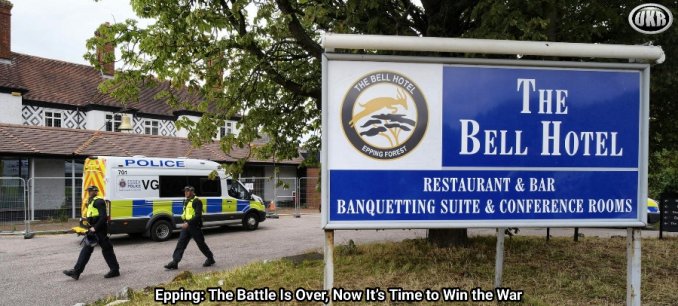
There have been precious few victories for the British people of late, and zero (to my mind at least) against the Starmer Inquisition (sorry, government). Tuesday’s temporary High Court injunction however, secured by Epping Forest District Council against the housing of illegal migrants at the Bell Hotel is, unmistakably, a victory. Contrary to media depictions of concerned parents as ‘far-right’ xenophobes, the local tension was sparked when a resident (Hadush Gerberslasie Kebatu) was charged with sexually assaulting a 14-year-old girl in the town. Thanks to a sustained period of peaceful protest around the hotel, most notably from Epping’s ‘pink ladies’ (despicable, ‘far-right’ racists to any Guardian readers out there), Mr Justice Eyre ruled ‘asylum seekers’ must be removed by 16:00 BST on 12 September.
Highly notable in this affair was the predictably lame response from the Home Office. Home Secretary Yvette ‘refugees welcome’ Cooper, shamefully attempted an unsuccessful 11th hour dismissal of Epping Forest’s application. Undoubtedly, she knows only too well how flimsy the immigration house of cards truly is. Having failed to prioritise the rights of illegals over the British people, the Home Office not only admitted the department had been left “reeling” by the ruling, but proceeded to warn how the decision would “substantially impact” its ability to house asylum seekers in hotels across the UK. True to form, Starmer’s government doesn’t quite grasp what a ‘warning’ is.
The injunction is a major coup for the British people and the safety of our children, and has widespread implications for the future war on mass immigration. First and foremost, despite the best efforts of the police and far-left counter-protestors the protests were almost exclusively peaceful. That’s no small matter, because even Starmer’s stormtroopers may be reluctant to engage in the mass arrest of women doing nothing more ‘thuggish’ than waving flags.
Second, standing tall and standing together really does count. Whether it’s love of country, the shared history and heritage symbolised by a flag, uniting against a common enemy, or simply opposing the decadent direction the nation is headed in: the authorities are terrified of unity. This of course, is why they will do absolutely anything to discredit the banner under which it comes.
Keir Starmer in particular is an utter coward, who buckles to the slightest show of strength if he considers it politically expedient. Whether it’s flip-flopping on winter fuel payments, chicks with dicks, or opposing the grooming gang inquiry – the Prime Minister is merely a weathercock without the balls. Safely ensconced inside Number 10, presumably the Pillsbury Doughboy-in-chief is considering whether to jail the parents of Epping en masse, and install the ‘asylum seekers’ as unusually well-built au pairs?
Third, and perhaps most importantly, the Battle of Epping proves one thing: there is courage and a sense of community still alive and kicking in Britain today. I for one am overjoyed to see it, for there have been periods recently where such a commodity seemed in scant supply.
Going forward, Epping may well be the template other councils follow. Broxbourne Borough Council, for instance, has been quick off the mark:

Meanwhile, Starmer’s political opponents are taking full advantage. Robert Jenrick, clearly desperate to get photographs with local residents, appears to have forgotten that as Immigration Minister he oversaw a rise in the procurement of asylum hotels. Nigel Farage, whose credit is slightly better, released the following statement on X:
“This is a victory for the parents and concerned residents of Epping. They do not want their young women being assaulted on the streets.
This community stood up bravely, despite being slandered as far right, and have won. They represent the vast majority of decent people in this country.
Young, undocumented males who break into the UK illegally should NOT be free to walk the streets anywhere. They must be detained and deported.
I hope that Epping provides inspiration to others across the country.”
Rupert Lowe, whose stance on immigration has been nothing short of unimpeachable, added this missive to Yvette Cooper’s in-tray:

While the politicking takes centre stage, lawyers suggest the real story may be the possibility of a chain reaction – which could leave Starmer the embarrassment of having to house the 30,000 asylum seekers chez Lord Alli.
The Battle of Epping may be over, but the war is far from won. Before we get carried away, there’s a few points that deserve attention. It is notable for example, that the injunction was served due to the council’s complaints that planning law had been breached – not the breach of ‘little girls’ right not to be raped on the way to school’. It must also be said, the snobbery against the protestors themselves is still palpable. It’s not so long ago that Reform UK’s Richard Tice dismissively referred to Tommy Robinson’s supporters (precisely the kind of people protesting outside the Bell Hotel) as “that lot”. And although victorious, Conservative councillor and Leader of Epping Forest Council, Chris Whitbread, couldn’t mask his disdain for the plebs:
“The reason I didn’t go on the demonstrations or protests, whichever way you want to look at it, was in some cases the people who were attending them. Let’s just leave it there.”
Meanwhile, the far-left campaign for fake asylum seekers has not thrown in the towel (call me old-fashioned, but I fail to understand how “stop complaining about the rape of your daughters” became quite so catchy, but whatever floats your dinghy I suppose). Still refusing to relinquish the old ‘war-zones are so bad, only women and children can bear them’ canard, Refugee Council Chief Executive, Enver Solomon, bizarrely claimed the government’s use of hotels was “completely unsustainable”:
“Through our frontline work we see how protests and hostility leave people who have fled war and persecution feeling terrified and targeted in the very places they are forced to live. This makes an already traumatising situation worse and robs people of any sense of safety.“Instead of relying on costly hotels, the Home Office should partner with local councils to provide safe, cost-effective accommodation within communities. But to end hotel use for good, the government needs to think differently about how we can speed up and improve asylum decision-making.”
A contemptible take from someone who should immediately have his spare bedrooms filled for him. He’s right about one thing though: if the asylum hotel scam has finally been put to bed (and assuming the government has no desire to actually deport the scammers), where exactly do these sexually rapacious young men go? As bad as the hotels are, at least young women currently know which places to avoid. If they’re subsequently moved to unknown houses of multiple occupancy, the British people have another problem on their hands.
This article (Epping: The Battle Is Over, Now It’s Time to Win the War) was created and published by Frank Haviland and is republished here under “Fair Use”
See Related Article Below
Why the Epping decision matters
A remarkable victory for the people over the establishment

MATT GOODWIN
It doesn’t happen very often but sometimes the people triumph over the establishment.
And that is exactly what happened yesterday afternoon, when a judge ruled that the Bell Hotel in Epping, Essex, which has been used to house illegal migrants and asylum-seekers, can no longer do so.
While the official reason for the decision was arcane planning laws, with the local council claiming the hotel was no longer being used for its original purpose, the reality is it was the people, by peacefully protesting, who forced officials to act.
And so, the decision is not only highly significant for British politics but has far-reaching implications for the Labour government, for the protests that are still sweeping through the country, and for the future of migration and asylum policy.
In the first instance, as I wrote on X last night, as you read this every local council up and down the country will currently be exploring whether they, too, can copy the Epping template, using planning laws and other mechanisms to shut down the migrant hotels that have become a focus of public protests.
Meanwhile, the message that is going out to the British people today, loud and clear, is that if they, too, organise and join protests against migrant hotels in their local communities then, chances are, they too will emerge triumphant against a ruling class and a state that appears completely deaf to the concerns of its own people.
The rapidly rising number of protests over the decision to house illegal migrants in the heart of Britain’s communities —some of whom have gone on to commit truly horrendous sexual offences— had already come to symbolise the enormous gulf between a fanatically pro-immigration elite class and a people who feel outraged about how illegal migration is violating their borders and sense of fair play.
But now, after Epping, the people have every incentive to take to the streets, to protest, to try and make things happen for themsleves.
And while Labour Ministers and hapless civil servants might complain about all this, the reality, as I pointed to weeks ago, is that it is the Labour government’s incompetence and failing policies that have pushed the country to the edge.
The fact of the matter is that all this chaos and carnage was completely avoidable had Keir Starmer and his incompetent Home Secretary Yvette Cooper bothered to listen to people who know a thing or two about border security and immigration policy.
Even before Labour took power, as I wrote back in early 2024, experts were already pointing out how Labour’s policy of trying to “smash the gangs” while putting the illegal migrants and asylum-seekers who make it to Britain in luxury hotels would not only fail but make the illegal migration crisis ten times worse.
And that is exactly what’s happened.
The small boat numbers, under Labour, have soared to record levels, while the entire system, as we can now see, is in chaos. Public concern over immigration is rocketing and public trust in politicians and government to do the right thing is collapsing.
And, no, this isn’t only because the Tories, from Boris Johnson to Robert Jenrick, were just as hapless on this issue, which they were, having presided over the expansion of the asylum hotels to begin with.
It is because of how, instead of taking control, Keir Starmer, Yvette Cooper and Labour promptly overturned the few good things the Tories left behind by decriminalising illegal migration and replacing deterrents with new incentives for many more migrants to break into the country.
Along the way, Labour allowed rapists, criminals, “alleged” Iranian terrorists, and ISIS-sympathisers into the country, putting them next to schools and families.
They put migrants in hotels and private housing amid one of the worst housing crises in British history. They handed the British people a bill of some £7-10 billion a year for the privilege of doing so, amid the worst cost-of-living crisis since World War Two.
And they even used the British people’s own money to offer illegal migrants more favourable rental contracts, outbidding the British people in their own housing market with their own money!
Labour, in short, has driven a tank straight through the British people’s sense of fairness, fuelling a rising tide of anger and alienation across the country.
Which leaves the total fiasco that we see around us today, with Yvette Cooper and Labour lawyers, astonishingly, even rushing in the final hours, yesterday, to try and oppose the court’s decision and prevent the people from taking back control of their own local communities.
Unsurprisingly, in the final hours, Labour lawyers claimed the decision would violate, you guessed it, their obligations under the European Convention on Human Rights.
Once again, in other words, foreign courts and conventions that were designed for an entirely different era are being cited as a reason why the Labour government could not prioritise the safety and security of its own citizens, alongside Labour’s fears that if the Epping hotel closed then the public might realise the efficacy of protesting.
Never in my lifetime, in short, have I seen a government that is so utterly adrift from the people on what is now, according to pollsters, the most important issue in Britain.
And, even today, Labour continues to gaslight and mislead the British people.
On the radio, this morning, I listened to a Labour politician claim the government “will bring down the number of asylum hotels” in the country, presenting this as some kind of serious response to public concern.
But what they mean by this, and what everybody needs to know, is all they will do is move the rapidly rising number of asylum-seekers and illegal migrants out of hotels like the one in Epping into things called HMOs –Housing for Multiple Occupancy–where dozens of migrants will be placed in terraced houses and buildings, once again, in the heart of Britain’s communities.
It seems highly likely, in other words, that the public protests that have been taking place outside the asylum hotels will now simply switch location to the HMOs.
Meanwhile, Labour is claiming it is “dealing with the issue” when, in reality, what it is doing is approving more than half of all asylum-claims, thereby incentivising more and more people to come, while simultaneously hiding the arrivals in private housing and the welfare state, hoping nobody in Britain will notice.
And so round and round we go, with the Labour government refusing to overturn this idiotic policy of de facto open borders, refusing to be honest with the British people, while the people themselves, understandably, become ever more frustrated, ever more angry, ever more disillusioned, with a government and system that is neither representing their views nor respecting them as tax-paying citizens.
None of this is sustainable. All it is doing is steadily turning up the temperature in this country, setting the stage for major protests, unrest, and perhaps even worse.
What we need to do to bring the entire situation under control —what even some liberal centrists such as The Economist are finally starting to realise about a decade after everybody else—is what this newsletter has argued for years.
We need to radically overhaul the legal and legislative regime that surrounds immigration and asylum in the West today.
We need to leave the European Convention on Human Rights, the ECHR. We need to radically reform if not fully replace the Human Rights Act. We need to revisit and reform the UN Refugee Convention of 1951. We need to immediately detain and deport anybody who arrives in Britain illegally, and process them offshore, away from the British people. And we need to have far more deterrents than incentives.
Until then, and I’ve never said this before, the British and the English people should apply what is the obvious lesson of Epping —they should continue to peacefully protest, they should continue to organise and mobilise, and they should continue to make their voice heard and unavoidable in the corridors of power.
Because, apparently, this incompetent and amateurish Labour government has absolutely no idea what it is doing anymore. And because, apparently, in Keir Starmer’s Britain, that’s the only way the people can reassert common sense.
Ever since Labour came to power, only a year ago, it has been pushing and pushing this country to the brink. So now, as Epping shows, it is time for the people to take back control but because clearly nobody in government is able to do so.
This article (Why the Epping decision matters) was created and published by Matt Goodwin and is republished here under “Fair Use”
*****
Immigration: making history
RICHARD NORTH
There can be no doubt as to the issue of the moment, with the victory of Epping Forest District Council in successfully obtaining an interim injunction, ordering the closure of the Bell Hotel in Epping as a migrant hotel by 12 September.
The success has been widely publicised in both national and local media – print and broadcast – with the [online] Telegraph’s headline typical of the many, declaring: “Migrants must leave Epping hotel, High Court rules”, with the sub-head: “Decision comes after Home Office warning that injunction could put asylum hotel scheme at risk”.
That warning of the effect of the injunction is taken up by the overnight edition of The Times which reports: “Asylum housing scheme in chaos after council fights back”, the sub-head in this case declaring: “Ministers expect other local authorities will move to shut down migrant hotels after Epping Forest council won a High Court injunction on planning grounds”.
For the moment, the text of the judgement, delivered in the High Court by Mr Justice Eyre, does not seem to be available on-line (the judgement has now been released. ed) and the nearest thing I can find to an official statement is the brief note on the Epping Forest website which notes that the injunction also contains a declaration that the use of the Bell Hotel for asylum seekers is not a permitted use of the hotel for planning purposes.
Whether or not planning permission for migrant hotels is needed depends essentially on the interpretation of the applicable legislation, The Town and Country Planning (Use Classes) Order 1987, which classifies hotels and hostels under Part C.
Generally, under the C1 category, no distinction is made between a hotel and a hostel, except that, when there is provided “a significant element of care and support”, the accommodation falls within Class C2. Since “care and support” is a defining characteristic of a migrant hotel – more accurately a hostel – the presumption is that the use falls within the C.2 classification. Change of use from one class to the other can require planning permission and it is within this provision that the Bell Hotel has fallen.
However, as the HoC Library points out, planning permission isn’t necessarily required. There must, in legal terms, be a “material change of use”, taken to mean a significant alteration in how a building or land is used, potentially impacting the local area’s character or amenities. Key factors include the intensity of the new use, its impact on traffic, noise, and visual aspects.
That said, while Epping is currently in the news, this is not the first time planning law has been tried out in an attempt to prevent hotels being used to accommodate migrants. Most attempts have been unsuccessful.
In November 2022, for instance, the High Court declined to continue injunctions sought by Ipswich Borough Council and East Riding of Yorkshire Council.
In these cases, the judge found there were arguments pointing towards and against hostel use, concluding: “the distinction between a hotel and hostel … is [a] fine [one]”. Whether a change of use from hotel to hostel is material, he added, depends on the planning consequences.
In these cases, the judge asserted, the consequences were “very limited”: the alleged change of use would not alter the buildings, cause environmental damage, or impact the character of the area.
The High Court has also declined to extend interim injunctions by Fenland District Council and Stoke-on-Trent City Council. It has declined North Northamptonshire Council’s application for an injunction.
On the other hand, in January 2023, the High Court decided to continue an injunction preventing the use of a seafront hotel in Great Yarmouth to house asylum seekers (Rupert Lowe’s territory).
Great Yarmouth’s local plan includes a policy to protect the seafront because of its importance to the town’s tourism economy. The local plan defines uses that are not permitted on the seafront, including hostels.
Here, the judge also considered the impact of an injunction on asylum seekers and whether the planning authority had used other enforcement powers prior to seeking an injunction. In fact, Great Yarmouth had issued an enforcement notice in 2006 prohibiting the use of the building as a hostel and the judge noted this was still in force but had not deterred the provider. This supported the use of more serious powers, in this case an injunction.
This question of alternative enforcement powers also came up in the Epping case, where the hotel owner, Somani Hotels Limited, argued that any breach of planning law could be dealt with by conventional enforcement action. The council, on the other hand, argued that an urgent order was needed, cited disruption caused by the protests and concerns for the safety of the asylum seekers themselves. Evidently, the judge agreed.
At the eleventh hour, just before the ruling was handed down, The Home Office made an application to intervene, joining in the action. This, according to the Telegraph got short shrift from the judge, who dismissed the application saying that the consequences of the [Home Secretary] joining would be the loss of yet further court time. “The impact of that”, he said, “is significant”.
A barrister for the home secretary had argued that a ruling in the council’s favour would have a substantial impact on the home secretary’s statutory duty to house asylum seekers while their cases are considered, and it is this aspect which is explored by The Times.
In reporting that the government’s asylum accommodation scheme has been “thrown into doubt”, the paper says that ministers are now braced for a wave of applications by local authorities also seeking to close migrant hotels in their areas.
However, as councillor Chris Whitbread, the leader of Epping Forest District Council says: “This is not the end of the matter”. The council has only obtained an interim stay and must return to the court and seek a permanent injunction. Whitbread does not say so, but it is the case that other councils have reached the interim stage but have failed in their quests for permanency.
What appears to have made the difference so far, though, is the extent of the public protests outside the hotel. In planning terms, this goes towards the “material change of use” consideration, where the new use is quite clearly impacting the local area’s character and amenities, with effects in terms of traffic, noise, and visual aspects.
On this basis, should public demonstrations – with all that they entail – become a permanent (or even common) feature of the change of use from hotel to migrant hostel, this could become a material consideration in determining whether planning permission was necessary, and provide solid grounds for rejection.
Tentatively, therefore, one can say that this is an issue where, demonstrably, public protest works. The home secretary might complain that rejection would interfere with her statutory duties, but that should not be any concern of the courts. If the Rule of Law is to mean anything, then planning law must apply equally to all parties, including the home secretary. She cannot exempt herself from the law.
There does remain, though, the question of where the migrants go if they are chucked out of the hotels, where success could turn out to be a Pyrrhic victory, with the outcome even less satisfactory than current provisions.
This is intimated by the comments of Enver Solomon, the chief executive of the Refugee Council, who says the ruling should signal the end of the use of hotels to house asylum seekers.
“Everyone agrees that hotels are the wrong answer – they cost the taxpayer billions, trap people in limbo and are flashpoints in communities”, he avers. “Instead of using costly hotels, the Government should partner with local councils to provide safe, cost-effective accommodation within communities”.
This begets another step in the Home Office’s dispersal programme where, instead of being accommodated in highly visible hotels, the migrants are farmed out to local authorities and tucked away in HMOs, repurposed office buildings and even converted shops – small packages of migrants deeply embedded in vulnerable communities.
This provision, though, is hardly likely to be any more popular than the hotels policy and, when it comes to demonstrations, these too will be dispersed, potentially more difficult to police, as resources are more thinly spread.
The government could, of course, resolve this matter by stopping the boats and deporting the existing illegal immigrants, but it shows no signs of doing either. More protests, though, and still more closures, will squeeze the government between a rock and hard place, perhaps forcing the issue.
With that, although only a tiny baby step in the larger scheme of things, yesterday Epping made history.

••••
The Liberty Beacon Project is now expanding at a near exponential rate, and for this we are grateful and excited! But we must also be practical. For 7 years we have not asked for any donations, and have built this project with our own funds as we grew. We are now experiencing ever increasing growing pains due to the large number of websites and projects we represent. So we have just installed donation buttons on our websites and ask that you consider this when you visit them. Nothing is too small. We thank you for all your support and your considerations … (TLB)
••••
Comment Policy: As a privately owned web site, we reserve the right to remove comments that contain spam, advertising, vulgarity, threats of violence, racism, or personal/abusive attacks on other users. This also applies to trolling, the use of more than one alias, or just intentional mischief. Enforcement of this policy is at the discretion of this websites administrators. Repeat offenders may be blocked or permanently banned without prior warning.
••••
Disclaimer: TLB websites contain copyrighted material the use of which has not always been specifically authorized by the copyright owner. We are making such material available to our readers under the provisions of “fair use” in an effort to advance a better understanding of political, health, economic and social issues. The material on this site is distributed without profit to those who have expressed a prior interest in receiving it for research and educational purposes. If you wish to use copyrighted material for purposes other than “fair use” you must request permission from the copyright owner.
••••
Disclaimer: The information and opinions shared are for informational purposes only including, but not limited to, text, graphics, images and other material are not intended as medical advice or instruction. Nothing mentioned is intended to be a substitute for professional medical advice, diagnosis or treatment.
Disclaimer: The views and opinions expressed in this article are those of the author and do not necessarily reflect the official policy or position of The Liberty Beacon Project.


Leave a Reply