

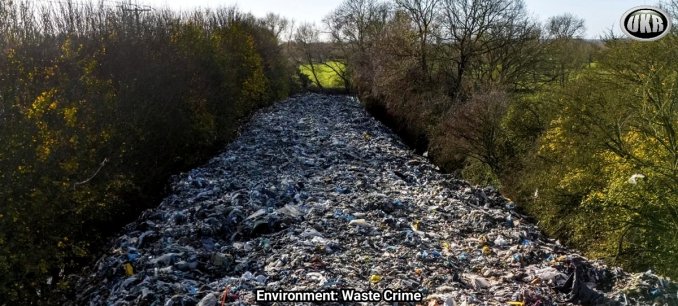
Environment: waste crime
RICHARD NORTH
The Sunday Times has published a report by Samuel Lovett on the fly-tipping plague which has reached epidemic proportions, blighting towns and countryside.
Lovett’s report starts with an account of an illegal tip in Burnley, where an illegal tip has been in operation for the past two years yet, despite local residents complaining to the council, collecting photo evidence and organising protest groups, nothing has been done by the authorities.
More than anything else, this is one of the main facets of a complex issue where, under the generic title of “fly tipping” there exists a spectrum of illegal activity.
This ranges from the one-time householder disposing of a bulky item, to a local builder routinely disposing of small amounts of trade waste, up to enterprises run by organised crime syndicates, involved in the illegal disposal of thousands of tonnes of illegal waste, raking in millions of pounds.
From the very start, the authorities are on the back foot as this year’s National Waste Crime Survey shows that almost three-quarters of waste crime goes unreported, despite more than half (57 percent) of landowners and farmers estimated to have been affected by waste crime.
Worse still, it is estimated that 35 percent of waste crime is committed by organised crime groups, attracted by financial gains, illustrated by one incident where a criminal gang was held responsible for illegally disposing of 26,000 tonnes of waste across 17 sites, avoiding landfill tax costs in excess of £2.7 million, and leaving landowners with a clean-up bill estimated at more than £3.2 million.
The detail on the landfill tax give the clue as to why this particular form of crime is so lucrative and has blossomed into a multi-million-pound enterprise. When introduced in 1996 in response to the EU’s Waste Framework Directive as a mechanism to reduce landfill, it started out at £7 per tonne and, via a variable “escalator” policy, it has been increased steadily over the years and now stands at £125.15 per tonne.
The tax policy was accompanied by an active policy of shutting down active landfill sites and refusing to license new ones so that, from 2008 when I was reporting that landfill charges were in the order of £30-50 per tonne, disposal costs can be anywhere from £250-400 depending on the area.
As Lovett points out a crime syndicate can avoid paying £4,368 in taxes and landfill fees by illegally emptying a single, fully loaded 28-tonne lorry but, if anything, that understates potential profits. In the south of England, where landfill is scarce, a 28-tonne load can cost as much as £11,000 in tax and tipping fees.
Although much is made of the occasional high-profile conviction, detection of wrong-doers and their successful prosecution is vanishingly rare and most of the gangs slip away to enjoy their profits of an “industry” estimated to be worth £1 billion a year.
In fact, the authorities are barely touching the problem. There are nearly 5,900 such sites in England alone, according to analysis of satellite imagery conducted by Air and Space Evidence, significantly more than the Environment Agency (EA) is detecting and closing down each year.
In 2024-25 the EA shut 743 sites in England. It has 13 cases that have been open for 11 years. There are five mega-sites under investigation by the EA, in Burnley, Northwich in Cheshire, Sittingbourne in Kent, Camborne in Cornwall and Fakenham in Norfolk.
According to Matthew Scott, the Kent police and crime commissioner – cited by Lovett in his article – efforts to stop waste crime are hampered by lack of communication between the three main bodies: the (EA), local authorities and police.
“Intelligence is being lost in what I call the Bermuda Triangle, because you’ve got these three agencies and they’re not talking. It’s all just falling through the middle”, Scott says.
A joint unit was set up six years ago to bring together 11 partners ranging from the EA to HM Revenue & Customs to bridge this gap but, we are told, critics question its effectiveness. In 2024-25 the unit led or supported 34 operations against waste crime.
Baroness Sheehan, who led the recent House of Lords inquiry into waste crime, said the unit was “inconsistent” in intelligence sharing and collaborating with partners.
Scott pointed to an illegal waste site in Kent, at Hoad’s Wood – a site of special scientific interest – as an example of how the system was failing. Over a six-month period in 2023 gangs were able to dump some 30,000 tonnes of waste in the forest, even as residents sounded the alarm, with no intervention by the authorities.
“Nothing happened about Hoad’s Wood for years”, Scott adds. “It was reported to the council, the police and the Environment Agency but no one gripped it.
Baroness Sheehan’s committee has come up with a number of detailed recommendations, suggesting that the response to waste crime should be subject to a root and branch review, conducted independently of Defra, the Environment Agency and HMRC, asking for it to be completed with a government response by May 2027 at the latest.
The committee wants the government to establish a single telephone number and an online reporting tool for the public to report waste crime, and it is asking for the Joint Unit for Waste Crime to improve collaboration between bodies with responsibility for waste crime at the local level (especially policing and local government), particularly in respect of the handling of reports and sharing of intelligence.
Typically of such reports, the committee want to throw money at the problem, asking the Treasury to review rules on managing public money preventing the Environment Agency to divert resources from its regulatory work to crime enforcement and maintain additional funding provided to the Environment Agency in 2025/26.
Additionally, the Environment Agency should be allowed to implement a proposed waste crime levy, charging legal operators additional fees to finance tougher enforcement.
The government is enjoined to ensure that the first phase of a planned mandatory digital waste tracking is delivered on time, and it wants funding to enable the expansion of digital waste tracking to legal waste carriers from 2027.
Only then does the committee ask the government to “fully assess the risks that landfill tax reform will increase other forms of waste crime and lead to the abandonment of landfill sites”, which were subject to consultation earlier this year.
This, in itself is the bombshell for, it appears, the government has learnt nothing from the experience of the burgeoning epidemic of waste crime which, in effect, is a creation of a legislative system which has increased the costs of waste disposal so much that there is a huge incentive for large-scale illegal dumping.
Rather than acknowledge this, though, the government is planning changes which will make waste disposal even more expensive, even though the worst of the proposals were abandoned in Rachel Reeves’ budget.
The essence of this problem, though, remains unchanged. Although there is no shortage of potential landfill sites in this country – with landfill remaining by far the cheapest form of waste disposal – the government, by implementing a misplaced EU rule (which is still in effect), is artificially inflating the costs of disposal and thereby creating a major explosion of illegal tipping.
Consistently, the media and politicians have missed this point and now, so lucrative has this crime become that we are experiencing a sinister development.
Reported since 2022, illegal drugs syndicates are moving into large scale dumping as a low-risk adjunct to their businesses, with the cash funnelled back into financing other illegal activities, which might include drug dealing, people trafficking and weapons smuggling.
The biggest crime syndicate of them all, though, is the government, which is creaming off the tax income to make our lives immeasurably worse.

••••
The Liberty Beacon Project is now expanding at a near exponential rate, and for this we are grateful and excited! But we must also be practical. For 7 years we have not asked for any donations, and have built this project with our own funds as we grew. We are now experiencing ever increasing growing pains due to the large number of websites and projects we represent. So we have just installed donation buttons on our websites and ask that you consider this when you visit them. Nothing is too small. We thank you for all your support and your considerations … (TLB)
••••
Comment Policy: As a privately owned web site, we reserve the right to remove comments that contain spam, advertising, vulgarity, threats of violence, racism, or personal/abusive attacks on other users. This also applies to trolling, the use of more than one alias, or just intentional mischief. Enforcement of this policy is at the discretion of this websites administrators. Repeat offenders may be blocked or permanently banned without prior warning.
••••
Disclaimer: TLB websites contain copyrighted material the use of which has not always been specifically authorized by the copyright owner. We are making such material available to our readers under the provisions of “fair use” in an effort to advance a better understanding of political, health, economic and social issues. The material on this site is distributed without profit to those who have expressed a prior interest in receiving it for research and educational purposes. If you wish to use copyrighted material for purposes other than “fair use” you must request permission from the copyright owner.
••••
Disclaimer: The information and opinions shared are for informational purposes only including, but not limited to, text, graphics, images and other material are not intended as medical advice or instruction. Nothing mentioned is intended to be a substitute for professional medical advice, diagnosis or treatment.
Disclaimer: The views and opinions expressed in this article are those of the author and do not necessarily reflect the official policy or position of The Liberty Beacon Project.


Leave a Reply