


WILLIAM M BRIGGS
The MPs in the UK passed a bill that will allow doctors to kill their patients. Maybe this is their solution to the rampant immoral immigration they can’t make themselves stop? Who knows. In any case, there is some to-ing and fro-ing left in the legalities before the bill becomes an official law, but all expect that it will.
Doctors in the UK have grown squeamish, coincidentally, I’m sure, at the same rate the profession becomes female. So this bill says doctors will only give Death Pills to patients, and have the patients swallow them on their own, albeit under supervision of Dying Experts. This is contrasted with the manly way of just bashing patients over the head, or slitting their throats.
At this early date, we won’t see, like in the Netherlands and Canada, doctors sneaking into patient rooms in the dark of the night and slipping them the needle. At first, anyway. Doubtless the Slippery Slope is being greased even as you read this.
They won’t slather on too much, though. Because consider: if you kill patients as they walk in the door, what you gain in dying efficiency and bed space you lose in the amount you can bill insurance companies. There has to be a balance of killing and care that maximizes revenue.
The UK Bill says doctors can’t kill just any old patient. Or any young patient, come to that. Doctors first have to pronounce the patients have only six months to live. Now I have read countless stories of doctors insisting patients are “brain dead”, right before the patients come back to “brain life”. Meaning the prognosticative ability of doctors is right up there with their ability to make moral arguments. Look for lots of “six months left” diagnoses to be charted.
Surely some pharmaceutical has tasked its marketing department to develop a clever, happy name for its Dying pills. Easy Off? No, that’s an oven cleaner. Could be the same ingredients, though. I see the possibilities for a tie-in here, especially as those crematorium’s ovens have to be cleaned by somebody. “Hands free death with scouring power!”
Maybe Endia. But, Wokepedia tells us, this is derogatory slang in India, so it can’t be marketed under that name there. Curryfinia might work there, though.
Gonegrinnia? Chokecheerica? Happy Exit?
How about Releasia? Don’t be satisfied with death pills that will have you spitting up blood — try new Painless Releaseia™ for your final release!
Can you imagine the commercials? People cavorting, smiling, one last push of the granddaughter on the swing. Dancing, even, then marching off to swallow Releaseia and leave their troubles for others to deal with. Ask your doctor if Releaseia is right for you.
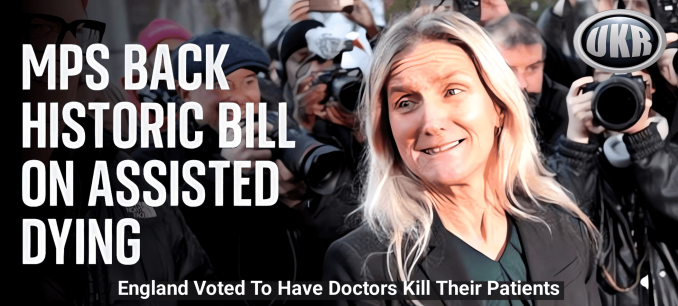
Not a joke, my friends. The ads are already here, and indeed, the image leading today’s post is one of them. Presumably that ad was right next to the Suicide Prevention hotline poster. Seriously, have you ever seen anybody about to kill herself as joyous as this? Besides Kamala, I mean.
Somebody pointed out the ad featured a white woman, which is odd in a culture that features Official Victims in nearly all ads. Some thought the ad was because of hatred of whites. That might be part of it, but consider if they instead had a happy Official Victim tap dancing her way into the grave. The hue and cry—there is no charge for these jokes, friends—would be ear splitting. How dare you express the desire for Victims to die!
I made the observation on Twitter that a cardiologist is a doctor who specializes in heart disease. An oncologist specializes in cancer. What do they call a doctor who specializes in killing his patients? Doctor.
What a good joke!
Somebody else suggested necrologist. I like it. It sings.
No sense being angry about any of this. Won’t do you the least bit of good. It would only increase your blood pressure, increasing the chances you’d make a visit to the doctor, and she’d only recommend death as treatment.
I say “she” in honor of Ellen Wiebe, a Canadian doctor who has sent over 400 of her patients to an early grave. She worries about anger too. She says “We know that angry family members are our greatest risk (laughter).”
Laughter.
This article (England Voted To Have Doctors Kill Their Patients) was created and published by Science Is Not the Answer and is republished here under “Fair Use”
******
RELATED:
Assisted Dying Bill
The Problem of Predicting End of Life
The Terminally Ill Adults (End of Life) Bill passed its second reading in the UK’s Houses of Commons. The Bill allows adults who are terminally ill, subject to safeguards and protections, to request and be provided with assistance to end their own life and for connected purposes.

For the purposes of the Bill, a person is defined as terminally if –
- the person has an inevitably progressive illness, disease or medical condition which cannot be reversed by treatment, and
- (b) the person’s death in consequence of that illness, disease or medical condition can reasonably be expected within 6 months.
We’re only into point 2, and TTE already has a significant problem with the Bill.
First, when the Bill says expected in 6 months, what does that mean? Take, for example, Stage 4 lung cancer. Most have poor survival; 25% to 30% die in less than 3 months. Yet, of those surviving more than 3 months, 10% to 15% survive very long.
The first problem we encounter is the lack of a definition linked to death within 6 months. The bill is likely referring to the median estimate, but it should also contain a measure of the dispersion, such as the range, which can be very wide.
For example, the median survival time for lung cancer is 13 months, with an interquartile range (IQR) of 6 to 39 months. So, when choosing the time someone has left, should we choose the median or the upper end of the range?
But this is not the bill’s main problem. The introduction of the term reasonably suggests some form of judicious logic is at play. The bill assumes that an element of accuracy can determine the timing of one’s death, especially if we choose doctors who know best.
Yet, what does the evidence say?
We’ll start with a systematic review of physicians’ survival predictions in terminally ill cancer patients published in the BMJ. The review reported on eight studies measuring clinical prediction of survival (CPS) and actual survival (AS). The results showed that CPS was generally overoptimistic: It was correct within one week in 25% of cases and overestimated survival by at least four weeks in 27%. This does not sound too bad until you realise that most of the studies analysed patients’ deaths within weeks.
Here’s how the paper says it:
‘Doctors’ predictions for terminally ill cancer patients (a population very close to death with a median survival of approximately four weeks) were inaccurate—they were correct to within a week in only 25% of cases and out by more than four weeks in a similar number.’
So, the longer the Clinician’s survival prediction, the greater the variability. It makes sense that predicting events that are expected to happen imminently is easier than predicting events some way off. Thus, when expected survival reaches six months, the clinician’s predictive ability breaks down compared to actual survival – they are no better than what could be expected by chance.
A more recent review published in PLosONE substantiates the BMJ review: ‘The evidence suggests clinicians’ predictions are frequently inaccurate. No sub-group of clinicians was consistently shown to be more accurate than any other.’ The difference between the median predicted and actual survival ranged from an underestimate of 86 days to an overestimate of 93 days.
A 2023 review of evidence from routinely collected data in urgent care records reported that there was good accuracy for estimates that patients were likely to die within days (74% correct) or to live for more than a year (83% correct)
So, clinicians are skilled at identifying individuals who will die imminently (within, say, 14 days) and identifying those who will live far longer. Everything in between is a bit of a blur.
Given its inherent inaccuracies, some researchers have developed algorithms to improve clinical judgment. However, while the best algorithms were no more accurate than clinicians’ judgments, the overall accuracy was only just over 60%. No doubt, though, artificial intelligence will claim it can save the day.
Some have tried a simple surprise question to identify patients at the end of life – asking whether the respondent would be surprised if the patient were to die within a specified period (usually the following year). Again, a systematic review reports the same problem – a wide degree of accuracy, from poor to reasonable.
One thing puzzles us in the TTE office. The bill reports that:
A registered medical practitioner may carry out the functions of the independent doctor under this Act only if that practitioner— (a) has such training, qualifications and experience as the Secretary of State may by regulations specify.
The accuracy of predictions varies more than people think due to variations in the disease trajectory, which can be affected by many factors. Just like weather predictions – once you go beyond 14 days, the reliability of any estimates breaks down as there are too many variables to consider.
Given that no sub-group of clinicians was consistently shown to be more accurate than any other, who does the Secretary of State have in mind with the training, qualifications, and experience to be no better than chance when predicting a person’s death within 6 months?
Two old geezers wrote this post and predicted each other would survive longer than a year.
This article (Assisted Dying Bill) was created and published by Trust the Evidence and is republished here under “Fair Use”

••••
The Liberty Beacon Project is now expanding at a near exponential rate, and for this we are grateful and excited! But we must also be practical. For 7 years we have not asked for any donations, and have built this project with our own funds as we grew. We are now experiencing ever increasing growing pains due to the large number of websites and projects we represent. So we have just installed donation buttons on our websites and ask that you consider this when you visit them. Nothing is too small. We thank you for all your support and your considerations … (TLB)
••••
Comment Policy: As a privately owned web site, we reserve the right to remove comments that contain spam, advertising, vulgarity, threats of violence, racism, or personal/abusive attacks on other users. This also applies to trolling, the use of more than one alias, or just intentional mischief. Enforcement of this policy is at the discretion of this websites administrators. Repeat offenders may be blocked or permanently banned without prior warning.
••••
Disclaimer: TLB websites contain copyrighted material the use of which has not always been specifically authorized by the copyright owner. We are making such material available to our readers under the provisions of “fair use” in an effort to advance a better understanding of political, health, economic and social issues. The material on this site is distributed without profit to those who have expressed a prior interest in receiving it for research and educational purposes. If you wish to use copyrighted material for purposes other than “fair use” you must request permission from the copyright owner.
••••
Disclaimer: The information and opinions shared are for informational purposes only including, but not limited to, text, graphics, images and other material are not intended as medical advice or instruction. Nothing mentioned is intended to be a substitute for professional medical advice, diagnosis or treatment.


Leave a Reply