

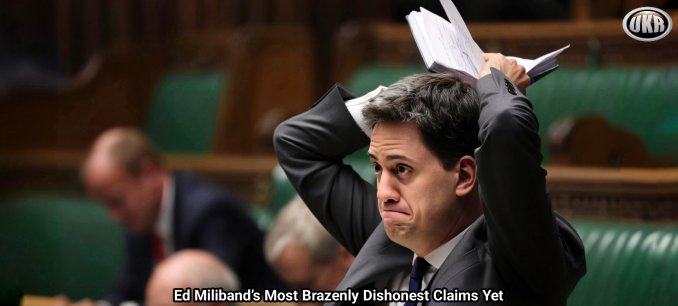
Ed Miliband’s Department for Energy Security and Net Zero has just announced the results of the new CfD auction, in what must go down as one of the most blatantly dishonest and arguably fraudulent Government press releases in recent years.


Britain has taken a monumental step towards ending the country’s reliance on volatile fossil fuels and lowering bills for good, by delivering a record-breaking offshore wind result in its latest renewables auction.
The results deliver the biggest single procurement of offshore wind energy in British and European history – confounding the global challenges facing the industry – a major vote of confidence in the UK’s new era of energy sovereignty and abundance.
The Government inherited the fiasco of the previous government’s failed Auction Round 5, in which not a single offshore wind project was secured. The last auction round, AR6, got the industry back on its feet. Now this auction round, known as Contracts for Difference AR7, has secured a record capacity of 8.4 GW of offshore wind which will generate enough clean electricity to power the equivalent of 12 million homes. The ground-breaking result puts Britain firmly on track to achieve its clean power mission by 2030.
These results show offshore wind is cheaper to build and operate than new gas. In new figures published today using the LCOE industry metric, the cost of building and operating a new gas fired power station is £147 per megawatt hour. By contrast, the results for fixed offshore wind in today’s auction were £90.91 per megawatt hour on average – or £65.25 in the commonly used benchmark of 2012 prices – 40% cheaper than the cost of building and operating new gas.
This auction will unlock around £22 billion in private investment, supporting around 7,000 jobs, bringing growth and good jobs to all regions of the country – and particularly to the country’s industrial heartlands. Clean power is also essential to tackle the climate crisis, the greatest long-term threat the country faces.
Below are the successful schemes:


Let’s start with the big lie:
Price for offshore wind agreed at 40% lower than the cost of building and operating a new gas power plant …
These results show offshore wind is cheaper to build and operate than new gas. In new figures published today using the LCOE industry metric, the cost of building and operating a new gas fired power station is £147 per megawatt hour. By contrast, the results for fixed offshore wind in today’s auction were £90.91 per megawatt hour on average – or £65.25 in the commonly used benchmark of 2012 prices – 40% cheaper than the cost of building and operating new gas.
There are the “new figures published today”:

The PDF analysis contains this table – I have highlighted the relevant column for Combined Cycle Gas Turbine (CCGT) technology:

The data annexes confirm that the cost of new CCGT is estimate as £109 per MWh at 2024 prices – but this includes £41 per MWh for carbon tax, which is not a “cost” at all but a Government imposition. (It relates to the Emissions Trading Scheme, which could be torn up tomorrow, if the political will was there.)
The Government claim that offshore wind is 40% cheaper than gas implies a cost of gas power of about £150 per MWh. That is a fake claim, even if you allow for carbon costs.
The simple reality is that the real cost of new gas power would be £68 per MWh, around a quarter less than these new contracts for offshore wind. Of this, fuel costs account for £45 per MWh.
The second lie concerns the use of “2024 prices”, on which the “90.91 per MWh” price for offshore wind is based.
It has probably occurred to you that we are now in 2026! Since 2024, CPI has risen by 4.5%. As CfD strike prices are index linked, that “£90.91” has already risen to about £95 per MWh.
The wholesale price in Q4 2025 was £74.44 per MWh, according to the Government’s Low Carbon Contracts Company. Offshore wind will therefore be subsidised to the tune of £20 per MWh at these prices.


Indeed, the Government admits as much, because the AR7 published results confirm that subsidies could top £1.9 billion a year by the time all the schemes are operational. These subsidies will have to be paid for 20 years, and index linked.

Then we come to the third big lie.
The Department for Energy Security and Net Zero (DESNZ) is comparing new offshore wind with new CCGT. The true comparison however should be with existing CCGT, as we already have under-utilised CCGTs. It is generation from these that new wind power will replace.
As we have already paid for all of the fixed costs anyway, the only cost of producing additional electricity at CCGTs is the fuel cost, which as we have seen is around £45 per MWh. That means the cost of sourcing power from these new wind farms will be about £50 per MWh dearer than the gas power they are replacing.
We are tight on CCGT capacity and will need to construct new plants if older ones close as expected. But – crucially – we will have to do that anyway, whether we build new wind farms or not as gas will remain our back-up for intermittent renewables for the foreseeable future.
What Miliband wants is to spend tens of billions building offshore wind farms in addition to paying for that new gas capacity. It will not “lower bills for good”, as the presa release blurb states. It will raise bills yet further.
First published on Paul Homewood’s blog, Not a Lot of People Know That.
See Related Article Below
Ed Miliband’s eco-socialism is costing us a fortune
JOHN FLESHER
Soaring energy bills for households and industry continue to keep inflation high and create a straitjacket for growth.
Labour’s arbitrary and unnecessary 2030 Clean Power Target continues to undermine the urgent mission to cut bills. And this has been laid bare yet again today.
Some might have hoped that the seventh allocation round (AR7) for new renewable energy projects would bring some welcome news for hard-pressed billpayers. But with the results of the auction, we now know the minimum amount the Government has agreed for billpayers and taxpayers to pay for the electricity produced by these new projects. The outcome isn’t pretty, with an unwelcome increase on last year’s price.
Wind has been – and can continue to be – a significant opportunity for Britain. It is our largest source of electricity generation, bringing high-paying jobs in the construction and maintenance of turbines, and is crucially a domestically produced energy source, not susceptible to control by hostile powers in the same way that fossil fuel prices are. Along with nuclear and other renewables, it should remain an important part of our energy mix, with gas as a back up when the wind doesn’t blow.
But AR7 has been a highly uncompetitive auction round, with the Government agreeing to pay £65 per mWh (in 2012 prices), compared to £54 per mWH last year – a significant increase at a time when we urgently need costs to come down. This locks both billpayers and the Government into unnecessarily high prices for electricity produced by these new wind projects for the next 20 years.
Wind has the potential to provide affordable, domestically produced power, still driving down the wholesale cost of energy. But, due to higher interest rates and a constrained supply chain, wind energy is unusually expensive at present. And the Government is making it worse.
There is a clear reason for this: the Government’s 2030 Clean Power Target, which aims to have 95% of the UK’s energy generation come from clean sources by the end of the decade. This may be a noble ambition in theory, but it is causing significant economic harm in practice.
To hit his target, Ed Miliband has to back wind power no matter the price and approve every project on offer. Instead of taking a truly competitive approach to this auction round to ensure good value for money, he has put an arbitrary goal ahead of lower bills for consumers.
This approach will continue to hurt our ability to ease the cost of electricity prices, which have been crippling both businesses and households for far too long.
The debate surrounding decarbonisation is fast becoming toxic, with people questioning whether wind really is the best bet. Agreeing to unnecessarily high prices for new wind projects is both politically and economically foolish.
Additionally, there is an environmental disadvantage. If electricity prices remain high, it will make it harder for consumers to make the switch to cleaner technologies like electric vehicles and heat pumps, which should be cheaper to run than their fossil fuel equivalents. If consumers don’t see the economic benefits, why would they make the switch?
Labour must urgently rethink its approach to energy. Instead of a myopic focus on the 2030 Clean Power Target, ministers should be looking at how they can cut costs for wind development and encourage a switch to cleaner energy that is driven by market forces rather than government diktat.
A major part of this will be streamlining and reforming planning and environmental regulations, which are needlessly increasing the time and cost of building not just wind energy, but other infrastructure projects like new nuclear. This is driving up the cost of energy and keeping strike prices unnecessarily high.
Wind power has much to offer the UK – protection against unstable oil and gas prices, a boost to economic growth and jobs, and greater energy security as we produce our own energy rather than import it. It should be a key part of our energy mix.
But building as much wind as fast as we can does not mean we take advantage of its benefits. If we are to get a grip on energy prices and decarbonise, we have to be realistic. And that starts with ditching the Clean Power Target.
Click here to subscribe to our daily briefing – the best pieces from CapX and across the web.
This article (Ed Miliband’s eco-socialism is costing us a fortune) was created and published by CapX and is republished here under “Fair Use” with attribution to the author John Flesher

••••
The Liberty Beacon Project is now expanding at a near exponential rate, and for this we are grateful and excited! But we must also be practical. For 7 years we have not asked for any donations, and have built this project with our own funds as we grew. We are now experiencing ever increasing growing pains due to the large number of websites and projects we represent. So we have just installed donation buttons on our websites and ask that you consider this when you visit them. Nothing is too small. We thank you for all your support and your considerations … (TLB)
••••
Comment Policy: As a privately owned web site, we reserve the right to remove comments that contain spam, advertising, vulgarity, threats of violence, racism, or personal/abusive attacks on other users. This also applies to trolling, the use of more than one alias, or just intentional mischief. Enforcement of this policy is at the discretion of this websites administrators. Repeat offenders may be blocked or permanently banned without prior warning.
••••
Disclaimer: TLB websites contain copyrighted material the use of which has not always been specifically authorized by the copyright owner. We are making such material available to our readers under the provisions of “fair use” in an effort to advance a better understanding of political, health, economic and social issues. The material on this site is distributed without profit to those who have expressed a prior interest in receiving it for research and educational purposes. If you wish to use copyrighted material for purposes other than “fair use” you must request permission from the copyright owner.
••••
Disclaimer: The information and opinions shared are for informational purposes only including, but not limited to, text, graphics, images and other material are not intended as medical advice or instruction. Nothing mentioned is intended to be a substitute for professional medical advice, diagnosis or treatment.
Disclaimer: The views and opinions expressed in this article are those of the author and do not necessarily reflect the official policy or position of The Liberty Beacon Project.


Leave a Reply