

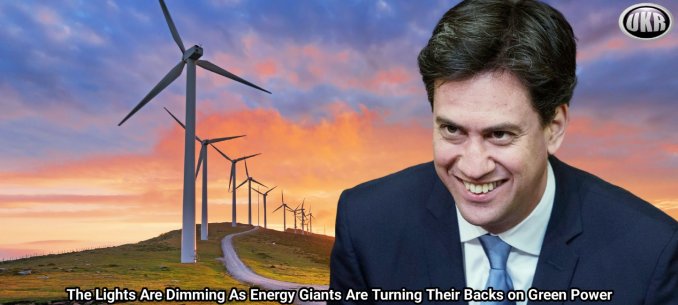
Ed Miliband is left swinging in the wind, and the lights are dimming as energy giants are turning their backs on green power
How much longer will UK citizens put up with the green energy scheme?

STU TURLEY
How much longer will UK citizens put up with the green energy scheme?
In the hallowed halls of Westminster, Ed Miliband, the UK’s Secretary of State for Energy Security and Net Zero, stands as the architect of a bold vision: a fossil fuel-free national grid by 2030 and net zero emissions by 2050. But as the chill of autumn sets in on September 10, 2025, the winds of change are blowing harshly against his ambitions.
Major energy players like BP and Shell are abruptly pivoting back to oil and gas, abandoning renewables in a move that’s leaving Miliband’s green dreams exposed and the British public footing ever-higher electricity bills. Drawing from recent analyses, including a pointed critique in the Daily Mail, this article examines the UK’s Net Zero policies, the skyrocketing cost of power over the past decade, the stagnant GDP that’s failing to keep pace, the retreat of oil majors from green energy, and why investors might be cheering if these giants relocate across the Atlantic to the United States.
The UK’s Net Zero Gamble: Ambitious Targets, Mounting Challenges
The UK’s journey toward net zero kicked into high gear with the Climate Change Act of 2008, but it was the 2019 amendment that enshrined the 2050 target into law, committing the nation to balance emissions with removals. Under the Labour government led by Keir Starmer, Miliband has doubled down, aiming for a 68% emissions cut by 2030, 81% by 2035, and full net zero by mid-century.
The Department for Energy Security and Net Zero (DESNZ) outlines a multifaceted strategy: decarbonizing electricity through offshore wind expansion, electrifying transport with EV mandates, and retrofitting homes for efficiency. The Seventh Carbon Budget, advised by the Climate Change Committee (CCC) in February 2025, calls for an 87% emissions reduction by 2040, emphasizing upfront investments in clean tech to slash long-term costs.
Yet, progress reports paint a mixed picture. The CCC’s June 2025 assessment to Parliament notes advancements in renewables—wind and solar now supply over 40% of electricity—but warns of delays in heat pump rollouts and grid upgrades.
A revised Net Zero plan is due by October 2025, amid criticisms that the strategy remains “performative,” offshoring emissions by importing biomass for stations like Drax while banning domestic fossil fuel exploration.
As American economist Noah Smith quipped in a scathing review, the UK’s approach has “deprived its citizens and companies in order to produce a totally performative emissions reduction, setting an example that almost no other countries followed.”
Electricity Prices: A Decade of Pain at the Pump (or Socket)If Net Zero is the promise of a greener future, the reality for UK households has been a brutal hike in electricity costs. In 2015, the average household paid around 12-13 pence per kilowatt-hour (p/kWh) for electricity, according to Ofgem data.
Fast-forward to the energy crisis of 2022, triggered by Russia’s invasion of Ukraine and global supply shocks, and prices surged seven-fold from historical averages, peaking at over 50 p/kWh in August.
By Q3 2025, they’ve eased to 25.73 p/kWh for typical usage—still double pre-2020 levels—but remain among the highest in Europe, 93% above the EU median in late 2022 and 40% higher than peers like Germany or France in March 2025 (0.4 USD/kWh vs. lower continental rates).
This isn’t just inflation; it’s policy-driven. Miliband’s push for offshore wind includes a “maximum strike price” of £113 per MWh for new farms—up from £72 last year—guaranteeing developers high returns at consumer expense.
The government’s 2025 spending review promises £600 annual savings via efficiency measures, but skeptics argue these are offset by reliance on volatile renewables and backup gas plants.
Annual domestic bills, per DESNZ stats, ballooned from £1,000 in 2015 to over £2,500 at 2022’s peak, settling at £1,800 in 2025— a net 80% rise over the decade.
GDP Stagnation: Green Dreams, Economic Blues
While electricity bills climb, the UK’s economy has sputtered. Gross Domestic Product (GDP) growth averaged a meager 1.2% annually from 2015 to 2025, hampered by Brexit, COVID-19, and now Net Zero’s fiscal drag. In constant 2015 USD terms (World Bank data):

Cumulative growth from 2015-2025: just 24%, lagging the EU’s 30% and the US’s 35%. Per capita GDP has flatlined at around £35,000, with energy costs eating into productivity—UK steel output, for instance, has cratered due to “the highest prices in the developed world.”
As prices doubled, real wages stagnated, fueling public backlash and highlighting how Net Zero’s “mismanaged push” has hurt growth without global emulation.
Oil Majors Bail on Green: BP and Shell Swing Back to Fossils
Enter the elephants in the room: BP and Shell, once poster children for energy transition, now emblematic of its retreat. In February 2025, BP’s CEO Murray Auchincloss declared, “We have completely decapitalised renewables,” scrapping a 20-fold increase target by 2030 and slashing green investments to refocus on oil and gas, boosting annual fossil spending to $10 billion.
Share prices plummeted under prior green bets, prompting the U-turn; BP now aims to grow oil output, abandoning 2050 net-zero planks.
Shell followed suit, ditching a massive Rotterdam biofuel plant—deemed “up to four times more expensive than kerosene”—and scaling back mandates amid global backsliding.
CEO Wael Sawan cited unprofitability, with Shell joining peers like Exxon in prioritizing hydrocarbons. Ineos’ Jim Ratcliffe halted UK investments, blasting the regime as “one of the most unstable… in the world.”
Even Lloyd’s of London scrapped its 2050 net-zero pledge for insurers.
This exodus risks North Sea jobs—a “hundred times” more than saved by green steel plants, per industry sources.
A Transatlantic Temptation: Would the US Be Better for Investors?As UK policies falter, whispers of relocation grow louder on platforms like Energy News Beat. A May 2025 analysis highlights why the US beckons: over five years, Shell and BP paid £50 billion in UK windfall taxes versus minimal US equivalents, stifling reinvestment.
Without punitive levies, firms could pour capital into Permian Basin plays or LNG exports, balancing fossils with select renewables for superior returns—ExxonMobil’s 15% ROI dwarfs BP’s 8%.
Speculation swirls around mergers: Shell eyeing BP acquisition could unlock value, but if BP bolts to the US first, it dodges acquisition premiums and ignites a bidding war with Chevron or Exxon.
US-friendly regs offer “investment flexibility,” per experts, boosting shareholder value amid BP’s underperformance (stock down 20% vs. Shell’s 10%).
For investors, it’s a no-brainer: America’s energy dominance promises stability over Britain’s “unstable fiscal regimes.”
Dimming Lights, Fading Hopes
Ed Miliband’s Net Zero crusade, once a Labour rallying cry, now swings precariously as giants like BP and Shell pivot to profitable fossils, exposing policy flaws that have doubled bills while GDP limps. Global peers—from Canada’s carbon tax repeal to New Zealand’s gas revival—signal a rethink, but the UK clings on.
As the Alberta Premier meets with Prime Minister Carney in Edmonton today, we are witnessing another significant step in standing up for low-cost energy and rejecting the climate green energy scam. So, while the EU, the UK, and Canada are all following the Net Zero financial death and decline model of energy, it will be interesting to see how the trading blocs realign.
For investors, the US move isn’t just better—it’s essential for survival in a world where green idealism meets harsh economics. As the lights dim under soaring costs, Britain must ask: Is performative virtue worth the blackout?
As for me and my house, we will invest in U.S. energy and be grateful that we dodged a huge bullet in the last election.
This article (Ed Miliband is left swinging in the wind, and the lights are dimming as energy giants are turning their backs on green power) was created and published by Energy News Beat and is republished here under “Fair Use” with attribution to the author Stu Turley
See Related Article Below
Jim Ratcliffe’s Energy Empire Ends All Investment in Britain Over Labour Tax Raids
Jim Ratcliffe’s energy empire, Ineos – one of the world’s largest chemical manufacturers – is ending all investment in Britain and diverting it to the US over Labour’s tax raid on oil and gas producers. The Mail has more.
Ineos, the energy empire owned by Manchester United Football Club investor Jim Ratcliffe, plans to plough £3 billion into America after turning its back on the UK.
It says the move is due to high costs including the windfall tax, a levy on oil companies making massive profits thanks to the global high price of energy.
Brian Gilvary, Chief Executive of Ineos’s energy division, said yesterday: “We have stopped investing in Britain. Our future investment will not be [in] the UK. There’s no question of that.”
And Mr Gilvary said the company “cannot invest with any certainty because we can’t be sure what future tax rates will be”.
He added: “The problem is that the UK has become one of the most unstable fiscal regimes in the world from a perspective of natural resources and energy.”
Ineos shut down the Grangemouth oil refinery in Scotland this year after a century, leading to the loss of more than 400 jobs. The firm also operates the Breagh gas field and Clipper South rig in the North Sea, off the coast of Teesside.
And its olefins and polymers plant, also at Grangemouth, is at risk of closure due to high carbon taxes foisted on manufacturers.
It is also behind the Forties Pipeline System, which carries 30% of the UK’s oil to shore.
Mr Gilvary said “the future lies” in other countries, especially the US.
He told the Telegraph: “The United States has got a long track record. In the 1990s, it was producing 6.5 million barrels of oil a day and importing five million.
“But now it’s producing 30 million barrels a day and exporting. That’s proper energy security and a proper fiscal regime.
“The US absolutely understands the importance of domestic supplies and how you can drive economic growth off the back of it, so that’s the place where we’ll be.”
In April, Sir Jim – whose wealth is estimated at £17 billion – warned that Labour is “squeezing the life out of our abundant energy reserves in the North Sea”.
Worth reading in full.

••••
The Liberty Beacon Project is now expanding at a near exponential rate, and for this we are grateful and excited! But we must also be practical. For 7 years we have not asked for any donations, and have built this project with our own funds as we grew. We are now experiencing ever increasing growing pains due to the large number of websites and projects we represent. So we have just installed donation buttons on our websites and ask that you consider this when you visit them. Nothing is too small. We thank you for all your support and your considerations … (TLB)
••••
Comment Policy: As a privately owned web site, we reserve the right to remove comments that contain spam, advertising, vulgarity, threats of violence, racism, or personal/abusive attacks on other users. This also applies to trolling, the use of more than one alias, or just intentional mischief. Enforcement of this policy is at the discretion of this websites administrators. Repeat offenders may be blocked or permanently banned without prior warning.
••••
Disclaimer: TLB websites contain copyrighted material the use of which has not always been specifically authorized by the copyright owner. We are making such material available to our readers under the provisions of “fair use” in an effort to advance a better understanding of political, health, economic and social issues. The material on this site is distributed without profit to those who have expressed a prior interest in receiving it for research and educational purposes. If you wish to use copyrighted material for purposes other than “fair use” you must request permission from the copyright owner.
••••
Disclaimer: The information and opinions shared are for informational purposes only including, but not limited to, text, graphics, images and other material are not intended as medical advice or instruction. Nothing mentioned is intended to be a substitute for professional medical advice, diagnosis or treatment.
Disclaimer: The views and opinions expressed in this article are those of the author and do not necessarily reflect the official policy or position of The Liberty Beacon Project.


Leave a Reply