

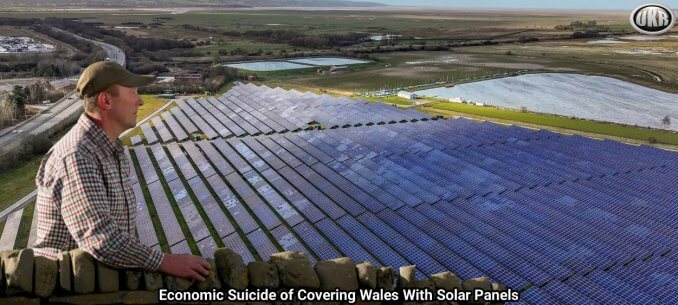
Economic suicide of covering Wales with solar panels
MAD ED Miliband’s mania for net zero has really taken hold in the socialist hell of Wales. Not satisfied with the UK’s delusion that it can achieve ‘net zero’ by 2050, thereby allegedly saving the planet, the Welsh Senedd is seeking to supply 100 per cent of the electricity that Wales consumes from renewable resources by 2035. This aspiration has led to the production of ‘ambitious’ local energy plans for Swansea, Carmarthenshire, Neath Port Talbot and Pembrokeshire.
Two words need clarification for a start. In the strange world of government-speak, ‘renewable’ may or may not include nuclear power but certainly excludes gas, coal and oil-fired power stations. ‘Ambitious’ means theoretically possible but probably impossible (as I explained in my 2021 book). Remember, the government has delivered vanishingly few programmes on specification, on time, and within budget.
Swansea is both a city and a county, the latter including the Gower peninsula. The area includes some 21,000 hectares of farmland. The overwhelming majority is pasture, i.e. grazing for sheep and cattle.
The Swansea part of the Senedd’s lunacy, enthusiastically embraced by the deranged and incompetent Labour-dominated Swansea Council, requires quadrupling of wind energy production within the City and County of Swansea plus an astonishing 12-fold increase in solar panels. That comes out at a further 600 hectares of farmland to be covered with solar panels.
On top of that there will be a need for substantial ancillary equipment to ensure that there isn’t a cascading failure, such as the lethal one that struck Spain in April this year. That killed seven people and cascaded into parts of France and all of Portugal. Such expensive equipment (which essentially pretends to be a turbine to provide inertia to a solar and wind-based generation network) is already being installed. Guess who will pay for it. (Hint: look in a mirror.) Renewable energy is not just expensive: it’s extortionate, which is why Wales (and the rest of the UK) has the most expensive electricity in the world.
Agriculture
Land underneath a solar panel can’t be cultivated or grazed. Whatever used to be produced, probably lamb, beef and milk, must come from elsewhere. Unfortunately there isn’t any spare productive agricultural land in Wales, or indeed the entire UK. This tightness of supply is being exacerbated by the current governments’ (Senedd and Parliament) love of ‘rewilding’ and green energy.
So the food that was produced locally must now be bought from overseas, to the detriment of the country’s fragile economics. Reducing exports and increasing imports doesn’t do much for the balance of payments.
Shutting some 15 farms might not cost many jobs, but it continues the erosion of rural communities, which are founded upon agriculture. The state of livestock farming at the moment is such that any farm closing affects the entire supply chain. Vets, abattoirs, meat processors, feed merchants, cattle markets and livestock transporters will all feel the crunch. In the current economic environment, that contraction might be enough to tip them into unprofitability and closure.
There isn’t much spare top-grade agricultural land available globally either. So the plan means that at least 600 hectares of virgin land, perhaps rainforest, will have to be cleared. I say ‘at least’ because the Gower is almost perfect for raising sheep and cattle; it will take more less-capable land to produce the same output. This has an impact on the emissions calculation.
Emissions
The park’s 600 hectares of solar panels will probably produce around 880 gigawatt hours per year, reducing annual Welsh CO₂ emissions by about 155,000 tons per year. Hurrah.
Or maybe not.
Wales’s annual CO₂ emissions are some 35,700,000 tons per year . This plan reduces that by less than half of 1 per cent. That reduction figure is the gross value. It ignores the CO₂ arising from making the panels and building the park.
How much CO₂ it takes to make a solar panel is a hotly contested figure and one not much talked about. It also glosses over the CO₂ impact of the displaced agriculture. I estimate the CO₂ cost of this solar park is about 25 per cent of its savings, making the total CO₂ saving just one third of 1 per cent of the Welsh emissions. This is from a city and county that houses 8 per cent of the Welsh population.
The Senedd’s deluded emissions plans make no sense; they’re harmful.
Tourism
The Gower Peninsula is a tourist hotspot: it has fabulous beaches and wonderful views of rolling, verdant countryside. The City and County of Swansea has approximately 30,000 bedspaces, including 3,900 serviced, 4,100 self-catering and 22,000 caravan and camping. Tourism generates revenue of £650million a year for the city and county. Many of those camping and caravan sites are on farms.
While there must be some of the 1.6million visitors who look to pitch their tent or spend their precious holiday next to a solar panel, they’re overwhelmingly outnumbered by those who travel in search of a rural idyll. Three-quarters of them are repeat visitors; I’m sure they’ll be ecstatic when they see acres of photovoltaics in place of fields of cows.
Economic damage
The UK has some of the most expensive electricity in the world. The chart below makes the point. (Data from The World Population Review.)

Why is this so? It depends on who you ask. Ed Miliband (and his lackey Torsten Bell) will tell you it’s because of the shock of the Ukraine invasion on the gas price. This suits their narrative but rather overlooks the realities of gas prices being pretty much back to where they were pre-invasion. Moreover, gas is a globally traded commodity, so all countries are competing in the same market. Torsten and Ed are telling porkies (no surprise, they both claim their manifesto promises haven’t been broken).
If you want the reality, look at the chart below, generated from government data. The green line is the proportion of electricity generated by wind, the blue line is the ‘Spark Ratio’, which is the price of non-domestic electricity divided by the price of non-domestic gas.
Until 2014, when wind generation was relatively small, the spark ratio was more or less constant, and electricity tracked the price of gas. As the proportion of wind increased, electricity became more expensive. Following the hiatus of the invasion of Ukraine, the spark ration (and thus the electricity price) tracks the proportion of wind. Why? Because the more wind we have the more often we must turn off gas generators, which increases the price of gas-generated electricity. Gas remains the source of 31 per cent of our generation, about the same as wind.

The more we generate from wind, the more expensive it becomes. The government obfuscates that through the energy price cap, which limits domestic electricity prices. All that means is that even more exorbitant costs are passed on to businesses and the government, responsible for 64 per cent of UK electricity consumption.
Politics
Thus the Westminster politics introduced by Mad Ed and so enthusiastically trumpeted by Eluned Morgan, Torsten Bell and Swansea Council will increase business costs, thereby damaging jobs, undermining tourism and driving more hospitality businesses to the wall. The solar panels alone will cost hundreds of millions and will most likely be made in China – shipping still more British capital overseas. Buying 600 hectares of the Gower doesn’t come cheap either. All to save a rounding error in emissions while propping up child labour and manufacturing jobs in communist China, maker of 80 per cent of all solar panels.
If Eluned and her band of Marxists wanted clean, reliable energy, why did they not bid for small nuclear reactors, soon to be built in Wales? For less money Swansea could have a Rolls-Royce Small Modular Reactor (SMR). That would generate twice the electricity and could also support a district heating system, potentially heating Swansea free of charge. An SMR needs only a couple of hectares, so the Gower’s grass would remain unsullied. SMRs are new too, so would have boosted tourism and hospitality as people and companies will visit.
The farmland would remain in use and people would not have to worry about what happens when the wind doesn’t blow and the sun won’t shine. No one would have to slash and burn rainforest to feed the planet. The (taxpayers’) capital would stay in the UK, in Wales in fact, as would the jobs.
Making such a sensible choice would have been easy for a wise government. Sadly the Labour Party and its governments in Westminster, Wales and Swansea are in the grip of a Marxist ship of fools suffering from an energy delusion. What is it about Welsh Marxists that means they can’t count?
Welsh voters can change the Senedd in May. I hope they do, because the next daft energy idea that’s coming down the track for Swansea is a multi-billion tidal lagoon.
More about that another day. Spoiler alert: there is nothing good.
This article appeared on Views From My Cab on November 29, 2025, and is republished by kind permission.

••••
The Liberty Beacon Project is now expanding at a near exponential rate, and for this we are grateful and excited! But we must also be practical. For 7 years we have not asked for any donations, and have built this project with our own funds as we grew. We are now experiencing ever increasing growing pains due to the large number of websites and projects we represent. So we have just installed donation buttons on our websites and ask that you consider this when you visit them. Nothing is too small. We thank you for all your support and your considerations … (TLB)
••••
Comment Policy: As a privately owned web site, we reserve the right to remove comments that contain spam, advertising, vulgarity, threats of violence, racism, or personal/abusive attacks on other users. This also applies to trolling, the use of more than one alias, or just intentional mischief. Enforcement of this policy is at the discretion of this websites administrators. Repeat offenders may be blocked or permanently banned without prior warning.
••••
Disclaimer: TLB websites contain copyrighted material the use of which has not always been specifically authorized by the copyright owner. We are making such material available to our readers under the provisions of “fair use” in an effort to advance a better understanding of political, health, economic and social issues. The material on this site is distributed without profit to those who have expressed a prior interest in receiving it for research and educational purposes. If you wish to use copyrighted material for purposes other than “fair use” you must request permission from the copyright owner.
••••
Disclaimer: The information and opinions shared are for informational purposes only including, but not limited to, text, graphics, images and other material are not intended as medical advice or instruction. Nothing mentioned is intended to be a substitute for professional medical advice, diagnosis or treatment.
Disclaimer: The views and opinions expressed in this article are those of the author and do not necessarily reflect the official policy or position of The Liberty Beacon Project.


Leave a Reply